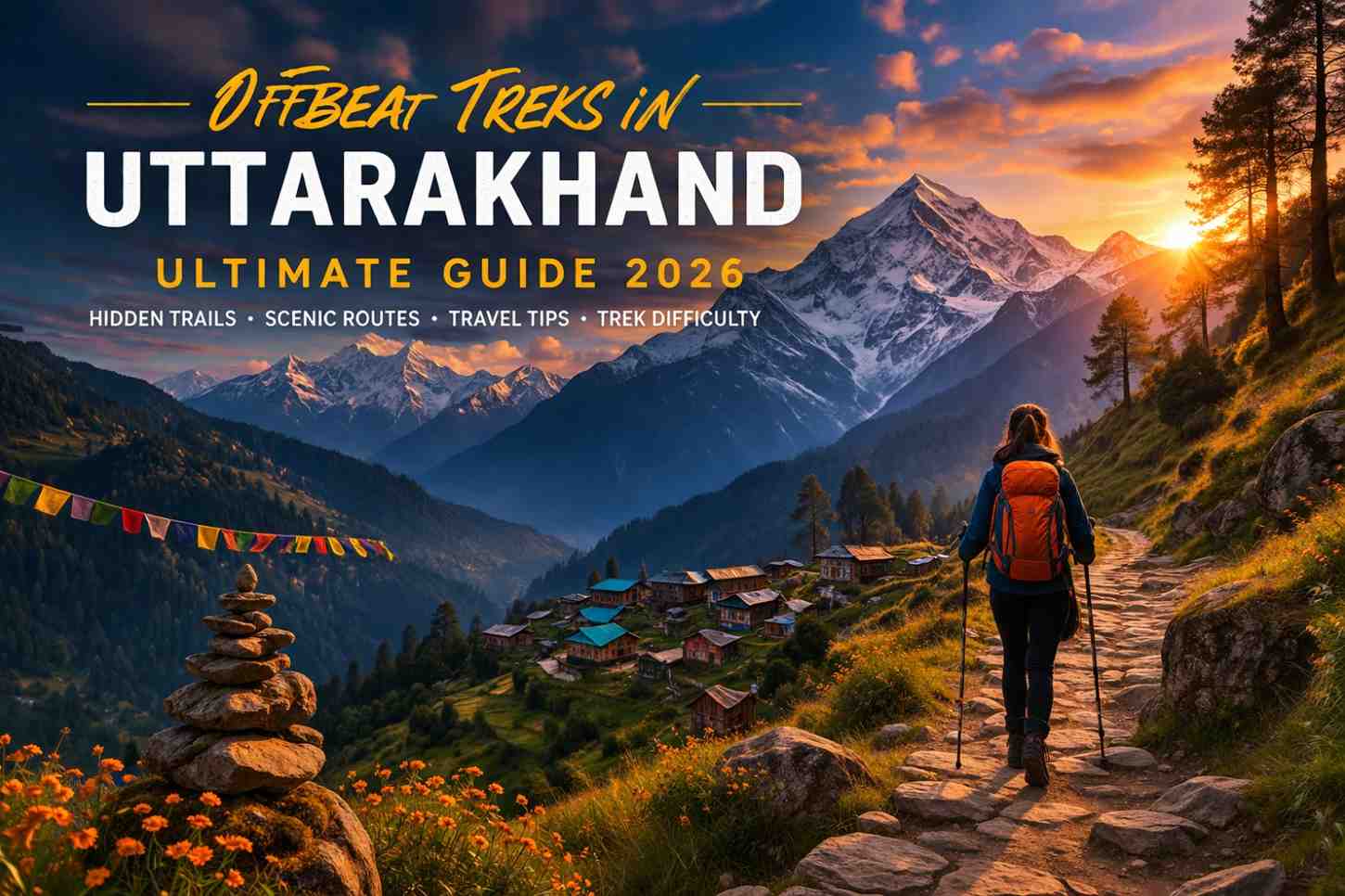
Uttarakhand is one of the most trekked states in India — and yet, most trekkers barely scratch its surface. While names like Kedarkantha and Roopkund dominate travel blogs and social media feeds, the real soul of the Himalayas lies hidden in trails that rarely appear on any bestseller list. We’re talking about offbeat treks in Uttarakhand where the only footprints in the snow might be yours, where rhododendron forests stretch uninterrupted for miles, and where local shepherds are often your only company.
If you’re done with crowded campsites and Instagram-famous viewpoints, this guide is for you. We’ve put together the most detailed and updated resource for lesser-known treks in Uttarakhand in 2026 — covering trail specifics, altitude profiles, difficulty levels, best seasons, and the latest ground updates every serious trekker must know before stepping on these routes.
Why Offbeat Trekking in Uttarakhand Is the Smartest Choice Right Now
Mainstream Himalayan trekking is under serious strain. Popular corridors are seeing thousands of footfalls weekly, leading to trail degradation, waste accumulation, and a tourism experience that feels more like a queue than a conquest. Choosing unexplored trekking routes in Uttarakhand isn’t just a personal preference — it is a conscious, responsible, and richly rewarding decision.
Here is what you gain when you go offbeat:
- Absolute solitude and raw, unfiltered mountain experience
- Authentic cultural immersion in remote Himalayan villages
- Lower permit costs and significantly reduced commercialization
- Better wildlife sightings — musk deer, Himalayan monal, snow leopard signs
- A stronger sense of personal achievement on unmarked, demanding terrain
- Direct support to local village economies that rarely benefit from mainstream tourism
And here’s an important 2026 update: On February 3, 2026, the Uttarakhand government announced the opening of 83 major Himalayan peaks for expeditions while scrapping expedition-related permit fees for Indian climbers entirely. This is a landmark development that has dramatically expanded access to high-altitude terrain across the state, making this the best time in years to plan an adventure into Uttarakhand’s remotest corners.
1. Panwali Kantha Trek — Uttarakhand’s Most Beautiful Secret Meadow
Location: Between Gangotri and Kedarnath valleys, Tehri Garhwal. Maximum Altitude: 3,368 metres (11,050 ft). Duration: 4 to 6 days. Difficulty: Easy to Moderate. Best Season: May to June, October to November
If you love bugyals — the high-altitude grasslands unique to Uttarakhand — but want to experience them without the crowds that now flock to Dayara Bugyal, Panwali Kantha is the answer. Panwali Kantha is one of Uttarakhand’s most scenic alpine meadows. Unlike commercial treks, it remains peaceful even in peak season. From the top, trekkers can witness majestic Himalayan peaks, including Bandarpoonch, Chaukhamba, and the Kedarnath range.
The trail begins near the Tehri district and passes through dense mixed forests of oak and rhododendron before opening up dramatically into rolling meadows at a higher altitude. Shepherd trails criss-cross the grasslands, and in spring, the entire landscape transforms into a canvas of wildflower colour. This trek is ideal for first-time offbeat trekkers in Garhwal and for those who’ve done more popular circuits and want something more intimate.
2026 Update: Panwali Kantha remains one of the least commercially developed bugyals in Uttarakhand. Trail registration is now recommended at the local forest check-post in Tehri before departure. Carry your own camping supplies as there are no tea house facilities beyond the lower villages.
2. Ranthan Kharak Trek — Deep Inside the Kumaon Wilderness
Location: Bageshwar District, Kumaon Maximum Altitude: 3,900 metres Distance: Approximately 40 km (loop) Duration: 6 to 7 days Difficulty: Easy to Moderate Best Season: April to June, September to November
Most trekkers overlook Kumaon entirely in favour of Garhwal’s famous circuits. This is a mistake that Ranthan Kharak will prove in the most beautiful way possible. The Ranthan Kharak Trek offers a rare blend of untouched wilderness, alpine meadows, dense forests, and breathtaking Himalayan views, starting from Gogina village in Bageshwar district and forming a scenic loop reaching a maximum altitude of around 3,900 metres.
The trail passes through traditional “kharaks” — the summer grazing grounds used by Bhotia shepherds for centuries — and offers some of the finest views of Panchachuli Peaks and Nanda Kot in all of Kumaon. One of the highlights is the stunning display of rhododendrons in spring, covering the trail in shades of pink and red with blooms persisting longer at higher elevations.
This trek is also increasingly recognized as a natural extension of the Pindari Glacier trail, and it takes you through landscapes that carry the cultural imprint of the indigenous Shauka people, who have lived in these high valleys for generations.
2026 Update: Homestays in Gogina have been significantly upgraded. 2026 group departures are available from reputed operators at approximately Rs 11,000 per person for a 7-day package including meals, permits, and a guide. Strongly recommended to book at least 6 weeks in advance for the May-June window.
A Word on Spiritual Trekking: The Panch Kedar Trek
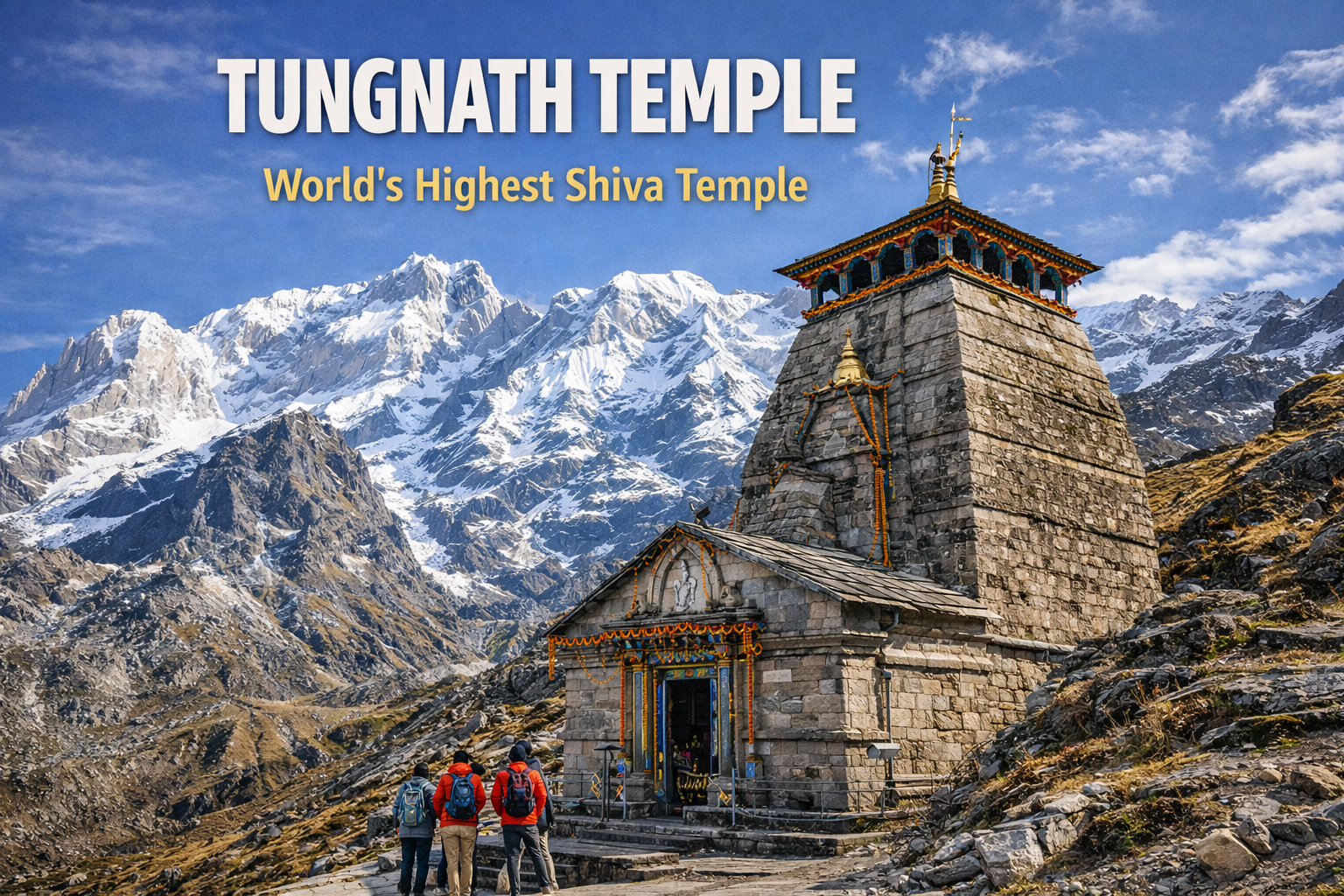
Before we go further into the list, it’s worth mentioning that Uttarakhand offers a dimension of trekking that very few mountain destinations in the world can rival — the fusion of spirituality and high-altitude adventure. The Panch Kedar trek is perhaps the finest example of this. Spanning five sacred Shiva temples — Kedarnath, Tungnath, Rudranath, Madhyamaheshwar, and Kalpeshwar — the Panch Kedar trek winds through some of the most remote and jaw-dropping terrain in Garhwal.
The middle temples — Rudranath and Madhyamaheshwar in particular — see a fraction of the footfall that Kedarnath receives, making them genuinely offbeat. Sections of this trek pass through meadows and ridges that rival anything the mainstream trekking circuit can offer, while the spiritual weight of the journey adds a dimension that no ordinary summit climb can replicate.
3. Satopanth Lake Trek — Glacial Wonder Beyond Badrinath
Location: Chamoli District, Garhwal Maximum Altitude: 4,600 metres (15,091 ft) Duration: 8 to 10 days Difficulty: Moderate to Challenging Best Season: June to September
The Satopanth Lake Trek leads into the heart of Chamoli’s glacial landscape. Snow-capped peaks of Chaukhamba and Swargarohini rise like silent sentinels, reflecting in the lake’s crystal waters across 8 days of moderate to challenging terrain.
What makes this trek especially compelling is its starting point — the sacred town of Mana, the last Indian village before the Tibetan border, located just a few kilometres from Badrinath. This geographic positioning means trekkers can integrate Satopanth into a broader spiritual itinerary with remarkable ease. The trail climbs through the Alaknanda valley floor, past waterfalls and boulder fields, before ascending to the ethereal, triangle-shaped lake at 4,600 metres — one of the most sacred bodies of water in Hindu cosmology, believed to be the site where Brahma, Vishnu, and Mahesh meditate.
2026 Update: The trail from Mana to Laxmi Van is now better marked with fresh waypoints placed by the Chamoli Forest Department. A guide is mandatory beyond Chakratirth. The Mana village entry restriction for non-Hindus remains in effect — check current norms with your operator before booking.
4. Dodital–Darwa Pass Trek — Forests, Sacred Lakes, and Secret Passes
Location: Uttarkashi District, Garhwal Maximum Altitude: 4,151 metres (Darwa Pass) Distance: 49 km Duration: 6 to 7 days Difficulty: Moderate Best Season: April to June, September to November
This trek is one of the finest forest treks in Uttarakhand and remains a genuine secret despite being accessible and reasonably well-routed. The Dodital–Darwa Pass trek begins at Agoda village and leads to the crystal-green Dodital lake at 3,024 metres before climbing further to Darwa Pass at 4,151 metres, winding through the deep jungles of the Assi Ganga valley in Uttarkashi.
Dodital itself is a stunning high-altitude freshwater lake surrounded by pine and oak forest, believed by locals to be the birthplace of Lord Ganesha. The lake is home to the rare golden Himalayan trout, and the forest around it is thick with birdlife. Beyond the lake, the trail climbs steeply to Darwa Pass, which opens up into sweeping views of the Kedarnath range on one side and the Gangotri range on the other.
2026 Update: Uttarkashi district has tightened its trekking checks, and insurance is now required for all treks. Medical fitness is mandatory on tougher routes, and trekkers aged 50 and above are required to carry medical certificates even on easier trails in the region.
5. Surya Top Trek — The Silent Extension of Dayara Bugyal
Location: Uttarkashi District, Garhwal Maximum Altitude: 3,650 metres Duration: 5 to 6 days Difficulty: Easy to Moderate Best Season: April to June, September to November
Dayara Bugyal is well known. Surya Top, which rises above it into quieter and more expansive terrain, is not — and that’s precisely what makes it special. Surya Top stays quiet and serene, giving trekkers space to truly be present with the mountains. From the top, the horizon is dominated by peaks like Srikanth, the Gangotri range, Draupadi Ka Danda 2, Bandarpoonch, and Jaonli.
The trek begins from Barsu village and moves through forests of oak, maple, and rhododendron before breaking into the vast open meadows of Dayara. Most day-trippers turn back here. The Surya Top route continues further, into less-travelled terrain where meadows grow wider, views grow grander, and the only signs of human presence are occasional shepherd trails. This is one of the best meadow treks in Garhwal for solo trekkers, families with older children, and those seeking a meditative Himalayan experience.
2026 Update: A new trekkers’ lodge operated by the Barsu gram panchayat now provides affordable accommodation and meals at the trailhead. It has made this trek considerably more accessible for solo travellers and first-timers.
Planning a Char Dham Yatra? Add an Adventure Trail to It
Uttarakhand’s spiritual and adventure landscapes are so deeply intertwined that it would be a missed opportunity to separate them. Thousands of pilgrims travel to Uttarakhand every year for the Char Dham Yatra — the sacred circuit of Yamunotri, Gangotri, Kedarnath, and Badrinath. What many don’t realise is that some of the state’s finest offbeat trekking routes begin right at or near these pilgrimage towns.
From Gangotri, the trail to Kedartal — a stunning glacial lake at 4,750 metres — peels off into the wild. From Badrinath, the Satopanth Lake trail begins just beyond Mana village. The Char Dham Yatra and offbeat trekking in Uttarakhand are not two separate trips — with the right planning, they can become one deeply layered, once-in-a-lifetime Himalayan journey. At Mountainiax.com, we design custom itineraries that combine both.
6. Mukta Top Trek — The Forest Summit That Beginners Deserve
Location: Uttarkashi District, Garhwal Maximum Altitude: 3,600 metres (11,800 ft) Duration: 5 to 6 days Difficulty: Easy to Moderate Best Season: Year-round (spring for flowers, winter for snow)
Mukta Top is a quiet trail starting from Kuflon, known for its rich forest sections with oak, pine, maple, and rhododendron trees lining the path. As altitude increases, the dense forests gradually give way to snow patches in winter, leading to a wide, open summit with panoramic views of the Gangotri range. The trail transforms beautifully with each season.
What makes Mukta Top particularly valuable is that it gives beginners a genuinely high-quality Himalayan summit experience without throwing them into technically demanding terrain. The trail is methodical, the elevation gain is manageable, and the rewards — sprawling views of Bandarpoonch, Black Peak, and Jaonli — are completely disproportionate to the effort. Unlike popular treks like Kedarkantha or Brahmatal, Mukta Top remains a hidden gem with fewer trekkers and limited mobile network beyond the base village.
That last point is worth noting — and embracing. Going offline for five or six days in the Himalayas is not a problem. It’s the point.
7. Bali Pass Trek — The High-Altitude Crossing That Tests Everything
Location: Uttarkashi District, Govind Pashu Vihar National Park Maximum Altitude: 4,950 metres (16,237 ft) Duration: 9 to 10 days Difficulty: Challenging Best Season: Mid-May to June, September to October
For experienced trekkers who want a route that demands everything — fitness, navigation skills, mental resolve, and technical preparation — Bali Pass is the answer. Bali Pass is a challenging high-altitude trek linking Har Ki Dun to Yamunotri with steep climbs, glacier sections, and remote valleys. The summit at 16,200 ft offers sweeping views of Bandarpoonch and Swargarohini.
The trail begins in the beautiful Har Ki Dun valley — itself a relatively offbeat destination — and crosses into the Yamunotri watershed via the pass. Along the way, trekkers pass through some of the most isolated forest terrain in Uttarakhand, traditional villages like Osla and Gangad, and vast glacial stretches that require crampons during the early summer window. This is not a trek for the unprepared.
2026 Update: Govind Pashu Vihar National Park now requires prior registration and a forest permit before entry. The range office at Sankri is the best point to confirm the latest permit requirements, trail condition updates, and guide availability
8. Ali Bedni Bugyal Trek — Meadow Trekking at Its Most Spectacular
Location: Chamoli District, Garhwal Maximum Altitude: 3,650 metres (Ali Bugyal), 3,354 metres (Bedni Bugyal) Duration: 5 to 6 days Difficulty: Easy to Moderate Best Season: May to June, September to October
The Ali Bedni Bugyal trek is among the most rewarding moderate treks in all of Uttarakhand and one that every Himalayan trekker should experience at least once. Connecting two of the highest and most expansive alpine meadows in the region, the Ali Bedni Bugyal trek rewards walkers with views of Trishul, Nanda Ghunti, and the Nanda Devi massif on clear days — a visual feast that few other trails in Garhwal can match.
The trek begins from Wan village in Chamoli and winds through dense forests of rhododendron and buransh before opening into the staggering horizontal expanse of Ali Bugyal, followed by the even more beautiful Bedni Bugyal just beyond. The landscape here is the kind that makes trekkers sit down mid-trail and simply stare. The Ali Bedni Bugyal trek is also a culturally rich route — Wan village is home to the ancient Nanda Devi Raj Jat procession, one of the most important Hindu pilgrimages in the Himalayas, held once every twelve years.
9. Kagbhusandi Lake Trek — Where Mythology Meets the Mountains
Location: Chamoli District, Garhwal Maximum Altitude: 4,490 metres Duration: 6 days Difficulty: Moderate Best Season: June to September
The Kagbhusandi Lake Trek is a spiritual and natural odyssey, leading to a sacred high-altitude lake surrounded by jagged peaks and alpine forests, encountering crystalline waters that mirror mountains and sky in landscapes imbued with cultural and mystical resonance. Hopping Trails
The trail is less physically demanding than Satopanth or Bali Pass but carries an intensity of its own — the upper sections pass through an amphitheatre of peaks that create the sensation of walking inside a painting. The lake is mentioned in ancient Hindu texts and holds deep significance for the surrounding Garhwali communities. Few offbeat pilgrimage treks in Uttarakhand combine natural drama with mythological depth as well as this one.
10. Pangarchulla Peak Trek — Summit Panoramas Without Summit Fees
Location: Chamoli District, Garhwal Maximum Altitude: 4,700 metres (15,420 ft) Duration: 6 to 7 days Difficulty: Moderate to Challenging Best Season: March to May, October to November
The Pangarchulla Trek is renowned for unobstructed, world-class panoramic views. Less crowded than the nearby Kuari Pass, it offers continuous views of Nanda Devi, Hathi Parvat, Ghori Parvat, and Chaukhamba — a visual feast for photography enthusiasts. Unleavables
The trail starts from Dhak village near Auli and climbs through forests and open ridges to a summit that genuinely delivers a 360-degree Himalayan panorama. Unlike technical mountaineering objectives, Pangarchulla requires no special technical skills — just consistent fitness, cold-weather gear, and a guide for the upper sections. The winter and early spring edition (February to March) of this trek is increasingly popular, with snow-covered ridges providing dramatic trail conditions.
2026 Update: Given the Uttarakhand government’s opening of 83 Himalayan peaks to climbers, the zone around Pangarchulla is seeing increased expedition activity. Book early with a local operator to secure guide availability, especially for the October window.
Quick Reference: Offbeat Treks in Uttarakhand (2026)
If you’re planning an adventure away from crowded trails, this quick comparison table will help you choose the right offbeat trek based on altitude, duration, difficulty, and best season.
| Trek Name | Max Altitude | Duration | Difficulty | Best Season |
| Panwali Kantha | 3,368 m | 4–6 days | Easy–Moderate | May–Jun, Oct–Nov |
| Ranthan Kharak | 3,900 m | 6–7 days | Easy–Moderate | Apr–Jun, Sep–Nov |
| Satopanth Lake | 4,600 m | 8–10 days | Moderate–Hard | Jun–Sep |
| Dodital–Darwa Pass | 4,151 m | 6–7 days | Moderate | Apr–Jun, Sep–Nov |
| Surya Top | 3,650 m | 5–6 days | Easy–Moderate | Apr–Jun, Sep–Nov |
| Mukta Top | 3,600 m | 5–6 days | Easy–Moderate | Year-round |
| Bali Pass | 4,950 m | 9–10 days | Challenging | May–Jun, Sep–Oct |
| Ali Bedni Bugyal | 3,650 m | 5–6 days | Easy–Moderate | May–Jun, Sep–Oct |
| Kagbhusandi Lake | 4,490 m | 6 days | Moderate | Jun–Sep |
| Pangarchulla Peak | 4,700 m | 6–7 days | Moderate–Hard | Mar–May, Oct–Nov |
Essential Tips for Offbeat Trekking in Uttarakhand in 2026
Preparation for offbeat treks is categorically different from preparing for organised, commercial treks. Here’s what you genuinely need to know:
Always hire a certified local guide. Offbeat trails in Uttarakhand are rarely marked, conditions shift seasonally, and local guides carry knowledge no GPS app can replicate. Guides from the nearest trailhead village are always preferable to agency-assigned guides from cities.
Sort your permits in advance. Almost all Himalayan trekking corridors in Uttarakhand pass through state-managed forest and wildlife land — Reserved or Protected Forests, Wildlife Sanctuaries, and National Parks — where entry is regulated, and a forest or park permit is your basic, lawful access document. For zones near the Tibet border — like Milam Glacier or Adi Kailash — an Inner Line Permit (ILP) is also required.
Acclimatize seriously. Most of the offbeat trails in this list cross 3,500 metres, and several push close to 5,000 metres. Spend at least one full rest day at your base town before beginning the climb. Carry a complete first aid kit. Medical facilities on offbeat routes are nonexistent. Basic altitude sickness medication (Diamox), wound care supplies, and a pulse oximeter are non-negotiable.
Check the trail status closer to your departure date. Glacial recession, monsoon erosion, and landslides continue to alter trail sections across Uttarakhand year on year. Always call a local operator or the nearest DFO office within two weeks of your planned departure to verify conditions.
Pack for environmental responsibility. These trails are pristine because they see fewer people. Carry all your waste back down, use refillable water bottles, and avoid single-use plastics entirely.
Frequently Asked Questions (FAQs)
Q1. Which are the best offbeat treks in Uttarakhand for beginners in 2026?
Mukta Top, Surya Top, Panwali Kantha, Gulabi Kantha, and Ali Bedni Bugyal are the top recommendations for beginners and first-time high-altitude trekkers. All are graded easy to moderate and require no prior technical trekking experience, only basic fitness preparation.
Q2. What permits do I need for offbeat trekking in Uttarakhand?
Requirements vary by zone. Forest entry permits are mandatory for most national park and wildlife sanctuary routes. Inner Line Permits are required for areas near the Indo-Tibet border, such as Adi Kailash and Milam Glacier. Trekking registration and photo ID are required at all major check-posts. Verify the exact requirements with the relevant District Forest Office before your trek.
Q3. When is the best time to do offbeat treks in Uttarakhand?
September and October offer the most reliable weather, crystal-clear skies, and firm, stable trail conditions — making them the best overall months. May to June is excellent for wildflower and snow combination treks. July and August (monsoon) are generally unsuitable for most high-altitude routes due to landslide risk and unstable trails.
Q4. Can I combine offbeat trekking with a Char Dham Yatra pilgrimage?
Yes — and it’s highly recommended. The Char Dham Yatra pilgrimage hubs at Gangotri and Badrinath are natural launch points for offbeat trails such as Kedartal and Satopanth Lake, respectively. With the right planning, you can experience the spiritual circuit of the Char Dham Yatra and a serious Himalayan adventure in a single, well-structured trip.
Q5. Is the Panch Kedar trek considered offbeat?
The full Panch Kedar trek circuit — connecting all five temples, including the relatively remote Rudranath and Madhyamaheshwar — is very much an offbeat experience. While Kedarnath and Tungnath receive large volumes of pilgrims, the other three temples on the trek circuit see only a fraction of that traffic, offering genuine solitude and raw Himalayan beauty.
Final Thought: The Mountains Are Waiting for Those Who Wander Off the Map
The truth about Uttarakhand is simple — its greatest gifts are not on any bestseller list. They are in the meadows no tourist board promotes, in the passes that only shepherds cross by name, and in the villages where tea is offered before questions are asked. Every offbeat trek in Uttarakhand is an invitation to engage with the Himalayas the way they deserve to be engaged — slowly, humbly, and with complete attention.
Whether you are drawn to the remote wilderness of the Ranthan Kharak trek, the high-altitude challenge of Bali Pass, the glacial serenity of Kagbhusandi Lake, the summit views from Pangarchulla Peak, or the peaceful alpine landscapes of Mukta Top, Uttarakhand’s offbeat trails offer diverse experiences shaped by terrain, altitude, and isolation. Each route presents unique ecological zones, cultural encounters, and varying levels of difficulty—ensuring that every trekker finds a journey aligned with their capability and intent.
At Mountainiax, we believe the best Himalayan stories are written on trails that fewer people walk. Go offbeat. Go deeper. Go better.