
- Uttarakhand · Kumaon Himalayas
Nanda Devi Basecamp Trek
- 12-Day Nanda Devi Basecamp Trek via Munsyari — Johar Valley Loop
- Book Now —₹14,500 + 5% GST per person, all-inclusive
- A 12-day loop from Kathgodam into the Johar Valley — climbing to Nanda Devi Basecamp at 4,150 m for close-up views of India's second-highest peak, then looping back through Milam Glacier and the historic ruins of Martoli, so you see entirely different terrain on the way out and the way back.
- 4.8/5 Rating
- Running since 2018
- Certified Trek Leaders
- 24/7 Support
4,150 M
Max Altitude Nanda Devi Basecamp
~97 KM
Trek Distance 9 trekking days
12 DAYS
Duration 11 nights
Difficulty
MODERATE-DIFFICULT
YEAR-ROUND
MAY-JUN · SEP-OCT
AGE 13-15+
Group Size Small batches
- Overview
Nanda Devi Basecamp Trek: A 12-Day Loop Through the Johar Valley
Last updated: September 2026
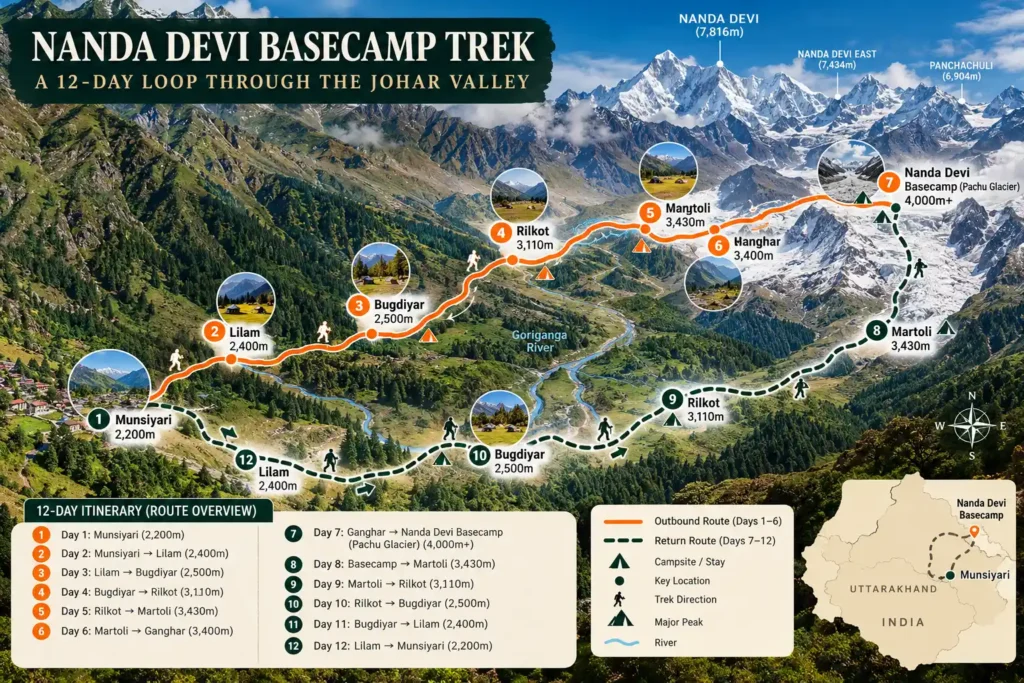
The first time our group crested the ridge above Ganghar and Nanda Devi finally filled the whole skyline ahead of us, our trek leader just stopped talking mid-sentence. Nobody said much for a good two minutes. At 7,816 m, Nanda Devi is the second-highest peak entirely within India, and the Nanda Devi Basecamp Trek is one of the very few trails that puts you close enough to feel the scale of it rather than just photograph it from a distance. What makes this particular trek stand out isn’t just the basecamp itself — it’s that the 12-day route is a genuine loop through the Johar Valley, taking you out via Bugdyar, Rilkot, and Ganghar, and bringing you back through Milam Village, Milam Glacier, Martoli, and Laspa, so you see an entirely different set of villages and landscapes on the way out versus the way back.
I remember the exact stretch of trail past Bugdyar where the Gori Ganga narrows into a proper gorge — the temperature actually drops a few degrees as the valley walls close in and block the sun. Our guide, who’s walked this route more times than he can count, barely reacted. For him, that cold pocket of air is just part of the trail’s rhythm. That’s the kind of detail that only comes from doing a route dozens of times, and it’s a big part of what the Johar Valley still offers that busier Uttarakhand trails don’t.
“This is the day the valley stops being pretty and starts being genuinely wild.”
The Nanda Devi Basecamp Trek follows the old Johar Valley trade route once used by Shauka (Bhotia) traders who carried salt, wool, and borax between Kumaon and Tibet before the 1962 border closure shut the route down for good. From Munsyari, the trail climbs through Bugdyar (2,500 m), Rilkot (3,230 m), and Ganghar (3,400 m) before reaching Nanda Devi Basecamp itself at 4,150 m — a night spent camping with Nanda Devi, India’s second-highest peak, dominating the skyline directly above you. This section of trail runs through Nanda Devi National Park, which along with the neighbouring Valley of Flowers National Park was jointly declared a UNESCO World Heritage Site.
What sets this trek apart from a straightforward out-and-back is the return leg. Instead of retracing the same path, the route loops back via Milam Village (3,500 m) and Milam Glacier (3,870 m) — one of the largest glaciers in the Kumaon Himalaya and the actual source of the Gori Ganga river — before continuing through Martoli (3,430 m), a village known for its old ruins and trading history, and Laspa (3,200 m), on the final stretch back to Munsyari. In practice, that means two treks in one: you get the basecamp views on the way out, and the glacier and historic villages on the way back, without repeating scenery.
This trek suits trekkers who’ve already done at least one multi-day Himalayan trek and are comfortable with 6-8 hour trekking days back-to-back for over a week. It’s not a first Himalayan trek, and it’s not a short weekend trip — but for trekkers who want both a genuine basecamp experience and a glacier visit on the same itinerary, this loop covers more ground, literally and figuratively, than most single-destination Kumaon treks.
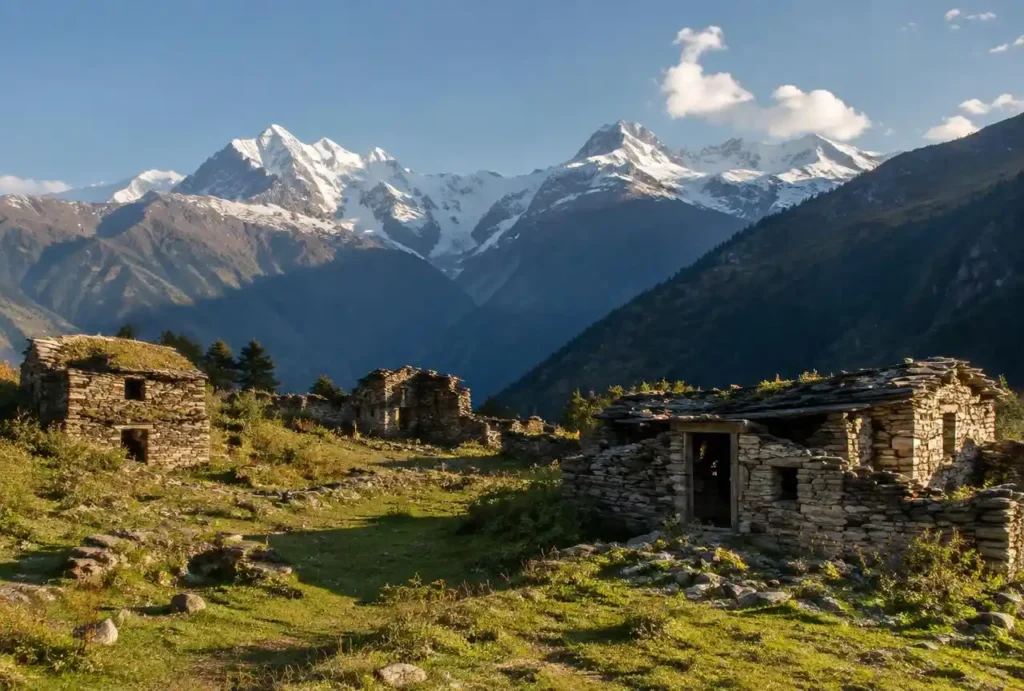
The trail opens up dramatically past Rilkot, with Nanda Devi visible for the first time on clear days.
Quick Facts
| Max Altitude | 4,150 m (Nanda Devi Basecamp) |
| Duration | 12 Days / 11 Nights |
| Trekking Distance | ~97 km on foot across 9 trekking days, plus road transfers (Kathgodam-Munsyari-Almora-Kathgodam) |
| Difficulty | Moderate to Difficult |
| Base Village | Munsyari (transport arranged from Kathgodam) |
| Nearest City | Haldwani / Kathgodam |
| Best Time | May-June and September-October |
| Price | ₹14,500 + GST (batch/package dependent) |
| Minimum Age | 13-15 years (fitness dependent) |
| Accommodation | Tented camping (triple sharing) on trek days, guesthouse/hotel on transfer days |
| Meals | All vegetarian meals with egg preparations, Day 1 dinner to Day 12 breakfast |
| Trust Rating | 4.8/5 · Certified leaders |
- Why Trek This
Why Trek Nanda Devi Basecamp
- 01
It's a Loop, Not an Out-and-Back
Most basecamp treks send you back the exact way you came. This one doesn’t — Bugdyar, Rilkot, and Ganghar on the way in, then Milam Village, Milam Glacier, Martoli, and Laspa on the way out, so almost every day of the trek shows you new terrain.
- 02
Two Major Attractions, One Trip
You get Nanda Devi Basecamp (4,150 m) and a dedicated day at Milam Glacier (3,870 m) in the same 12-day trip — most operators sell these as two separate treks.
- 03
Genuine Johar Valley History at Martoli
Martoli’s old ruins are a direct link to the region’s pre-1962 trade history with Tibet. Walking through what’s left of a trading settlement with high peaks framing the background is not something most Himalayan treks can offer.
- 04
Fully Arranged, Door to Door
Transport is included from Kathgodam all the way back to Kathgodam, along with all camping equipment, sleeping bags, and mats — you’re not left arranging a single logistics piece on your own once you land at the pickup point.
- 05
A UNESCO World Heritage Backdrop
The trail runs close to Nanda Devi National Park, jointly inscribed as a UNESCO World Heritage Site with the Valley of Flowers National Park — you’re trekking through a legally protected, ecologically significant landscape, not just a scenic valley.
- 06
Small-Batch Guide Attention
Capped group sizes mean guides can genuinely track how each trekker is handling the altitude gain across Bugdyar-Rilkot-Ganghar-Basecamp, rather than managing a large group by average pace.
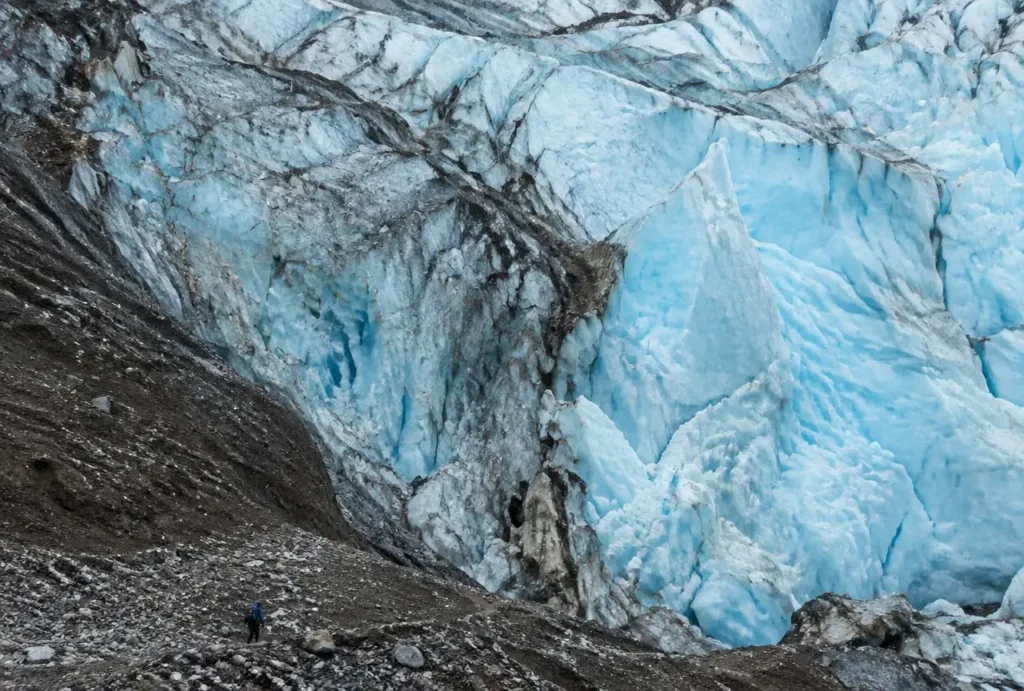
Milam Glacier (3,870 m)
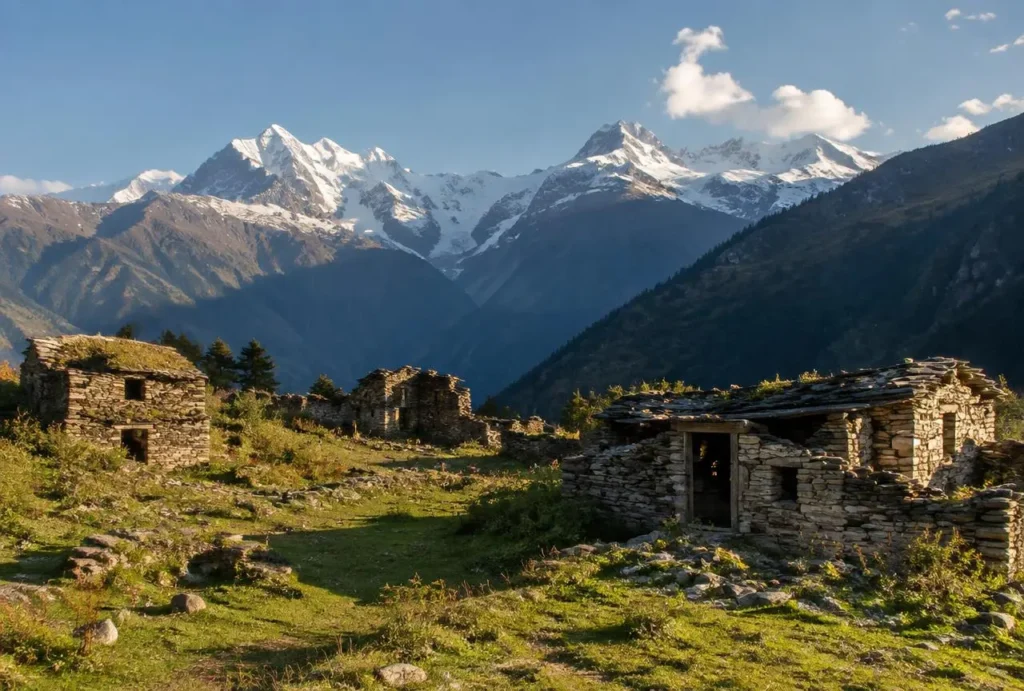
Genuine Johar Valley History at Martoli
- Before You Book
Honest Warnings — What You Should Know
⚠ Honest Warning #1 — Network Dies Early and Stays Dead
Expect essentially no reliable mobile signal from the time you leave Munsyari until you’re back there roughly 9 days later. Tell family in advance rather than promising regular check-ins.
⚠ Honest Warning #2 — Nine Trekking Days Back-to-Back Adds Up
Unlike a 5-day trek with one hard day, this route has multiple 10-15 km days in a row (Day 8’s 12 km, Day 9’s 14 km, and Day 10’s 15 km come right after each other, on tired legs). Cardio base fitness matters more here than raw strength.
⚠ Honest Warning #3 — Crampons Are Listed as "If Required" for a Reason
Snow conditions on the Rilkot-Ganghar-Basecamp stretch vary year to year and month to month. Even in the recommended season, be ready for the trek leader to call for crampon use on short notice.
⚠ Honest Warning #4 — This Is Triple-Sharing Camping, Not a Private Tent
Tented accommodation through the trek is on a triple-sharing basis. If you specifically want a private tent, confirm this as a customization before booking rather than assuming it by default.
- Seasons
Nanda Devi Trek Best Time — Month by Month
January - March
- avoid
Heavy snow closes the upper valley beyond Munsyari, and the trek is not operated in this window. [VERIFY: exact yearly road/trail reopening dates]
April
- Marginal, Early-Season Only
Day temperatures around 10-15°C in Munsyari, dropping well below freezing at Ganghar and the basecamp. Snow patches beyond Rilkot are still likely.
May
- Strong Choice
Day temperatures 12-18°C lower down, 0 to -5°C at night near Ganghar and the basecamp. Trail is largely clear by mid-May, and this is one of the two best windows for this trek.
Months to Avoid: January, February, March, July, August, December.
Ideal Months in Order: 1) Late September, 2) Early June, 3) October, 4) May.
- Conditions
Weather & Temperature on the Nanda Devi Basecamp Trek
| Season | Day Temp | Night Temp | Trail Condition |
|---|---|---|---|
| Spring (Apr-May) | 10-18°C | -5 to 2°C | Clearing snow on higher stretches |
| Summer (Jun) | 12-18°C | -5 to 3°C | Generally clear, watch late-June monsoon onset |
| Monsoon (Jul-Aug) | Variable, wet | 2-8°C | Not operated — landslide and river risk |
| Autumn (Sep-Oct) | 8-16°C | -10 to 0°C | Clearest skies of the year, cold nights |
| Winter (Nov-Mar) | -2 to 8°C | -15 to -5°C | Snow-bound, not operated |
Weather shifts noticeably as you gain altitude through the loop. Munsyari sits at 2,200 m and feels mild compared to what follows. By Bugdyar (2,500 m) the gorge traps cooler air even on sunny days. Push on to Rilkot (3,230 m) and Ganghar (3,400 m) and the day-to-night temperature swing becomes sharp — 15-20°C isn’t unusual. At the basecamp itself (4,150 m), wind off the surrounding glacial moraine matters more than the raw temperature reading. On the return loop, Milam Glacier (3,870 m) carries its own localized cold thanks to direct proximity to ice, even when Martoli and Laspa lower down feel comparatively mild.
- Fitness
Nanda Devi Trek Difficulty: How Hard Is the Basecamp Trek?
Short answer: moderate to difficult, driven mainly by cumulative distance and altitude over 9 trekking days rather than technical climbing. There’s no rope work on the standard route, but crampons are listed as trek gear for a reason — snow sections above Rilkot can require them depending on conditions.
Total ascent: From Munsyari (2,200 m) to Nanda Devi Basecamp (4,150 m) is just under 2,000 m of net gain, spread across four trekking days (Bugdyar, Rilkot, Ganghar, Basecamp) before the loop drops back down through Milam Village, Milam Glacier, Martoli, and Laspa.
Daily distances: Range from a manageable 5-7 km (Day 5 to Basecamp, Day 7 to Milam Glacier) to demanding 14-15 km days on the return loop (Day 9 to Laspa, Day 10 back to Munsyari) — the toughest distances actually come on the way down, which catches some trekkers off guard.
Terrain type per day: Forested trail near Munsyari and Bugdyar, open valley and meadow sections around Rilkot and Ganghar, glacial moraine near the basecamp and Milam Glacier itself, and mixed village trail through Martoli and Laspa on the return.
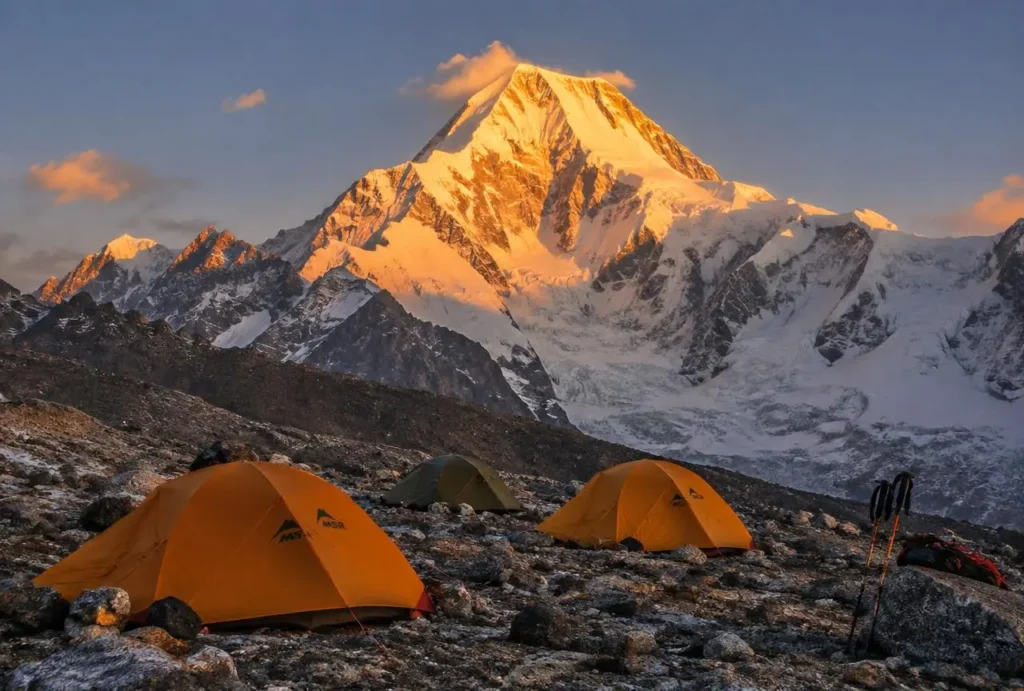
Fitness training plan (start 6-8 weeks out)
- 1
Weeks 1-2: Build a base with 30-40 minutes of brisk walking or jogging, 4x/week
- 2
Weeks 3-4: Progress to jogging 5 km in under 35 minutes; add stair-climbing or a weighted daypack (6-8 kg) on weekend walks
- 3
Weeks 5-6: Add 2 long weekend hikes of 10+ km with your actual pack weight, plus 2x/week leg and core strength training
- 4
Weeks 7-8: Taper slightly, keep 3-4 shorter sessions, and do one final long hike with full pack 10-14 days before departure — Days 9 and 10 of the actual trek (14-15 km each) are what you’re training for specifically
How it compares to other Kumaon/Garhwal treks
Vs. Pindari Glacier Trek: Pindari is shorter (5-6 days) and better supported with more established rest-house infrastructure; this trek is longer, covers more ground as a loop, and pushes higher.
Vs. Kuari Pass Trek: Kuari Pass is shorter and lower-altitude, generally suited to first-time Himalayan trekkers; this trek’s 4,150 m basecamp and 12-day duration are a clear step up.
Vs. doing Milam Glacier as a separate trek: Some operators run Milam Glacier as its own shorter trek. This itinerary already includes a dedicated Milam Glacier day (Day 7) as part of the same loop, so there’s no need to book it separately if you’re already doing this trek.
Who this trek suits
- ✓ Trekkers who've already finished at least one multi-day Himalayan trek
- ✓ Anyone comfortable with 6-8 hour trekking days, back-to-back, for over a week
- ✓ Trekkers who want a basecamp AND a glacier day on one itinerary
- ✓ Teenagers 13-15+ who trek regularly, with a family group
Who might find it harder than expected
- First-time Himalayan trekkers — this is not a first trek
- Anyone expecting one hard day rather than nine consecutive ones
- Trekkers who need daily phone connectivity
- Anyone assuming a private tent — camping is triple-sharing
- Safety
Safety and Acclimatization on the Nanda Devi Basecamp Trek
At 4,150 m, you’re within the altitude range where Acute Mountain Sickness (AMS) is a real risk, especially given the trek climbs from Munsyari’s 2,200 m to basecamp’s 4,150 m over four trekking days. Watch for persistent headache, nausea, loss of appetite, disturbed sleep, and unusual fatigue. Confusion, loss of coordination, or breathlessness at rest are signals to descend immediately.
Prevention built into the itinerary: Gradual daily altitude gain (Bugdyar → Rilkot → Ganghar → Basecamp, roughly 200-900 m of gain per day rather than one large jump), professional guide and support staff on every batch, and crampons carried for sections where snow conditions demand them.
Guide and crew: Every batch includes a professional guide, cook, and support staff, along with porter and mule support for camping equipment, so trekkers aren’t carrying heavy loads on the demanding return-loop days.
Evacuation considerations: This is remote, glacier-adjacent terrain with no vehicle access between Munsyari and the basecamp/glacier loop. [VERIFY: nearest hospital and current helicopter evacuation arrangement for this specific route — confirm with your operations team before every batch]. The cancellation and refund policy explicitly notes that medical evacuation costs arising from unforeseen circumstances are not included in the trek price, so travel insurance is worth considering separately.
Daily safety protocol: [VERIFY: confirm your specific daily health-check protocol — e.g., oximeter checks, buddy system — so this can be stated precisely rather than assumed.]
- Getting There
How to Reach Nanda Devi Basecamp Trek — Munsyari
Nearest Railway Station:
Kathgodam, the last railhead on this side of Kumaon, well connected to Delhi by overnight trains, and the fixed pickup/drop point for this trek.
Nearest Airport:
Pantnagar Airport, near Haldwani, with limited daily flight connectivity to Delhi.
Included transport:
Transport is arranged as part of the package from Kathgodam to Kathgodam — pickup on Day 1 and drop on the last day are both included, so you don’t need to separately arrange the Munsyari leg.
From Delhi:
Delhi to Kathgodam is typically an overnight train (around 6-7 hours) or a day’s drive of roughly 8-9 hours via NH9 and NH87 through Rudrapur and Haldwani. From there, the included transport takes over for the Munsyari leg.
- The Loop
Route Loop: Two Different Halves, One Trip
- Day by Day
Nanda Devi Trek Itinerary: 12-Day Day-Wise Plan
1
DAY
- Kathgodam to Munsyari
- Drive Distance: 300 km
- Drive 10-11 Hours
- 2,200 m , Stay: Guesthouse
Your journey begins with an early morning departure from Kathgodam, the railhead of the Kumaon region. The long drive winds through changing mountain landscapes, with river valleys, pine forests and small hill towns along the way. Plan for a few tea and meal breaks, as this is the longest road day of the trip. On reaching Munsyari, check into your guesthouse, freshen up and meet your trek team. Use the evening to rest, repack your bags and get ready for the trek ahead.
2
DAY
- Munsyari to Bugdyar
- Trek Distance: 12 km
- Duration: Trek 6-7 Hours
- 2,200 m → 2,500 m , Stay: Camp
The trek starts from Munsyari, where the trail leads you into lush green forests and follows the Gori Ganga river for much of the day. It is a good first day for settling into a walking rhythm, with a gradual altitude gain of around 300 meters. You reach Bugdyar by evening, where your camp is set up for the night. Enjoy a hot meal and the quiet of your first night in the mountains.
3
DAY
- Bugdyar to Rilkot
- Trek Distance: 12 km
- Duration:Trek 5-6 Hours
- | Altitude: Bugdyar - 2,500 meters, Rilkot - 3,230 meters | Accommodation: Camp
Today you continue towards Rilkot and climb from 2,500 to 3,230 meters. The trail opens up from forest into beautiful meadows, with wide high-altitude views along the way. This is a noticeable altitude gain, so walk at a steady pace and drink plenty of water. Camp is set up at Rilkot for the night.
4
DAY
- Rilkot to Ganghar
- Trek Distance: 10 km
- Duration: Trek 5-6 Hours
- Rilkot - 3,230 meters, Ganghar - 3,400 meters , Stay: Camp
The route today takes you to Ganghar, a quaint village surrounded by stunning views of the nearby peaks. The altitude gain is a gentle 170 meters, which helps your body acclimatize before the higher sections ahead. Spend the evening soaking in the surroundings, and camp overnight at Ganghar.
5
DAY
- Ganghar to Nanda Devi Basecamp
- Trek Distance: 7 km
- Duration: Trek 4-5 Hours
- Ganghar - 3,400 meters, Nanda Devi Basecamp - 4,150 meters , Stay: Camp
This is the highlight of the trek. The distance is short at 7 km, but you climb from 3,400 to 4,150 meters, so take it slow and rest when needed. At Nanda Devi Basecamp you are rewarded with breathtaking views of the majestic Nanda Devi. You camp overnight at the basecamp, surrounded by high Himalayan scenery. This trek lies within Nanda Devi National Park, declared a World Heritage Site by UNESCO.
6
DAY
- Nanda Devi Basecamp to Milam Village
- Drive Distance: 10 km
- Duration: Trek 5-6 Hours
- Nanda Devi Basecamp - 4,150 meters, Milam Village - 3,500 meters , Stay: Camp
After the basecamp, you trek back towards Milam Village, retracing your steps along the beautiful trail. The descent from 4,150 to 3,500 meters is a welcome change for the body after the high-altitude night. The familiar route also gives you a second look at the scenery from a different angle. You camp overnight in Milam Village.
7
DAY
- Milam Village to Milam Glacier (and back)
- 5 km
- Duration: Trek 3-4 Hours
- Milam Village - 3,500 meters, Milam Glacier - 3,870 meters , Stay: Camp
This is a shorter day, with a hike to Milam Glacier, the source of the Gori Ganga river, the same river you walked beside on Day 2. Spend some time at the glacier, then return to Milam Village. With fewer trekking hours, it is a comfortable day to enjoy the landscape without rushing. Camp overnight in Milam Village.
8
DAY
- Milam Village to Martoli Village
- 12 km
- Duration: Trek 6-7 Hours
- Milam Village - 3,500 meters, Martoli Village - 3,430 meters , Stay: Camp
Today’s trek takes you from Milam to Martoli Village, known for its historic ruins and beautiful landscapes. It is a long walking day of 6-7 hours, so start early and keep a steady pace. Camp overnight at Martoli.
9
DAY
- Martoli Village to Laspa Village
- 14 km
- Duration: Trek 7-8 Hours
- Martoli Village - 3,430 meters, Laspa Village - 3,200 meters , Stay: Camp
This is the longest trekking day of the itinerary at 14 km. You continue to Laspa Village along a scenic route, with chances to experience the local culture along the way. Keep your energy up with regular snack and water breaks. Camp overnight at Laspa.
10
DAY
- Laspa Village to Munsyari
- 15 km
- Duration: Trek 7-8 Hours
- Laspa Village - 3,200 meters, Munsyari - 2,200 meters , Stay: Guesthouse
On the final day of trekking, you walk back to Munsyari, completing the loop. The descent from 3,200 to 2,200 meters is long, so take your time on the downhill sections. After reaching Munsyari, rest, celebrate the successful trek with your group and enjoy a comfortable overnight stay at the guesthouse.
11
DAY
- Munsyari to Almora
- 200 km
- Drive Duration: Drive 7-8 Hours
- 1,650 m , Stay: Hotel
Today you drive to Almora, a historic hill station of Kumaon. Visit the Kasar Devi Temple and explore the local area at your own pace. Kasar Devi Temple in Uttarakhand is said to be one of only three places on the planet affected by highly charged geomagnetic fields within the Van Allen Belts, discovered by NASA. Overnight at a hotel.
12
DAY
- Almora to Kathgodam
- 90 km
- Drive Duration: Drive 3-4 Hours
- 554 m , Return
Drive back to Kathgodam, reflecting on your adventure and the memories made. This marks the end of your journey.
- On the Trail
Camping and Trek Experience
Accommodation through the trekking days is tented camping on a triple-sharing basis, using good-quality ¾ or 4-season “A”-shaped or dome tents, with separate kitchen, common, and toilet tents at each campsite — clean sleeping bags and mats are provided as part of the package, so you don’t need to arrange or rent these separately. On transfer days (Day 1, Day 10, Day 11), accommodation shifts to a guesthouse or hotel instead.
Meals are all-vegetarian with egg preparations included, running from dinner on Day 1 through breakfast on the final day, prepared fresh by the trek’s dedicated cook and support staff at each stop. Porter and mule support carries the camping equipment throughout, so the daily load on trekkers is limited to a daypack if you choose to offload your main backpack (an option worth taking, especially ahead of the longer Day 9 and Day 10 stretches).
- Checklist
What to Pack for the Nanda Devi Basecamp Trek
Basics / Gear
- 40-litre backpack with rain cover
- Trekking shoes
- Trekking pole
- LED torch
- One 1-litre water bottle
- Any prescribed or basic personal medications
Clothing
- A trekking jacket
- Three warm layers
- Two trek pants
- T-shirts
- Two pairs of thermals
Accessories
- Sunglasses
- Sunscreen (SPF 50/70)
- Lip balm (SPF 30)
- A sun cap
- Synthetic hand gloves
- Two pairs of socks
- Raincoat or poncho — a must, not optional, given how quickly weather can turn in the gorge sections
Others
- A 20-litre daypack if you plan to offload your main backpack onto the mule/porter support
- A plastic cover for keeping wet clothes separate, especially useful in winter or rainy conditions
Mandatory Documents
- Original and a photocopy of a government-issued photo ID — passport, Aadhaar card, driving licence, or voter ID
What’s already included, so don’t over-pack it: Sleeping bags, sleeping mats, and tents are all provided as part of the package — there’s no need to bring or rent your own. Crampons are also arranged if trail conditions require them.
Offloading your bag: If you’d rather not carry your full backpack, porter/mule support for personal luggage can be arranged at an additional cost of ₹300 per day, for one soft bag under 12 kg per person.
- Camera Notes
Trek Photography on the Nanda Devi Basecamp Trek
The standout photography moment is the first clear view of Nanda Devi as you approach the basecamp on Day 5 — the peak dominates the frame in a way that photos from more distant viewpoints simply can’t capture. Milam Glacier on Day 7 offers a completely different subject: the blue-white ice against dark moraine rock, with the Gori Ganga visibly originating right at the glacier’s edge. Martoli’s old ruins on Day 8, shot with the surrounding peaks in the background, are worth slowing down for rather than rushing through on a long trekking day.
Cold drains batteries fast above 3,500 m — keep spares in an inner jacket pocket close to body heat, and carry a lens cloth for condensation when moving between cold outdoor air and a warmer tent.
- Environment
Flora, Fauna and Ecosystem of the Johar Valley
The lower valley near Munsyari and Bugdyar sits in mixed temperate forest, giving way to open meadows and high-altitude pasture around Rilkot and Ganghar, and finally alpine scrub and glacial moraine near the basecamp and Milam Glacier. The route runs close to Nanda Devi National Park, a UNESCO World Heritage Site known for its rich biodiversity, though the park’s most ecologically sensitive core zones carry separate, stricter access rules than the standard trekking trail [VERIFY: exact core-zone boundary relative to this specific route]. Wildlife sightings can include species typical of the high-altitude Kumaon Himalaya, though sightings of rarer species are occasional rather than guaranteed on any given batch [VERIFY: specific species commonly observed on this route].
Given the ecological sensitivity of the national park boundary, trekkers are expected to stay on marked trails, avoid disturbing the ruins at Martoli beyond respectful photography, and carry out all non-biodegradable waste.
- Families
Trekking with Kids — Family Suitability
The minimum age for this trek is 13-15 years, and given the trek’s 12-day length, 4,150 m altitude, and consecutive long trekking days on the return loop (up to 15 km on Day 10), it’s a genuine safety threshold rather than a formality. For teenagers within this age range who trek regularly, this can work as a serious family Himalayan trip — but it isn’t the right choice as a first high-altitude experience for a young trekker. May or early June tends to be the gentler seasonal choice for family batches, given marginally milder night temperatures than the September-October window.
- Add-ons
Places to See Before or After the Trek
If Dayara Bugyal’s easy-moderate profile suits you, a few other treks in our lineup follow a similar spirit:
1. Panchachuli Viewpoint, Munsyari
Right in the base village; best at sunrise, no extra travel needed.
2. Kasar Devi Temple, near Almora
Already built into Day 11 of the itinerary; a small hilltop temple with panoramic views and a well-known local claim about its geomagnetic setting.
3. Almora Town
Covered as an overnight halt on Day 11; worth extra time in the old-town market if your schedule allows.
4. Khaliya Top, Munsyari
A separate short trek from the base village (roughly a half-day round trip), doable as an add-on before the main trek begins if you arrive a day early.
5. Birthi Falls
A roadside waterfall stop on the Kathgodam-Munsyari drive route, worth 30-45 minutes if your driver can build in the stop.
- The Operator
Why Trek Nanda Devi Basecamp with Mountainiax
Offbeat Himalayan Focus
Mountainiax runs treks like this loop route specifically because it covers lesser-known trails and unexplored corners of the Himalaya rather than only the crowded mainstream circuits.
Small-Group Attention
Smaller batch sizes mean guides can genuinely track how each trekker is handling the altitude gain across Bugdyar-Rilkot-Ganghar-Basecamp, rather than managing a large group by average pace.
Customized Trek Options
Private, group, and tailor-made itineraries are available for this route, including family, solo, school, and fully customized trips.
Certified Local Expertise
Guides and support staff bring practical, on-ground Johar Valley knowledge — route conditions, weather patterns, and local culture — that generic pan-Himalayan operators don't carry for this specific region.
Adventure Plus Local Culture
The itinerary isn't just a basecamp-and-return exercise — Martoli's trading history and the villages along the Milam side of the loop are built into the experience, not treated as incidental stops.
Safety-Focused Operations
First-aid-trained staff, quality camping equipment, and crampons carried whenever trail conditions call for them.
Safety-Focused Operations
First-aid-trained staff, quality camping equipment, and crampons carried whenever trail conditions call for them.
1200+
Happy Trekkers
4.9/5
Average Rating
100%
Success Rate
8+
Years Experience
- Explore
Other Treks You Might Like
Pindari Glacier Trek
A shorter, better-supported alternative in the same broader Kumaon region for trekkers wanting something less demanding.
Kuari Pass Trek
A good lower-altitude, shorter option if you want a taste of high-Himalayan views without the full 12-day commitment.
Roopkund Trek
For trekkers who want a different high-altitude mystery-and-history angle in the Garhwal Himalaya.
Panchachuli Base Camp Trek
Another Munsyari-region trek worth considering if you’re already making the journey out to this part of Kumaon.
- Compare
Nanda Devi Basecamp Trek vs Similar Treks
| Trek | Max Altitude | Duration | Difficulty | Best For |
|---|---|---|---|---|
| Nanda Devi Basecamp (Mountainiax loop) | 4,150 m | 12 Days | Moderate-Difficult | Trekkers wanting both a basecamp and a glacier visit on one loop itinerary |
| Pindari Glacier | ~3,660 m [VERIFY] | 5-6 Days | Easy-Moderate | First-time Himalayan trekkers, shorter trips |
| Kuari Pass | ~3,860 m [VERIFY] | 5-6 Days | Easy-Moderate | Beginners wanting Himalayan views without a long commitment |
| Roopkund | ~5,029 m [VERIFY] | 8-9 Days | Difficult | Fit trekkers seeking a well-known high-altitude mystery trail |
The Nanda Devi Basecamp Trek is the longest and most demanding option in this set, but it’s also the only one that combines a genuine basecamp experience with a dedicated glacier day and two distinct sets of villages on the outbound and return legs — most comparable treks in the region ask you to choose one or the other.
- Reviews
What Trekkers Say
- Responsibility
Sustainable Trekking Practices on This Route
Given that this trek runs directly alongside a UNESCO World Heritage-listed national park, Leave No Trace practices are followed at every campsite from Bugdyar through to Laspa — all non-biodegradable waste is carried out rather than left or burned on the trail. Porter and mule loads for camping equipment are kept within humane limits, and local Munsyari-region guides, cooks, and support staff are engaged directly for the trek, keeping trek income within the local Johar Valley economy. Trekkers are briefed on Leave No Trace principles before departure, with particular emphasis on not disturbing the ruins at Martoli beyond respectful photography and staying on marked trail sections near the national park boundary.
- Cost and Inclusions
Nanda Devi Trek Price 2026, Inclusions & Booking Policy
₹14,500 + GST per person
| Included | Not Included |
|---|---|
✓ Transport support from Kathgodam to Kathgodam (pickup Day 1, drop on the last day) ✓ All vegetarian meals with egg preparations, from dinner on Day 1 to breakfast on the last day ✓ Professional guide, cook, and support staff ✓ Camping equipment rental, including clean sleeping bags and mats ✓ Good-quality ¾ or 4-season “A”-shaped or dome tents, plus kitchen, common, and toilet tents ✓ Crampons, if required by trail conditions ✓ Forest entry charges ✓ Porter and mule support to carry camping equipment ✓ Tented accommodation throughout the trek on a triple-sharing basis, with guesthouse/homestay accommodation on the days specified in the itinerary | ✗ Personal expenses such as tips, personal medicines, and phone calls ✗ Any transport beyond what’s listed in inclusions ✗ Any cost or service not explicitly mentioned in inclusions ✗ Accommodation in Dehradun ✗ Costs arising from unforeseen incidents such as bad weather, medical evacuation, or road blocks ✗ Porter/mule charges for personal luggage (available separately at ₹300 per day, for one soft bag under 12 kg per person) |
Cancellation & Refund Policy
We understand that plans can change. If you need to cancel, reduce, or amend a guaranteed reservation, please do so by 12 noon, 15 days prior to arrival to avoid cancellation charges. Any cancellation made within 15 days of arrival will be 100% non-refundable. Bookings made under non-cancellable or non-amendable packages or rates cannot be canceled or amended, and the full amount of the advance paid will be treated as the cancellation fee. The same terms apply if guests do not show up.
For all bookings other than non-cancellable ones, if the guest does not show up, the complete booking will be non-refundable. If the guest chooses to check out early, one night’s room rate, including taxes, will be charged. No cancellations will be accepted over the phone or via WhatsApp message. Please reply to the email confirmation you received at the time of booking to request a cancellation.
No refunds will be provided in case of problems arising due to government orders, harsh weather conditions, protests, landslides, or other unforeseen circumstances. In such cases, we usually have a backup plan ready and will proceed with that. Sometimes, we may have to cancel activities mentioned in the itinerary due to circumstances beyond our control.
If a trek is called off at the last moment due to natural calamities or unforeseen circumstances (such as rain, snowfall, earthquake, landslides, strikes, or bandhs), participants will be provided with a travel voucher for the same amount. This voucher can be used within 365 days of the issuance date for any package of equal value, subject to availability.
If a trek or trip has to be aborted midway due to natural calamities or unforeseen circumstances, no refund will be provided. Mountainiax will not bear any extra expenses due to such natural calamities or unforeseen circumstances.
Refund Policy
The following refund shall be payable to the user in case of valid cancellation as per the guidelines
Cancellations up to 21 days prior to departure date – 70% refund
Between 21 days to 14 days prior to departure – 50% refund
Between 14 days to 10 days prior to departure- 30% refund
Less than 10 days of departure – No refund or you can transfer your trek (same batch date & same trek) to your dear one.
The refunds will be credited to your bank account within 30 days of cancelation.
Trek Gallery
- Questions
FAQs — Nanda Devi Basecamp Trek
Is Nanda Devi Basecamp Trek difficult for beginners?
It’s not recommended as a first Himalayan trek. Nine trekking days, a climb to 4,150 m, and back-to-back long days on the return loop (up to 15 km on Day 10) make it better suited to trekkers who’ve already completed at least one shorter Himalayan trek.
What is the best time to do Nanda Devi Basecamp Trek?
Late September to October and May to early June are the strongest windows. Avoid monsoon (July-August) and winter (December-March), when the trek isn’t operated.
How many days does the Nanda Devi Basecamp Trek take?
The itinerary runs 12 days and 11 nights, including drive days to and from Kathgodam, 9 trekking days, and a loop that covers both the basecamp and Milam Glacier.
Is there network connectivity on Nanda Devi Basecamp Trek?
Expect essentially no reliable mobile signal from the time you leave Munsyari (Day 2) until you return there on Day 10. Inform family in advance rather than promising daily calls.
What is the minimum age for Nanda Devi Basecamp Trek?
13–15 years, and it’s a genuine safety threshold given the altitude, duration, and consecutive long trekking days — not a formality.
How cold does it get on Nanda Devi Basecamp Trek?
Night temperatures near Ganghar and the basecamp can drop to -10°C to -15°C in October, and roughly -5°C to -8°C in May-June.
Does Nanda Devi Basecamp Trek also cover Milam Glacier?
Yes. Day 7 of the itinerary is a dedicated round trip from Milam Village up to Milam Glacier (3,870 m), the source of the Gori Ganga river, before the loop continues on to Martoli and Laspa.
What is the total trekking distance of Nanda Devi Basecamp Trek?
Approximately 97 km of on-foot trekking across 9 trekking days, plus the road transfers from and back to Kathgodam.
Is the route an out-and-back or a loop?
It’s a loop. The outbound route runs via Bugdyar, Rilkot, and Ganghar to reach the basecamp; the return runs via Milam Village, Milam Glacier, Martoli, and Laspa — different villages on the way back than the way out.
What kind of accommodation is provided?
Triple-sharing tented camping on trekking days (with sleeping bags and mats provided), and guesthouse or hotel stays on Day 1, Day 10, and Day 11.
What kind of food is served during the trek?
All vegetarian meals with egg preparations, served from dinner on Day 1 through breakfast on the last day, prepared by the trek’s dedicated cook.
Can I offload my backpack during the trek?
Yes. Porter/mule support for personal luggage can be arranged at ₹300 per day for one soft bag under 12 kg per person, in addition to the included camping-equipment portering.
What is the cancellation and refund policy?
Cancellations must be made by 12 noon, 15 days before arrival to avoid charges. Refunds scale down from 70% (21+ days out) to 0% (under 10 days out), and are processed within 30 days of a valid cancellation, minus any costs already incurred.
Are permits required for this trek?
The route passes through Nanda Devi National Park, a UNESCO World Heritage Site, and forest entry charges are included in the trek price.
How do I reach Munsyari, the base village for this trek?
Transport is included as part of the package, picking up from Kathgodam and driving roughly 300 km / 10-11 hours to Munsyari on Day 1.
Is crampon use required on this trek?
Crampons are included and carried “if required” — trail and snow conditions on the Rilkot-to-Basecamp stretch vary by season, and the guide will call for crampon use when conditions warrant it.
Will I see Nanda Devi peak clearly on this trek?
On clear days, yes — the basecamp at 4,150 m offers a close, dominant view of Nanda Devi (7,816 m), India’s second-highest peak, particularly from Day 5 onward.
What makes this trek different from doing Milam Glacier as a standalone trek?
This itinerary already includes a dedicated Milam Glacier day (Day 7) as part of the same 12-day loop, alongside the Nanda Devi Basecamp visit — so trekkers get both destinations without booking two separate treks.
What is the altitude of Nanda Devi Basecamp Trek?
(basecamp 4,150 m, peak 7,816 m