- ⭐ Moderate · 7N/8D · Uttarakhand, India
Chenap Valley Trek 2026
- Untouched Valley near Nanda Devi
- ON REQUEST per person onwards
- 7N/8D / 4,748 m / 60 km / Moderate / Best: June - September
- Transport Included
- Certified Guides
- All Meals Included
- Group Size: 20 Max
Duration
7N/8D
Max Elevation
4,748 m
Gradient
Moderate
Distance
60 km
Best Month
June - September
Group Size
20
Starting From
ON REQUEST
- Overview
Chenap Valley Trek — Overview
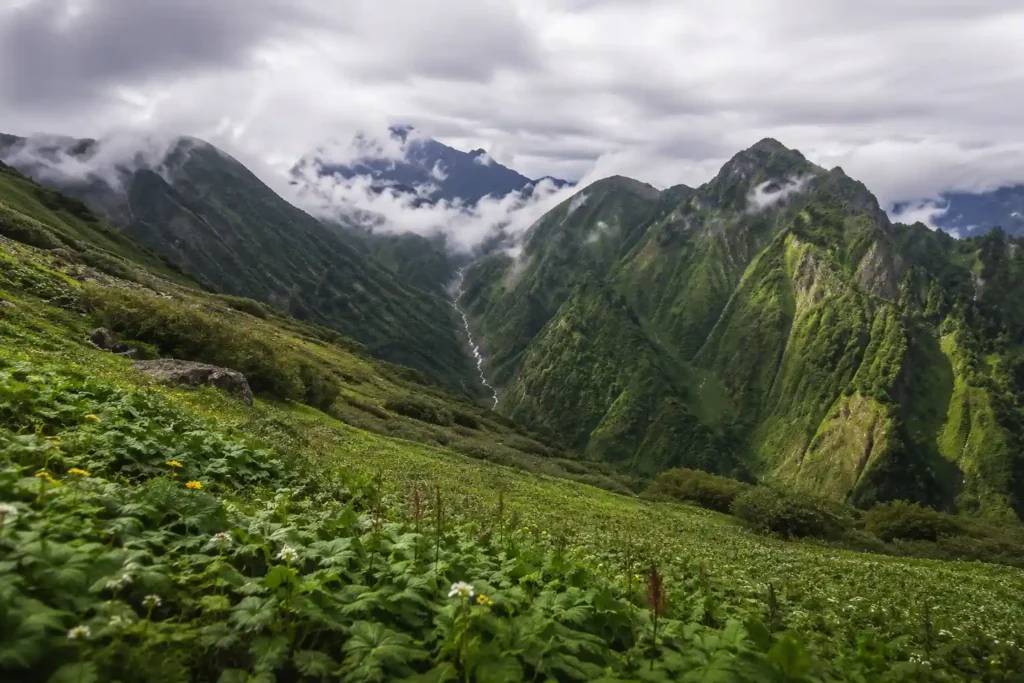
Chenap Valley is a verdant valley nestled high in the Himalayas of Uttarakhand, perched at an altitude of 3,900 meters above sea level, shielded by snowy mountains deep in the heart of the Himalayas. Due to its easy-to-moderate gradient, the Chenap Valley trek is deemed an ideal choice for beginners seeking a longer, more immersive Himalayan adventure. A guided trip of six days is sufficient to immerse you in the exhilarating aspects of a trekking adventure.
The itinerary, crafted by our experienced trek mentors, enables you to explore the remote wilderness of isolated and secluded villages, as well as the remarkable vantage points of Chenap Valley. Moreover, it brings you into close proximity to the majestic mountain peaks of Nanda Devi, Nanda Kot, and Dronagiri — some of the most dramatic peaks in the Kumaon Himalayas.
This is one of the longest and most remote trek offerings at Mountainiax — a total distance of 60 km with a maximum elevation of 4,748 m. It is ideal for those who wish to experience true Himalayan isolation, authentic Kumaoni culture, ancient Himalayan villages still cut off from the modern world, and pristine high-altitude landscapes completely away from the typical trekking crowds.
- Complete Information
Quick Facts
Base Camp
Munsiyari, Pithoragarh
Pickup
Haldwani / Kathgodam
Nearest Railway Station
Kathgodam
Nearest Airport
Pantnagar Airport / Jolly Grant (Dehradun)
Temperature
Day: 18-22°C | Night: 2° to -8°C (monsoon season trek)
Mobile Network
Munsiyari: Jio/Airtel. No network on trail.
Electricity
Munsiyari town only. No electricity on trail.
Last ATM
Munsiyari town. Carry sufficient cash.
- Trek Grading
Difficulty Explained
Why Chenap Valley is rated Moderate — and what that means on the trail.
- Terrain
Forest climbs through oak and rhododendron from Vishnuprayag to Thaing Village, followed by a steep ascent to Dhar Kharak with narrow ridge stretches. The trail then opens into wide alpine meadows near Chenap. No technical climbing, but a few exposed forest switchbacks demand sure footing.
- Altitude Gain
From 1,875 m (Joshimath) to approximately 3,900 m (Chenap Meadow) over 3–4 trekking days — a steady gradient that allows gradual acclimatisation, unlike treks with sudden altitude jumps.
- Daily Effort
5–6.5 km per day, 5–6 hours of walking with a daypack. The Thaing Village to Dhar Kharak stretch is the toughest climb on the trek, with no water source along the way.
Verdict: Best suited to fit beginners with one trek already done, and seasoned trekkers looking for an offbeat, less-crowded alternative to the Valley of Flowers.
- Stay Safe
Altitude Sickness (AMS) on Chenap Valley
Chenap tops out at 3,900 m. AMS risk is low-to-moderate — knowing the signs matters.
- Common Symptoms
- Headache, especially after the Dhar Kharak climb
- Loss of appetite, mild nausea
- Disturbed sleep at Chenap Meadow camp
- Breathlessness while gaining the final ridge to the meadow
- Prevention Protocol
- Spend an acclimatisation night at Joshimath (1,875 m)
- Drink 3–4 L of water per day from Joshimath onwards
- No alcohol or smoking on trek
- Walk at your own pace — never race the group
- Inform your guide at the first sign of discomfort
Our guides carry pulse oximeters and emergency oxygen cylinders on every Chenap Valley batch.
- Train Before You Trek
Fitness Requirement
A 5-week prep window is enough to enjoy Chenap Valley comfortably.
- Cardio Benchmark
- You should be able to comfortably:
- • Jog 5 km in under 32 minutes on flat ground
- • Climb 50 floors (stairs) with a 5 kg backpack in 12
- • Cycle 20 km in under an hour
- Strength Benchmark
- • 3 sets × 15 squats (knee strength for the Dhar Kharak descent)
- • 3 sets × 45-second plank (core stability)
- • 3 sets × 10 push-ups (upper-body endurance)
- • 45-min daily brisk walk with a 5 kg backpack
Week 1
Walk 3 km · light squats
Week 2
Jog 3 km · stairs 30 floors
Week 3
Jog 4 km · stairs 45 floors
Week 4
Jog 5 km · stairs 50 floors + pack
Week 5
Jog 5 km + pack · weekend hike
- Day by Day
Detailed Itinerary — Chenap Valley Trek
1
DAY
- Rishikesh/Haridwar → Joshimath
- 🚗 250 KM DRIVE
- 🕐 9–10 HRS
- 📍 JOSHIMATH: 1,875M
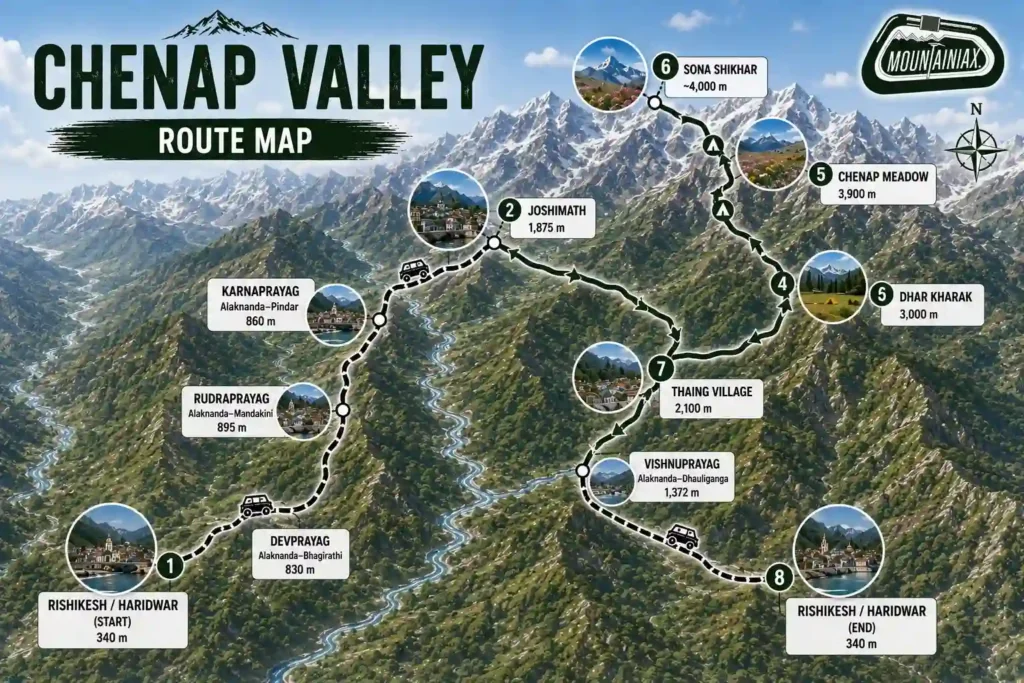
A full day on the road tracing the Alaknanda through some of Garhwal’s most sacred confluences — Devprayag (Alaknanda-Bhagirathi), Rudraprayag (Alaknanda-Mandakini), and Karnaprayag (Alaknanda-Pindar). The drive itself is a mini-pilgrimage through temple towns before climbing into Joshimath, gateway to Auli and the high Himalaya. Overnight at a guesthouse.
2
DAY
- Joshimath → Thaing Village (via Vishnuprayag)
- 🥾 10 KM TREK
- 🕐 5–6 HRS
- 📍 THAING VILLAGE: 2,100M
Drive to Vishnuprayag, where the Alaknanda meets the Dhauliganga beneath a dramatic gorge, then cross a suspension bridge to officially enter Chenap territory. The trail climbs gently through terraced fields into Thaing — a remote village with a history tied to a local king, and known for its home-cooked Garhwali food. This is the last village with electricity on the route. Overnight camping/homestay.
3
DAY
- Thaing Village → Dhar Kharak
- 🥾 5.5 KM TREK
- 🕐 5–6 HRS
- 📍 DHAR KHARAK: 3,000M
The toughest climbing day of the trek — a steady, forested ascent with no water source en route, so tank up before leaving Thaing. En route, keep an eye out for rare Himalayan fruit and root herbs (locally called kandmol) foraged by villagers. From Dhar Kharak, you get your first full view of Thaing Village sitting in the valley below. Overnight camping.
4
DAY
- Dhar Kharak → Chenap Meadow
- 🥾 4 KM TREK
- 🕐 3–4 HRS
- 📍 CHENAP MEADOW: 3,900M
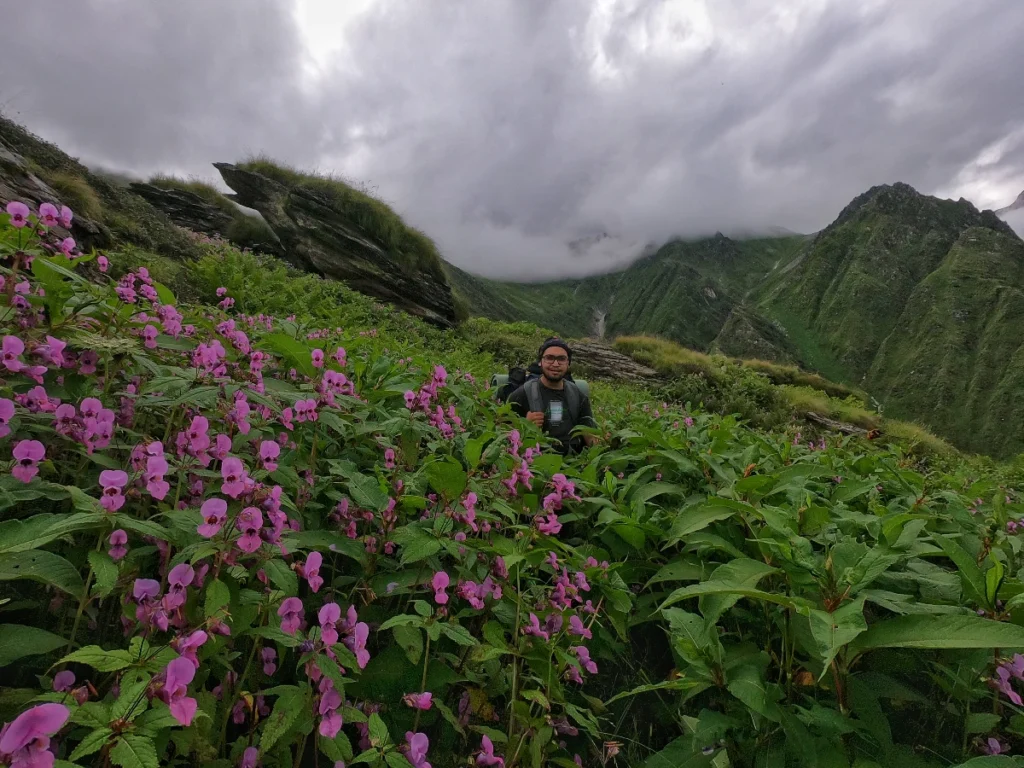
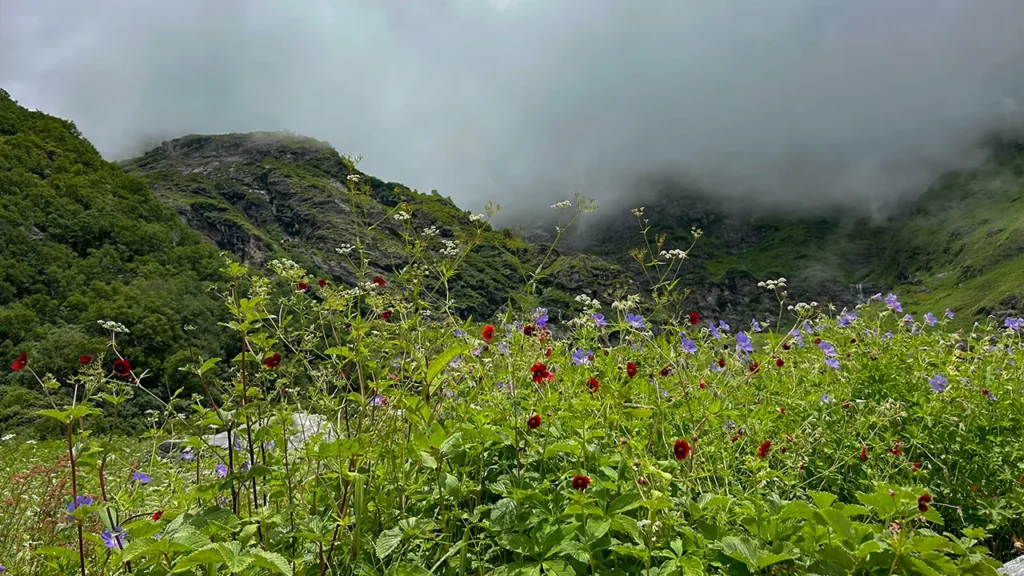
A short but scenic day — cross a couple of ridgelines through forest before the trail opens into Chenap’s flowering meadows. Over 500 species of flowers and medicinal herbs carpet the valley in season, and the scent often reaches the trail before the view does. Camp right inside the meadow — something not permitted at the more famous Valley of Flowers. Overnight camping.
5
DAY
- Chenap Valley Exploration (optional Sona Shikhar side-trek)
- 🥾 8 KM TREK (OPTIONAL)
- 🕐 6–7 HRS
- 📍 SONA SHIKHAR: ~4,000M
A free day to soak in golden sunrise and sunset light on Nanda Devi, Nanda Kot, Nanda Ghunti, Trishul, Hathi Parbat, and Dronagiri. For the more adventurous, an optional side-trek to Sona Shikhar via Fulna and Maskyani Bugyal rewards you with sightings of the rare Brahma Kamal — Uttarakhand’s state flower. Overnight camping.
6
DAY
- Chenap Valley → Thaing Village
- 🥾 9.5 KM TREK
- 🕐 6–7 HRS
- 📍 THAING VILLAGE: 2,100M
Retrace your steps through Dhar Kharak for one last look at the meadow before descending into forest cover. A good day to slow down, spot birdlife, and reflect on the trail with your group before the final night in the village. Overnight stay.
7
DAY
- Thaing Village → Joshimath (via Vishnuprayag)
- 🥾 10 KM TREK
- 🕐 5–6 HRS
- 📍 JOSHIMATH: 1,875M
Descend to Vishnuprayag, crossing the suspension bridge one final time, and drive back to Joshimath. If the group has energy, a short evening stroll around Joshimath’s old town and views toward Auli make for a relaxed close to the trek. Overnight stay.
8
DAY
- Joshimath → Rishikesh/Haridwar
- 🚗 250 KM DRIVE
- 🕐 9–10 HRS
- The Trail
Route Map
- Paperwork
Trek Permits
Chenap Valley lies inside the Nanda Devi Biosphere buffer zone — a forest entry permit applies.
- For Indian Nationals
- Forest Department entry permit
- Forest fee: ₹200/day per person
- Original government photo ID required (Aadhaar / Voter ID / Driving Licence / Passport)
- Permit issued at the DFO Office, Joshimath on Day 1 evening
- Carry 2 passport-size photos as backup — some forest checkpoints ask for them
- For Foreign Nationals
- Forest fee: ₹650/day per person (additional, not included)
- Passport + valid Indian visa required
- No inner-line permit required for Chenap Valley (unlike nearby restricted zones such as Niti Valley)
- Please share a scanned passport copy at least 7 days before the trek date
- Group permits are processed together — solo foreign trekkers should confirm batch size in advance
- Getting There
How to Reach Joshimath (Base)
Joshimath is 255 km from Rishikesh — a 9–10 hour mountain drive along the Alaknanda.
- By Air
Nearest airport: Jolly Grant, Dehradun (DED) — 290 km from Joshimath. Direct flights from Delhi, Mumbai, Bengaluru, and other major cities. Continue by shared taxi or pre-booked cab to Joshimath via Rishikesh (approx. 8–9 hrs onward drive).
- By Train
Reach Haridwar (HW) or Rishikesh (RKSH) — well connected to Delhi via Nanda Devi Express, AC SF Express, and Jan Shatabdi. From here, shared sumos and our trek transport depart at 5:00 AM.
- By Road
Daily Volvo/AC buses from Delhi ISBT Kashmere Gate to Rishikesh/Haridwar (approx. 6 hrs). From Rishikesh, GMOU buses and shared cabs run to Joshimath via Devprayag, Rudraprayag, and Chamoli.
- Stay Connected
Network Availability
Connectivity ends at Subhain village — be prepared for a true digital detox on the trail.
| Location | Altitude | Mobile Network | Electricity |
|---|---|---|---|
| Rishikesh | 372 m | All networks (Jio/Airtel/VI/BSNL) | Stable |
| Rudraprayag | 895 m | All networks | Stable |
| Joshimath | 1,875 m | All networks (last ATM stop) | Stable |
| Thaing Village | 2,100 m | Patchy Jio / BSNL | Available at homestays |
| Dhar Kharak | 3,000 m | No network | None |
| Chenap Meadow | 3,900 m | No network | None |
Carry a 10,000–20,000 mAh power bank, a head torch with spare batteries, and share emergency numbers with family before leaving Joshimath.
- Plan the Window
Weather — Month by Month
Chenap Valley is at its best from May–June and September–October. Here’s what each month feels like.
January
ClosedFebruary
ClosedMarch
ClosedApril
GoodMay
BestJune
BestJuly
AvoidAugust
AvoidSeptember
BestOctober
BestNovember
GoodDecember
Closed- Be Prepared
Things to Carry
- 🎒 Basic Gear
- Backpack
- Trekking Shoes
- Trekking Pole
- LED Torch
- One Water Bottle (1 litre)
- Lunch Box
- Basic / Prescribed Medications
- 🧥 Clothes
- Trekking Jacket
- Warm Layers
- Two Trek Pants
- Full Sleeve Dry-fit T-shirts
- Thermals (1 pair)
- 🕶️ Accessories
- Sunglasses
- Sunscreen Lotion (SPF 50/70)
- Lip Balm (SPF 30)
- Synthetic Hand Gloves
- Woolen Cap
- Three Pairs of Socks
- Raincoat / Poncho (must)
- 📄 Documents & Others
- Daypack (for Summit Day)
- Plastic cover for wet clothes
- Original + photocopy of Govt Photo ID (Passport / Aadhaar / Driving License / Voter ID)
Chenap Valley Trek — Package & Cost
Dehradun to Dehradun — Quad Sharing
- 7 Nights / 8 Days
- Starting from Dehradun
- Transport: Dehradun pickup to drop included
- Accommodation: Quad sharing (4 per tent/room)
- All vegetarian meals — Day 1 dinner to Day 8 tea
- Certified trek guide and support staff
- Nanda Devi Biosphere Reserve forest entry permit
- Sleeping bags, mats, and camping tents
Limited seats — call +91-6398937502
NOTE: 5% GST is to paid additional on the trek cost.
Dehradun to Dehradun — Double Sharing
- 7 Nights / 8 Days
- Starting from Dehradun
- Transport: Dehradun pickup to drop included
- Accommodation: Double sharing (2 per tent/room)
- All vegetarian meals — Day 1 dinner to Day 8 tea
- Certified trek guide and support staff
- Nanda Devi Biosphere Reserve forest entry permit
- Sleeping bags, mats, and camping tents
Limited seats — call +91-6398937502
NOTE: 5% GST is to paid additional on the trek cost.
Rishikesh to Rishikesh — Quad Sharing
- 7 Nights / 8 Days
- Starting from Rishikesh
- Transport: Rishikesh pickup to drop included
- Accommodation: Quad sharing (4 per tent/room)
- All vegetarian meals — Day 1 dinner to Day 8 tea
- Certified trek guide and support staff
- Nanda Devi Biosphere Reserve forest entry permit
- Sleeping bags, mats, and camping tents
Limited seats — call +91-6398937502
NOTE: 5% GST is to paid additional on the trek cost.
Rishikesh to Rishikesh — Double Sharing
- 7 Nights / 8 Days
- Starting from Rishikesh
- Transport: Rishikesh pickup to drop included
- Accommodation: Double sharing (2 per tent/room)
- All vegetarian meals — Day 1 dinner to Day 8 tea
- Certified trek guide and support staff
- Nanda Devi Biosphere Reserve forest entry permit
- Sleeping bags, mats, and camping tents
Limited seats — call +91-6398937502
NOTE: 5% GST is to paid additional on the trek cost.
- Choose Your Plan
- What's Covered
Inclusions & Exclusions
- ✅ Included
- Transport support from Rishikesh or Dehradun
- Meals from Day 1 Dinner to Day 8 Breakfast. All breakfast, lunch and dinner meals during the trek.
- Accommodation throughout the trek on a quad sharing basis
- Professional guide, and support staff
- Comfortable hotel Stay
- Forest entry charges for Indian nationals.
- Tolls and taxes included
- ❌ Excluded
- Personal expenses like tips, personal medicines, phone calls etc
- Any transport support during the trek apart from what is included above Any cost or services not mentioned in the Inclusions
- Cost arising due to unforeseen incidents like bad weather, medical evacuation, road blocks etc
- Porter/mule charges to carry personal luggage can be arranged at an additional cost of INR 500 per day (1 soft bag per person < 12 kg)
- Important
Cancellation & Refund Policy
Cancellation Policy
We understand that plans can change. If you need to cancel, reduce, or amend a guaranteed reservation, please do so by 12 noon, 15 days prior to arrival to avoid cancellation charges. Any cancellation made within 15 days of arrival will be 100% non-refundable.
No cancellations will be accepted over the phone or via WhatsApp message. Please reply to the email confirmation you received at the time of booking to request a cancellation.
No refunds will be provided in case of problems arising due to government orders, harsh weather conditions, protests, landslides, or other unforeseen circumstances. If a trek is called off at the last moment due to natural calamities, participants will be provided with a travel voucher for the same amount, valid within 365 days for any package of equal value.
Refund Policy
| Cancellation Timing | Refund |
|---|---|
| Up to 21 days prior to departure | 70% refund |
| Between 21 to 14 days prior | 50% refund |
| Between 14 to 10 days prior | 30% refund |
| Less than 10 days of departure | No refund (can transfer trek to someone else) |
Note: Refunds are subjected to deductions for any expenses incurred for hotel booking or transport. Refunds are applicable on the total cost and not on the advance amount.
- Plan Your Trip
Best Time to Visit
- ⭐ Best Season
Mid-July – September
Flowering Season
Peak bloom across the meadows — 500+ species of flowers including Brahma Kamal in full colour. Post-monsoon showers keep the valley lush and green. Days mild, nights cool (5–10°C). Ideal conditions for the classic “hidden Valley of Flowers” experience.
- ✅ Good Season
June – Early July
Pre-Monsoon
Clear mountain views before the rains set in, trails still dry and easy underfoot. Flowers just beginning to bloom — fewer varieties than peak season but noticeably fewer crowds too.
- ⚠️ Avoid
October – November
Post-Monsoon / Early Winter
- ❌ Closed
December – May
Winter / Snow-bound
- Why Mountainiax
Trusted by Thousands of Trekkers
- 🏆
4.9 ★ on Google & TripAdvisor
Trusted by 1,000+ trekkers. Consistently rated best-in-class for safety and experience across Uttarakhand.
- 🏛️
Government Registered
Registered with Uttarakhand Tourism Department and MSME. All guides certified by the state government.
- 🌍
TripAdvisor Travellers' Choice
Awarded Travellers' Choice by TripAdvisor for 2021 & 2022. Ranked Top 5 Outdoor Company in Dehradun.
- 🧑🤝🧑
Small Batch Sizes
Maximum 20 trekkers per batch — never overcrowded. More personal attention, better safety management.
- 🎯
Local Dehradun Team
We are from Uttarakhand — not a travel aggregator. Our guides know these mountains personally.
- 🛠️
Customised Treks
Private group bookings and custom itineraries available. Call us to design your perfect Chenap Valley experience.
- Visual Journey
Chenap Valley Trek Gallery
- Need Help?
Frequently Asked Questions
1. What is the best time to do the Chenap Valley Trek?
The best time is mid-July to September (peak flowering season, valley in full bloom) and June–early July (pre-monsoon, clear views, fewer crowds). The trek is closed December–May due to heavy snow above Dhar Kharak. Avoid October–November as flowers have dried and early snowfall risk increases.
2. Is there mobile network connectivity on the Chenap Valley Trek?
Network is available up to Joshimath. Thaing Village has patchy Jio/BSNL and is the last point with electricity. Beyond Dhar Kharak, there is no network coverage at all.
3. Can solo trekkers join a Chenap Valley Trek group?
Yes, solo trekkers are welcome to join our fixed departure batches. We recommend confirming your slot in advance as group sizes are kept small for a better trekking experience.
4. Where is the last ATM before the Chenap Valley Trek?
Joshimath has the last ATM on the route. Carry sufficient cash from there, as no ATM or digital payment options are available beyond this point.
5. What fitness level is required for the Chenap Valley Trek?
A moderate fitness level is required — the ability to jog 5 km comfortably and walk 5–6 hours a day with a daypack. See our Fitness Requirement section for a detailed 5-week training plan.
6. Is a forest permit required for the Chenap Valley Trek?
Yes, since Chenap Valley lies within the Nanda Devi Biosphere buffer zone, a forest entry permit is required. This is included in our package for Indian nationals; foreign nationals pay an additional forest fee.
7. Are oxygen cylinders carried on this trek?
Yes, our guides carry a first-aid kit and are trained in basic altitude sickness management. Please confirm with our team about specific emergency equipment carried on each batch.
8. Can beginners do the Chenap Valley Trek?
It’s better suited to trekkers with at least one prior moderate Himalayan trek, given the sustained ascents (especially Thaing Village to Dhar Kharak) and remote terrain with no rescue infrastructure nearby.
9. What should I pack for the Chenap Valley Trek?
Layered trekking clothes, a good rain jacket (monsoon-season trek), sturdy trekking shoes, a reliable water bottle/hydration pack, headlamp with spare batteries, and personal medication — since network and facilities are limited beyond Thaing Village.
10. Is the Chenap Valley Trek safe during monsoon?
Yes, with proper guidance — mid-July to September is actually the best season for the bloom — but trekkers should be prepared for sudden rain and slippery trail sections, and follow the guide’s route decisions closely, especially near river crossings and ridgelines.
- Ready to Trek?
Ready to Trek Chenap Valley?
Limited seats per batch — book early to secure your spot. Free consultation call available.
- Also reachable at +91-7887449236 | 239/2 Lane no.-3, Turner Road, Clement Town, Dehradun