- Uttarkashi · Garhwal Himalayas
Surya Top Trek
- A Quieter, Higher Extension of the Dayara Bugyal Trek
- Price on request — call for current batch dates
- Six days from Dehradun to a 3,930 m summit above the Dayara meadow — a multi-kilometre ridge walk with the Gangotri range on one side and Bandarpoonch on the other.
- 4.8/5 Rating
- Running since 2018
- Certified Trek Leaders
- 24/7 Support
3,930 M
Max Altitude Surya Top summit
31 KM
Trek Distance Ridge walk route
6 DAYS
Duration 5 nights
MODERATE
Difficulty Prior trek advised
APR–JUN · OCT–NOV
Best Months Closed in winter
UP TO 20
Group Size Barsu base village
- About the Trek
Surya Top Trek: The Complete Guide to Uttarakhand's Longest Ridge Walk
The Surya Top trek takes the same meadows that make Dayara Bugyal famous and keeps going — past the grassland, up a long open ridge, to a 3,930 m summit with one of the widest 360-degree panoramas in the Uttarkashi region. Where Dayara Bugyal is built for first-timers and families, Surya Top is built for trekkers who’ve done a Himalayan trek before and want something with more altitude, more ridge-walking, and considerably fewer people on the trail.
This isn’t a heavily marketed route. Most trekkers who do it have already done Dayara Bugyal, Kedarkantha, or something similar, and are specifically looking for the next step up — a trek that keeps the manageable forest-and-meadow character of the region but adds a genuine summit and one of the longest sustained ridge walks in Indian trekking. If that’s what you’re after, very few treks in Uttarakhand deliver it with this little crowding.
| Quick Facts | |
|---|---|
| Duration | 6 Days / 5 Nights |
| Trek Distance | 31 km |
| Max Altitude | 3,930 m (12,900 ft) — Surya Top summit |
| Difficulty | Moderate |
| Base Village | Barsu, Uttarkashi district |
| Distance from Dehradun | 165 km (7–8 hour drive) |
| Best Time | April–June (best), October–November (good) |
| Trek Price | On Request — call for current batch pricing |
| Group Size | Up to 20 |
About the Surya Top Trek
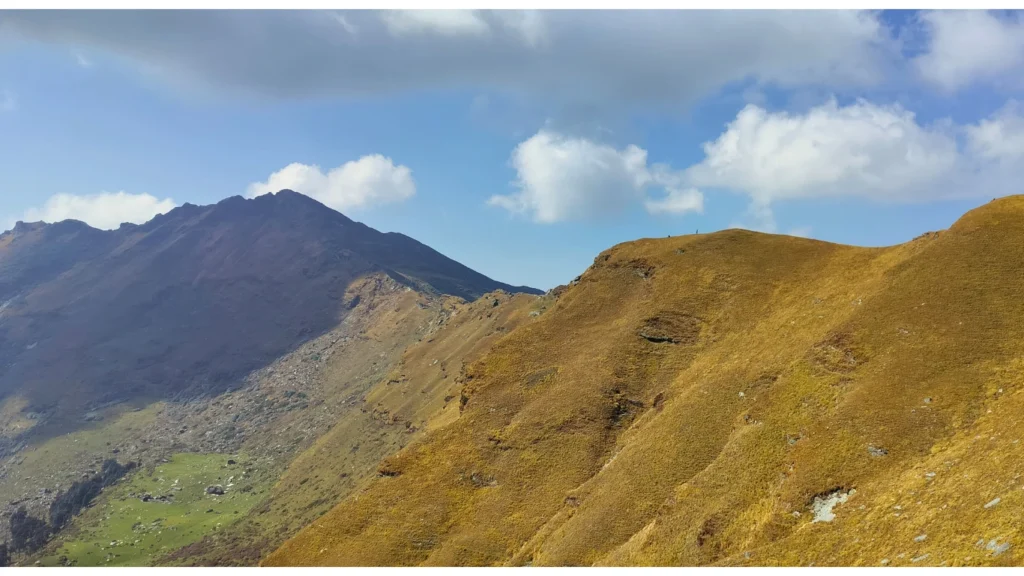
Surya Top sits above the same Dayara Bugyal meadow that draws thousands of beginner trekkers every year — but almost none of them continue past it. The trail that does is the Surya Top trek, and it’s one of the more genuinely offbeat routes we run: dense oak, rhododendron, maple, and cedar forest out of Barsu village, opening into the Dayara meadow by Day 2, and then climbing further still, past where most Dayara itineraries turn back, onto a long alpine ridge that eventually reaches the 3,930 m summit of Surya Top.
What happens next is the part that makes this trek worth the extra effort: a multi-kilometre ridge walk from Surya Top down toward Devkund, with views opening on both sides simultaneously — the Gangotri range (Bhagirathi I & II, Mt. Meru, Thalay Sagar, Kedardome) on one side, the Yamunotri range (Bandarpoonch I & II, Kalanag) on the other. Very few treks in India put you on a ridge this long, this exposed to view, for this many consecutive kilometres. It’s the single biggest reason people specifically seek this trek out rather than settling for Dayara Bugyal alone.
The trek finishes at Devkund, a campsite with the Bandarpoonch massif filling the skyline directly ahead of you — genuinely one of the more dramatic campsite views in the region, and one that repeat trekkers consistently mention as the highlight of the whole trip. From there, the route retraces itself back through Dayara Bugyal and down to Barsu.
Because the first two days overlap with the standard Dayara Bugyal route, this is technically an extension trek — if you’ve already done Dayara and want to know what lies beyond the meadow, Surya Top is the direct answer. For the shorter, more beginner-oriented version of this same landscape, see our Dayara Bugyal trek page.
Where the Name Comes From
“Surya” means sun in Sanskrit and Hindi, and the ridge is named for how it catches first light — trekkers who camp near the top consistently describe sunrise here as one of the more striking moments of the trek, with the entire Gangotri-Yamunotri skyline lighting up before the meadows below have caught any sun at all.
An Extension Trek, Not a Repeat
It’s worth being clear about what “extension” means here, because it isn’t just marketing language. Roughly a third of this itinerary — Day 1 and Day 2 — genuinely overlaps with our standalone Dayara Bugyal trek, using the same base village area and the same lower forest trail. From Day 3 onward, the route diverges entirely into terrain the Dayara Bugyal itinerary never touches. If you’ve already done Dayara Bugyal with us and are considering Surya Top, expect the first two days to feel familiar and the remaining four to feel like an entirely different trek layered on top of it — which is exactly the point.
- On This Page
- About the Surya Top Trek
- Why Trek Surya Top
- Surya Top Trek Itinerary — Day by Day
- Surya Top Trek Difficulty
- Best Time for the Surya Top Trek
- How to Reach Surya Top Trek Base Camp from Dehradun
- Camping and Trek Experience on the Surya Top Trek
- Safety on the Surya Top Trek
- What to Pack for the Surya Top Trek
- Photography on the Surya Top Trek
- Flora, Fauna and the Route's Ecosystem
- Surya Top vs Dayara Bugyal — Which Should You Choose?
- Permits and Trek Logistics
- Cancellation & Refund Policy
- Surya Top Trek Package — Inclusions and Exclusions
- Trusted by Thousands of Trekkers
- Places to See Before or After Your Surya Top Trek
- What Trekkers Say About This Route
- Surya Top Trek Gallery
- Other Treks You Might Like
- Dayara Bugyal Trek FAQs
- The Case For It
Why Trek Surya Top
- 01
The Ridge Walk
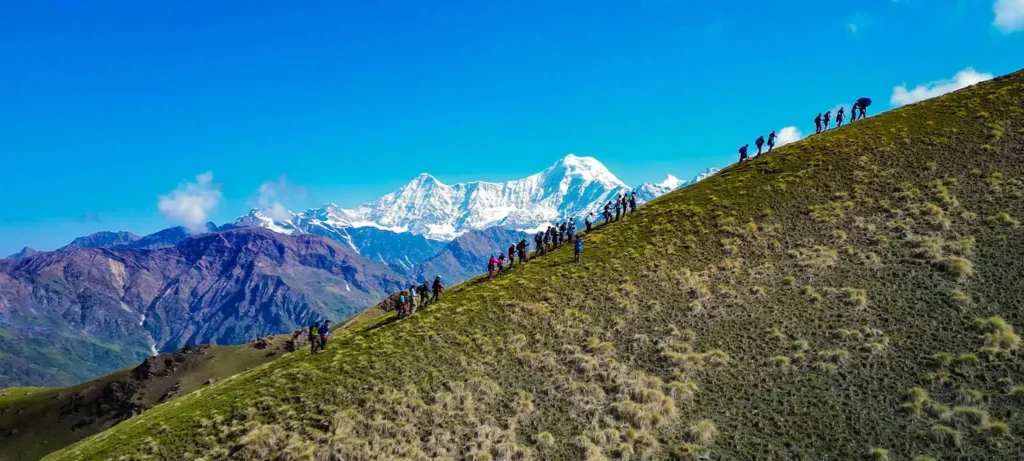
This is the trek’s defining feature. The stretch from Surya Top to Devkund runs for roughly 7 km along an open alpine ridge, with the Gangotri range visible on one side and the Yamunotri range on the other for nearly the entire walk. Ridge walks of this length and this consistently panoramic are genuinely uncommon in Indian trekking — most routes give you a summit view and then descend back into forest or a valley. Surya Top gives you the view for hours, not minutes.
What makes it work as a walk rather than just a viewpoint is the terrain itself — undulating rather than flat, so the angle to each range shifts gradually as you move, and neither skyline ever quite repeats itself from one stretch to the next. Trekkers who’ve done both a standard summit trek and this ridge walk consistently point to the difference: a summit gives you one view and then it’s over; a ridge like this gives you a changing sequence of views across several hours, which tends to be the part people remember most clearly once they’re home.
- 02
Devkund Campsite
Camping with the Bandarpoonch massif directly ahead of you, close enough that it dominates the entire view rather than sitting distantly on the horizon, is the kind of campsite that photographs don’t fully capture until you’ve actually stood there at dawn watching the first light hit the snow.
Devkund itself sits in a natural bowl below the ridge, sheltered enough to be noticeably calmer than the exposed ridge campsite the night before — a welcome contrast after a full day on open terrain. It’s also, practically speaking, one of the more comfortable overnight stops on the trek: more level ground for tents, closer proximity to water, and a clear line of sight to the peak that most trekkers specifically remember from this route.
- 03
Genuinely Offbeat
Dayara Bugyal gets meaningful trekking traffic, especially in peak season. Surya Top does not — the extra distance, altitude, and the fact that most operators don’t run it at all keeps this trail quiet even during peak Dayara season. If crowded trekking routes are specifically what you’re trying to avoid, this is one of the more reliable ways to do that in the Uttarkashi region.
- 04
A 360-Degree Summit
From the top itself, the peaks in view read like a checklist of Garhwal’s biggest names: Bhagirathi I & II, Mt. Meru, Thalay Sagar, Kedardome, Bandarpoonch I & II, and Kalanag, with the Dayara meadow visible far below you on the descent side. Few moderate-grade treks in the region offer this many named 6,000m+ peaks from a single vantage point.
- 05
A Natural Progression from Dayara Bugyal
If you’ve already trekked Dayara Bugyal and want to go further into the same landscape without switching regions entirely, Surya Top is the logical next trek — same base area, same starting forests, but with two extra days, a genuine summit, and a ridge walk Dayara’s standard itinerary doesn’t include.
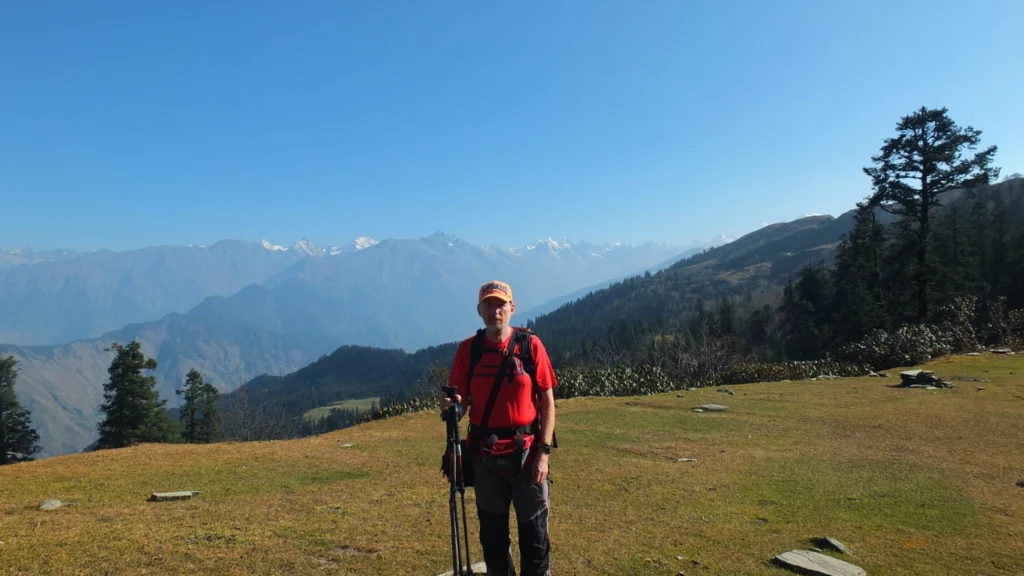
Days 2 and 3 run almost entirely under oak and rhododendron cover.
Days 2 and 3 run almost entirely under oak and rhododendron cover.
- Detailed Itinerary Day by Day
Surya Top Trek Itinerary — Day by Day
1
DAY
- Dehradun to Barsu Village
- Drive Distance: 165 km
- Drive Duration: 7–8 hours
- Altitude: 2,740 m
Pickup from near Dehradun railway station, early morning. The drive runs through the Yamuna valley, passing Mussoorie, Barkot, and Uttarkashi before reaching Barsu — a Garhwali village that serves as the base camp for both this trek and the standard Dayara Bugyal route. Barsu has a warmer, more lived-in feel than a typical trekking base — terraced fields, working farms, and genuine village life rather than a settlement built around tourism. Overnight in a guesthouse, triple-sharing.
2
DAY
- Barsu to Dayara Bugyal
- Trek Distance: 7 km
- Duration: 4–5 hours
- Altitude Gain: 2,740 m → 3,408 m
The trail climbs out of Barsu through dense oak and rhododendron forest, gaining altitude steadily rather than steeply, before opening into the Dayara meadow — the same 28 sq km bugyal that anchors our standalone Dayara Bugyal trek. If you’ve read up on that trek already, this section of trail will feel familiar; if this is your first time hearing about Dayara, it’s worth knowing you’re walking through one of Uttarakhand’s largest and most photographed alpine meadows on your way to somewhere most trekkers never see.
The forest itself changes character as you climb — dense and shaded near the village, gradually opening into taller, more widely spaced oak as you gain elevation, with rhododendron thickening again closer to the treeline. Most groups reach the meadow edge by early-to-mid afternoon, with enough daylight left to walk further into the open grassland before making camp. Camping directly on the meadow, with the Bandarpoonch and Gangotri skyline as your evening backdrop, is generally the point where trekkers doing this route for the first time start to understand why Dayara alone draws so much trekking traffic — and also why continuing past it, rather than stopping here, is worth the extra two days.
3
DAY
- Dayara Bugyal to Surya Top
- Trek Distance: 8 km
- Duration: 5–6 hours
- Altitude Gain: 3,408 m → 3,930 m
This is where the Surya Top trek diverges from the standard Dayara itinerary and starts to earn its “Moderate” grading. The trail leaves the main meadow and climbs onto the ridge system that leads to Surya Top itself, with the gradient noticeably steeper and more sustained than anything on Day 2. As you gain altitude, the panorama opens in a way that’s hard to describe accurately without sounding like marketing copy — but multiple named 6,000m+ peaks becoming visible in a single sweep, with clouds occasionally drifting below the ridgeline rather than above it, is a genuinely different kind of view than a standard meadow trek offers. Camp near the Surya Top ridge.
4
DAY
- Surya Top Ridge Walk to Devkund
- Trek Distance: 7 km
- Duration: 4–5 hours
The signature day of the trek. Rather than climbing to a summit and descending the same way, you traverse — walking the ridge itself for several kilometres with the Gangotri range (Bhagirathi I & II, Mt. Meru, Thalay Sagar, Kedardome) on one side and the Yamunotri range (Bandarpoonch I & II, Kalanag) on the other, essentially the entire time. It’s alpine terrain rather than forest — exposed, open, and genuinely one of the more memorable single days you’ll find on a moderate-grade Himalayan trek. The descent into Devkund brings you to a campsite with the full Bandarpoonch massif dominating the skyline directly ahead.
5
DAY
- Devkund to Dayara Bugyal to Barsu
- Trek Distance: 10 km
- Duration: 5–6 hours
The return journey, retracing the route back through Dayara Bugyal and down through the forest to Barsu. It’s the longest single trekking day by distance, but almost entirely downhill or gently graded, which makes it more manageable than the distance alone suggests. Overnight back in the Barsu guesthouse — a hot shower and a proper bed after four nights of camping tends to be genuinely appreciated at this point in the trek.
6
DAY
- Barsu to Dehradun
- Drive Distance: 165 km
- Drive Duration: 7–8 hours
Return drive via Uttarkashi, Barkot, and Mussoorie, arriving back in Dehradun by early evening. As with any Himalayan trek, plan onward travel — especially flights — for after 8-9 PM this day, or the following morning, to leave a buffer for road delays.
- Difficulty
Surya Top Trek Difficulty — What "Moderate" Actually Means Here
Is the Surya Top trek difficult? It’s graded Moderate — noticeably harder than a standard meadow trek like Dayara Bugyal, but well within reach of a reasonably fit trekker who’s done at least one Himalayan trek before.
Where the difficulty actually comes from
The first two days (Barsu to Dayara Bugyal) are close to Dayara’s own easy-moderate profile — steady forest climbing, nothing technical. The difficulty steps up sharply on Day 3, when the trail leaves the meadow and climbs onto the ridge system toward Surya Top itself — a sustained, steeper ascent that gains over 500 metres in a single day. Day 4’s ridge walk to Devkund isn’t steep in the way Day 3 is, but it’s long, exposed, and demands sustained effort across 7 km of alpine terrain with no real flat sections to recover on.
Total elevation gain
Across the trek, you gain roughly 1,900 metres cumulatively, topping out at 3,930 m on Day 3 — noticeably higher than Dayara Bugyal’s 3,408 m ceiling, and high enough that altitude should be taken seriously even though it’s still well below the range where altitude illness becomes a major concern on most Himalayan treks.
AMS and altitude considerations
At 3,930 m, mild AMS symptoms (headache, fatigue, reduced appetite) are more likely than on Dayara Bugyal, though still generally manageable with proper pacing. Our itinerary builds in a gradual two-day ascent through Dayara before the steeper Day 3 push, which is deliberate acclimatization built into the route rather than an accident of geography. As with all our treks, guides carry oxygen and monitoring equipment and are trained to recognise early symptoms.
Fitness benchmark
Given the longer ridge day and the steeper summit push, we’d recommend a higher baseline than Dayara Bugyal: comfortably walking 8-10 km on varied terrain, or jogging 5 km in under 35 minutes, in the weeks leading up to the trek. If you’ve done one moderate Himalayan trek before and finished it without significant difficulty, you’re likely at the right fitness level for this one.
Who this trek suits
- Trekkers who've completed at least one Himalayan trek before and want the next step up
- Anyone specifically seeking a long ridge walk rather than a single summit-and-descend day
- Trekkers who prioritise quiet, low-traffic trails over well-known routes
Who might find it harder than expected
- Complete first-time trekkers — Dayara Bugyal or Nag Tibba are better starting points
- Anyone uncomfortable with sustained exposure on an open ridge (there's no technical exposure requiring gear, but psychologically it's a different experience than forest trekking)
- Trekkers expecting Dayara Bugyal's gentler pace — this route is a genuine step up, not a minor variation
A Simple Training Plan
If you have four to six weeks before your batch date and want to arrive properly prepared rather than just adequately fit, here’s a straightforward build-up: in weeks one and two, aim for three sessions a week of brisk walking or light jogging, working up to 5 km comfortably. In weeks three and four, add one weekly session on stairs or an incline — even a stairwell repeated for 20-30 minutes builds the specific leg strength Day 3’s climb demands more than flat-ground cardio alone. In the final one to two weeks before departure, taper down rather than pushing harder — a rested body handles altitude and sustained effort better than a fatigued one, even if that fatigue came from good training.
If you already trek regularly, this timeline compresses considerably — a couple of weekend hikes with some elevation gain in the month before departure is usually enough of a top-up.
- Season by Season
Best Time for the Surya Top Trek — Season by Season
When is the best time for the Surya Top trek? April to June is the primary window, with October-November as a strong secondary option — outside of these, the route is either dangerous (monsoon) or closed by snow (winter).
Spring / Summer
- April–June
Day temperature
18–22°C
Night temperature
2°C to -8°C
Layers
3
This is the recommended window for the trek, and for good reason: rhododendrons bloom through the forest sections in April-May, the Dayara meadow is at its greenest, and — most importantly for this particular trek — the ridge walk to Devkund gets its clearest, most reliable visibility of the year. If the ridge walk is the reason you’re doing this trek (and for most people, it is), this is when to book it.
- Good
Post-Monsoon (October–November)
Golden meadows, crisp air, and exceptional visibility of both the Gangotri and Yamunotri ranges from the ridge — arguably competitive with the spring window for pure viewing conditions, with the trade-off of colder overnight temperatures and a shorter daylight window for the longer trekking days.
- Avoid
Monsoon (July–August)
Heavy rainfall makes the ridge trail genuinely slippery and reduces visibility on the one section of the trek — the ridge walk — that the entire route is built around. We don’t run batches during this window, and we’d recommend against attempting it independently either.
- Closed
Winter (December–March)
Heavy snow blocks access to both Dayara Bugyal and the Surya Top ridge during these months. Unlike Dayara Bugyal, which we run as a dedicated winter/skiing trek, Surya Top’s higher altitude and exposed ridge make it genuinely inaccessible rather than just harder in winter — we don’t operate batches in this window, and this isn’t a trek to attempt independently during it either.
- Getting There
How to Reach Surya Top Trek Base Camp from Dehradun
How do I get to the Surya Top trek base camp? Barsu village is roughly 165 km from Dehradun — a 7-8 hour drive via Mussoorie, Barkot, and Uttarkashi — with pickup and drop included in every Mountainiax package.
Getting to Dehradun
By Air
Jolly Grant Airport (DED), connected to Delhi, Mumbai, and other major cities.
By Train
Dehradun railway station, with direct connections from Delhi and other major cities — pickup for this trek is arranged from near the railway station itself, which makes an overnight train a genuinely convenient option.
By Road
Regular Volvo and overnight buses from Delhi, roughly 6-7 hours.
Plan to arrive in Dehradun the evening before Day 1 — early-morning pickup leaves no buffer for delayed flights or trains arriving the same day.
The Drive to Barsu
The route runs through the Yamuna valley via Mussoorie, Barkot, and Uttarkashi — largely the same corridor as the Dayara Bugyal drive, since Barsu and Raithal (Dayara’s base village) sit close to each other in the same trailhead area. Roads are well-paved for most of the drive, with the usual mountain-road stops for chai along the way.
If You're Arranging Your Own Travel to Barsu
Some trekkers prefer reaching the base village independently rather than joining group transport, particularly if they’re coming from Uttarkashi or a nearby town already. The practical route is Dehradun to Uttarkashi by bus (roughly 6 hours), followed by a shared jeep or taxi from Uttarkashi to Barsu (about 1-1.5 hours). As with any independent connection in this region, don’t leave the second leg too late in the day — shared vehicles from Uttarkashi’s taxi stand thin out by early evening.
Returning to Dehradun
As with any Himalayan trek on this kind of road network, avoid booking same-evening onward travel on Day 6 — build in a buffer for the return drive. Given this trek’s longer duration and more remote final two days, we’d suggest an even more generous buffer than you might plan for a shorter trek — a full extra day in Dehradun before an international flight, for instance, rather than cutting it close.
- On The Trail
Camping and Trek Experience on the Surya Top Trek
What is camping like on the Surya Top trek? Triple-sharing tents with quality sleeping bags and mats through the trek, plus triple-sharing guesthouse accommodation in Barsu on the first and last nights — a setup built for the group-oriented batches this trek typically runs.
Accommodation
In Barsu, you’re in guesthouse rooms, triple-sharing, on Day 1 and Day 5. On the trek itself — Dayara Bugyal, near Surya Top, and Devkund — you’re in triple-sharing tents with sleeping bags, mats, and proper kitchen and toilet tents set up at each site by our support team.
Meals
All meals are vegetarian, prepared fresh by our cook and support staff, running from dinner on Day 1 through breakfast on Day 6.
Toilets
Dedicated toilet tents at every campsite — the standard pit-and-cover system used across Himalayan trekking, kept clean by the support team throughout your stay at each site.
Water
Natural water sources near each campsite, supplemented by what you carry during trekking hours. As with any high-altitude trek, we’d recommend carrying purification tablets as backup even though refill points exist along most of the route.
Electricity and Mobile Network
Barsu has electricity and Jio/Airtel mobile coverage — your last point for both before the trek starts. Once on the trail, there’s no electricity and no mobile network at all until you’re back in Barsu on Day 5. Charge everything and send any last messages before Day 2.
A Practical Note on the Triple-Sharing Format
This trek runs on triple-sharing accommodation throughout — both in the Barsu guesthouse and in tents on the trail — rather than the twin-sharing setup you might be used to from other treks. If you’re travelling with two friends or family members, this works naturally. If you’re a solo trekker or in a pair, you’ll be grouped with another trekker from the batch; our team makes an effort to group compatible trekkers together where batch composition allows, though this can’t always be guaranteed given real-world group sizes.
Support on the Trail
Porter and mule support for camping equipment is included in the package, and personal luggage offloading is available on request at ₹500/day (one soft bag per person, maximum 12 kg) — worth arranging in advance if you’d rather not carry your own pack on the longer trekking days.
- Safety
Safety on the Surya Top Trek
Is the Surya Top trek safe? Yes, when done with proper acclimatization and an experienced guide — the higher altitude and longer ridge day mean it demands more respect than a beginner trek like Dayara Bugyal, but it’s a well-established route for reasonably fit, moderately experienced trekkers.
Our Safety Setup
Certified guides with 8+ years of specific experience on this route lead every batch, alongside standard first-aid equipment and oxygen support carried on the trek. The route’s remoteness — genuinely quiet even in peak Dayara season — means self-sufficiency matters more here than on higher-traffic routes, which is exactly why we don’t compromise on guide experience for this particular trek.
Altitude-Related Risks
At 3,930 m, mild-to-moderate AMS symptoms are more of a real possibility than on Dayara Bugyal’s 3,408 m ceiling. Our itinerary’s gradual two-day approach through Dayara before the steeper Day 3 climb is built specifically to manage this. Disclose any relevant medical history before the trek — it changes our monitoring, not your ability to join.
Emergency Evacuation
Given the more remote nature of this route compared to Dayara Bugyal, evacuation from the Surya Top ridge or Devkund campsite genuinely takes longer — plan on this being a more serious undertaking than a similar situation on a higher-traffic trek. From the ridge or Devkund, the fastest route back typically means retracing the trail through Dayara Bugyal to Barsu, which can take the better part of a day depending on the exact location and the trekker’s condition. This is part of why guide experience and proper pre-trek health disclosure matter more here than on a shorter, higher-traffic trek.
Nearest Medical Facilities
Uttarkashi District Hospital is the nearest facility, roughly on the route back toward Dehradun. For anything beyond what our on-trek first-aid setup can manage, Dehradun (7-8 hours away) is the nearest major hospital hub.
What We Ask of You
As with all our treks, tell us honestly about any pre-existing conditions — heart issues, asthma, previous altitude sickness, joint problems — before you arrive. Given this route’s higher altitude ceiling and longer, more remote final two days, this disclosure matters even more here than on a beginner trek like Dayara Bugyal. It changes nothing about whether you can join; it changes how closely your guide watches you and how the team plans around you specifically.
- Packing
What to Pack for the Surya Top Trek
What should I carry on the Surya Top trek? Beyond a standard Himalayan trekking kit, this route’s ridge day and higher altitude call for slightly heavier warm layers and a genuine daypack for the summit push.
Footwear and Clothing
- Trekking jacket
- Warm layers (more than you'd bring for Dayara Bugyal — nights on the ridge drop close to -8°C even in the best season)
- Two trek pants
- Full-sleeve dry-fit t-shirts
- One pair of thermals
Basic Gear
- Backpack (with a separate daypack for the summit/ridge day)
- Trekking shoes, broken in beforehand
- Trekking pole
- LED torch
- One 1-litre water bottle
- Lunch box
- Basic or prescribed medications
Accessories
- Sunglasses (UV protection matters more at 3,930m than at Dayara's lower altitude)
- Sunscreen, SPF 50/70
- Lip balm, SPF 30
- Synthetic hand gloves
- Woolen cap
- Three pairs of socks
- Raincoat or poncho — genuinely essential, not optional
Documents & Other Essentials
- Daypack specifically for the summit/ridge day
- Plastic cover for wet clothes
- Original plus photocopy of a government photo ID (Passport, Aadhaar, Driving License, or Voter ID)
Why This Kit Differs from Dayara Bugyal's
If you’ve read our Dayara Bugyal packing list, you’ll notice this one leans slightly heavier on warm layers and adds a dedicated daypack — both are direct responses to the higher summit altitude and the longer, more exposed ridge day this trek includes.
Gear Worth Renting Rather Than Buying
If this isn’t your first Himalayan trek, you may already own most of this kit. If it is, or if you’re missing a couple of specific items, a good insulated jacket and trekking poles are usually the two most worth renting rather than buying — particularly if you’re not planning multiple treks a year. We can point you to reliable rental options in Dehradun if you let us know what you need before your batch date.
What Not to Overpack
Given the longer ridge day and the offloading option available for camping gear, keep your personal daypack genuinely light — this is the one day on the trek where every extra kilogram is noticeable, since you’re carrying it yourself across sustained, exposed terrain rather than a shaded forest trail. Pack for the day’s conditions specifically (water, snacks, an extra layer, your camera) rather than everything you might conceivably want.
- Photography
Photography on the Surya Top Trek
If Dayara Bugyal photography is about the scale of a single open meadow, Surya Top photography is about sequence — the ridge walk gives you a genuinely different composition every few hundred metres, with the angle to the Gangotri and Yamunotri ranges shifting continuously as you traverse. Golden hour on Day 3, from the Surya Top ridge itself, is the single most photographed moment on this trek among our past trekkers, largely because the light catches both mountain ranges simultaneously from that vantage point in a way few other spots along the route allow.
Devkund campsite is the other standout — waking up with the Bandarpoonch massif filling the frame directly ahead, close enough that a standard lens captures the whole scene without needing to stitch a panorama. If you’re serious about photography on this trek, plan to be up and outside your tent before sunrise on Day 4; the transition from pre-dawn blue light to full sun on the massif happens faster than you’d expect, and it’s not a moment you get a second take on.
- Nature
Flora, Fauna and the Route's Ecosystem
The forest sections out of Barsu — oak, rhododendron, maple, and cedar — are ecologically continuous with the same forest belt that surrounds Dayara Bugyal, and you’ll likely encounter similar wildlife signs: Himalayan Monal calls in the early morning, langurs moving through the canopy on the lower sections, occasional vultures riding thermals above the ridge on Day 3 and 4. Above the treeline, the alpine ridge system supports a sparser but genuinely resilient ecosystem — hardy alpine grasses and, depending on season, wildflowers scattered across the more sheltered stretches of the ridge.
The ridge itself sits high enough and far enough from any village that it sees very little grazing pressure compared to the Dayara meadow below — one of the quieter reasons this route feels as untouched as it does. Trekkers who’ve spent time on both sections often mention the shift in character: Dayara feels like a living, working landscape with visible shepherd trails and grazing livestock in season, while the Surya Top ridge feels considerably more remote and self-contained, closer to true high-alpine terrain than pastureland.
Trekking Responsibly on an Offbeat Route
Precisely because this trail sees so little traffic compared to Dayara Bugyal, it’s also more sensitive to damage — a route with a handful of batches a season doesn’t have the same resilience to off-trail erosion that a heavily walked path does. We ask every trekker to stay on the marked trail through the ridge sections specifically, carry out all waste, and avoid disturbing the alpine grass cover, which is slower to recover at this altitude than the lower meadow vegetation at Dayara.
- Comparison
Surya Top vs Dayara Bugyal — Which Should You Choose?
If you’re deciding between the two, here’s the honest comparison rather than a push toward the pricier or longer option.
Choose Dayara Bugyal if
This is your first Himalayan trek, you’re bringing children, you want a trek that works reliably across three seasons including winter, or you’d rather have a gentler, more predictable week.
Choose Surya Top if
You’ve already done at least one moderate Himalayan trek, you specifically want a long ridge walk and a genuine summit, you’re comfortable with a higher altitude ceiling (3,930m vs 3,408m), or you want a noticeably quieter trail than Dayara’s peak-season traffic.
A third option
If you’re not sure which fits, several of our repeat trekkers do Dayara Bugyal first — often as a family or beginner trip — and come back for Surya Top on a second visit once they know what Himalayan trekking involves and want more of it. There’s no wrong order, but that sequence tends to work well if you’re genuinely unsure.
What Trekkers Who've Done Both Usually Say
The comparison that comes up most often isn’t about difficulty — it’s about pace. Dayara Bugyal, even at its most scenic, is a trek people describe as relaxed: forest walks, a big open meadow, evenings around camp with plenty of downtime. Surya Top gets described differently — more purposeful, more sustained effort day to day, and a stronger sense of actually going somewhere rather than arriving and settling in. Neither is better; they’re built for different moods as much as different fitness levels. If you’re choosing based on how you want the week to feel rather than just the numbers, that distinction is probably more useful than the altitude figures on their own.
For more on the shorter, beginner-oriented version of this landscape, see our full Dayara Bugyal Trek page.
- Logistics
Permits and Trek Logistics
Do I need a permit for the Surya Top trek? Yes — like Dayara Bugyal, the route passes through forest department land, and permits are mandatory. Forest entry charges for Indian nationals are included in your package; our team handles the paperwork, you just need to carry valid ID.
Group Composition
Batches run up to 20 trekkers, supported by certified guides, a cook, and support staff, with porter and mule support for camping equipment included in your package. Given the more remote nature of this route compared to Dayara Bugyal, our guides carry more specific, route-tested experience here — most have 8+ years specifically on this trail rather than general Himalayan trekking experience.
Network and Connectivity Planning
Because there’s no mobile network at all between Barsu and your return on Day 5, let anyone who needs to reach you know in advance that you’ll be unreachable for roughly four days. This is worth mentioning specifically for this trek, since its longer duration and more remote character make the communication gap longer than most of our other departures.
What You Need to Carry
Original plus a photocopy of a government-issued photo ID — Passport, Aadhaar, Driving License, or Voter ID. Checkpoint staff typically want to see the original directly, so don’t rely on the photocopy alone.
Pre-Trek Registration
As with all our treks, you’ll receive a short pre-trek form after booking covering medical history, emergency contacts, and any specific concerns. Given this route’s higher altitude and longer ridge day compared to a beginner trek, we’d ask you to be particularly thorough here — it directly shapes how closely your guide monitors you on Day 3 and Day 4 specifically.
- Important
Cancellation & Refund Policy
Cancellation Policy
We understand that plans can change. If you need to cancel, reduce, or amend a guaranteed reservation, please do so by 12 noon, 15 days prior to arrival to avoid cancellation charges. Any cancellation made within 15 days of arrival will be 100% non-refundable.
No cancellations will be accepted over the phone or via WhatsApp message. Please reply to the email confirmation you received at the time of booking to request a cancellation.
No refunds will be provided in case of problems arising due to government orders, harsh weather conditions, protests, landslides, or other unforeseen circumstances. If a trek is called off at the last moment due to natural calamities, participants will be provided with a travel voucher for the same amount, valid within 365 days for any package of equal value.
Refund Policy
| Cancellation Timing | Refund |
|---|---|
| Up to 21 days prior to departure | 70% refund |
| Between 21 to 14 days prior | 50% refund |
| Between 14 to 10 days prior | 30% refund |
| Less than 10 days of departure | No refund (can transfer trek to someone else) |
Note: Refunds are subjected to deductions for any expenses incurred for hotel booking or transport. Refunds are applicable on the total cost and not on the advance amount.
- Cost and Inclusions
Surya Top Trek Package — Inclusions and Exclusions
Our Surya Top (Dayara Bugyal) trek package is all-inclusive for the full 6 days / 5 nights — call or message us for current batch pricing.
Enquire About Surya Top Trek PriceWhat's Included
- Transport support, Dehradun to Dehradun
- All vegetarian meals, dinner on Day 1 through breakfast on Day 6
- Guesthouse accommodation in Barsu, triple-sharing, for the first and last night
- Triple-sharing tent accommodation throughout the trek
- Experienced guide, cook, and support staff
- Camping equipment — sleeping bags, mats, quality tents, kitchen and toilet tents
- Forest entry charges for Indian nationals
- Porter and mule support to carry camping equipment
- All applicable taxes
What's Not Included
- Personal expenses — tips, personal medicines, phone calls
- Any transport beyond what's listed above
- Anything not explicitly mentioned in the inclusions
- Accommodation in Dehradun or Rishikesh before or after the trek
- Costs from unforeseen incidents — bad weather, medical evacuation, road blocks
- Porter/mule support for personal luggage — available separately at ₹500/day (1 soft bag per person, max 12 kg)
Batch pricing is currently on request — call or WhatsApp us at +91-6398937502 for current dates and rates.
- Why Mountainiax
Trusted by Thousands of Trekkers
- 🏛️
Govt Registered Company
Fully registered travel operator with valid GSTIN and all required tourism licenses. Your money is safe with us.
- 🧭
Certified & Experienced Guides
Our trek coordinators and guides have 8+ years of experience on the Surya Top Trek route. They know every turn, every campsite.
- ⭐
4.9★ on Google & TripAdvisor
Trusted by 1000+ trekkers across 100+ successful Surya Top Trek batches. Consistently rated best-in-class for safety and experience.
- 🕐
On-Time Operations
Punctual pickups, pre-booked guesthouses, and well-planned itineraries. No last-minute surprises or hidden costs.
- 📞
24/7 Support During Trek
Dedicated trip coordinator with you throughout. 24-hour call assistance for any emergency or query during the trek.
- 👨👩👧
Beginner & Group Friendly
Perfect first Himalayan trek. We manage solo trekkers, groups, corporate teams, and college trips with equal expertise.
- Nearby
Places to See Before or After Your Surya Top Trek
Since this trek runs through the same corridor as our Dayara Bugyal route, the same pre- or post-trek stops apply if you’re building in a buffer day:
Mussoorie
on the drive up, worth a half-day stop for Mall Road and the Kempty Falls detour if you have time to spare
Rishikesh
about 45 minutes from Dehradun, a natural contrast destination if you want a day of river and cafe culture before or after five days in the mountains
Uttarkashi
the largest town on the route, with the Vishwanath Temple and your last reliable ATM and shopping before Barsu
Dehradun itself
Robber’s Cave is an easy half-day activity if you’re arriving a day early and want something low-effort before the trek begins
- Feedback
What Trekkers Say About This Route
Because this trek runs in far smaller numbers than Dayara Bugyal, the feedback we get tends to be more specific and less generic than typical trek reviews — people talk about the exact moment the ridge opened up, or a particular stretch of the Day 4 walk, rather than broad impressions. That specificity is, in its own way, a signal about the trek itself: routes that blur together in people’s memory don’t usually generate that kind of detail.
We’d rather you read verified reviews directly than take our word for it — our Google Business Profile and TripAdvisor listing, both linked in the site footer, reflect real, dated trekker feedback specific to this route rather than a static number on a page.
- Visual Journey
Surya Top Trek Gallery
- More Trails
Other Treks You Might Like
You can browse our complete list of departures on the all treks page, or read more trekking guides, packing advice, and destination breakdowns on the Mountainiax blog.
- Answers
Dayara Bugyal Trek FAQs
Common questions about Dayara Bugyal trek package, weather, difficulty, camping, and more. Can’t find your answer? Contact us!
How many days is the Surya Top Trek?
Mountainiax runs it as a 6 Days / 5 Nights itinerary — Day 1 Dehradun to Barsu, Days 2-5 through Dayara Bugyal, Surya Top, and Devkund, Day 6 back to Dehradun.
What is the difficulty level of the Surya Top Trek?
Graded Moderate. The first two days closely resemble Dayara Bugyal’s easy-moderate profile, but Day 3’s climb to the 3,930m summit and Day 4’s long ridge walk to Devkund are noticeably more demanding — better suited to trekkers with some prior Himalayan trekking experience than complete first-timers.
What is the best time to do the Surya Top Trek?
April to June is the best window — clear ridge views and blooming rhododendrons. October-November is a strong second option with crisp post-monsoon visibility. Avoid July-August (monsoon, slippery ridge trail); the route is snowed in and closed December-March.
What is the altitude of Surya Top?
Surya Top stands at 3,930 m (12,900 ft), the highest point on the trek. From the summit and the ridge walk that follows, you get views of the Gangotri range (Bhagirathi I & II, Mt. Meru, Thalay Sagar, Kedardome) and the Yamunotri range (Bandarpoonch I & II, Kalanag).
Where does the Surya Top Trek start?
Barsu village in Uttarkashi district, about 165 km from Dehradun. Some operators route through the neighbouring village of Raithal instead — both sit in the same trailhead area, but Mountainiax’s itinerary departs directly from Barsu.
Is the Surya Top Trek the same as the Dayara Bugyal Trek?
No — Surya Top is an extension of it. It covers the same Dayara meadows on Day 2 but continues past them across a long ridge to the Surya Top summit and Devkund campsite, adding roughly two extra days, over 500m of extra altitude, and a summit climb the standard Dayara Bugyal itinerary doesn’t include.
How do I reach the base camp, and what's the pickup point?
Pickup is from near Dehradun railway station (nearest airport: Jolly Grant). From there it’s a scenic 165 km, 7-8 hour drive via Mussoorie, Barkot, and Uttarkashi to Barsu village.
Is the Surya Top Trek suitable for beginners? How fit do I need to be?
It’s better suited to trekkers with at least one prior Himalayan trek behind them. Given the longer ridge and summit days, we’d recommend being able to walk 8-10 km comfortably, or jog 5 km in under 35 minutes, before attempting it. Complete first-timers are generally better served starting with Dayara Bugyal.
Which peaks are visible from Surya Top?
A 360-degree sweep of the Gangotri range (Bhagirathi I & II, Mt. Meru, Thalay Sagar, Kedardome) and the Yamunotri range (Bandarpoonch I & II, Kalanag), with the Dayara meadow visible below on the descent side.
What's the accommodation like on this trek?
Triple-sharing guesthouse rooms in Barsu on Day 1 and Day 5, and triple-sharing tents with sleeping bags and mats at Dayara Bugyal, near Surya Top, and at Devkund.
Is offloading available for personal luggage?
Yes — porter/mule support for personal bags is available at ₹500/day (one soft bag per person, maximum 12 kg), arranged in advance. Camping equipment offloading is already included in the package.
What's the cancellation and refund policy?
Cancel or amend by 12 noon, 15 days before arrival, to avoid charges. Refunds scale down from 70% (21+ days before departure) to none within 10 days of departure, though the trek can be transferred to someone else in that case. Full details are in the Cancellation & Refund Policy section above.
Still have questions about the Surya Top Trek?
Call us at +91 6398937502 or send us a WhatsApp — we're happy to help you plan.