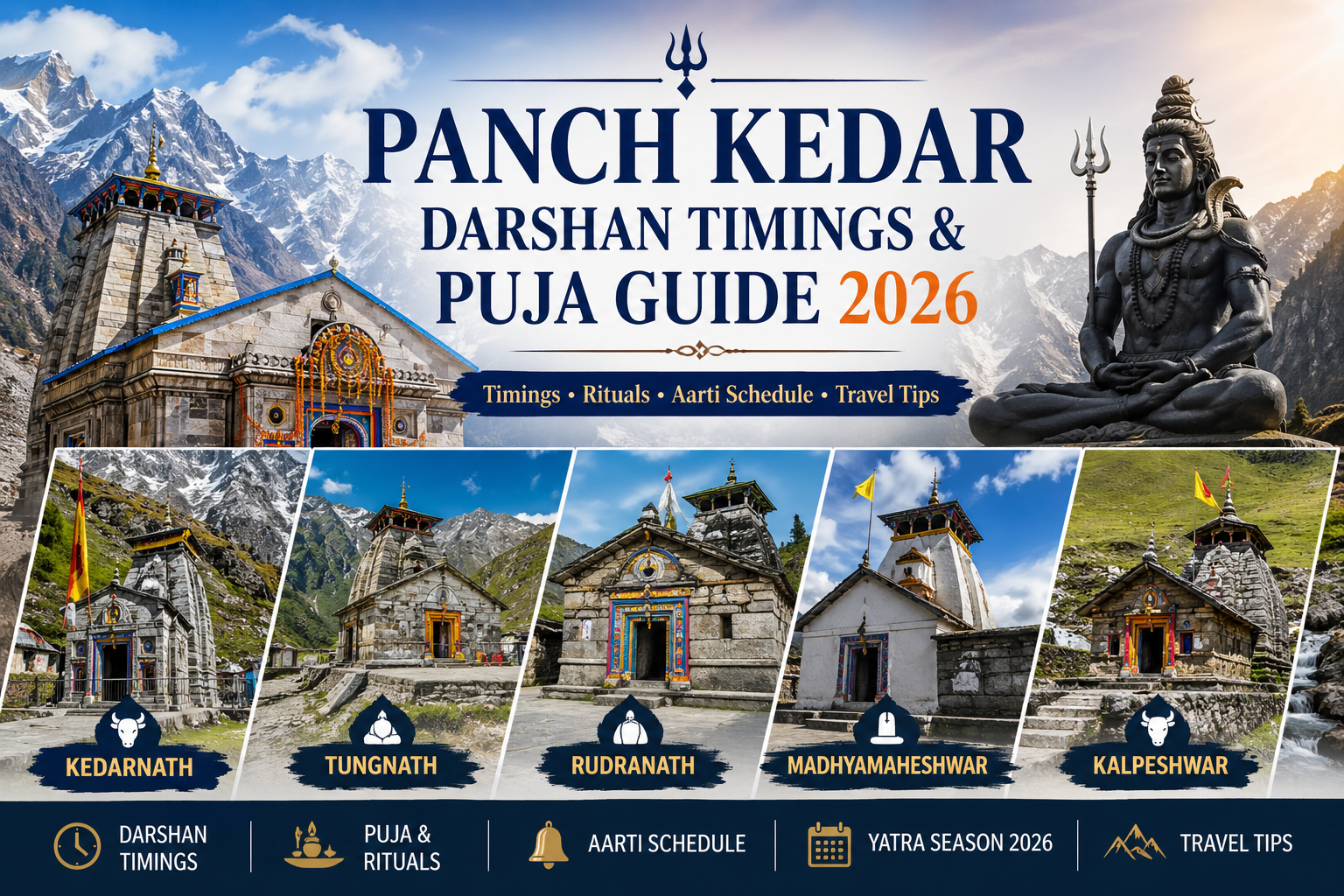
For a Shaivite pilgrim, there are five points in the Garhwal Himalayas where the divine is not metaphor but geography. Five temples that together form the complete cosmic body of Lord Shiva — each shrine enshrining a different part of his divine form across five separate mountain peaks. The Panch Kedar circuit — Kedarnath, Tungnath, Rudranath, Madhyamaheshwar, and Kalpeshwar — is not only one of India’s most demanding pilgrimages. It is one of its most transformative.
The Panch Kedar Darshan Timings & Puja Guide 2026 is written for pilgrims who understand that arriving at a sacred Himalayan temple without knowing when the aarti begins, when the afternoon closure falls, and how to pre-book the puja they want is a preventable frustration — and a missed opportunity. This guide provides temple-specific darshan timings, the complete Kedarnath puja booking process, dress code requirements, photography rules, and offering protocols across all five shrines.
Whether you are visiting Kedarnath for the first time or completing the full Panch Kedar yatra circuit, the information here ensures that you stand before Mahadev fully prepared — at the right hour, in the right spirit, with the right offerings in hand. The mountain rewards readiness. This guide helps you bring it.
The Panch Kedar Temples — A Devotional Overview
The Panch Kedar circuit is rooted in the Mahabharata tradition. After the Kurukshetra war, the Pandavas sought Lord Shiva’s forgiveness for the sin of kin-slaying. Shiva, evading them, took the form of a bull and submerged into the earth at Kedarnath. Different parts of his divine body emerged at different locations, each of which became a temple.
- Kedarnath (3,583m) — the hump of the sacred bull; seat of the primary Jyotirlinga equivalent in the Panch Kedar circuit
- Tungnath (3,680m) — the arms of Shiva; the highest Shiva temple in the world
- Rudranath (2,286m) — the face of Shiva; the most remote and ecologically spectacular of the five
- Madhyamaheshwar (3,497m) — the navel of Shiva; the Shivalinga here is immersed in a natural spring
- Kalpeshwar (2,200m) — the matted hair (jata) of Shiva; the only temple open year-round
Together, these five shrines constitute the complete form of Mahadev distributed across five Himalayan peaks. Completing darshan at all five is understood in the Shaiva tradition to carry the same merit as performing a full abhisheka of the entire cosmic body of Lord Shiva.
Panch Kedar Darshan Timings 2026 — Temple by Temple
The timings listed below are drawn from established seasonal patterns and the expected 2026 schedule. All times are subject to official confirmation by the Badrinath-Kedarnath Temple Committee (BKTC) and local temple management for each shrine. Verify current timings before departure through the official BKTC portal or your yatra operator.
Kedarnath Temple Darshan Timings 2026
| Session | Timings |
| Nirmalya Darshan (Brahma Muhurta) | 4:00 AM – 7:00 AM |
| Morning General Darshan | 7:00 AM – 12:00 PM |
| Afternoon Closure (Puja & Rest) | 12:00 PM – 3:00 PM |
| Afternoon Darshan | 3:00 PM – 5:00 PM |
| Evening Shringar Aarti | 5:00 PM – 8:00 PM |
| Temple Closes | 9:00 PM |
2026 Opening: Akshaya Tritiya (late April / early May — exact date confirmed by BKTC) 2026 Closing: Bhai Dooj following Diwali (typically November)
Tungnath Temple Darshan Timings 2026
| Session | Timings |
| Morning Aarti & Opening | 6:00 AM |
| General Darshan | 6:00 AM – 12:00 PM |
| Afternoon Closure | 12:00 PM – 2:00 PM |
| Afternoon & Evening Darshan | 2:00 PM – 7:00 PM |
| Evening Aarti | 6:30 PM |
| Temple Closes | 7:00 PM |
Tungnath sits at 3,680 metres — the highest Shiva temple in the world. The morning darshan here, with the Chaukhamba and Nanda Devi ranges visible at sunrise, is among the most visually and devotionally powerful in the circuit.
Rudranath Temple Darshan Timings 2026
| Session | Timings |
| Morning Aarti & Darshan Opens | 6:00 AM |
| General Darshan | 6:00 AM – 12:00 PM |
| Afternoon Closure | 12:00 PM – 2:00 PM |
| Evening Darshan | 2:00 PM – 6:30 PM |
| Evening Aarti | 6:00 PM |
| Temple Closes | 6:30 PM |
Rudranath enshrines the face of Lord Shiva and sees considerably fewer pilgrims than Kedarnath. The morning darshan is intimate, unhurried, and — for most pilgrims — deeply moving.
Madhyamaheshwar Temple Darshan Timings 2026
| Session | Timings |
| Morning Aarti & Opening | 5:30 AM |
| General Darshan | 5:30 AM – 12:00 PM |
| Afternoon Closure | 12:00 PM – 2:00 PM |
| Evening Darshan | 2:00 PM – 6:00 PM |
| Evening Aarti | 5:30 PM |
| Temple Closes | 6:00 PM |
The Shivalinga at Madhyamaheshwar is immersed in a continuously flowing natural spring — the abhisheka here is perpetual, making every moment of darshan an act of witnessing the most natural form of Shiva worship.
Kalpeshwar Temple Darshan Timings 2026
| Session | Timings |
| Morning Opening | 6:00 AM |
| General Darshan | 6:00 AM – 1:00 PM |
| Afternoon Closure | 1:00 PM – 2:00 PM |
| Evening Darshan | 2:00 PM – 7:00 PM |
| Evening Aarti | 6:30 PM |
| Temple Closes | 7:00 PM |
Kalpeshwar is accessible year-round and is the only Panch Kedar shrine open during winter. The jata (matted hair) of Shiva is enshrined within a natural cave — the sanctum has an atmosphere of deep, quiet power unlike any of the other four temples.
The mythological thread that connects all five of these shrines is traced by the Pandava Trail — the ancient pilgrimage route believed to have been first walked by the Pandavas themselves in their quest for Shiva’s blessing after Kurukshetra. For pilgrims undertaking the full five-temple circuit today, walking sections of the Pandava Trail is not simply trekking — it is retracing the steps of the greatest act of devotion in the Mahabharata tradition, approaching each darshan with the understanding that these mountains received the feet of Yudhishthira, Bhima, and Arjuna on this same sacred errand.
Brahma Muhurta Aarti at Kedarnath — Why Pilgrims Wake at 4 AM
No ritual experience in the Panch Kedar circuit compares to the Brahma Muhurta aarti at Kedarnath. Known as Nirmalya Darshan, it begins at 4:00 AM and is the first sacred act of the temple’s daily cycle.
In Shaiva tradition, Brahma Muhurta — the period roughly 1 hour and 36 minutes before sunrise — is the most spiritually receptive period of the full 24-hour cycle. The conscious mind is not yet captured by the affairs of the day. The subtle body, according to yogic understanding, is in its most open, permeable state. Divine transmission, in this framework, meets the least resistance.
At Kedarnath, the priests conduct the following sequence during this pre-dawn window:
Nirmalya Removal: The offerings from the previous day — flowers, bilva, and materials from the evening puja — are ceremonially cleared. Witnessing this removal is itself considered a form of darshan of extraordinary merit: you see the deity as he has rested through the night.
Jalabhisheka: Water drawn from the sacred streams of the Mandakini basin is poured over the Shivalinga as the morning’s first abhisheka. Vedic Shiva mantras recited by the officiating priests fill a space that is otherwise completely silent — no street noise, no machinery, only the mountain wind and the lamp flame.
Shringar: The Shivalinga is freshly adorned with flowers, sacred ash, and ceremonial ornaments. In the wavering light of the oil lamps, the deity takes on a presence that pilgrims who have witnessed it describe in terms that photographs simply cannot capture.
Trekkers staying at the Kedarnath base camp rise at 3:30 AM to join the queue. At this hour, in temperatures that can approach zero even in June, wearing every layer they have brought, they file toward the temple in silence. The combination of glacial cold, high-altitude darkness, the sound of the Mandakini river, and the glow of the temple sanctum creates an atmosphere that places this aarti among the most spiritually potent dawn rituals in the Indian pilgrimage tradition.
Do not miss this if you are visiting Kedarnath in 2026. No other experience on the circuit matches it.
The devotional discipline of rising at 4 AM for the Brahma Muhurta aarti echoes the inner logic of the entire Pandava Trail — the understanding that access to the highest experience demands sacrifice of ordinary comfort. The Pandavas’ pilgrimage was an act of surrender. Every pilgrim who steps out into the mountain darkness at 3:30 AM repeats, in their own small way, that same ancient choice.
Kedarnath Puja Booking 2026 — Abhishek, Rudrabhishek and VIP Darshan
The Badrinath-Kedarnath Temple Committee (BKTC) manages all puja bookings at Kedarnath. The primary booking channel for 2026 is the official portal at badrinath-kedarnath.com. The following puja categories are standard — confirm exact 2026 pricing directly on the portal before booking.
Types of Puja Available at Kedarnath
Samanya Abhishek: A standard abhishek of the Shivalinga with water, milk, and bilva leaves. Conducted within the general puja session. Approximate cost in 2026: ₹1,500 – ₹2,500. Suitable for most pilgrims and a complete devotional act in its own right.
Laghu Rudrabhishek: A structured ritual with dedicated mantra recitation and multiple offering materials, including panchamrita. A dedicated priest conducts the puja for a single pilgrim or a small group. Approximate cost: ₹3,000 – ₹5,500.
Maha Rudrabhishek: The most complete puja available at Kedarnath — a full Vedic mantra recitation sequence, extended abhishek with multiple sacred materials, and a duration that allows for a genuinely immersive ritual experience. This requires booking and is best planned for non-peak days. Approximate cost: ₹7,000 – ₹15,000. Verify the current rate structure on the BKTC portal.
VIP / Priority Darshan For pilgrims seeking a direct, queue-free darshan experience. Bookable through the official BKTC system. Approximate cost: ₹3,000. Recommended for elderly pilgrims, those with limited mobility, or anyone whose schedule cannot accommodate the general queue on peak days.
Online vs Offline Puja Booking
Online Booking (Strongly Recommended for 2026) Visit badrinath-kedarnath.com. Register with a valid Aadhar card, select your puja category, choose your date and session, and complete payment. A booking confirmation is issued — present it at the temple counter on arrival. During peak season (May–June and September), popular slots fill 3–4 weeks in advance. Book early.
Offline Booking Available at BKTC counters at Kedarnath, Gaurikund, and Sonprayag. Same-day slots may be available early in the morning outside peak season. During peak pilgrimage months, offline availability is extremely limited and unreliable.
Important: Puja booking for Tungnath, Rudranath, Madhyamaheshwar, and Kalpeshwar is managed directly by hereditary local priests on-site. There is no centralised booking system for these four temples. Arrive at the appropriate time (early morning for best access), carry appropriate dakshina, and engage the presiding pujari directly.
What to Offer at Each Panch Kedar Temple
Each of the five shrines carries a traditional offering most sacred to the form of Shiva enshrined there. Bringing the correct offering demonstrates devotional knowledge and is received warmly by the local priests.
- Kedarnath: Bilva leaves (bel patra), raw milk, Mandakini river water, ghee, and white flowers. A ghee diya that burns through the night is considered especially meritorious. The three-lobed bilva is Shiva’s most beloved offering across all traditions — carry dried leaves if fresh ones are unavailable at altitude.
- Tungnath: Bilva leaves, wild flowers gathered from the surrounding bugyals (alpine meadows) where permitted, water, jaggery (gur), and incense. Dhatura — the wild thorn-apple that grows near Tungnath — is traditionally offered to Shiva and is accepted here.
- Rudranath: The face of Shiva is associated with blessings of speech, wisdom, and the removal of deep-seated fear. Sesame seeds (til), bilva, fragrant flowers, and water are the primary offerings. The wildness of the Rudranath setting — alpine meadows, granite ridges, no permanent settlement — gives the offering ritual an intimacy with the undomesticated natural world that no city temple can replicate.
- Madhyamaheshwar: The navel Shivalinga is immersed in a living spring — offerings here dissolve directly into the waters surrounding the deity. Milk, bilva, and water are ideal. The pilgrimage to Madhyamaheshwar is associated with blessings of health, longevity, and the fulfilment of sincere, righteous desire.
- Kalpeshwar: Sesame, bilva, incense, and water poured in the direction of the jata within the cave sanctum. The name Kalpa implies the granting of wishes — pilgrims come here with focused intentions and strong faith in this temple’s capacity to receive and honour sincere prayer.
For families making this pilgrimage together, the offering rituals across all five temples provide a particularly rich way to include younger members in the living practice of Shaiva devotion. Those planning Panch Kedar with Kids will find Kalpeshwar and Tungnath — the most accessible of the five in terms of trail length and altitude — to be the most appropriate entry points for young pilgrims. The tactile, participatory nature of offering rituals — selecting the bilva, pouring the water, watching the flame of the aarti — holds children’s attention and builds devotional instinct through direct experience in a way that no classroom can replicate.
Dress Code and Photography Rules at Panch Kedar Sanctums
At Panch Kedar sanctums, modest traditional attire is expected, ensuring respect for sacred customs. Photography is generally restricted inside temple premises, especially near the garbhagriha, preserving sanctity, privacy, and the spiritual atmosphere of these revered Himalayan shrines.
Dress Code at Each Temple
Traditional attire is expected and respected at all five Panch Kedar shrines.
Men: Dhoti, kurta-pyjama, or simple trousers and a full-sleeved shirt. The upper body is typically covered with a shawl or uttariya during puja and aarti. Shorts, sleeveless shirts, and synthetic sportswear are not acceptable inside the sanctum.
Women: Saree, salwar kameez, or traditional regional dress in sober, non-transparent colours. Many women cover their heads with a dupatta during aarti. Sleeveless garments and short skirts are inappropriate.
Footwear: Removed before entering all sanctum areas without exception across all five temples. The stone floors at high altitude are cold even in summer — bring warm socks.
Photography Rules Inside the Temples
Kedarnath: Photography inside the sanctum is strictly prohibited and actively enforced. Outside the main structure, photography is permitted. Respect this rule without negotiation.
Tungnath, Rudranath, Madhyamaheshwar, Kalpeshwar: Policies vary by temple and may depend on the presiding priest’s discretion. As a general and respectful rule, ask before raising a camera inside any temple. During aarti at all five shrines, put all devices away.
A guiding principle for the entire circuit: prioritise presence over documentation. No image captures the experience of the Brahma Muhurta aarti at Kedarnath — and attempting to photograph it replaces the only thing that makes it extraordinary, which is the quality of attention you bring to it.
For those undertaking Panch Kedar with Kids, the photography rule carries a parallel teaching value. Guiding young pilgrims to observe and experience rather than record is itself a devotional lesson — restraint in the face of beauty as an act of reverence. Children who learn this at the Panch Kedar shrines carry it as an instinct into the rest of their lives.
Auspicious Muhurtas for Darshan at Panch Kedar 2026
Arriving at a sacred temple during an auspicious muhurta amplifies the devotional merit of the darshan. In the Jyotisha framework, this is not superstition — it is alignment of individual intention with the rhythms of time as understood in classical Indian sacred science.
For the 2026 Panch Kedar yatra, the following dates carry particular devotional significance:
- Akshaya Tritiya (Late April 2026): Coincides with the expected opening ceremony of Kedarnath. Darshan on the opening day carries exceptional merit and is among the most auspicious of the entire season.
- Shravan Month (July–August 2026): The month most sacred to Shiva in the Hindu calendar. Darshan during any Monday of Shravan (Shravan Somavar) at any of the five shrines carries multiplied devotional merit.
- Pradosham (Twice Monthly, Trayodashi): Arriving for the evening aarti on the 13th lunar day — the Pradosham window — is considered especially powerful for Shiva worship across all traditions. It falls twice every lunar month.
- Maha Shivratri (February/March 2026): Applicable to Kalpeshwar, the only winter-accessible temple. Shivratri darshan at Kalpeshwar is a rare and profound experience, given the winter silence of the valley.
- Sharad Navaratri (September–October 2026): Many Shaivite pilgrims time the completion of their Panch Kedar circuit to arrive at Kedarnath during this window, combining the energy of the goddess and Shiva seasons in a single yatra.
Consult a reliable Panchang for precise tithi and muhurta windows aligned with your specific travel dates before finalising your 2026 schedule.
Panch Kedar vs Char Dham — Darshan Protocol Differences
For pilgrims approaching the Panch Kedar circuit after completing the Char Dham yatra, understanding the protocol differences helps set accurate and appropriate expectations.
Crowd Scale: The Char Dham temples — including Kedarnath — have developed extensive crowd management infrastructure, including digital queues and BKTC coordination systems. The remaining four Panch Kedar shrines are managed by small hereditary pujari families with traditional, informal protocols. There are no queue tokens, no digital systems, and frequently no other pilgrims at all.
Puja Booking: Kedarnath’s booking is centralised through BKTC. All four other Panch Kedar temples are booked directly with the presiding priest on arrival. This informal access is not a limitation — it is an invitation to a far more direct and personal ritual encounter.
Physical Accessibility: All Char Dham sites are now road-accessible (Kedarnath requires a 22km trail from Gaurikund). The Panch Kedar circuit requires committed trekking: Rudranath and Madhyamaheshwar involve 2–3 day treks from the nearest motorable road; Tungnath, though shorter, reaches the world’s highest Shiva temple altitude; Kalpeshwar alone is easily accessible within a half-day.
Darshan Intimacy: At Rudranath or Madhyamaheshwar, you may be one of only a handful of people in the entire temple complex at the moment of your darshan. This level of intimacy — a one-to-one encounter with the divine in a high-altitude wilderness setting — is vanishingly rare in India’s major pilgrimage landscape and is the defining quality of the Panch Kedar for serious devotees.
The physical contrast between the Char Dham experience and the full Panch Kedar circuit cannot be understated. If you are planning the complete five-temple route in 2026, understanding How To Prepare For The Panch Kedar Trek in advance is not optional — it is the foundation on which the entire yatra rests. The circuit involves over 150 kilometres of mountain trekking across multiple days at elevations between 2,200 metres and 3,700 metres. Building cardiovascular fitness, planning acclimatisation correctly, and selecting equipment appropriate to highly variable Himalayan weather requires months of preparation, not weeks.
Practical Tips for a Devotionally Complete 2026 Panch Kedar Yatra
Register Early: For Kedarnath and the broader Char Dham, Panch Kedar yatra registration is managed through the Uttarakhand government’s tourism portal. Registration is mandatory and includes a health certificate for pilgrims above 60. Begin this process well in advance of your travel window.
Sequence the Circuit Thoughtfully: The traditional sequence — Kedarnath, Madhyamaheshwar, Tungnath, Rudranath, Kalpeshwar — is considered most auspicious. However, logistics and weather windows in 2026 may necessitate adjustments. Consult your yatra operator for the most current route conditions.
Plan for Weather Windows: Afternoon thunderstorms are routine in the Garhwal Himalayas during the monsoon months. Plan all outdoor darshan and trekking for early morning hours. The temples’ afternoon closure slots — typically 12:00 PM to 2:00 PM — align well with the need to shelter from midday weather. Use that window for rest and inner reflection rather than continuing to push on the trail.
Carry Your Own Puja Materials: Bilva leaves, rudraksha mala, camphor, and incense are available at major points along the circuit, but supply is unreliable at the more remote temples. Carry a compact personal puja kit from home to ensure you are never without the essentials at the moment of darshan.
Engage the Local Priests with Respect: The hereditary pujari families of Tungnath, Rudranath, Madhyamaheshwar, and Kalpeshwar are the living custodians of rituals that stretch back centuries. Engage them with gratitude and genuine curiosity. They often share oral traditions, local history, and devotional context that no printed guide can replicate. Offer appropriate dakshina and accept whatever guidance they offer.
For those approaching the trek dimension of this circuit for the first time, ensuring that your physical preparation matches your devotional intention is the most honest form of respect for the mountains. Resources on How To Prepare For The Panch Kedar Trek — covering fitness protocols, altitude acclimatisation, and gear selection — are available through Mountainiax and will save you from the common mistake of arriving at the trailhead underprepared for what the circuit demands.
Frequently Asked Questions
Q1. What time does the Kedarnath aarti start in 2026? The Brahma Muhurta aarti (Nirmalya Darshan) at Kedarnath typically begins at 4:00 AM. General Darshan opens from approximately 7:00 AM. The evening Shringar Aarti is held from 5:00 PM to 8:00 PM. All timings are subject to official confirmation by the BKTC for the 2026 season — check badrinath-kedarnath.com for updates.
Q2. How do I book Rudrabhishek at Kedarnath in 2026? Visit the official BKTC portal at badrinath-kedarnath.com. Register using your Aadhar card details, select your puja type (Samanya Abhishek, Laghu Rudrabhishek, or Maha Rudrabhishek), choose your preferred date and session, and complete payment online. Book at least 3–4 weeks in advance during peak season (May–June and September).
Q3. What is the Tungnath temple timing in 2026? Tungnath typically opens at 6:00 AM and holds its morning aarti at the same hour. There is a midday closure from 12:00 PM to 2:00 PM. The evening aarti is at approximately 6:30 PM, and the temple closes by 7:00 PM. Confirm with local temple management before departure.
Q4. What is the Rudranath darshan time? Rudranath opens at 6:00 AM for morning aarti and general darshan. The midday closure runs from 12:00 PM to 2:00 PM. The evening aarti is at approximately 6:00 PM, and the temple closes by 6:30 PM. Rudranath is the most remote and crowd-free temple in the circuit — morning darshan here is exceptionally intimate.
Q5. Can I complete the full Panch Kedar circuit in one trip? Yes, but it requires 14–18 days of dedicated trekking. The full circuit is best undertaken between May and October. The recommended auspicious sequence is Kedarnath — Madhyamaheshwar — Tungnath — Rudranath — Kalpeshwar, though alternate sequences are also followed based on logistics.
Summary
The Panch Kedar circuit is among the most complete and physically demanding expressions of living Shaiva devotion available to the contemporary pilgrim. It requires preparation at every level — physical, ritual, logistical, and spiritual. Arriving at each of the five shrines informed about the darshan timings, the puja booking process, the offering traditions, and the sanctum protocols is the baseline that separates a meaningful pilgrimage from a confused scramble.
The Panch Kedar Darshan Timings & Puja Guide 2026 presented here gives you exactly that baseline. The darshan timings tables for all five temples — confirmed against the established seasonal schedule and expected 2026 BKTC announcements. The complete Kedarnath puja booking pathway, from Samanya Abhishek to Maha Rudrabhishek. The offering protocols at each unique shrine. The dress code and photography rules keep your conduct aligned with the sanctity of the space.
Verify all timings through the official BKTC portal as your travel date approaches — the mountain calendar is subject to weather, seasonal conditions, and committee decisions. And when you finally stand at 4:00 AM in the dark outside Kedarnath, with the glacial wind coming off the Mandakini and the orange glow of the first oil lamp flickering in the sanctum door, everything this guide gave you will recede — and what the mountain gives will take its place.
With the Panch Kedar Yatra season approaching, it’s time to plan something truly extraordinary. From breathtaking Himalayan peaks to spiritually powerful temples hidden deep in remote valleys, this journey offers an experience that goes beyond a typical trek—it becomes a story you carry for life. To make your journey seamless and well-organised, choose the best trekking company in Uttarakhand for reliable trek packages, detailed itineraries, and hassle-free booking.
Visit this page for Trek Packages, Itinerary & Booking.