Most people who attempt the Panch Kedar trek will tell you the same thing afterwards — they wish they had planned the timing better. Not the fitness, not the gear. The timing. Because this is not a trek where you pick a month, pack your bag, and go. Five sacred Shiva temples, five different altitudes, five individually governed opening dates scattered across the Garhwal Himalayas. Get it wrong, and you could arrive at Rudranath to find a locked shrine, or hit Madhyamaheshwar during a week of solid monsoon rain that no amount of enthusiasm will make enjoyable.
The Best Time for Lord Shiva 5 Temples sits inside two windows — late May through June, and mid-September through October. Everything outside those months demands either experience, flexibility, or a willingness to accept conditions on their own terms. Between the two peaks lies the monsoon. Before them, a winter that holds snow on high passes well into May.
This guide gives you the full picture — confirmed 2026 temple opening and closing dates, a month-by-month weather breakdown from May through November, and honest advice on when to go based on what kind of trekker you are.
What Is Panch Kedar, and Why Does Timing Matter?
Spread across the remote upper valleys of the Garhwal Himalayas, Panch Kedar is one of the most sacred and demanding pilgrimage circuits in all of India. It connects five ancient Shiva temples — Kedarnath, Tungnath, Rudranath, Madhyamaheshwar, and Kalpeshwar — each said to enshrine a different part of Lord Shiva’s divine body that appeared here following the Mahabharata war. Kedarnath holds his hump, Tungnath his arms, Rudranath his face, Madhyamaheshwar his navel, and Kalpeshwar his matted hair.
What makes timing so critical here compared to other treks is the combination of high altitude, extreme seasonal weather, and individually governed temple calendars. Each of the four higher shrines opens on an astronomically determined auspicious date in spring and closes before the first heavy snowfall of winter. Miss a window by even a week, and you may find a sacred site locked, a high-altitude trail buried in fresh snow, or a river crossing dangerously swollen from monsoon runoff. The official trekking season runs from early May through to mid-November, but the quality of experience varies dramatically across those months.
Panch Kedar Temple Opening and Closing Dates 2026
This is the section to bookmark before you plan anything else. The exact opening and closing dates for each temple are announced by the Badrinath–Kedarnath Temple Committee (BKTC) after the Mahashivratri puja each year, so the figures below are confirmed or expected based on official 2026 announcements. Always cross-check with the BKTC website or your trek operator in the weeks before departure, as dates can shift by a day or two depending on the Hindu calendar.
Kedarnath, at 3,583 metres, is the anchor of the circuit and typically opens on or around 5 May 2026, with closing expected on Bhai Dooj in mid-November — around 19 November 2026. Tungnath, at 3,680 metres, the world’s highest Shiva temple, follows closely with an expected opening around 10 May 2026 and closing around 14 November 2026. Rudranath, the most remote of the five at 3,600 metres, usually opens a week or two later — around 20 May 2026 — and closes in early November, around 3 November 2026. Madhyamaheshwar, at 3,497 metres above the Kedarnath massif, typically opens around 25 May 2026 and closes around 8 November 2026. Kalpeshwar, the lowest of the five at 2,200 metres in the Urgam Valley, is the sole exception to seasonal closures — it remains open throughout the year.
These dates define the outer boundaries of your planning window. For a full circuit covering all five shrines, the practical trekking season is late May through to late October, with the widest window of ideal conditions concentrated in two distinct peaks: late May to June, and September to mid-October.
Month-by-Month Conditions on the Panch Kedar Circuit
May
May marks the opening of the season and brings some of the most visually spectacular conditions on the entire circuit. Temperatures range from around 2°C at night to 16°C during the day at altitude, and the rhododendron forests between Sari village and the Rudranath trail are at their absolute peak — a sea of crimson and pink blossoms against snow-dusted ridgelines. The higher temples open progressively through the month, with Kedarnath and Tungnath temple accessible from early May and Madhyamaheshwar typically opening in the final week. Trails above 3,200 metres may still carry residual ice in early May, so trekkers should carry microspikes and be prepared for slow going on shaded sections. Crowds are moderate at this stage, and accommodation is relatively easy to secure, making early to mid-May an underrated window for those comfortable with slightly colder conditions.
June
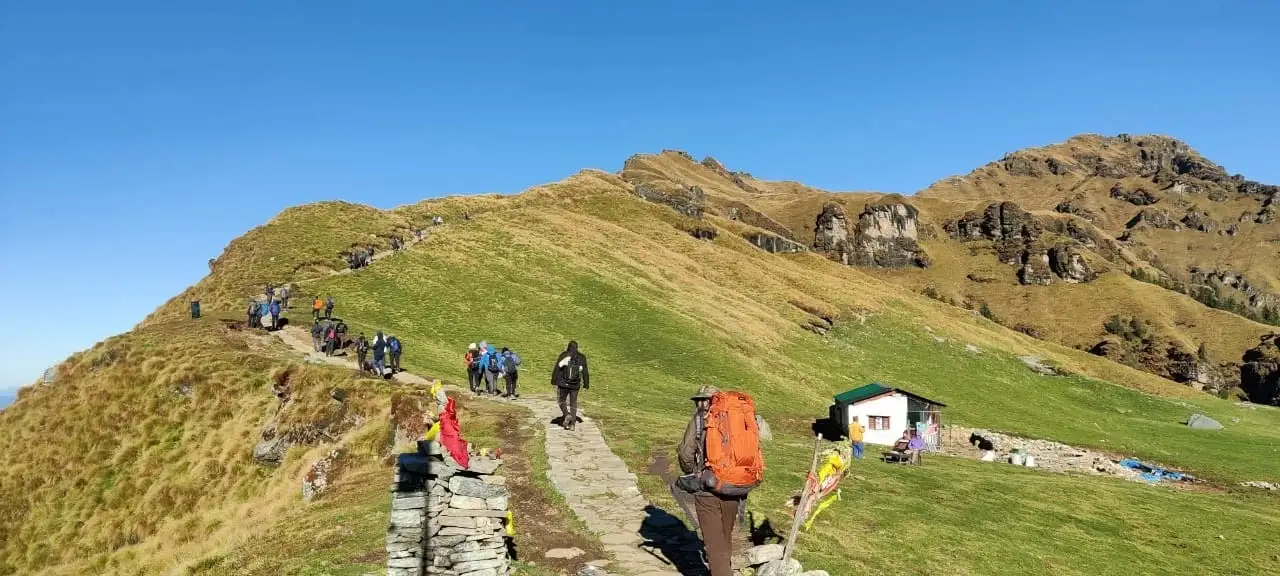
June is peak season on the Panch Kedar trek, and for good reason. All five temples are fully open and operating on complete ceremonial schedules. Temperatures have warmed to a comfortable 8–20°C range, alpine meadows are turning a vivid green, and the skies offer long, clear windows with visibility that can stretch 60–80 kilometres on a good morning. The entire trail infrastructure is fully operational — guides, porters, homestays, camping operators, and helicopter services from Phata and Sersi to Kedarnath are all running at capacity. If you want optimal weather combined with a full cultural experience of the circuit, June is your month. The one caveat is the sheer volume of pilgrims, particularly on the Kedarnath trail from Gaurikund, which can see upwards of 4,000 people a day at its busiest. Book accommodation and departure dates as far in advance as possible. Slots fill fast in peak season, and a last-minute approach almost always means compromising on dates. If you’re planning a June trip, secure your place now through a Panch Kedar Yatra Package, May–June 2026.
July and August
The southwest monsoon typically arrives in the Garhwal Himalayas in late June and dominates through July and August. This is the most challenging period to trek the circuit. Heavy, persistent rainfall causes trail erosion on the steep sections above Sari and Ransi, and the Mandakini and Alaknanda tributaries run fast and dangerously, making river crossings unpredictable. Landslide risk is real, and road closures between Rishikesh and the trailhead villages are common. The lower forest trails are leech territory, and cloud cover typically smothers views above 2,500 metres for days at a time. The temples remain open, and some determined pilgrims do complete the circuit in these months, but for the majority of trekkers — and particularly anyone on their first visit — July and August are better spent planning and training for a September departure. If travel in this window is unavoidable, hire an experienced local guide, carry emergency shelter, and build at least three to four buffer days into your itinerary.
September
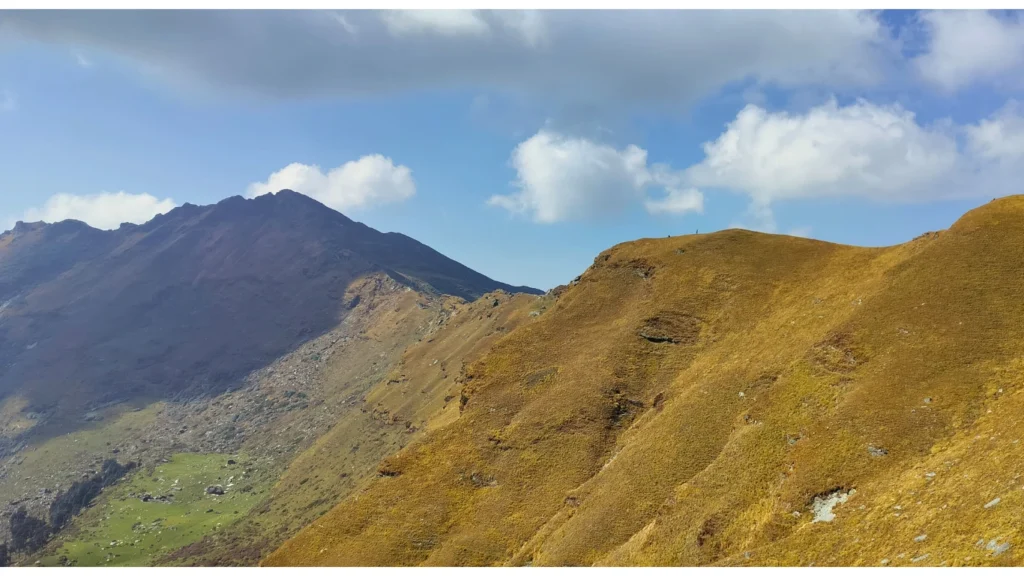
September is a month of rapid transformation in the Garhwal Himalayas. The monsoon begins retreating around the second week, and as the clouds part, the landscape emerges freshly washed, intensely green, and dramatically clear. Visibility improves with each passing day, and by late September, the atmosphere is clean enough to see the Gangotri range from the meadows above Tungnath. Temperatures sit in a comfortable 6–18°C range, the trails are free of snow, and the crowds are noticeably thinner than in June. Rivers are still running high in early September, so trekkers should wait until at least mid-month for the safest crossing conditions. The combination of solitude, post-monsoon greenery, and crystalline mountain air makes mid to late September one of the best-kept secrets on the entire circuit.
October
October rivals June as the best month for trekking in the Garhwal Himalayas. The monsoon is fully gone, the skies are deep blue, and the Himalayan panoramas from the higher meadows above Tungnath and Madhyamaheshwar are at their finest — crisp, cold, and impossibly clear. Alpine shrubs take on burnished gold and copper tones as the high country prepares for winter, giving the landscape a richness absent in the greener summer months. Kedarnath in particular draws large numbers of pilgrims in October, including those who come specifically for the closing ceremonies — particularly the Kedarnath Dorr Bandh puja, one of the most emotionally significant rituals on the entire pilgrimage calendar. Nights are cold, dipping to -2°C or below at camps above 3,000 metres, so a sleeping bag rated to at least -5°C is essential. Book well in advance as October demand has grown sharply in recent years.
November
November is the closing month of the season and should be approached with caution. The temples shut progressively through the first three weeks — Rudranath closes earliest, followed by Madhyamaheshwar, Tungnath, and finally Kedarnath around Bhai Dooj in mid-November. Heavy snowfall above 3,000 metres becomes increasingly likely from the first week of the month, and conditions can deteriorate rapidly with little warning. Kalpeshwar remains the one reliable option and can be visited as a standalone day trek from the Urgam Valley throughout November and beyond. Experienced winter trekkers comfortable with ice and snow may find the early weeks of November rewarding, but for most travellers, the season is effectively over once October ends.
The Best Months in Detail: Why May–June and September–October Stand Apart
If you have full flexibility in your schedule, you really cannot go wrong with either of the two peak windows. May and June offer the most complete experience of the circuit — all five temples open simultaneously, trails at their most accessible, service infrastructure at full capacity, and the rhododendron and alpine wildflower bloom that approaches Rudranath through the Panar bugyal one of the most beautiful short stretches of trekking in the entire Himalayas. The trade-off is crowds and the need to plan far ahead.
September and October give you the mountain scenery at its most dramatic alongside a quieter, more contemplative experience on the trails. The landscape has a different mood entirely — where June is lush and vibrant, October is spare and golden, the high meadows thinning out as the cold settles in. For photographers especially, the quality of October light in the Garhwal Himalayas is extraordinary, and the combination of post-monsoon clarity with dusting of fresh snow on the highest peaks creates conditions that are genuinely hard to match anywhere in India.
The decision ultimately comes down to what you value most. For the most complete cultural and natural experience, go in late May or June. For solitude, views, and the reward of the trails less travelled, go in late September or October. Either way, start planning early. The best guides, the best accommodation, and the best departure dates are claimed months in advance by trekkers who know the circuit well.
Panch Kedar Trek Difficulty: What You Need to Know
One of the most common questions in any Panch Kedar trek guide is about difficulty, and the honest answer is that it depends heavily on how you approach the circuit. Each temple trek ranges from easy to moderate on its own — Kalpeshwar is a gentle valley walk of about 8 kilometres return, and Tungnath is a short 4-kilometre ascent from Chopta that most reasonably fit people can manage. Kedarnath is a 16-kilometre return trek from Gaurikund on a well-maintained trail that serves pilgrims of all ages, with a helicopter option available if needed.
The longer approaches to Rudranath and Madhyamaheshwar are where the Panch Kedar trek difficulty genuinely earns its reputation. Rudranath involves a 24-kilometre return trek from Sari through dense oak and rhododendron forest, across open bugyals, and up to a windswept shrine at 3,600 metres — the most remote and arguably the most spiritually intense of the five. Madhyamaheshwar is a similar distance from Ransi and offers some of the most intimate views of the Kedarnath massif on foot. Both require good cardiovascular fitness, solid footwear, and ideally prior experience at altitude.
For the full circuit covering all five shrines, plan for 18 to 24 days depending on your pace and acclimatisation needs. The recommended fitness baseline is the ability to walk 15 to 18 kilometres on consecutive days carrying a 7 to 10 kilogram pack. Rushing the circuit is the single biggest mistake first-time trekkers make — altitude gain is the key variable, and an extra rest night at Chopta or Ukhimath before pushing higher pays dividends on the body and the spirit alike.
A Few Practical Notes Before You Book
Regardless of when you travel, a few planning principles hold for every season. First, the approach roads to the Panch Kedar trailheads — particularly the route via Rudraprayag, Ukhimath, and Augustmuni — are narrow mountain roads prone to landslides and temporary closure, especially in the early and late seasons. Build a day of buffer at either end of your trip rather than arriving at the trailhead on the same morning you plan to start walking.
Second, temperature swings at altitude are significant even in the warmest months. A June afternoon at 2,500 metres might feel like a pleasant 18°C, but by 5 am the following morning at a high camp, the same location can drop to 4 or 5°C. Layering — a moisture-wicking base, a mid-layer fleece, and a waterproof outer shell — is essential regardless of the month you choose.
Third, the Panch Kedar circuit is as much a pilgrimage as it is a trek. The villages you pass through — Triyuginarayan, Ransi, Sari, Bantoli, Urgam — are living communities whose livelihoods depend on respectful visitors. Take the time to learn a few words of Garhwali, observe temple protocols, and support the local homestays and dhabas rather than relying exclusively on packaged food. The hospitality of the Garhwali people is one of the genuine pleasures of trekking in this part of the Himalayas.
Summary
For most trekkers visiting for the first time, the ideal window is late May or the first three weeks of June. You get all temples open, stable weather, full trail infrastructure, and the visual spectacle of the blooming Himalayan meadows at their peak. If you prefer fewer crowds and are comfortable with colder nights, late September to mid-October is equally rewarding and in some respects even more beautiful. What both windows share is a finite number of available slots, beds, and guides — and a booking window that gets shorter every year as the Panch Kedar circuit grows in popularity.
If you are serious about a 2026 departure, the time to act is now. Check Panch Kedar trek availability for your preferred dates and lock in your itinerary before the best options disappear.
With the Panch Kedar Yatra season approaching, it’s time to plan something truly extraordinary. From breathtaking Himalayan peaks to spiritually powerful temples hidden deep in remote valleys, this journey offers an experience that goes beyond a typical trek—it becomes a story you carry for life. To make your journey seamless and well-organised, choose the best trekking company in Uttarakhand for reliable trek packages, detailed itineraries, and hassle-free booking.
Visit this page for Trek Packages, Itinerary & Booking.