- ★ Uttarakhand · Kumaon Himalayas
Adi Kailash Yatra 2026
- The Complete Guide to India's Sacred Chhota Kailash Pilgrimage
- Book Now — ₹38,000/- per person onwards
- Everything a pilgrim needs to know before walking into the abode of Lord Shiva — mythology, packages, cost, itinerary, permits, fitness, and the honest details no one tells you.
- 4.8/5 Rating
- 1000+ Trekkers
- Certified Guides
- 24/7 Support
Adi Kailash Yatra 2026
Chhota Kailash & Om Parvat Yatra from Delhi, Kathgodam & Dehradun — Pithoragarh, Uttarakhand
May–October 2026 | 7 Days from Delhi | Package from ₹38,000 per person
- 4.8/5 Rating
- 500+ Yatris
- ILP Included
- 24/7 Support
5,945 m
Max Elevation Adi Kailash
60 km
Distance Total trek
7–9 Days
Duration adi kailash
Moderate-Difficult
Difficulty Beginner friendly
May–October
Best Months Year-round trek
Up to 20
Group Size Small batches
- About the Yatra
Adi Kailash Yatra 2026: The Complete Guide to India's Sacred Chhota Kailash Pilgrimage
Everything a pilgrim needs to know before walking into the abode of Lord Shiva — mythology, packages, cost, itinerary, permits, fitness, and the honest details no one tells you.
There is a particular kind of silence that settles over a pilgrim standing at Jolingkong for the first time. The wind has stopped arguing with the valley. The Kali River, which has been a constant companion for two days of driving, has fallen far behind. And there, rising directly ahead in a near-perfect pyramid of rock and snow, is Adi Kailash — the mountain that millions of Hindus believe is the original, primordial seat of Lord Shiva. This guide exists for one reason: to give you everything you need to plan the Adi Kailash Yatra 2026 properly, without the confusion, inflated promises, or half-answers that scatter across the internet whenever this pilgrimage is searched.
Whether you found this page because you are comparing Adi Kailash Yatra packages, trying to understand the real Adi Kailash Yatra cost, checking the Om Parvat darshan season, or simply wondering whether your 65-year-old father can complete this journey — you are in the right place. Mountainiax has organised this pilgrimage for over five hundred yatris across fifty-plus batches, and this page is built from that ground experience, not recycled brochure copy.
What Is the Adi Kailash Yatra?
The Adi Kailash Yatra is a Himalayan pilgrimage to Adi Kailash, a sacred peak standing between 5,945 and 6,191 metres (figures vary slightly depending on the survey source) in the Pithoragarh district of Uttarakhand, India. Locally and devotionally, the mountain carries several names — Chhota Kailash, Baba Kailash, and Shiva Kailash — each pointing to the same belief: that this peak is a genuine, living manifestation of Mount Kailash in Tibet, situated entirely within Indian territory.
For pilgrims who cannot undertake the far more demanding and expensive Kailash Mansarovar Yatra across the Tibetan border, Adi Kailash has become the accessible spiritual alternative — a journey that delivers the same devotional weight, the same high-altitude grandeur, and, according to many who have done both, an equally profound sense of having stood in Shiva’s presence, without the passport, the Chinese visa, or the twenty-one-day commitment.
The yatra typically runs 7 to 9 days from Delhi or Kathgodam, threading through Pithoragarh, Dharchula, Gunji, and finally Jolingkong — the high-altitude meadow that serves as base camp for Adi Kailash darshan. Along the way, pilgrims also witness Om Parvat, the mountain whose snowfields naturally form the shape of the sacred “Om” symbol, making this one of the very few pilgrimages in India where two independently miraculous sights are covered on a single itinerary.
What sets the modern Adi Kailash Yatra apart from how it was undertaken even a decade ago is the road. The stretch from Gunji (or the neighbouring settlement of Nabi) all the way to Jolingkong is now motorable by 4×4 vehicle, which means the actual walking distance on this yatra has shrunk to somewhere between 2 and 7 kilometres of optional trekking — mostly to reach Parvati Sarovar and Gauri Kund. This single infrastructure change has quietly transformed Adi Kailash from a trekker’s expedition into a pilgrimage that families, senior citizens, and first-time high-altitude travellers can complete with genuine comfort.
Sacred Significance and Mythology of Adi Kailash
To understand why thousands of devotees undertake the Adi Kailash Yatra every year, it helps to begin with its name. In Sanskrit, “Adi” means first or primordial, while “Kailash” refers to Lord Shiva’s sacred abode. Together, they form “Adi Kailash” – the Original Kailash, which Hindu tradition regards as Lord Shiva’s first earthly seat of meditation. Because of this belief, the mountain is also known as Chhota Kailash. Here, “Chhota” does not imply lesser importance; instead, it reflects a more intimate and accessible pilgrimage for devotees who cannot visit Mount Kailash in Tibet.
According to Hindu scriptures, Adi Kailash is a place where Lord Shiva performed eternal meditation. Its striking pyramid-shaped peak is often compared to Mount Meru, the cosmic axis described in Hindu, Buddhist, and Jain traditions. Many pilgrims visiting Jolingkong describe the atmosphere as deeply peaceful and spiritually powerful.
The region is also closely connected with Goddess Parvati. Local beliefs associate Nabhidhang, the famous viewpoint of Om Parvat, with the “Nabhi” (navel) of Goddess Parvati, making it one of the most revered stops on the yatra. The Mahabharata adds another layer of significance, as local legends say the Pandavas, especially Bheem, stayed in this region during their exile. Bheem Ki Kheti, located along the route, is believed to be the field cultivated by Bheem himself.
Another important legend links Adi Kailash with Ravana, who, despite being known as Lord Rama’s opponent, is also revered as one of Lord Shiva’s greatest devotees. Local traditions say Ravana performed intense penance in this region, adding to its spiritual significance.
For those who wish to explore these stories in greater detail, Mountainiax offers a dedicated guide on The Sacred Story of Adi Kailash, covering the Puranic references, the Skanda Purana, and the theological importance of this self-manifested pilgrimage site.
Many Shaivite devotees also treat the yatra as a spiritual discipline rather than a sightseeing trip. They often take a Shiva Sankalpa before departure, seek blessings at Jageshwar Dham, and follow traditional rituals throughout the journey. Our guide on Adi Kailash Yatra for Shaivites – Spiritual Protocols explains these practices, the associated mantras, and the customs observed at Jolingkong.
- The Divine Route
Sacred Sites Along the Way
One of the most underrated aspects of the Adi Kailash Yatra is how much sacred geography is packed into a single route. This is not a pilgrimage with one destination and a long, uneventful drive to reach it — nearly every stop along the way carries its own mythology, its own ritual significance, or its own quiet historical weight.
01
Kalapani — The Sacred Confluence
Early in the journey, most itineraries pass through or near Kalapani, a high-altitude settlement where multiple glacial tributaries converge to form the Kali River, also known locally as the Sharda or Mahakali. At the centre of this confluence stands the Kali Mata Temple, a modest stone shrine that pilgrims describe as carrying a stillness disproportionate to its size. Kalapani has also historically been a crossroads on ancient trans-Himalayan trade routes, where merchants once carried salt, wool, and borax between Tibet and the Indian plains through the Lipulekh Pass. Many yatris pause here to offer prayers and to observe a quiet moment in honour of the Indo-Tibetan Border Police personnel stationed nearby, guarding one of the most sensitive frontiers in the country.
Our standalone guide, Kalapani: Sacred Confluence on Adi Kailash Route, covers the site’s spiritual meaning and contested geography in full detail.
02
Gunji and Nabi Villages — The High-Altitude Gateway
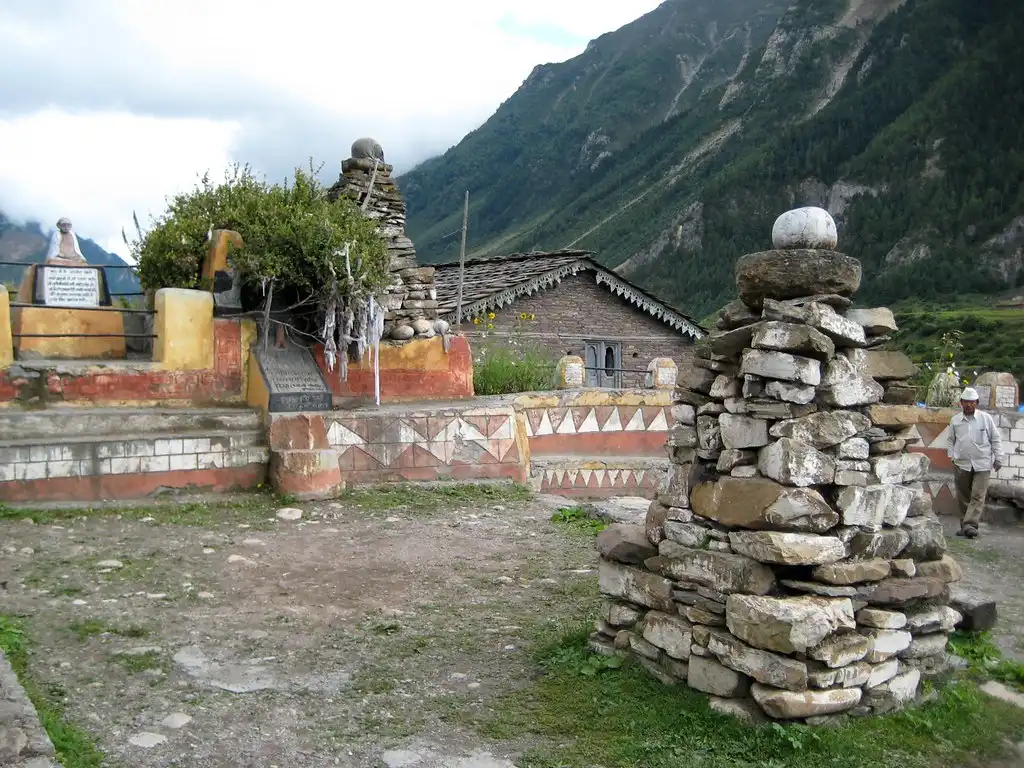
Gunji, sitting at roughly 3,200 metres, functions as the last significant settlement before the final push toward Jolingkong. Most Adi Kailash Yatra itineraries in 2026 use Gunji or the neighbouring village of Nabi as the overnight base for two nights — once on the way up, for the short excursion to Nabidhang, and again on the way back down. It is here that the extraordinary shift in accessibility becomes obvious: what was once a multi-day trek from Gunji to the higher sacred sites is now a manageable drive, opening this yatra to travellers who could never have attempted it a decade ago. Our detailed guide on Gunji, the base camp village, covers homestay arrangements, network connectivity, and acclimatisation tips specific to this stop.
03
Om Parvat and Nabidhang
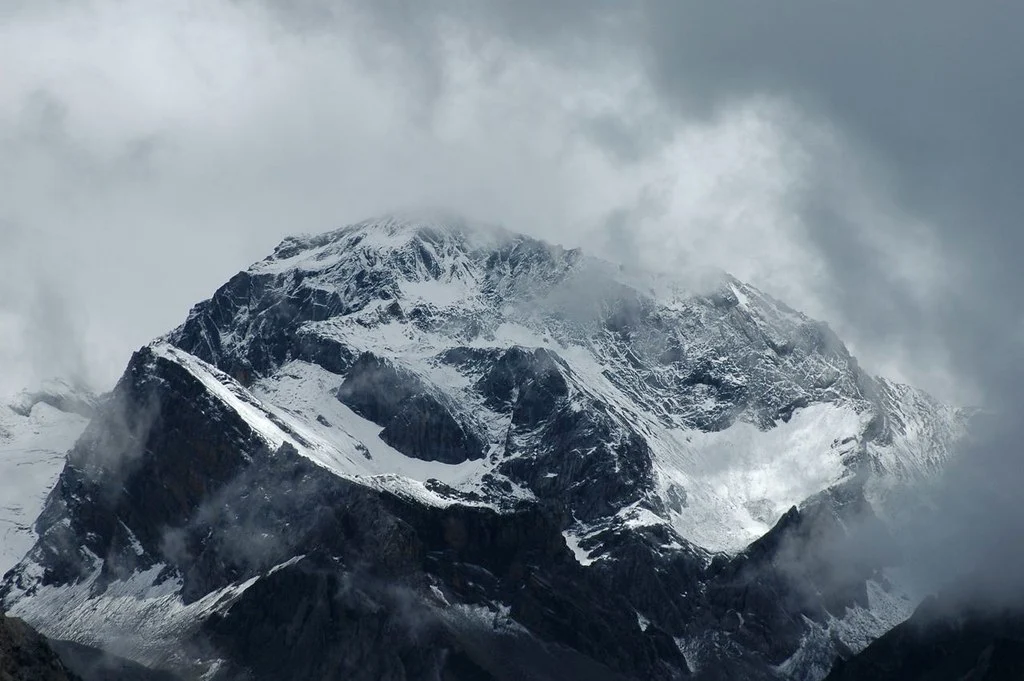
Arguably the single most photographed and most awe-inspiring sight on the entire Adi Kailash Yatra is Om Parvat, a peak of roughly 5,010 to 6,191 metres (measurements vary by source) where snow naturally settles into the unmistakable shape of the sacred Om symbol. There is no human intervention involved — no carving, no painting — simply the geometry of the rock face and the physics of snow accumulation producing what looks, from a distance, like deliberate sacred art. Pilgrims view Om Parvat from Nabidhang, a short drive of roughly 25 kilometres from Gunji, reachable in two to three hours. Weather plays a decisive role here: cloud cover can obscure the summit entirely, which is one reason experienced operators build a buffer day into every Om Parvat darshan itinerary. For a deeper look at the phenomenon and the best conditions for a clear sighting, see our feature on Om Parvat Darshan 2026 — Witnessing the Sacred Om Symbol.
04
Jolingkong, Parvati Sarovar, and Gauri Kund
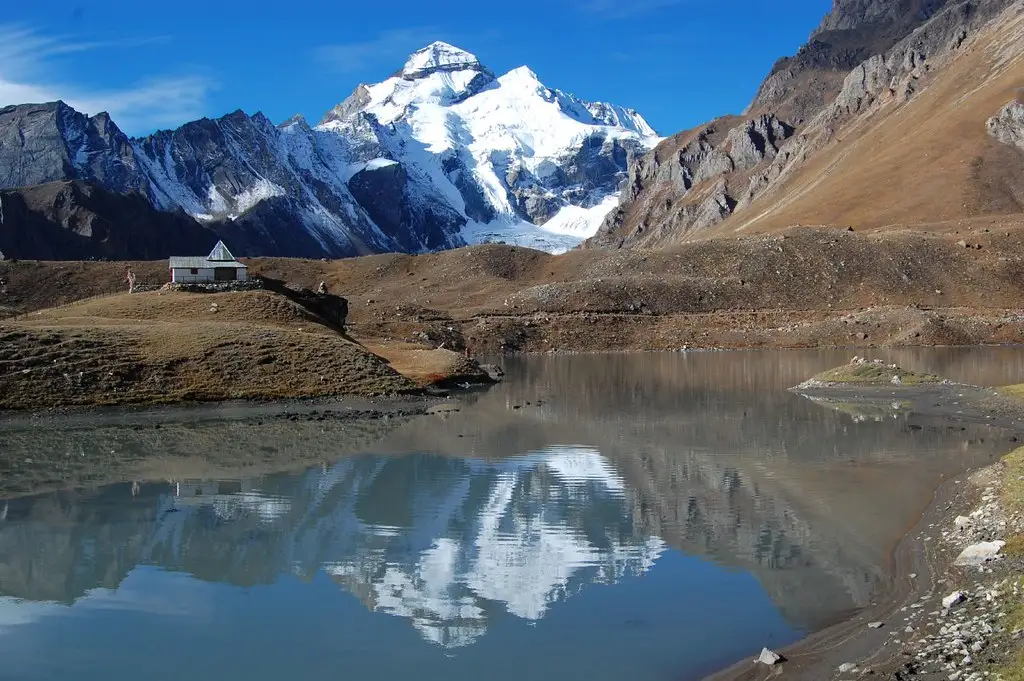
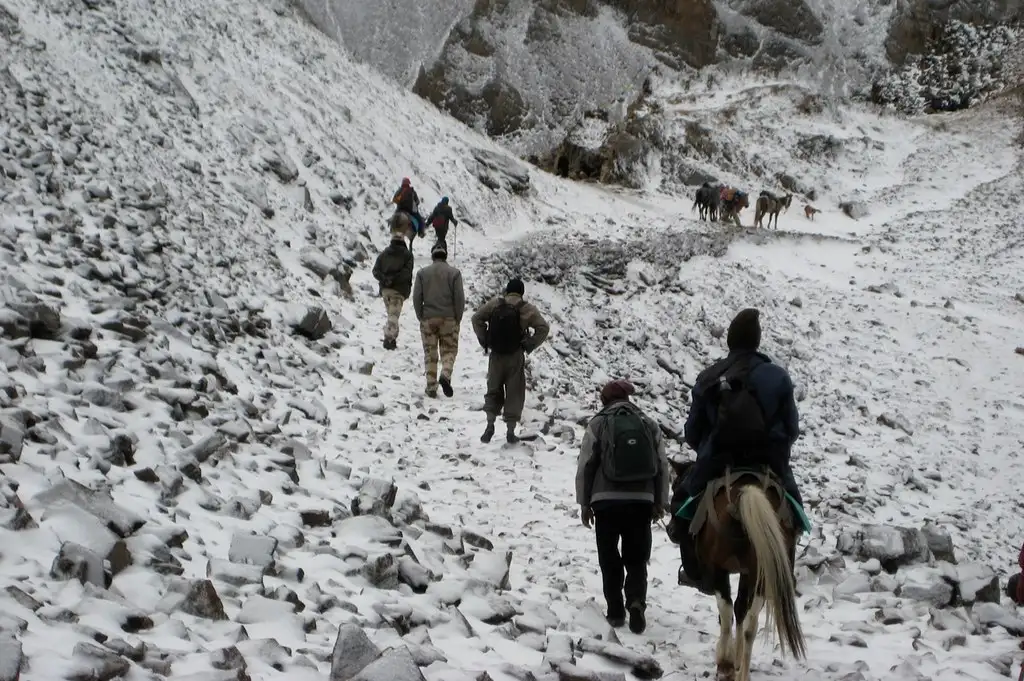
Jolingkong, at approximately 4,378 to 4,420 metres, is the emotional and spiritual centrepiece of the entire yatra. This high meadow is where pilgrims finally stand face-to-face with Adi Kailash itself, its conical summit filling the horizon and glowing gold at sunrise. Directly below the peak lies Parvati Sarovar, a glacial lake believed to be the very spot where Goddess Parvati meditated and bathed. A gentle walk of roughly one to two kilometres from the Jolingkong campsite brings you to its shore, and many pilgrims choose to take a ritual dip despite the bitterly cold water, believing it cleanses accumulated karma. Nearby, Gauri Kund — a separate holy water body — is associated with the same goddess and is reached by a short two-kilometre optional trek. Together, Parvati Sarovar and Gauri Kund represent the only meaningful “trekking” most yatris will do on this entire pilgrimage, and both are entirely optional depending on your fitness and time. Our dedicated write-up, Final Stop Before Adi Kailash: Jolingkong and Parvati Guide, covers the sacred geography of this valley — including lesser-known landmarks like Pandav Parvat and the Parvati Mukut rock formation — in complete depth.
05
Lipu Lekh Pass and the Ancient Silk Route
For pilgrims interested in the historical rather than purely devotional dimension of this journey, the Lipu Lekh Pass adds real depth. This high-altitude mountain pass has served for centuries as a trade and pilgrimage corridor connecting India and Tibet, forming part of the broader trans-Himalayan Silk Route through which goods, culture, and religious ideas moved between the two regions. Today the pass remains strategically and diplomatically significant, and its presence along the route adds a layer of geopolitical context that few other Indian pilgrimages offer.
- Comparison
Adi Kailash vs Kailash Mansarovar — Which Should You Choose?
Every year, thousands of devout pilgrims face the same crossroads: the ancient Kailash Mansarovar Yatra in Tibet, or the increasingly popular Adi Kailash Yatra within India. Both carry immense spiritual weight, both involve genuine high-altitude Himalayan terrain, and both promise a life-changing darshan. But beyond that surface similarity, the two journeys differ enormously in logistics, cost, physical demand, and accessibility.
Kailash Mansarovar sits inside the Tibet Autonomous Region of China at 6,638 metres and is revered across four major world religions — Hinduism, Buddhism, Jainism, and Bon. Reaching it requires an Indian passport, a Chinese visa, and travel through either Nepal or the Lipulekh Pass, with the entire yatra susceptible to sudden cancellation due to diplomatic tensions between India and China, as pilgrims have experienced repeatedly in recent years. Adi Kailash, by contrast, is conducted entirely within Indian territory, in the Kumaon Himalayas of Uttarakhand — no passport, no foreign visa, no dependence on cross-border diplomacy.
For a full point-by-point breakdown of geography, cost, physical demand, and suitability for different traveller profiles, our companion article Adi Kailash vs Kailash Mansarovar — Explained goes deeper than the summary table below.
| Feature | Adi Kailash Yatra 2026 | Kailash Mansarovar Yatra |
|---|---|---|
| Location | Uttarakhand, India | Tibet Autonomous Region, China |
| Passport required | Not required | Required |
| Visa required | Not required | Chinese visa mandatory |
| Starting cost per person | ₹38,000 onward | ₹2,00,000 onward |
| Duration | 7–9 days | 21–28 days |
| Peak altitude | 5,945–6,191 m | 6,638 m |
| Difficulty level | Easy to moderate | Very difficult |
| Season 2026 | May to October | June to September |
| Actual walking distance | 2–7 km (rest by 4x4) | Approx. 52 km parikrama on foot |
| Age suitability | 9–70 years | 18–65 years, strict medical screening |
The bottom line most operators, including Mountainiax, arrive at: Adi Kailash offers a comparable darshan of Shiva’s abode, entirely on Indian soil, at roughly a fifth of the cost and a third of the duration, with a physical demand low enough that families and senior citizens routinely complete it without incident.
- The Divine Route
Adi Kailash Yatra 2026 — Trek Snapshot
One of the most underrated aspects of the Adi Kailash Yatra is how much sacred geography is packed into a single route. This is not a pilgrimage with one destination and a long, uneventful drive to reach it — nearly every stop along the way carries its own mythology, its own ritual significance, or its own quiet historical weight.
Adi Kailash Yatra Packages 2026 — Cost & Inclusions
All-inclusive Adi Kailash Om Parvat Yatra from Kathgodam. ILP, meals, and transport included. 6 Nights / 7 Days from Kathgodam.
Adi Kailash Yatra Packages
- 6 Nights / 7 Days
- Starting from: Delhi | Kathgodam
- 6N/7D
- Transportation support from kathgodam to kathgodam
- Shared accomodation
- Meals included
- ILP permits
- Experienced guide
Limited seats — call +91-6398937502
- Cost
Adi Kailash Yatra Cost 2026 — The Complete, Honest Breakdown
One of the most common frustrations pilgrims report while researching this yatra is inconsistent pricing across different websites — numbers ranging anywhere from ₹21,000 to over ₹70,000 with very little explanation of what actually drives the difference. Understanding the Adi Kailash Yatra cost in full, not just the headline package price, is what separates a smooth pilgrimage from a financially stressful one. Costs in this region are shaped by several independent variables that compound on each other, and our dedicated guide, Adi Kailash Yatra Cost 2026 — Complete Budget Breakdown, walks through every one of them in detail. Below is the summary.
The total price you pay depends on: your starting point (Delhi packages naturally cost more than Kathgodam-only packages because of the additional 290 km of travel each way); your chosen vehicle category (shared jeep versus private vehicle); your accommodation grade (basic homestay versus better-category hotel); the season you travel in (October departures, being peak photography season, often carry a premium); and whether porter or medical support is included.
| Cost Component | Budget Range | What It Covers |
|---|---|---|
| Train, Delhi to Kathgodam | ₹400 – ₹1,000 | Sleeper to 3AC class, one-way |
| Bus, Delhi to Haldwani | ₹500 – ₹1,500 | Overnight government or private bus |
| Flight, Delhi to Pantnagar | ₹4,000 – ₹8,000 | One-way, subject to seasonal fare |
| Accommodation, Pithoragarh/Dharchula | ₹1,000 – ₹5,000/night | Basic guesthouse to deluxe hotel |
| Accommodation, Gunji/Nabi | ₹800 – ₹3,500/night | Homestay to better-category guesthouse |
| Private vehicle, Kathgodam–Dharchula round trip | ₹6,000 – ₹10,000 | Per vehicle, shared among group |
| Local 4x4, Dharchula–Gunji–Jolingkong | ₹4,000 – ₹6,000 | Per vehicle round trip, shared |
| Inner Line Permit processing | Included in package | Government fee plus operator handling |
| Guide / trip coordinator fee | ₹500 – ₹1,500/day | Per group, based on size |
| Meals (outside package) | ₹300 – ₹600/day | If not opting for a meal-inclusive package |
As a rule of thumb: budget packages in the ₹27,000 to ₹34,000 range cover a shared 4×4, twin or triple-sharing homestays, and vegetarian meals, and represent the most-booked tier among Adi Kailash pilgrims. Standard packages in the ₹35,000 to ₹50,000 range add better accommodation and a more relaxed group size. Premium and deluxe packages above ₹50,000 add private vehicles, upgraded hotels, and additional buffer time. Helicopter packages, priced separately at roughly ₹1,45,000, sit in an entirely different category built around speed and minimal physical exertion rather than cost efficiency.
A practical note that most websites skip: online banking and ATM services stop working almost entirely beyond Dharchula. Carry ₹10,000 to ₹25,000 in cash for the mountain stretch of your journey — for personal purchases, additional meals, offerings at temples, or simply a comfortable safety margin, since card and UPI payments are unreliable once you cross into the restricted zone.
- Packing List
What's Included and What's Not — 2026 Package Terms
Inclusions
- Transportation support throughout the journey. Vehicle Type –Pushback AC Traveller, Innova Crysta, Scorpio Dharchula to Dharchula –Scorpio, Isuzu Dmax
- 6 nights accommodation at Hotels/Resorts/ Homestays in Twin/ Triple sharing basis
- Yatra Inner Line Permit
- Meals (vegetarian) at Mapi plan, From Dinner on Day 1 to breakfast on Day 6.
- 24 hours call assistance.
- A well experienced Trip Coordinator for Adi Kailash Yatra and Om Parvat Yatra.
- All Toll Tax, Parking, and Driver allowances.
Exclusions
- Anything that has not been mentioned in the inclusions mentioned above.
- Meals during Transit- Any lunch and other meals not mentioned in package inclusions.
- Any additional expenses such as of personal nature/excursions/medical exigency not mentioned in the inclusions.
- Any Monument/ View Point fees during sightseeing.
- Any Activity Fees.
- Extended stay or travelling due to any reason.
- Insurance
We recommend every pilgrim purchase independent travel insurance covering high-altitude evacuation before departure. This is not included in any standard package — from any operator — and is the single most overlooked safety gap among first-time Himalayan travellers.
Cancellation and refund policy
- Policy
Cancellation Policy
We understand that plans can change. If you need to cancel, reduce, or amend a guaranteed reservation, please do so by 12 noon, 15 days prior to arrival to avoid cancellation charges. Any cancellation made within 15 days of arrival will be 100% non-refundable. Bookings made under non-cancellable or non-amendable packages or rates cannot be canceled or amended, and the full amount of the advance paid will be treated as the cancellation fee. The same terms apply if guests do not show up.
For all bookings other than non-cancellable ones, if the guest does not show up, the complete booking will be non-refundable. If the guest chooses to check out early, one night’s room rate, including taxes, will be charged. No cancellations will be accepted over the phone or via WhatsApp message. Please reply to the email confirmation you received at the time of booking to request a cancellation.
No refunds will be provided in case of problems arising due to government orders, harsh weather conditions, protests, landslides, or other unforeseen circumstances. In such cases, we usually have a backup plan ready and will proceed with that. Sometimes, we may have to cancel activities mentioned in the itinerary due to circumstances beyond our control.
If a trek is called off at the last moment due to natural calamities or unforeseen circumstances (such as rain, snowfall, earthquake, landslides, strikes, or bandhs), participants will be provided with a travel voucher for the same amount. This voucher can be used within 365 days of the issuance date for any package of equal value, subject to availability.
If a trek or trip has to be aborted midway due to natural calamities or unforeseen circumstances, no refund will be provided. Mountainiax will not bear any extra expenses due to such natural calamities or unforeseen circumstances.
Refund Policy
The following refund shall be payable to the user in case of valid cancellation as per the guidelines:
Note: The above-mentioned refunds are subjected to deductions for any expenses that may have been incurred for hotel booking or transport etc. Refunds are applicable on the total cost and not on the advance amount.
- Detailed Itinerary
Adi Kailash Yatra Itinerary 2026 — Complete Day-by-Day Route
What follows is the full route from Delhi through Kathgodam, Pithoragarh, Dharchula, Gunji, and Jolingkong, with realistic altitude, distance, and drive-time figures for every leg. Treat the timings as approximate — Himalayan border roads are subject to weather, landslide clearance, and military convoy movement, all of which can add hours to any given day without warning.
1
DAY
- Delhi → Kathgodam → Pithoragarh
- 📍 Alt: 1,585m / 5,200 ft
- 🛣️ Dist: 290 km drive (Delhi–Kathgodam) + 200 km (Kathgodam–Pithoragarh)
- ⏱️ Time: 7–8 hrs from Kathgodam
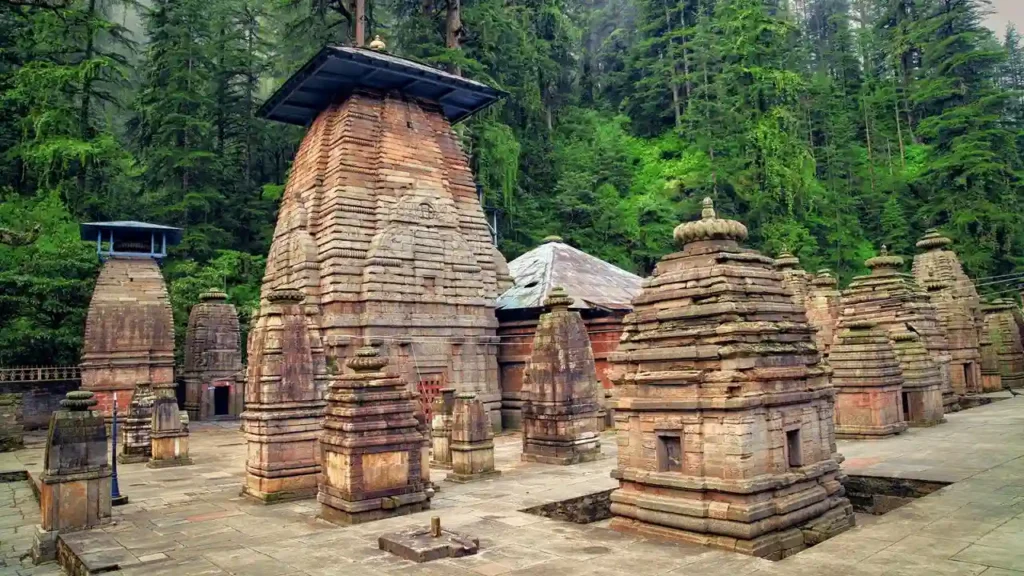
Most pilgrims begin with an overnight train from Delhi to Kathgodam — the Ranikhet Express and the Kathgodam Shatabdi are the two most commonly recommended services, arriving by roughly 6:00 AM, where the Mountainiax team receives you at the station. From here, the drive continues toward Pithoragarh, a stretch of approximately 200 kilometres that takes 7 to 8 hours. En route, most itineraries stop at Jageshwar Dham, an extraordinary cluster of 124 ancient Nagara-style stone temples set inside a deodar forest, of which 108 are dedicated to Lord Shiva. Many pilgrims, particularly Shaivites, treat this as the spiritual opening of the yatra — a place to perform an abhisheka and seek blessings before the higher mountain journey begins. Overnight halt is in Pithoragarh at approximately 1,585 metres.
2
DAY
- Pithoragarh → Dharchula → Gunji or Nabi
- 📍 Alt: 3,200m / 10,500 ft (Gunji)
- 🛣️ Dist: 170 km drive
- ⏱️ Time: 7–8 hrs
The second day is largely administrative but essential: your Inner Line Permit registration happens at the SDM office in Dharchula, a process that typically takes half a day and requires original identity documents plus your medical fitness certificate. Once permits clear, the drive continues along the Kali River, through what is officially a restricted border zone requiring the ILP you just obtained, covering roughly 170 kilometres in 7 to 8 hours to reach Gunji or the neighbouring village of Nabi at approximately 3,200 metres. This is your first genuine high-altitude night, and most experienced coordinators recommend an early dinner and minimal exertion to begin acclimatising.
3
DAY
- Gunji/Nabi → Nabidhang → Om Parvat Darshan → Back to Gunji
- 📍 Alt: 4,300m / 14,100 ft (Nabidhang)
- 🛣️ Dist: 25 km one way
- ⏱️ Time: 2–3 hrs
This is, for many pilgrims, the single most emotional day of the entire yatra. A relatively short drive of about 25 kilometres — roughly two to three hours — takes you to Nabidhang at 4,300 metres, from where Om Parvat reveals itself in full: the sacred Om symbol formed naturally in snow against a stark blue Himalayan sky. Weather permitting, this darshan is unhurried; pilgrims typically spend an hour or more here for prayer, photography, and quiet reflection before returning to Gunji for a second overnight stay.
4
DAY
- Gunji/Nabi → Kuti → Jolingkong (Adi Kailash Base Camp)
- 📍 Alt: 4,420m / 14,500 ft (Jolingkong)
- 🛣️ Dist: 20–25 km one way
- ⏱️ Time: 2–3 hrs (Gunji–Kuti: 1hr, Kuti–Jolingkong: 1hr)
The drive to Jolingkong, the base camp for Adi Kailash darshan, covers 20 to 25 kilometres and takes two to three hours, broken into a roughly one-hour stretch from Gunji to Kuti and a further hour from Kuti to Jolingkong at 4,420 metres. En route, most itineraries include stops at Bheem Ki Kheti, the mythological field associated with the Pandava Bheem, offering the first close views of the sacred Adi Kailash peak as it comes into sight above the valley.
5
DAY
- Adi Kailash Darshan and Parvati Sarovar
- 📍 Alt: 4,420m / 14,500 ft
- 🛣️ Dist: 2–7 km optional treks
- ⏱️ Time: Full day at base camp
A full day is dedicated to Adi Kailash itself. Pilgrims perform puja at Jolingkong, facing the peak directly, and undertake the short optional walk to Parvati Sarovar — the glacial lake at the base of the mountain where a ritual dip is considered deeply purifying despite the near-freezing water. Those with additional time and energy continue to Gauri Kund, a further two kilometres. This is the day most pilgrims describe, afterward, as the emotional peak of the entire journey. In the evening, the group returns to Gunji for the night.
6
DAY
- Gunji → Chaukori
- 📍 Alt: 2,010m / 6,600 ft
- 🛣️ Dist: 180 km drive
- ⏱️ Time: 7–8 hrs
The return journey begins with a scenic 180-kilometre, 7 to 8 hour drive back through the Kumaon valleys to Chaukori, a hill station known for sweeping views of the Panchachuli peaks. This day is often treated as a symbolic close to the yatra — the descent from sacred, high-altitude terrain back toward greener, more familiar landscapes — and many groups mark it with a small celebration.
7
DAY
- Chaukori → Patal Bhuvaneshwar → Kathgodam
The final leg of the pilgrimage includes a stop at Patal Bhuvaneshwar, a mystical 160-metre-long limestone cave temple, 90 feet deep, believed to house natural Shiva Lingam formations and, according to local legend, once visited by the Pandavas themselves. From here, the drive continues back to Kathgodam, where pilgrims board their return train or bus to Delhi. The yatra concludes.
8
DAY
- Buffer Day
Every well-planned Adi Kailash itinerary — ours included — keeps one full buffer day in reserve. Himalayan border roads close without notice for landslide clearance, military convoy priority, or sudden weather, and this buffer exists specifically to absorb those delays without forcing you to miss your onward travel from Delhi. If unused, it simply becomes a relaxed extra day in Kathgodam or Chaukori.
9
DAY
- Optional Extension — Departure from Kathgodam or Private Return to Delhi
Premium and Deluxe package pilgrims are driven privately back to Delhi with comfort stops along the way, arriving typically the same evening. Standard and Budget tier yatris depart by train or bus from Kathgodam, as arranged on Day 1.
A practical note worth repeating: distance, altitude, and driving hours across this entire itinerary are approximate, and road conditions in a restricted, high-altitude border zone can vary significantly by week and by year. Keep original identity documents and a photocopy on you at all times, and treat the buffer day as a genuine part of your plan rather than a worst-case afterthought.
- Getting There
How to Reach Adi Kailash — Complete Travel Guide 2026
The journey to Adi Kailash begins, for almost every pilgrim, at Kathgodam Railway Station in Uttarakhand — the last major point of conventional transport infrastructure before the mountain roads take over. Our full guide, How to Reach Adi Kailash from Delhi — Complete 2026 Guide, covers every travel mode in detail; the summary is below.
By Train
An overnight train from Delhi to Kathgodam covers approximately 290 kilometres in 6 to 7 hours. Kathgodam is well connected to Delhi, Kolkata, Dehradun, and Lucknow, and the Ranikhet Express and Kathgodam Shatabdi are the most commonly recommended services for pilgrims. Arriving by 6:00 AM allows the Mountainiax team to receive you directly at the station and begin the drive without losing a day.
By Bus
An overnight bus from Delhi’s Anand Vihar ISBT to Haldwani is the most economical option. From Haldwani, Kathgodam is just 6 kilometres away — a 15-minute cab ride. Government-run buses are generally more reliable than private operators on this route. One important note: buses to Haldwani depart specifically from Anand Vihar, not Kashmere Gate — a mix-up that has cost more than a few pilgrims their morning connection.
By Flight
The nearest airport is Pantnagar, roughly 27 kilometres from Haldwani, with direct flights available from Delhi. Because flight frequency on this route is limited, especially during peak season, pilgrims flying in are advised to arrive a day early and book well in advance. From Pantnagar, a 45-minute cab ride connects to Kathgodam.
By Road (Self-Drive)
Self-driving pilgrims typically follow NH9 via Moradabad and Haldwani to reach Kathgodam, a distance of about 290 kilometres taking 6 to 7 hours. From Kathgodam onward, however, self-driven vehicles are not permitted beyond Dharchula — only KMVN-operated or tour-operator-arranged 4×4 vehicles are allowed to navigate the restricted high-altitude roads toward Gunji and Jolingkong, for border security reasons. Plan your self-drive leg only as far as Kathgodam or Pithoragarh, and hand off to an authorised operator from there.
Pickup and drop for every Mountainiax package happens at Kathgodam Railway Station — pickup at 6:00 AM, drop between 6:30 and 7:30 PM at the end of the yatra — with complimentary cloakroom storage available at base camp for luggage you don’t need to carry into the restricted zone.
- Best Time
Best Time to Visit Adi Kailash — Month-by-Month
Timing is arguably the single most consequential decision in planning this pilgrimage, more so than which package tier you choose. Adi Kailash sits at an elevation where heavy snowfall can shut the entire route for months, and the monsoon turns the approach roads genuinely dangerous. Our companion guides, Best Time to Visit Adi Kailash and Adi Kailash Weather and Temperature Guide 2026, break every month down in far more depth than is practical here — this section summarises the essentials.
| Period | Conditions | Recommendation |
|---|---|---|
| November – April | Heavy snowfall, Lipu Lekh Pass blocked, road officially closed | Not recommended — yatra season closed |
| May – June | Cool weather, clear skies, snow clearing from trail sections | Recommended — ideal for first-timers |
| July – August | Monsoon, heavy rainfall, active landslide risk | Avoid — road closures common |
| September – October | Crystal-clear post-monsoon skies, best mountain visibility | Best — peak season for clear Om Parvat views, book early |
May marks the official opening of the season, though the exact date depends on how heavy the previous winter’s snowfall was — in 2026 the route is expected to clear by mid-May. Lower sections between Dharchula and Tawaghat are typically in good shape early, while the final approach to Jolingkong can retain deep snow pockets even into the third week of May, meaning early-season pilgrims should carry serious cold-weather gear regardless of what the calendar says.
June is widely considered the single best all-around month: snow has cleared from all major trail sections, days stretch to 13–14 hours of daylight, and the pre-monsoon atmosphere keeps mornings relatively clear. Road conditions in June are the most reliable of the entire season, with the approach to Jolingkong walkable in standard trekking footwear.
July and August are best avoided entirely. This is peak monsoon, and the Kali River corridor is one of the more geologically active landslide zones in Uttarakhand. Roads that were fine in June can close for days with little notice during these two months.
September and October bring the clearest skies of the year and are, for photographers and pilgrims chasing an unobstructed Om Parvat darshan, the single best window — though this also means it is peak booking season, and slots fill up well in advance.
Temperature-wise, expect daytime readings of roughly 5–15°C and nighttime lows of -5°C to 0°C at Jolingkong and Gunji even during peak season, dropping further in early May and October. This is not a casual-jacket kind of cold; it demands genuine layering, which is covered in full in our packing section below.
- Fitness & Safety
Fitness, Eligibility, and Altitude Sickness — What You Actually Need to Know
The Adi Kailash Yatra is rated easy to moderate difficulty precisely because the vehicle-supported route has removed most of the traditional trekking burden. But “easy to moderate” does not mean “no preparation required” — you are still travelling to sustained altitudes above 4,000 metres, and altitude does not negotiate with good intentions.
Age and General Eligibility
Mountainiax accepts pilgrims between the ages of 7 and 70, with the caveat that first-timers and anyone outside typical fitness ranges should consult a doctor before booking. The vehicle-based nature of the modern route genuinely does make this accessible to seniors and families — we have successfully run batches with pilgrims in their late 60s — but “accessible” still assumes baseline good health, not the absence of any fitness requirement.
Basic Fitness Benchmark
A reasonable self-test before booking: you should be able to jog 5 kilometres in around 40 minutes, or walk 10 kilometres in about 90 minutes, without significant strain. BMI should ideally sit within the 18 to 29 range. These aren’t arbitrary numbers — they correlate reasonably well with how your body handles reduced oxygen availability above 3,500 metres, which is the more relevant stress on this yatra than raw walking distance.
Medical Conditions That Require Extra Caution
Pilgrims with liver or kidney conditions, diabetes, bronchial asthma, heart disease, hypertension, or a pacemaker implant should consult a physician well before booking, and in several of these cases, the yatra may not be advisable at all. Those with a history of epilepsy or chronic sinus conditions should also seek medical clearance in advance. This is not bureaucratic caution — altitude genuinely stresses the cardiovascular and respiratory systems in ways that can seriously aggravate these conditions.
Medical Fitness Certificate
Every pilgrim is required to submit an MBBS doctor’s medical fitness certificate at Dharchula as part of the ILP process. The certificate needs to confirm resting vitals broadly within normal range — pulse between 60 and 100 bpm, blood pressure between roughly 100–130 systolic and 75–85 diastolic. Get this done in the weeks before departure, not the night before; rushed certificates are one of the most common causes of last-minute permit delays.
Understanding Acute Mountain Sickness (AMS)
Altitudes between roughly 2,400 and 3,700 metres are generally classified as high altitude, and above that — which includes Gunji at 3,200 metres and Jolingkong at 4,420 metres — falls into very high altitude territory, where mountain sickness becomes a genuine risk regardless of your age, sex, or general fitness level. Acute Mountain Sickness typically begins with headache, mild nausea, fatigue disproportionate to exertion, and difficulty sleeping. In its more serious forms — high-altitude pulmonary or cerebral edema — it becomes a medical emergency requiring immediate descent.
The single most effective countermeasure is proper acclimatisation, which is why a well-structured itinerary builds in a rest window at Gunji before pushing on to higher elevations, rather than rushing straight to Jolingkong. Hydrate consistently throughout the journey — dehydration compounds altitude symptoms significantly. Avoid alcohol entirely during the mountain stretch of the yatra. Begin light cardio conditioning — brisk walking, jogging, or stair climbing — in the four to six weeks before departure. Carry any personal medication your doctor prescribes for altitude, but always consult a physician before taking anything new, including over-the-counter altitude medication like acetazolamide.
Every Mountainiax batch travels with a basic first aid kit including supplementary oxygen, and our trip coordinators are trained to recognise early AMS symptoms and adjust pacing accordingly. If you or a fellow yatri begins showing signs of serious altitude illness, the correct response is always descent — no darshan is worth risking pulmonary or cerebral edema at 4,400 metres.
- Packing
Adi Kailash Yatra Packing List — What to Actually Carry
The villages along this route — Gunji, Kuti, Nabi — offer almost nothing beyond basic food. There are no gear shops, no pharmacies, and no warm cafés waiting around the next bend. What you pack in Dharchula is what you carry all the way to Jolingkong and back, which makes your packing list one of the more consequential decisions of the entire trip. Our full checklist, Adi Kailash Yatra Packing List — Complete 2026 Checklist, goes item by item; here is the essential summary.
Clothing — Three-Layer System
- Thermal base layer tops and bottoms (2 sets) — merino wool or synthetic; avoid cotton entirely, as it retains moisture and accelerates heat loss
- Moisture-wicking t-shirts (3–4) for daytime layering
- Insulated down jacket — arguably your single most critical item, given how sharply temperatures fall after dark near Jolingkong
- Fleece mid-layer for the transitional hours around dawn and dusk
- Waterproof outer shell to guard against wind and sudden precipitation
- Thermal socks (3–4 pairs) plus one heavier wool pair for the coldest nights
- Warm cap, neck gaiter or scarf, and insulated gloves
- High-ankle waterproof trekking boots, broken in well before the yatra — blisters at altitude are far more painful and slower to heal
Health & Personal Essentials
- Original Aadhaar card or Voter ID, plus photocopies
- MBBS medical fitness certificate, original and copy
- Personal prescription medicines, carried in hand luggage, never checked baggage
- Sunscreen rated SPF 50+ — UV exposure at altitude is significantly higher than at sea level
- UV-rated sunglasses to prevent snow glare and eye strain
- Electrolyte or glucose powder sachets for energy and cramp prevention
- A basic personal first aid kit including altitude medication prescribed by your doctor
- Power bank (10,000 mAh or higher) — charging points become unreliable beyond Dharchula
- Torch or headlamp for early-morning departures and unlit guesthouse corridors
Practical Gear
- A 1-litre or larger water bottle, or a 2-litre hydration bladder that fits inside your daypack
- A daypack for the short optional treks to Parvati Sarovar and Gauri Kund
- Biodegradable soap and shampoo in small travel bottles — facilities along the route are basic
- A lightweight duffel bag for the main luggage that travels by vehicle, plus a smaller daypack for what you carry yourself
Mountainiax sends every confirmed pilgrim a detailed, printable packing checklist after booking, tailored to your specific departure month, since May packing needs differ meaningfully from September or October packing needs.
- Permits
Inner Line Permit (ILP) — Registration Process 2026
Because the route to Adi Kailash runs through a restricted zone near the Indo-Tibet border, every pilgrim requires an Inner Line Permit issued by the Sub-Divisional Magistrate at Dharchula. This is non-negotiable and cannot be skipped or fast-tracked outside official channels.
Step 1 — Collect Your Documents
You will need your Aadhaar card or Voter ID, recent passport-size photographs, and your MBBS medical fitness certificate. Keep both originals and photocopies — you will be asked for both at different checkpoints.
Step 2 — Medical Fitness Check
Age eligibility for the permit itself runs from 9 to 70 years, and basic fitness is required — no serious cardiac or respiratory conditions are permitted to proceed. This check happens in parallel with, and is verified against, the certificate you carry from Step 1.
Step 3 — ILP Issuance by the SDM
The permit itself is issued by the SDM Dharchula office, either online through the official portal or offline in person, with processing typically taking one to three working days. Mountainiax handles the entire submission and coordination process on your behalf — you simply provide the documents, and our team manages the paperwork so you can focus on the pilgrimage itself rather than bureaucracy. Validity generally runs up to 15 days, though a shorter visit restriction within the core zone near Adi Kailash itself is sometimes in effect to manage congestion, so always confirm current terms before finalising your exact dates.
Step 4 — Begin the Yatra
Once your ILP clears, your journey continues from Dharchula in an authorised 4×4 vehicle. Note that foreign tourists, NRI passport holders, and OCI cardholders are not permitted to undertake the Adi Kailash Yatra, given the region’s proximity to the Indo-Tibet border — this applies regardless of which operator you book with.
- Nearby
Nearby Sacred Attractions on the Adi Kailash Route
One of the genuine strengths of this itinerary is how much additional sacred geography sits directly on the route, requiring no detour or extra travel days.
Jageshwar Dham
En route, Day 1–2 — Believed by many to be the eighth Jyotirlinga, this is a complex of 124 ancient Nagara-style temples, 108 of them dedicated to Lord Shiva, set inside a serene deodar forest — one of the most sacred sites in the entire Kumaon region.
Patal Bhuvaneshwar Cave
En route, Day 7 — A mystical 160-metre-long limestone cave temple, 90 feet deep, believed to be an abode of Lord Shiva, featuring naturally occurring Shiva Lingam formations and said in legend to have been visited by the Pandavas.
Narayan Ashram
Near Dharchula — A peaceful spiritual retreat founded by Sri Narayan Swami in 1936, sitting at 2,734 metres with sweeping views of the Panchachuli peaks — a genuine detour for meditation and quiet reflection.
Chitai Golu Devta Temple
Near Almora, 30 km — The famous temple of Golu Devta, revered as the god of justice, where devotees tie letters describing their wishes and grievances to thousands of brass bells that adorn the shrine.
Kainchi Dham
En route, Day 1 — The world-famous ashram of Neem Karoli Baba, considered an incarnation of Hanuman, and known internationally for having been visited by figures like Steve Jobs and Mark Zuckerberg — a site many pilgrims describe as unexpectedly powerful even for the non-religious.
Kasar Devi Temple
En route, Day 7 — One of only three locations on Earth situated under a NASA-documented Van Allen Belt geomagnetic anomaly, historically significant as the site where Swami Vivekananda meditated, and dedicated to Goddess Durga since roughly the 2nd century.
- Why Mountainiax
Why Choose Mountainiax for the Adi Kailash Yatra?
Adi Kailash is a pilgrimage where the difference between operators shows up not in the marketing, but in the small operational details — whether your ILP paperwork is actually filed correctly, whether your driver knows which stretch of road floods first during a sudden downpour, whether someone notices early symptoms of altitude sickness in a quiet member of your group before it becomes serious.
Government-registered operator
Mountainiax holds a valid GSTIN and the tourism licenses required to legally operate pilgrimage tours in this restricted border zone.
Experienced, route-certified guides
Our trip coordinators average 8+ years of specific experience on the Adi Kailash circuit, and know the terrain, the villages, and the seasonal risk patterns intimately.
500+ pilgrims across 50+ successful batches
With a 4.8-star average rating across Google and TripAdvisor.
On-time, no-surprises operations
Punctual pickups, pre-confirmed hotel bookings, and itineraries that are planned in detail rather than assembled on the fly.
24/7 support throughout the yatra
A dedicated trip coordinator travels with your group, backed by round-the-clock call assistance for emergencies or last-minute questions.
Senior and family-friendly by design
Our vehicle-based route planning has been specifically refined to support senior citizens and families travelling with children, not retrofitted as an afterthought.
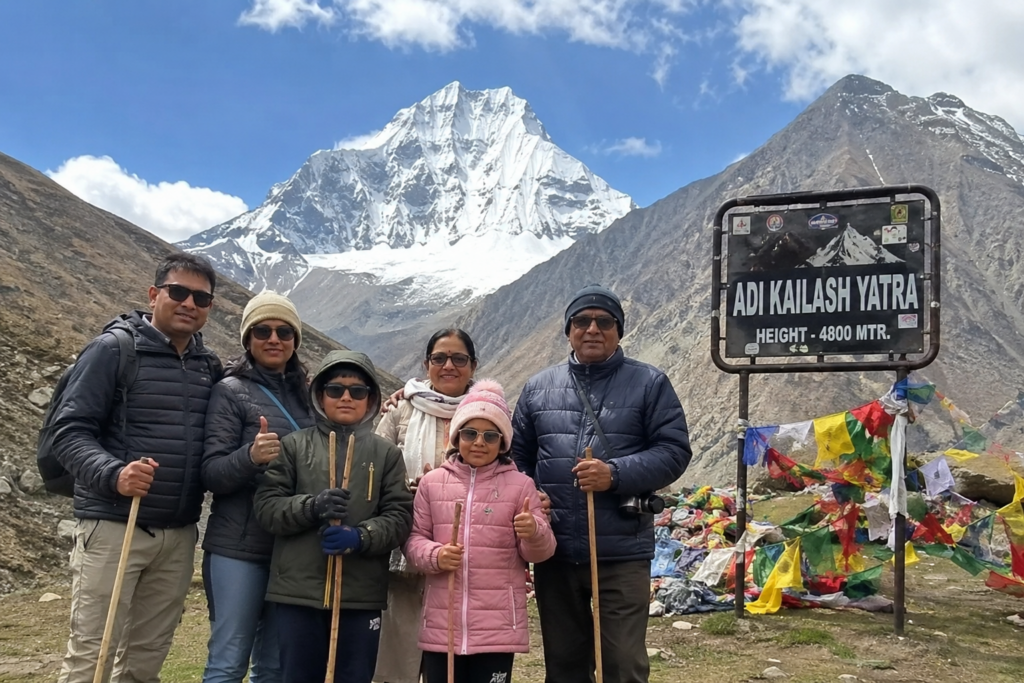
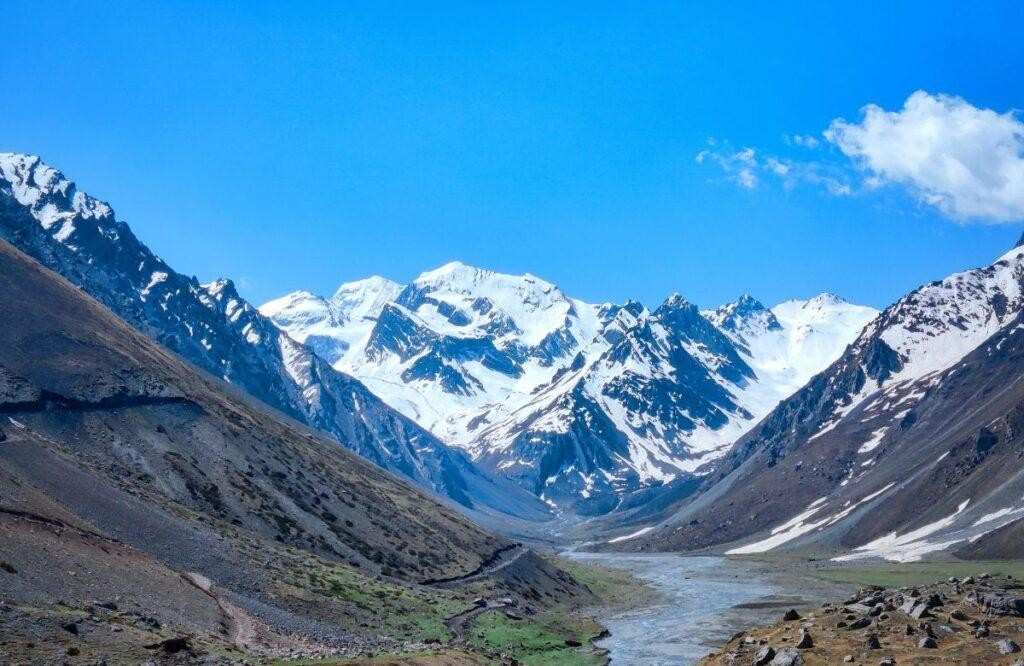
Adi Kailash Yatra Gallery
A glimpse of the beauty that awaits you on the trail.
What Our Yatris Say About Adi Kailash Yatra
Trusted by 500+ yatris — real reviews from pilgrims who completed the Adi Kailash Om Parvat Yatra with Mountainiax.
“Adi Kailash ka anubhav shabd mein nahi likha ja sakta. Mountainiax ki team ne sab kuch bahut achha manage kiya. ILP se lekar meals tak — seamless!”
Ramesh Sharma
- Delhi • 52 yrs
“Om Parvat darshan aur Parvati Sarovar — life-changing experience. Snow mein OM symbol dekhna — ek alag hi feeling thi. Highly recommend!”
Priya Nair
- Bangalore • 34 yrs
“ILP process se leke stay tak sab kuch seamless tha. Best Adi Kailash Yatra operator. Humne 3 families ke saath yatra ki — sab khush the.”
Vikram Singh
- Dehradun • 45 yrs
“67 saal ke dada ji ke saath Adi Kailash gaye. Vehicle-based route hone se unke liye bhi comfortable tha. Bheem Ki Kheti aur Gauri Kund — unforgettable.”
Ananya Gupta
- Lucknow • 28 yrs
“Helicopter yatra li thi. Pithoragarh se aerial views of Adi Kailash — absolutely divine! Zero trekking, maximum darshan. Worth every rupee.”
Dr. Suresh Patel
- Mumbai • 61 yrs
“Kathgodam se pickup on time, Gunji mein guesthouse clean tha, khana ghar jaisa. Parvati Sarovar ke paas meditation karna — spiritual experience of a lifetime.”
Meena Devi
- Jaipur • 48 yrs
Frequently Asked Questions — Adi Kailash Yatra 2026
Explore detailed FAQs on Adi Kailash covering everything pilgrims need to know before planning the Chhota Kailash Yatra 2026, including registration process, ILP permit requirements, travel cost, opening dates, fitness preparation, packing essentials, accommodation, weather conditions, and transportation details.
Adi Kailash Yatra 2026 opening date kab hai?
Adi Kailash Yatra 2026 ka opening date 13 May 2026 hai. Season May se October tak chalta hai. ILP (Inner Line Permit) SDM Dharchula office se issue hota hai.
Kya Adi Kailash Yatra ke liye passport chahiye?
Nahi, Adi Kailash Yatra ke liye passport ki zaroorat nahi hai. Yeh yatra poori tarah se India mein hoti hai — Uttarakhand ke Pithoragarh district mein. Sirf Aadhaar card aur ILP chahiye.
Adi Kailash Yatra kitne din ka hai?
Adi Kailash Yatra ka cost ₹38,000 per person hai (6N/7D, Kathgodam to Kathgodam). ILP, meals, aur transport included hai. Helicopter yatra ₹1,45,000 per person hai alag se.
Adi Kailash aur Kailash Mansarovar mein kya fark hai?
Adi Kailash Uttarakhand mein hai — no passport, no visa, ₹21,000 se start. Kailash Mansarovar Tibet mein hai — passport + China visa zaruri, ₹2 lakh+ ka budget, 21–28 days duration. Adi Kailash zyada accessible aur affordable hai.
Kya yatra physically demanding hai?
Adi Kailash trek moderate difficulty ki hai. Zyada tar route vehicle se cover hota hai. Actual trekking sirf 2–7 km hai. 7 se 70 saal ke log yatra kar sakte hain. BMI normal range (18–29) mein hona chahiye.
Om Parvat bhi isi yatra mein aata hai?
Haan! Om Parvat darshan Adi Kailash Yatra ka ek important part hai. Nabidhang (4,300m) se Om Parvat ka view milta hai — jahaan snow mein natural OM symbol dikhta hai. Gunji se drive se Nabidhang 2–3 ghante mein pahunch sakte ho.
Booking kaise karein?
Website par booking form fill karein ya +91-6398937502 par WhatsApp/call karein. Hum 2 ghante mein confirm kar dete hain.
Adi Kailash mein actual trek kitna hai?
Road ban jaane ke baad actual trekking sirf 2–7km reh gayi hai. Gunji se Jolingkong tak vehicle se jaa sakte ho. Parvati Sarovar ke liye 1km aur Gauri Kund ke liye 2km optional trek hai. Yatra seniors aur families ke liye bhi comfortable hai — no long trekking required.
Adi Kailash Yatra ke liye age limit kya hai?
Minimum age 7 saal, maximum 70 saal. Physically fit hona zaruri hai. MBBS doctor ka medical certificate Dharchula mein submit karna hoga. Vehicle-based route hone se seniors bhi aasani se yatra kar sakte hain. BMI 18–29 ke beech hona chahiye.
Kya Adi Kailash Yatra helicopter se bhi ho sakti hai?
Haan! Helicopter se Adi Kailash Yatra Pithoragarh se available hai — zero trekking, aerial views of Himalayas, 4D/3N itinerary, ₹1,45,000 per person. Seniors aur time-constrained yatris ke liye best option. Call/WhatsApp karein booking ke liye.
Adi Kailash Yatra ke liye packing list kya hai?
Essential items: warm clothes (thermals, jacket, gloves, cap), waterproof trekking shoes, sunscreen SPF 50+, UV sunglasses, Aadhaar card (original), medical certificate, personal medicines, water bottle (1L+), power bank, torch. Mountainiax team booking ke baad detailed packing list send karta hai.
Adi Kailash Yatra ke liye ILP (Inner Line Permit) kaise milta hai?
ILP SDM Dharchula office se issue hota hai. Required documents: Aadhaar card/Voter ID, passport-size photos, medical fitness certificate. Humari team poori ILP processing assist karti hai — aapko sirf documents dene hain.
Kya Adi Kailash Yatra mein network/mobile signal milta hai?
Network connectivity limited hai. Dharchula tak BSNL aur Jio kaam karta hai. Gunji ke baad mostly no network. Satellite phones available hain emergency ke liye. Power bank zaroor carry karein.
Adi Kailash Yatra mein khaana kaisa milta hai?
Sabhi meals included hain — breakfast, lunch, dinner (vegetarian). Guest house/homestay mein garam khana serve hota hai. Nutritious aur hygienic food ensure kiya jaata hai taaki energy bani rahe.
Adi Kailash mein mausam kaisa hota hai?
May–June mein cool weather (5–15°C daytime). July–August monsoon mein heavy rain aur landslide risk. Sep–Oct mein crystal clear views, best photography weather. Raat ko temperature 0°C tak gir sakta hai — warm clothes zaruri hain.
Kathgodam tak kaise pahunchein?
Delhi se overnight train (Ranikhet Express, Shatabdi) ya bus (Anand Vihar ISBT se). Pantnagar Airport nearest hai (27 km). Self-drive bhi kar sakte hain (290 km, 6–7 hrs). Kathgodam station se humari team pickup karti hai 6:00 AM pe.
Bheem Ki Kheti kya hai?
Bheem Ki Kheti (Bheem’s Field) Adi Kailash route par ek mythological site hai. Mahabharata ke anusar, vanvaas ke dauraan Pandavon ne yahan samay bitaya tha. Bheem ne is zameen ko jota tha — ancient stone formations aaj bhi dikhte hain.