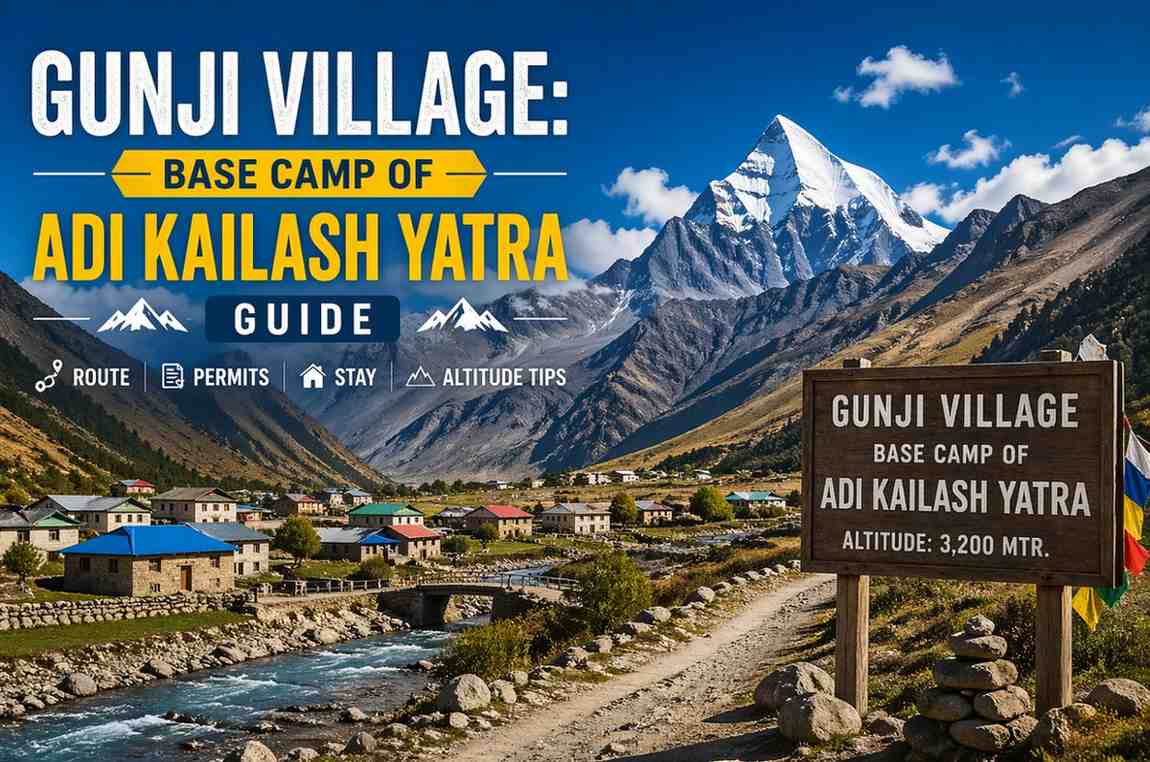
Tucked deep in the Pithoragarh district of Uttarakhand, Gunji Village sits at an elevation of approximately 3,200 metres above sea level, surrounded by some of the most dramatic Himalayan terrain in India. For anyone planning the sacred Adi Kailash Yatra, this remote settlement is far more than just a waypoint on the map. It is where the journey truly begins to feel real, raw, and deeply spiritual.
Most travellers encounter the name Gunji briefly in itinerary lists, but rarely do guides pause to honour what this village actually represents. Gunji is the beating heart of the entire yatra circuit. It houses the last government check post before the high-altitude passes, serves as the primary acclimatisation zone, and connects pilgrims to sacred sites that most first-timers never knew existed.
This complete Gunji Village: Base Camp of Adi Kailash Yatra Guide is written for serious trekkers, pilgrims, and Himalayan explorers who want to understand not just where Gunji is, but what it demands of you, what it offers in return, and how to make the most of your time there. Whether you are travelling solo, with a group, or on an organised yatra package, this guide will prepare you properly.
Where Is Gunji Village and How Do You Get There
Gunji Village is located in the Byans Valley of Pithoragarh district, in the Kumaon Himalayas of Uttarakhand. It sits along the route connecting Dharchula to Lipulekh Pass, historically part of the ancient Kailash Mansarovar trade route.
The most common route to Gunji follows this road corridor:
- Delhi to Kathgodam by train or road
- Kathgodam to Pithoragarh by road (approximately 5 to 6 hours)
- Pithoragarh to Dharchula by road (approximately 4 hours)
- Dharchula to Gunji by road via Tawaghat, Narayana Ashram, Sosa, Gala, and Budhi (approximately 70 km, roughly 5 to 6 hours depending on road conditions)
The road beyond Dharchula passes through some genuinely remote terrain. It winds along the Kali River gorge, crosses landslide-prone sections, and passes through several small villages. Between June and September, the ITBP (Indo-Tibetan Border Police) maintains check posts along the way, and all travellers require valid Inner Line Permits (ILP) to proceed.
KMOU (Kumaon Motor Owners Union) buses and shared jeeps operate on this route, but for the Adi Kailash Yatra, most yatris either use organised transport through KMVN (Kumaon Mandal Vikas Nigam) or private operators.
What to Expect When You Arrive at Gunji
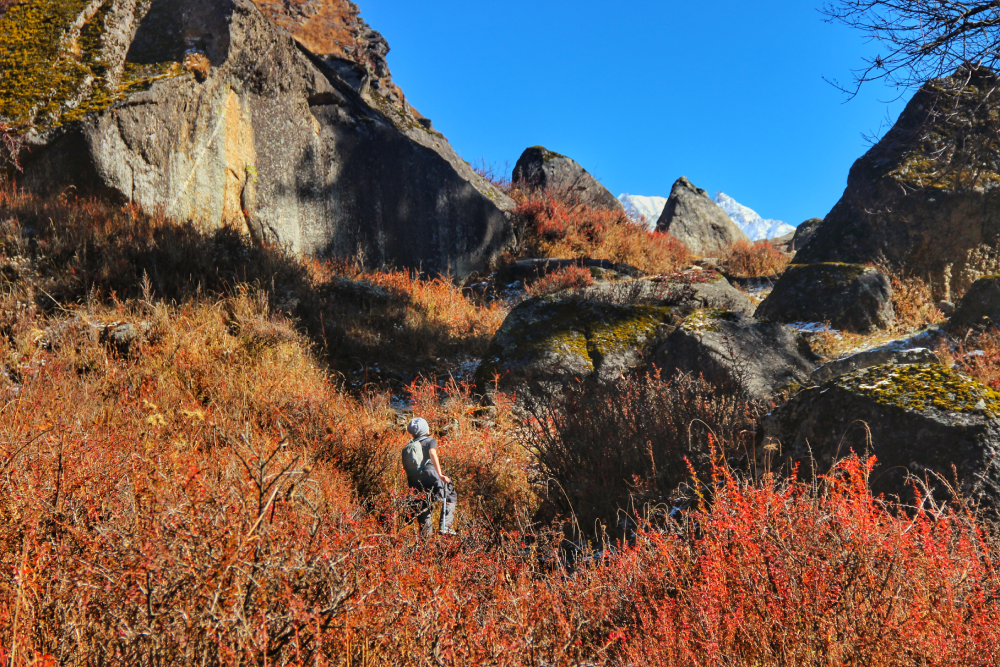
Arriving in Gunji for the first time is a moment that stays with pilgrims long after the yatra ends. The village is small, with a population that swells dramatically during the June to September yatra season. What greets you is a landscape of extraordinary power: the Kali River rushing below, snow-capped peaks rising on all sides, and an atmosphere charged with both physical remoteness and spiritual significance.
Here is what first-time visitors typically encounter:
The check post and permit verification. Gunji has a key ITBP and district administration check post. All pilgrims must present their Inner Line Permits and government-issued photo ID here. This is non-negotiable and delays happen, so keep documents easily accessible.
Limited but functional infrastructure. Gunji has basic dharamshalas, KMVN guest house facilities, government circuit houses, and small private lodges. Power supply can be inconsistent. Mobile connectivity is sparse, with BSNL being the most reliable network in this region.
An altitude adjustment. At 3,200 metres, the air is noticeably thinner than at Dharchula (approximately 915 metres). If you have driven up quickly, symptoms of mild altitude sickness, such as headache, fatigue, or breathlessness, may begin here. This is entirely expected and manageable with rest.
The unmistakable energy of a pilgrimage hub. During peak season, Gunji buzzes with groups of yatris, ITBP personnel, KMVN staff, local traders, mule owners, and porters. There is a distinct atmosphere that blends the practical with the sacred.
Accommodation Options in Gunji Village
Given its role as the operational base camp of the Adi Kailash Yatra, Gunji has a range of accommodation options, though none could be described as luxurious. Expectations should be calibrated accordingly.
KMVN Tourist Rest House: The most reliable option for travellers on KMVN-organised yatras. Rooms are basic but clean, with attached or shared toilets. Meals are usually included in the yatra package price. Bookings are typically made in advance as part of the official yatra registration process.
Government Circuit Houses and Forest Rest Houses: Available for certain categories of travellers, including government officials and sometimes pilgrims with prior permission. These are the best-maintained facilities in Gunji.
Private Lodges and Dharamshalas: A handful of small private establishments offer rooms and dormitory beds. These are more flexible in availability but vary in quality. Prices are modest by any standard, often between 300 and 800 rupees per night during the season.
Tent Accommodation: Some operators set up temporary tented camps during the peak season. This is particularly useful when the village accommodation is full, which can happen during festival periods or when large yatra groups arrive simultaneously.
A practical tip: if you are travelling independently rather than through KMVN, call ahead through local contacts or Dharchula-based travel operators to confirm availability. Gunji does not have a functioning online booking system for most of its accommodation.
Gunji Village in the Context of the 2026 Yatra Season
The 2026 Adi Kailash Yatra season is expected to see continued strong interest following recent years of high pilgrimage demand. The Uttarakhand government and KMVN have been steadily improving infrastructure along the route, including road maintenance, solar power installations at some rest stops, and expanded medical outposts.
For those considering Adi Kailash Yatra by Helicopter 2026, Gunji’s role shifts slightly. Helicopter services typically operate between Dharchula or Pithoragarh and points closer to the sacred sites, but Gunji remains the ground-level hub for the circuit. Even helicopter yatris often spend a night here for acclimatisation and permit completion before proceeding.
Registration for the 2026 season through KMVN typically opens in early spring. Book early, particularly for KMVN rest house accommodation in Gunji, as capacity fills quickly during peak season windows of June, July, and early September.
Food Availability at Gunji: What You Can Realistically Expect
Food at Gunji is simple, filling, and sufficient. Do not arrive expecting a varied menu or restaurant-style service. The village runs on dal, rice, roti, sabzi, and chai, and honestly, after the journey from Dharchula, that is exactly what your body needs.
Dhaba-style setups operate during the yatra season, offering:
- Dal rice and sabzi (the staple of every meal)
- Aloo parathas in the morning
- Maggi noodles as a quick snack
- Chai and hot water are available almost continuously
- Glucose biscuits, dry fruits, and basic packaged snacks from small shops
Those on KMVN packages have meals arranged at the rest house, which usually means two or three meals a day with adequate portions. The cooking at these rest houses is straightforward, North Indian vegetarian fare.
One practical recommendation: carry personal nutrition supplements, energy bars, electrolyte sachets, and any dietary-specific foods from Pithoragarh or Dharchula. Once beyond Gunji, options narrow further. Also note that alcohol is not permitted in the yatra zone, and this is enforced at the check posts.
Acclimatisation at Gunji: Why You Cannot Skip This Step
Acclimatisation at Gunji is not optional. It is one of the most important safety decisions you will make on the entire yatra. The jump from Dharchula at 915 metres to Gunji at 3,200 metres is significant, and most standard itineraries include a rest day here for very good reason.
Your body needs time to adjust to reduced oxygen levels at altitude. Rushing this phase increases the risk of Acute Mountain Sickness (AMS), which in severe cases can escalate to High Altitude Pulmonary Oedema (HAPE) or High Altitude Cerebral Oedema (HACE). These are serious medical emergencies, and medical facilities beyond Gunji are extremely limited.
Acclimatisation tips for your time at Gunji:
- Rest on arrival day. Do not push for sightseeing on the day you arrive. Let your body settle.
- Hydrate consistently. Drink at least three to four litres of water daily. Avoid caffeine and carbonated drinks.
- Walk gently but do not idle. Short, slow walks around the village help your body adapt without overexerting.
- Monitor yourself and your group. Persistent headache, nausea, confusion, or loss of coordination are warning signs. Descend immediately if symptoms worsen.
- Do not take sleeping pills or strong sedatives. These can mask AMS symptoms and suppress breathing at night.
- Carry and know how to use Diamox (Acetazolamide) if prescribed by a doctor before departure.
The Final Stop Before Adi Kailash is as much a physical preparation zone as it is a geographical waypoint. Your experience on the mountain will be directly shaped by how seriously you treat your time in Gunji.
Nearby Sights and Sacred Spots Around Gunji
One of Gunji’s most underappreciated aspects is its proximity to remarkable spiritual and natural sites. Many pilgrims who arrive exhausted and treat Gunji purely as a rest stop miss experiences that are genuinely worth the detour.
Vyaas Gufa (Vyas Cave)
Located a short distance from Gunji, Vyaas Gufa is a sacred cave associated with the sage Vyas, the legendary compiler of the Mahabharata and the Puranas. The cave sits along the ancient trade and pilgrimage route and holds immense religious significance for Hindus. Local belief holds that Vyas meditated here during his journeys through this high-altitude corridor.
The walk to Vyaas Gufa is manageable for most pilgrims and offers a beautiful introduction to the landscape surrounding Gunji. The trail passes through rocky terrain with views of the surrounding peaks. It is an ideal acclimatisation walk that doubles as a deeply meaningful spiritual experience.
Kaali Mandir
The Kaali Mandir near Gunji is one of the most visited sacred sites in the Byans Valley. Dedicated to Goddess Kali, the temple is deeply revered by local communities and visiting pilgrims alike. It is believed to be one of the oldest temples in this remote corridor, and its position against the stark mountain backdrop gives it an atmosphere of raw spiritual intensity.
Pilgrims typically visit the Kaali Mandir early in the morning before continuing further on the yatra route. Offerings of flowers, incense, and coconut are common. The temple premises are modest but well-maintained by local devotees and the ITBP personnel stationed nearby.
Ganesh Parvat Viewpoint
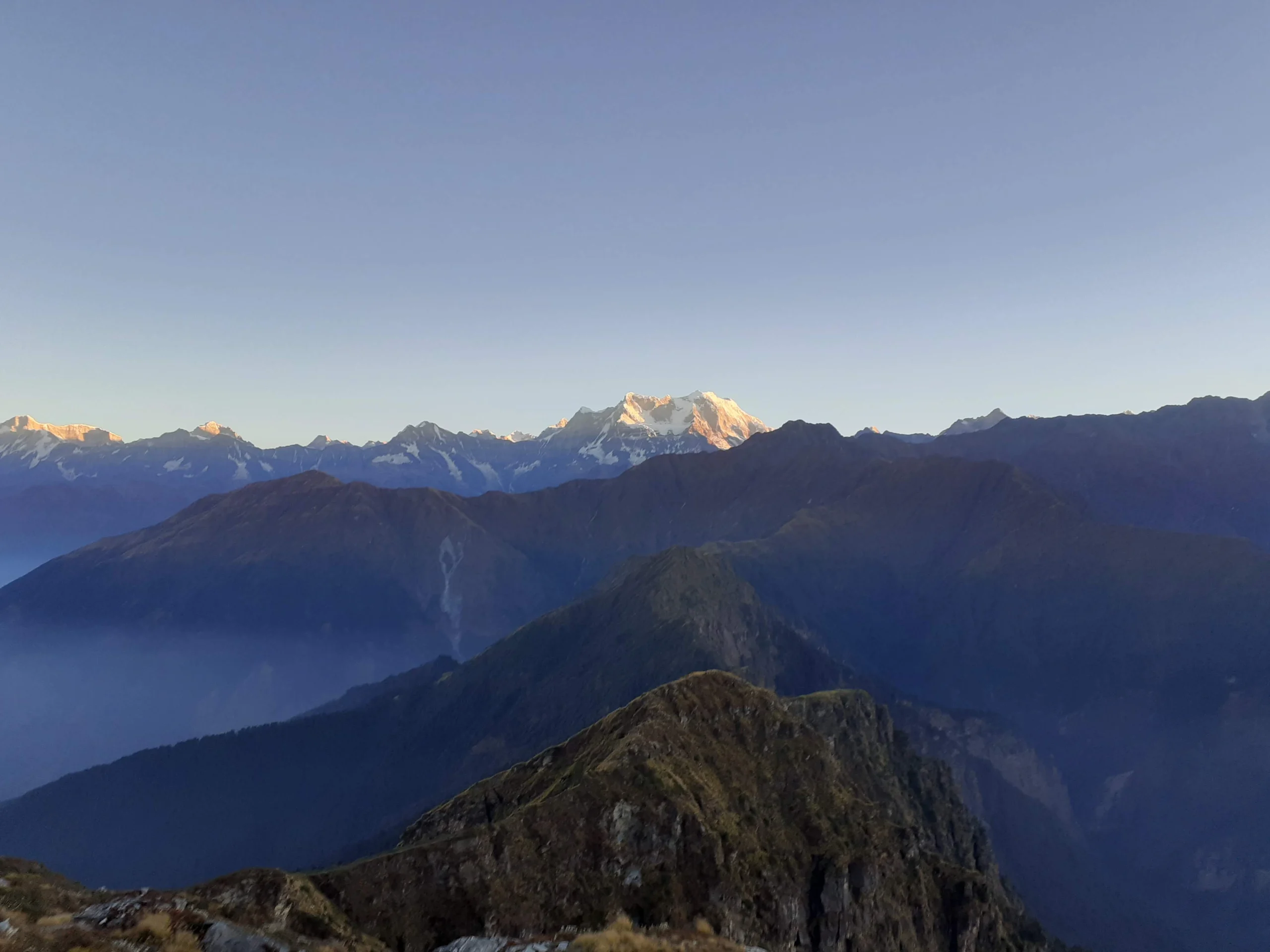
For those who love mountain photography and panoramic vistas, the Ganesh Parvat viewpoint near Gunji is outstanding. Ganesh Parvat, a striking Himalayan peak visible clearly from this region, dominates the skyline and provides one of the most dramatic mountain views on the entire Adi Kailash route.
The best time to visit the viewpoint is at sunrise, when the early light turns the snow-covered summit golden. Even seasoned Himalayan travellers find this sight genuinely moving. Carry a warm layer and arrive before dawn for the full effect.
Gunji as the Operational Nerve Centre of the Adi Kailash Yatra
Understanding why Gunji is the operational base of the yatra requires looking at both its geography and its logistics.
From Gunji, the route splits to serve multiple sacred destinations. The path to Om Parvat (at approximately 4,900 metres) and the Adi Kailash trek (reaching up to 5,945 metres in the surrounding region) both flow through this village. All supplies, porter arrangements, mule logistics, and permit verifications are managed through or from Gunji.
The KMVN and ITBP both maintain operational infrastructure here. Medical assistance, if required, is coordinated through the ITBP station. Emergency evacuation, when necessary, begins here. Communications to Dharchula and Pithoragarh are routed through this node.
For those exploring What to Expect on Your First Adi Kailash Yatra, understanding Gunji’s central role transforms your entire preparation strategy. You stop thinking of it as a transit village and start recognising it as a command centre that keeps the yatra functioning safely.
Practical Tips for Your Stay in Gunji
- Carry cash in small denominations. There are no ATMs beyond Dharchula.
- Pack a quality sleeping bag rated to minus 10 degrees Celsius at minimum. Nights at 3,200 metres get cold even in summer.
- Bring water purification tablets or a filter bottle. Tap water quality in the village should not be assumed safe.
- Keep a headlamp with spare batteries. Power outages are common at night.
- Register your presence with the ITBP check post on arrival. This is mandatory and also serves as a safety measure.
- Respect local customs and dress modestly, particularly near the temples.
- Do not litter. The Byans Valley ecosystem is fragile. Pack out everything you pack in.
FAQs: Gunji Village and the Adi Kailash Yatra
1. What is the altitude of Gunji Village? Gunji Village sits at approximately 3,200 metres (10,500 feet) above sea level in the Byans Valley of Pithoragarh district, Uttarakhand.
2. Is Gunji the last village before Adi Kailash? Gunji is the primary base camp and operational hub. The route continues through Nabhidhang and further toward Om Parvat and the Adi Kailash region. Gunji is not the final village but is the last significant settlement with organised accommodation and facilities.
3. Do I need a permit to enter Gunji? Yes. All travellers beyond Dharchula require an Inner Line Permit (ILP), obtainable from the District Magistrate’s office in Pithoragarh or through authorised yatra operators. Foreign nationals have additional restrictions in this border region.
4. How many days should I spend at Gunji? Most itineraries include one to two nights at Gunji for acclimatisation. If you feel any symptoms of altitude sickness, extend your stay until symptoms fully resolve.
5. Is mobile connectivity available in Gunji? BSNL has the strongest signal in this region. Other networks are largely unreliable. Satellite phones are available with some yatra operators for emergencies.
Summary
This guide to the Gunji Village: Base Camp of Adi Kailash Yatra Guide has walked you through everything that matters — from the logistics of getting there and the realities of accommodation and food, to the sacred sites surrounding the village and the critical importance of acclimatisation. Gunji is not just a stop on a map. It is where the Adi Kailash pilgrimage truly takes shape, where the mountains begin to demand your full attention, and where the spiritual weight of the journey becomes impossible to ignore.
If you are serious about experiencing the Adi Kailash Yatra safely and deeply, give Gunji the time and respect it deserves. Prepare your body, prepare your documents, and prepare your spirit. The sacred peaks ahead have been drawing pilgrims for thousands of years, and Gunji has always been where those pilgrims paused, gathered themselves, and stepped forward.
With the Adi Kailash Yatra season approaching, it’s time to plan a journey that blends spirituality with raw Himalayan adventure. From sacred lakes to the divine presence of Adi Kailash, every moment feels profound and transformative. If you seek purpose beyond travel, this is your path.
Visit this page for Yatra Packages, Itinerary & Booking.