Choosing your first Himalayan adventure is one of the most exciting decisions you will ever make as a trekker. The mountains of Nepal offer experiences that stay with you for a lifetime, but with so many iconic routes to choose from, narrowing it down can feel overwhelming. Two names dominate every conversation about Nepal trekking: Annapurna Base Camp and Everest Base Camp. Both are legendary. Both are life-changing. But they are very different journeys.
In the debate of Annapurna Base Camp vs Everest Base Camp, there is no universally right answer. The better question is: which one is right for you, right now? Your fitness level, available time, budget, desired scenery, and trekking experience all play a role in making this call. This article breaks down everything you need to know to make a confident, informed decision.
Whether you are a first-time Himalayan trekker or someone who has explored trails across the world, this comparison will give you an honest, detailed picture of both routes so you can plan your Nepal trek with clarity and confidence.
Overview: What Are These Treks?
Before diving into the comparison, it helps to understand what each trek actually involves at a basic level.
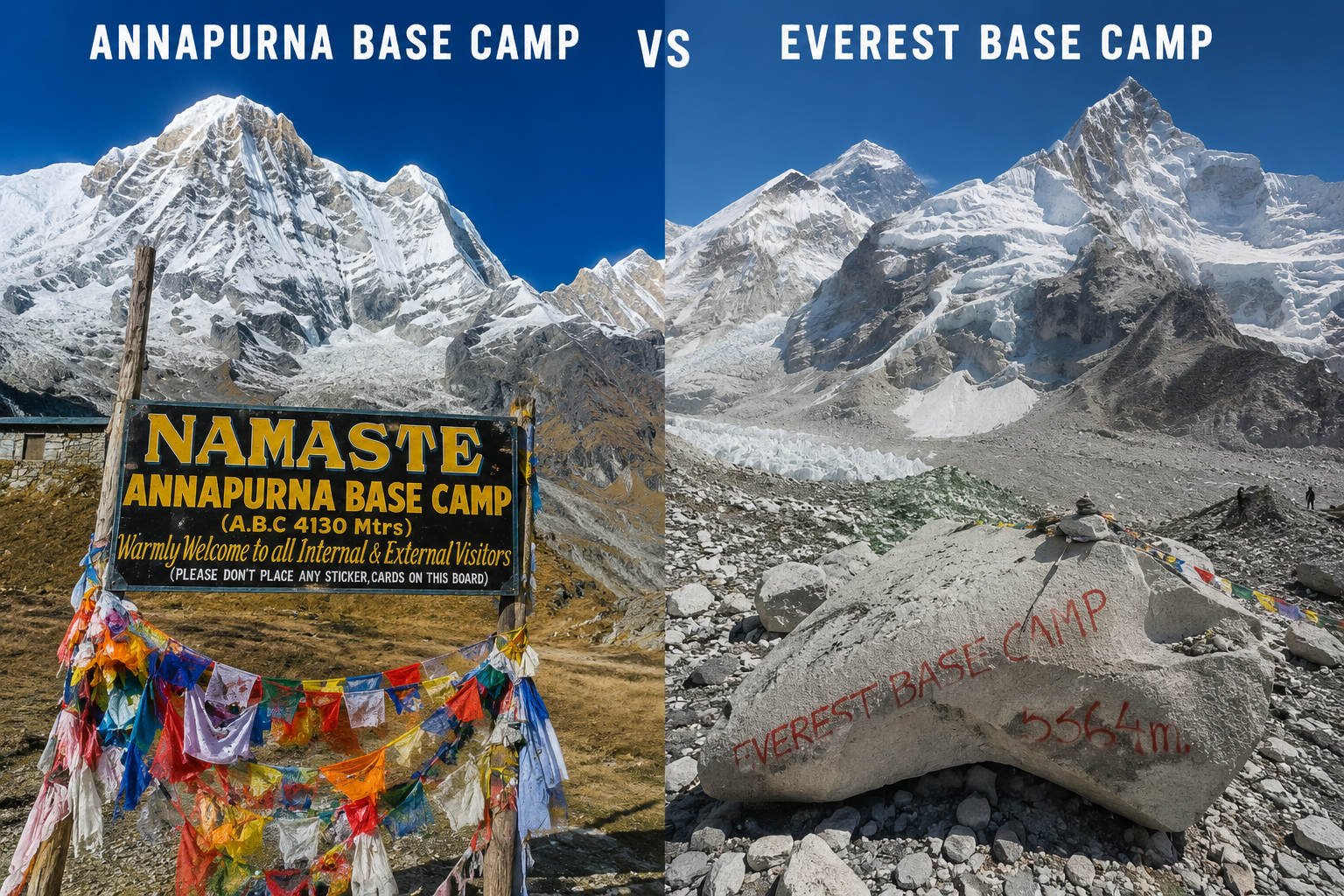
Annapurna Base Camp Trek (ABC) is a circuit that takes you deep into the Annapurna Sanctuary, a natural amphitheatre surrounded by some of the world’s highest peaks including Annapurna I (8,091m), Machapuchare (6,993m), and Hiunchuli (6,441m). The base camp sits at approximately 4,130 metres above sea level.
Everest Base Camp Trek (EBC) follows the iconic Khumbu Valley route through Sherpa villages, Buddhist monasteries, and dramatic high-altitude terrain to reach the base of the world’s tallest mountain, Mount Everest (8,849m). The base camp is at 5,364 metres, making it significantly higher than ABC.
Both treks are considered classic Himalayan trekking experiences and are among the most popular routes in the world.
Difficulty Level: Which Trek Is Harder?
This is usually the first question trekkers ask, and the answer matters enormously if you are planning your very first Himalayan adventure.
Annapurna Base Camp: Moderate Difficulty
The ABC trek is widely regarded as moderately challenging. You will deal with steep ascents and descents, especially in the lower rhododendron forests and gorge sections, but the altitude gain is gradual and manageable. The highest point, ABC itself at 4,130m, is demanding but not extreme. Most reasonably fit trekkers with no prior high-altitude experience can complete it with proper preparation.
Key difficulty factors for ABC:
- Maximum altitude: 4,130 metres
- Daily walking hours: 5 to 7 hours on average
- Terrain: Forest trails, stone steps, rhododendron paths, open ridgelines
- Altitude sickness risk: Moderate, manageable with acclimatisation days
Everest Base Camp: Strenuous Difficulty
EBC is considerably harder. The altitude alone separates it from most other treks in Nepal. You will sleep at altitudes above 4,000 metres for several consecutive nights and spend your final push approaching 5,364 metres. Altitude-related symptoms are common, and acclimatisation days in places like Namche Bazaar and Dingboche are essential, not optional.
Key difficulty factors for EBC:
- Maximum altitude: 5,364 metres (Kala Patthar at 5,545m if you include the popular viewpoint)
- Daily walking hours: 5 to 8 hours on average
- Terrain: Rocky paths, glacial moraines, suspension bridges, high ridgelines
- Altitude sickness risk: High, especially above Namche Bazaar
Verdict: If you are a first-time high-altitude trekker, ABC is the safer and more accessible starting point. EBC demands more experience, physical preparation, and altitude awareness.
Duration: How Much Time Do You Need?
Time is often the deciding factor, particularly for trekkers flying in from India or other parts of South Asia with limited vacation windows.
Annapurna Base Camp typically takes 10 to 14 days for a comfortable round trip from Pokhara, including acclimatisation time and buffer days for weather. A faster version can be done in 8 to 10 days, though this is not recommended for beginners.
Everest Base Camp typically requires 12 to 16 days from Lukla, the standard entry point for the Khumbu region. Rushing EBC is one of the most common mistakes trekkers make and is often responsible for altitude sickness cases that cut trips short.
If you are planning an Annapurna Base Camp Trek from India, the logistical timeline is actually more manageable than many trekkers expect. Pokhara is well-connected from major Indian cities via Kathmandu, and the trek start point at Nayapul or Phedi is only an hour from Pokhara. You can realistically plan a 14 to 16-day trip from India that includes travel, acclimatisation, and the full trek without feeling rushed.
Scenery and Landscapes: What Will You See?
Both treks deliver breathtaking landscapes, but the character of the scenery is completely different.
Annapurna Base Camp: Lush, Intimate, and Dramatic
ABC is a feast of variety. You start in subtropical lowlands and climb through dense rhododendron forests (spectacular from February to April), bamboo groves, and Gurung villages before entering the stark, icy grandeur of the Annapurna Sanctuary. The 360-degree mountain panorama at base camp, surrounded by giants on every side, is one of the most dramatic natural views in the Himalayas. Machapuchare, the Fishtail Mountain, is a constant companion on this trek and is arguably one of the most beautiful peaks in all of Nepal.
Everest Base Camp: Raw, High, and Iconic
EBC landscapes are bigger, more barren, and intensely powerful. As you climb through Namche Bazaar, Tengboche, and Lobuche, the terrain becomes increasingly raw. The Khumbu Glacier is one of the world’s largest glaciers, and the sight of Everest’s Southwest Face from Base Camp or the summit views from Kala Patthar are simply unlike anything else on earth. This trek has a weight to it, a sense of scale and history that is difficult to describe until you are standing in the middle of it.
Cost: Which Trek Is More Budget-Friendly?
Budget matters, and ABC has a clear advantage here.
Annapurna Base Camp Approximate Costs (Excluding International Flights)
- ACAP permit: NPR 3,000 (approximately USD 22)
- TIMS card: NPR 2,000 (approximately USD 15)
- Tea house accommodation and meals: USD 20 to 40 per day
- Guide and porter (recommended): USD 25 to 40 per day combined
- Total estimated trek cost: USD 500 to 900 for 12 days
Everest Base Camp Approximate Costs (Excluding International Flights)
- Sagarmatha National Park permit: NPR 3,000
- Khumbu Pasang Lhamu Rural Municipality permit: NPR 2,000
- Flight Kathmandu to Lukla (return): USD 350 to 500
- Tea house accommodation and meals: USD 25 to 60 per day (prices increase with altitude)
- Guide and porter: USD 30 to 50 per day combined
- Total estimated trek cost: USD 1,200 to 2,000 for 14 days
The Lukla flight alone adds a significant cost to EBC. For trekkers on a tighter budget, ABC delivers equal if not greater scenic reward at a much lower price point.
Permits and Visa Requirements
Both treks require permits, and for Indian and international trekkers, understanding the Nepal Visa for Indians process is useful before you begin planning. Indian nationals do not need a visa to enter Nepal, which is a major logistical and financial advantage over other international trekkers. You only need a valid Indian passport or voter ID card to cross into Nepal.
For international trekkers from other countries, Nepal offers visa on arrival at Tribhuvan International Airport in Kathmandu, available for 15, 30, and 90-day stays. For EBC trekkers, ensure your visa duration covers your full itinerary including travel days.
For ABC, you need the Annapurna Conservation Area Permit (ACAP) and a TIMS (Trekkers’ Information Management System) card. For EBC, you need the Sagarmatha National Park permit and the Khumbu Pasang Lhamu Rural Municipality entry permit.
Tea Houses and Accommodation
Both routes are well-serviced with tea house accommodation, meaning you do not need to carry a tent or cooking gear.
On the ABC Route
Tea houses are generally comfortable, warm, and affordable. Lower-altitude lodges often have attached bathrooms, hot showers, and even Wi-Fi. At base camp level, facilities are more basic but perfectly adequate for a one or two-night stay.
On the EBC Route
Tea houses are excellent in Namche Bazaar and Lukla but become progressively more basic as you gain altitude. At Gorak Shep, the closest tea house stop to base camp, conditions are cold, food options are limited, and prices are notably higher. Electricity and charging facilities often come at an extra fee at high altitudes.
Which Trek Should You Do First?
Here is a straightforward summary to help you decide:
Choose Annapurna Base Camp First If:
- You are new to high-altitude trekking
- You have 10 to 14 days available
- You want diverse scenery including forests, villages, and mountain views
- You are trekking on a moderate budget
- You want a full Himalayan experience without extreme altitude risk
- You are travelling from India and want a more logistically simple trip
Choose Everest Base Camp First If:
- You have prior high-altitude trekking experience
- You have 14 to 16 days or more available
- Standing at the base of the world’s highest mountain is your primary goal
- You are comfortable managing altitude sickness risks proactively
- Budget is not a primary concern
For most first-time Nepal trekkers, the advice from experienced mountaineers and guides consistently points the same way: start with ABC. It builds your confidence, tests your body’s response to altitude, and delivers one of the most complete trekking experiences in the Himalayas. Then, return to Nepal and tackle EBC with real-world high-altitude experience behind you. Many seasoned trekkers describe this sequence as the perfect Himalayan education.
Best Time to Go
Timing your trek correctly can make the difference between a life-changing experience and a frustrating weather-bound trip. The Best Time to Trek Annapurna Base Camp is from October to November and from March to May. These pre-monsoon and post-monsoon windows offer clear skies, stable weather, and the most reliable mountain views. March and April bring rhododendron blooms that transform the lower forests into a blaze of pink and red, a sight not to be missed.
The Everest Base Camp trek follows a similar seasonal pattern. October and November are peak season with crystal-clear skies and firm trails. Spring (March to May) is also excellent and coincides with the Everest climbing season, meaning you may spot expedition teams preparing their summit bids at base camp.
Monsoon season (June to September) brings heavy rainfall, leeches on lower trails, and poor visibility on both routes. Winter (December to February) is possible but cold, with high passes on EBC potentially closed due to snowfall.
FAQ: Annapurna Base Camp vs Everest Base Camp
1. Which is easier, Annapurna Base Camp or Everest Base Camp?
Annapurna Base Camp is easier. It reaches a maximum altitude of 4,130 metres compared to EBC’s 5,364 metres, making it more accessible for beginners and first-time high-altitude trekkers.
2. Can beginners do the Everest Base Camp trek?
Yes, but preparation is essential. EBC is not technically difficult in terms of climbing skills, but the altitude is a serious challenge. Beginners should train for 3 to 4 months beforehand and must not rush acclimatisation days.
3. How many days is the Annapurna Base Camp trek?
A comfortable ABC trek takes 10 to 14 days round trip from Pokhara, including acclimatisation and rest days.
4. Is a guide necessary for both treks?
A guide is not officially mandatory for either trek, but one is strongly recommended, especially for EBC. A good guide manages your safety, handles logistics, and enriches your cultural understanding of the region.
5. Which trek has better mountain views?
Both are extraordinary. ABC offers an intimate 360-degree amphitheatre of peaks at base camp. EBC offers the raw power of Everest, with Kala Patthar providing arguably the best summit-level view of the mountain.
Conclusion
Both Annapurna Base Camp and Everest Base Camp represent the very best of Himalayan trekking, but they speak to different trekkers at different stages of their journey. ABC welcomes you with warmth, variety, and an altitude that challenges without overwhelming. EBC commands respect, demands preparation, and rewards you with the singular feeling of standing at the foot of the world’s highest peak.
If you are standing at the crossroads trying to decide, think of it this way: ABC is where great trekkers are made, and EBC is where they prove themselves. Doing them in that order is not taking the easy route. It is taking the smart one.
Nepal has a way of getting under your skin. Most trekkers who complete one of these routes do not stop there. They come back, lace up again, and go higher. Whichever trail you choose first, know this: the mountains will stay with you long after you have left them behind.
With the Annapurna Base Camp Trek 2026 season approaching, now is the perfect time to plan an unforgettable Himalayan adventure. Surrounded by snow-covered peaks, diverse landscapes, and authentic mountain culture, the Annapurna Base Camp Trek offers an experience far beyond an ordinary trek—it becomes a lifetime memory filled with challenge, beauty, and achievement. To make your journey smooth, safe, and well-organised, choose a trusted trekking company for expertly designed trek packages, detailed itineraries, and hassle-free booking assistance.
Visit this page for Trek Packages, Itinerary & Booking.