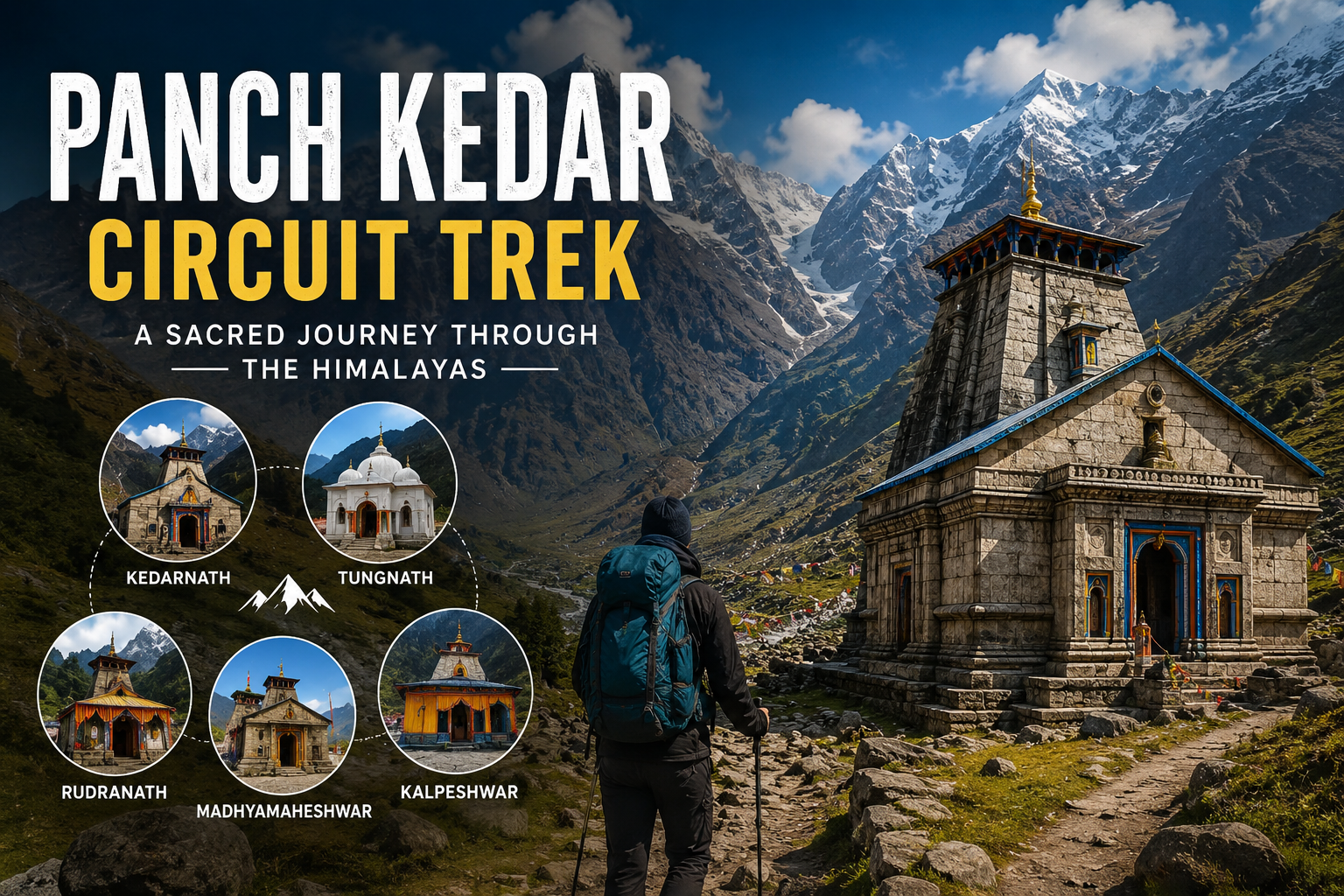
There are treks you complete, and then there are treks that complete you. The Panch Kedar Circuit Trek belongs firmly in the second category. Covering five sacred Shiva temples scattered across the remote ridgelines of the Garhwal Himalayas, this is not simply a pilgrimage or a trail — it is a weeks-long conversation between you and the mountains, conducted in silence, sweat, and occasional tears.
At Mountainiax, we have walked this circuit multiple times across different seasons, with different groups, carrying different emotional weights. Every time, the mountains reveal something new. Not about themselves — but about the people walking through them. This is our honest account: the raw, unfiltered Panch Kedar trek experience that no route map or itinerary will ever fully prepare you for.
This is not a checklist. This is a diary. And if you are sitting on the fence about whether to attempt the circuit, we hope the next few thousand words settle it — one way or another.
Before You Even Begin: What You Should Know Honestly
Let’s get the fundamentals out in the open before the stories start.
The Panch Kedar yatra covers five temples: Kedarnath, Tungnath, Rudranath, Madhyamaheshwar, and Kalpeshwar. Each holds a different physical form of Lord Shiva — from the hump (Kedarnath) to the hair (Kalpeshwar). Together, they form one of the most spiritually and physically demanding pilgrimage treks in India.
The typical circuit spans 14 to 18 days, depending on your route sequencing and rest days. Total trekking distance falls between 160 and 180 kilometres. You will gain and lose elevation repeatedly, sleep in thin-walled dhabas and tents at altitude, and go without mobile signal for stretches that feel both terrifying and liberating.
Panch Kedar trek difficulty is real but often misunderstood. It is not the individual stages that break people — most single days are manageable. It is the accumulation: day after day of ascent, descent, altitude adjustment, and emotional intensity. The circuit demands genuine preparation and honest self-knowledge. Not just fitness. Willingness.
Day 1 to 3: The Bells of Kedarnath at 4 am
We always begin the circuit with Kedarnath. Partly for logistical reasons — the helicopter and road access make it the most practical starting point — but mostly because Kedarnath sets the emotional tone for everything that follows.
We arrived at the temple town in late evening, altitude already nudging 3,583 metres. The dhaba was warm, the dal was oversalted, and no one complained. By 3:45 a.m., our guide Bhuvan knocked on the door. “Come,” he said simply.
We stepped into a darkness so complete it felt physical. The Mandakini river roared below. And then — the bells. Deep, rhythmic, rolling out from the temple in a frequency that you do not hear with your ears alone. There was no crowd yet. No phones. No queue. Just a small group of us, breath visible in the cold, standing before one of the oldest surviving Himalayan temples with a silence that felt earned.
That moment — 4 am at Kedarnath before the pilgrimage crowds arrived — is something no guidebook can hand you. You have to be awake for it. You have to be willing to be cold and uncertain and slightly overwhelmed. That is the price of the real Panch Kedar Uttarakhand experience, and it is worth every rupee and every training run you put in beforehand.
The trail from Gaurikund to Kedarnath (14 kilometres one way) is demanding but well-maintained. Pony services and palkis are available, but walking it gives you time to absorb the glacial valley, the waterfalls, and the slow shift in oxygen that humbles even experienced trekkers.
For trekkers who want to document this journey visually, our Panch Kedar Photography Guide covers everything from the ideal shooting windows at Kedarnath temple to managing camera gear in sub-zero conditions — a resource built from our own failures and eventual breakthroughs on this route.
Day 4 to 6: Tungnath and the Lesson of Chandrashila
After Kedarnath, the group dynamic shifts. People have seen the mountain now. Some are emboldened. Some are quietly recalibrating.
Tungnath at 3,680 metres is the highest Shiva temple in the world. The trail from Chopta (often called the mini-Switzerland of Uttarakhand) is a 3.5-kilometre ascent through rhododendron forest. In spring, the hillside is painted red and pink. In October, the trees are bare, and the wind cuts clean through every layer you think will be enough.
Chandrashila, just above Tungnath at 4,130 metres, is where many trekkers experience their first serious altitude awareness. Heart rate climbs disproportionately. Simple sentences require effort. One member of our group — a 34-year-old marathon runner from Pune — sat down at the summit and said nothing for twenty minutes. Not from discomfort. From impact.
On a clear day, the panorama includes Nanda Devi, Trishul, Kedarnath, Chaukhamba, and Bandarpunch. It is the kind of view that makes you feel both enormous and entirely irrelevant. Both feelings, strangely, are welcome.
Trek tip: The Chopta to Tungnath trail can get deceptively crowded on weekends, even in shoulder season. Starting before 7 am keeps the trail quieter and the light better.
Day 7 to 9: The Rudranath Trail and Two Days Without Signal
If Kedarnath is the heart of the Panch Kedar circuit, Rudranath is its soul — and its most demanding test.
Rudranath sits at 3,600 metres and is reached via a trail from Sagar village (near Gopeshwar). The route is roughly 20 kilometres one way and passes through high-altitude bugyal meadows, boulder fields, and stretches of total, absolute wilderness. For two days on this trail, we had no mobile signal. None.
That sounds minor until it is not. One member of our group had a family situation at home that she was anxious about. Another had an elderly parent. The silence of the mountains became loud in a different way. What our guide Bhuvan said on Day 8, when the mood had thickened into something heavier than altitude: “The mountains will tell you what is actually your worry and what is just noise. They do not lie to you the way cities do.”
Day 8 is where the circuit shows its real face. The panch kedar trek difficulty real impact arrives here — not in dramatic collapses but in quieter forms. Legs that refuse to cooperate on climbs. A mental flatness where even beautiful views feel like an obligation. Loss of appetite. The sense that you have been walking forever and will walk forever still.
This is the wall. Every long trek has one. The Panch Kedar circuit places it here, between Rudranath and the descent back to Sagar, when the body’s glycogen stores are depleted, and the novelty of the experience has faded into something rawer and more honest.
Our guides are trained specifically to recognise this phase. The tools are simple: a slower pace, more frequent rest stops, a cup of something hot, and — most importantly — someone saying “this is normal, this is the trek, this is not failure.” That conversation, held on a boulder somewhere above 3,200 metres with clouds below us and the Himalayan ridgeline ahead, changed the energy of the entire group.
Around Sagar, on the descent, we stopped at a small dhaba run by a woman named Asha. Rain had started in that sudden Himalayan way — no warning, no negotiation. A family from Barmer, Rajasthan, was already inside, sharing space on the wooden bench. The father was in his 60s and on his fourth Panch Kedar attempt. He had turned back at Rudranath twice before. This time, he had made it. He was eating rice with his hands and smiling at nothing in particular. That image stayed with us longer than any summit view.
Day 10 to 12: The Shepherd of Madhyamaheshwar
Madhyamaheshwar sits in a high valley at around 3,497 metres, flanked by the twin peaks of Kedarnath and Chaukhamba. The trail from Ransi village climbs steadily through oak and rhododendron forest before opening into a vast alpine meadow that feels like a secret the mountains kept for themselves.
Near the upper meadow, we met a man named Govind Singh — a Garhwali shepherd who, when asked how many times he had done the full Panch Kedar circuit, paused and genuinely tried to count. He arrived at twelve. Maybe thirteen. He had lost track.
He was not a guide. He was not trying to sell anything. He simply sat beside us and talked about the mountains the way people talk about family — with equal parts love and exasperation. He described Madhyamaheshwar as “the one that feels like home” and Rudranath as “the one that wants to know if you are serious.” He had walked the circuit in segments, in full, in different seasons. He had done it once with his son when the boy was twelve years old. The son is now married with children and has done the circuit himself.
That conversation, unrepeatable and unplanned, is the kind of panch kedar first-hand account that defines why people return to the Garhwal Himalayas again and again. The mountains do not just offer scenery. They offer encounters. With people. With your own limits. With something harder to name.
For those planning their visit carefully, knowing the Panch Kedar Darshan Timings for each temple is essential — opening hours vary by temple and season, and arriving outside these windows means missing the primary spiritual experience of the circuit. Our dedicated resource covers all five temples with verified timings, special puja schedules, and seasonal closure dates.
Day 13 to 15: Kalpeshwar and the Quiet Ending
Kalpeshwar is the gentlest of the five. Located in the Urgam Valley near Helang, it sits at a relatively modest elevation of around 2,200 metres. The short 8-kilometre trek through forested valley feels almost casual after what has come before.
But the gentleness is deliberate. Kalpeshwar is where the hair of Shiva is worshipped. The trail follows the Kalpganga river through a landscape that feels soft and forgiving — as though the mountains are offering a slow, considered farewell rather than a dramatic finale.
Most trekkers report a complex emotional state at Kalpeshwar. Relief, certainly. But also a strange reluctance. After two weeks in this landscape — the altitude, the cold, the shared meals and silences, the physical and spiritual intensity — re-entering ordinary life feels abrupt.
Our group stood outside the ancient cave shrine for a long time without speaking. The temple priest offered us prasad. A dog slept in a patch of afternoon sun. Someone laughed suddenly, for no obvious reason, and then everyone did.
That is what completing all five temples of the Panch Kedar yatra actually feels like. Not triumph. Not relief. Something quieter and more durable — the sense that you have been somewhere real and that it will take time to fully understand what happened to you there.
Was This Trek Right for Me? An Honest Reflection
We get asked this constantly. Here is our honest answer:
The Panch Kedar circuit trek is right for you if you are physically prepared to walk 12 to 16 kilometres on consecutive days with 600 to 1,200 metres of elevation gain, comfortable with basic camping or basic dhaba accommodation, and genuinely open to an experience that will challenge your emotional and psychological reserves as much as your legs.
It is not right for you if you are looking primarily for a tick-box pilgrimage experience or expecting the comfort and infrastructure of Kedarnath alone. The comparison between Panch Kedar vs Kedarnath experience is not really fair — Kedarnath, for all its power, is one temple with well-established infrastructure. The full circuit is a different category of commitment.
For those newer to multi-day Himalayan trekking, our complete Panch Kedar Trek for Beginners guide addresses fitness preparation, altitude management, budget planning, and what to realistically expect before you set out — a critical read before booking any dates.
Would we do it again? Without hesitation. Every time. The circuit does not get easier with repetition — but you get better at receiving what it offers.
Practical Tips From the Trail
- Best seasons: May to June and September to November. Avoid the monsoon (July to mid-August) for the exposed ridgeline sections.
- Guides are non-negotiable: Not because the trail is dangerous alone, but because what they carry — knowledge, pace judgment, local relationships — is irreplaceable on a circuit of this length.
- Pack for cold nights at every stop. Even in June, temperatures at Rudranath and Madhyamaheshwar campsites drop to 2°C to 5°C.
- Carry cash. ATMs thin out fast beyond Gopeshwar.
- Accept the dhaba food. Rajma chawal and aloo paratha at 3,500 metres tastes better than any restaurant meal you have ever had.
- Budget 16 to 18 days for the full circuit without rushing. The treks that go wrong are almost always the ones where someone was trying to save two days.
Frequently Asked Questions
1. How difficult is the Panch Kedar circuit trek really?
It is a moderate to challenging multi-day trek. Individual stages are manageable, but the cumulative effort over 14 to 18 days — repeated elevation gains, altitude exposure, and basic accommodation — makes it genuinely demanding. Honest physical preparation is essential.
2. Which is the hardest temple to reach among the Panch Kedar?
Most trekkers and guides identify Rudranath as the most physically and logistically challenging due to its remoteness, trail length, and limited infrastructure.
3. Can beginners attempt the full Panch Kedar circuit?
Not without specific preparation. Fit beginners who train seriously for over 2 to 3 months can complete the circuit, but it should not be the first multi-day trek someone attempts. Starting with Kedarnath or Tungnath individually is a smarter first step.
4. What is the best month for the Panch Kedar yatra?
September and October offer the best conditions — stable weather, clear skies, and post-monsoon trail clarity. May to early June is the second-best window, with rhododendrons in bloom.
5. Is the Panch Kedar trek better than Kedarnath alone?
They serve different purposes. Kedarnath alone is a powerful pilgrimage experience. The full circuit is a transformative, weeks-long journey. Both are valid. The full circuit is for those who want depth over convenience.
Summary
The Panch Kedar Circuit Trek is not something you do to say you did it. It is something you do because a part of you already knows it is necessary — and the mountains confirm that suspicion within the first two days. From the pre-dawn bells at Kedarnath to the silent meadows above Madhyamaheshwar, from the loneliness of the Rudranath trail to the unhurried grace of Kalpeshwar’s valley, this circuit offers a kind of depth that shorter treks simply cannot replicate.
Come prepared. Come honest. Come willing to be changed. The Garhwal Himalayas have been at this for a very long time. They know what they are doing.
With the Panch Kedar Yatra season approaching, it’s time to plan something truly extraordinary. From breathtaking Himalayan peaks to spiritually powerful temples hidden deep in remote valleys, this journey offers an experience that goes beyond a typical trek—it becomes a story you carry for life. To make your journey seamless and well-organised, choose the best trekking company in Uttarakhand for reliable trek packages, detailed itineraries, and hassle-free booking.
Visit this page for Trek Packages, Itinerary & Booking.