The Beginners Guide for five Kedars is one of the most searched pilgrimage-trekking queries in India right now — and the question behind it is completely valid. Five ancient Shiva temples scattered across the high Garhwal Himalayas, altitudes touching 3,680 metres, remote trails with no mobile signal, and a complete circuit that takes nearly three weeks. On paper, it sounds like something only seasoned trekkers attempt.
But here is the honest answer: yes, Beginner’s Guide to the Five Kedars — not necessarily all five legs in one go, but enough of it to make the journey spiritually complete and physically meaningful. The circuit is not a monolith. Each of the five temples has its own trail, its own difficulty, and its own demand on your body. Understanding those differences is what separates a well-planned first experience from a misguided one.
This guide gives you exactly that understanding — temple by temple, difficulty by difficulty, month by month — so you can walk in with clarity and walk out with a story worth telling.
The Five Temples, the Mythology, and What You Are Actually Signing Up For
The Panch Kedar is rooted in one of Hinduism’s most compelling post-war stories. After the Kurukshetra battle, the Pandavas sought Lord Shiva’s forgiveness for killing their own kinsmen. Shiva, unwilling to grant them an easy absolution, fled into the Garhwal Himalayas disguised as a bull. The Pandavas cornered him — but before they could reach him, his body submerged into the earth, reappearing at five separate locations. Each site became a temple, each enshrining a different body part of the divine form.
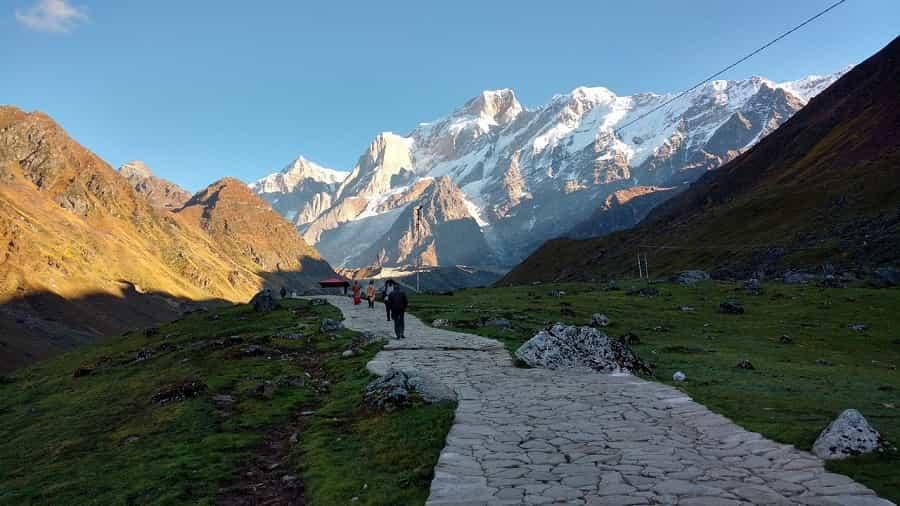
Kedarnath (3,583 m, Rudraprayag) — the hump of Shiva. The most visited, the most infrastructure-supported, and the most famous of the five. Sixteen kilometres one way from Gaurikund.
Tungnath (3,680 m, Rudraprayag) — the arms of Shiva, and the highest Shiva temple on Earth. The 3.5-kilometre ascent from Chopta makes it paradoxically the most accessible high-altitude shrine.
Rudranath (3,600 m, Chamoli) — the face of Shiva. The most isolated, the most demanding, and the wildest of the five. Twenty kilometres from Sagar village through unmarked forest and open bugyals.
Madhyamaheshwar (3,497 m, Rudraprayag) — the navel and chest of Shiva. A two-day trek from Ransi through meadows that bloom with wildflowers in summer. Moderately challenging.
Kalpeshwar (2,200 m, Chamoli) — the matted hair (jata) of Shiva. The only Panch Kedar temple open year-round, reachable by a two-kilometre walk from Urgam village. The gentlest of all five.
Completing all five in a single continuous journey — the full Panch Kedar Yatra — takes 20 to 24 days. Most first-timers visit two or three temples in a single trip, which is entirely valid as a pilgrimage.
Difficulty Breakdown — Temple by Temple, Honest and Unfiltered
Understanding the Panch Kedar trek difficulty at the individual temple level is the most important thing a first-timer can do. The overall circuit rating of “moderate to difficult” is misleading when applied uniformly, because the gap between Kalpeshwar and Rudranath is not a step; it is a canyon.
| Temple | Altitude | One-Way Distance | Difficulty | Verdict for Beginners |
| Kalpeshwar | 2,200 m | ~2 km from Urgam | Easy | Ideal starting point |
| Tungnath | 3,680 m | ~3.5 km from Chopta | Easy–Moderate | Most beginner-friendly high-altitude leg |
| Kedarnath | 3,583 m | ~16 km from Gaurikund | Moderate | Achievable with preparation |
| Madhyamaheshwar | 3,497 m | ~24 km from Ransi | Moderate–Difficult | Only with prior training |
| Rudranath | 3,600 m | ~20 km from Sagar | Difficult | Not for first-timers |
Kalpeshwar requires no trekking background whatsoever. The path from Urgam is paved in places, passes through a naturally occurring cave, and gains negligible altitude. It is comfortable for older pilgrims, families with children, and anyone who has never worn trekking boots before. Do not underestimate its spiritual weight because of its physical ease — Kalpeshwar is deeply sacred, and the cave approach to the temple is unlike anything else in the circuit.
Tungnath is the crown jewel of the beginner Panch Kedar experience. The trailhead at Chopta is motor-road accessible, the path is well-worn and clearly marked, and the 600-metre altitude gain from Chopta to the temple takes most people two to three hours at a comfortable pace. From the temple, a further one-kilometre ascent reaches Chandrashila peak at 4,130 metres — a viewpoint that puts Nanda Devi, Trishul, Kedarnath, and the entire Chaukhamba range in front of you simultaneously. Many first-timers cite this view as one of the defining moments of their Himalayan experience.
Kedarnath carries a moderate rating primarily because of distance — 16 kilometres one way — not because of technical difficulty. The trail is stone-paved from Gaurikund almost all the way to the temple. Rest stops, tea stalls, and medical camps are distributed along the entire route. Ponies, palanquins, and with a single acclimatisation night at Gaurikund or Sonprayag, a reasonably fit first-timer completes it comfortably.
Madhyamaheshwar is where the Panch Kedar begins to test you. The route from Ransi takes two full days to complete, passing through forest, river crossings, and open high-altitude meadows with far fewer support facilities than Kedarnath. It is manageable for a beginner who has done at least one prior multi-day trek and has trained seriously beforehand — but it is not a trail to walk into casually.
Rudranath is categorically not a beginner’s trail. The path from Sagar village is steep, frequently unmarked, and passes through dense Rhododendron and Oak forest, where navigation errors are genuinely possible. The high-altitude grasslands beyond the treeline are exposed and weather-sensitive. Emergency access is extremely limited. Even experienced trekkers who have done Kedarnath and Madhyamaheshwar multiple times approach Rudranath with additional preparation.
Which Legs Can You Realistically Combine as a First-Timer?
The most practical question for a first-timer is not “can I do the whole circuit” but “which combination gives me the fullest experience within my time and fitness?”
3 to 4 days: Tungnath and Chandrashila. Drive to Chopta, ascend to Tungnath, continue to Chandrashila, return. This is the single most rewarding short Panch Kedar experience available — genuine Himalayan altitude, extraordinary views, and the darshan of the world’s highest Shiva temple, all within a long weekend.
5 to 7 days: Kalpeshwar and Tungnath together. Two temples, two completely different landscapes, and a combined experience that covers the easiest and the most scenic legs of the circuit. Adding Kedarnath to this window is possible with tight logistics.
10 to 14 days: Kedarnath, Tungnath, and Madhyamaheshwar. Three temples, one moderately demanding multi-day leg, and a comprehensive introduction to the Panch Kedar landscape. This is the most complete beginner itinerary available without touching Rudranath.
20 to 24 days (full circuit): All five temples in the traditional sequence. Achievable for a first-timer who has trained seriously and has completed at least one prior multi-day trek in the mountains.
Panch Kedar vs Kedarnath: Which One Should a First-Timer Choose?
This comparison comes up constantly among first-time spiritual trekkers, and it deserves a straight answer rather than a diplomatic non-answer.
Kedarnath as a standalone pilgrimage is complete in itself — spiritually, logistically, and experientially. Millions of devotees complete it every year across a spectrum of age, fitness, and trekking experience. The infrastructure that surrounds it — ponies, dolis, medical camps, GMVN guesthouses — makes it one of the most well-supported high-altitude pilgrimages in the world. If you have five days, limited fitness preparation, and want a focused, deeply meaningful Himalayan pilgrimage, Kedarnath alone is absolutely the right choice.
The Panch Kedar, even partially, is a different kind of experience. It is not a single destination but a journey through varied landscapes — lowland forests at Kalpeshwar, open meadows at Madhyamaheshwar, the wide sky at Tungnath, and the raw wilderness approach to Rudranath. The reward is layered in a way that a single-temple visit cannot replicate. For a first-timer with 8 to 12 days and genuine fitness motivation, a partial Panch Kedar circuit offers more than Kedarnath alone — but it demands more in return.
The short version: if time and fitness are limited, choose Kedarnath. If you have time, motivation, and the willingness to prepare, start your Panch Kedar journey — even two temples done right will change you.
How to Physically Prepare — Six Weeks Out
Most first-timers underestimate what the Panch Kedar trails ask of the body — not because the trails are extreme, but because sustained uphill walking at altitude is a very specific physical demand that everyday urban life does not replicate. Six weeks of honest preparation make the difference between a journey you endure and one you enjoy.
Weeks one and two: Daily brisk walking for 45 to 60 minutes, incorporating any available incline. If you are in a flat city, staircase climbs — ten to fifteen floors up and down continuously — simulate the muscular demand of trail ascents better than flat walking ever will.
Weeks three and four: Add cardiovascular sessions three times a week — cycling, swimming, or jogging. The goal is aerobic capacity, not speed. You should be able to sustain moderate exertion for three to four hours. Add leg-strength exercises: squats, lunges, and step-ups. The quadriceps and knee stabilisers take the most stress on long descents.
Weeks five and six: If possible, do a practice day hike on any available hill terrain. Wearing your actual trekking shoes on this practice day is important — broken-in footwear prevents blisters that can derail a week-long trek in the first two hours.
Altitude, Acclimatisation, and What to Watch For
Altitude sickness (Acute Mountain Sickness, or AMS) does not respect fitness levels. It affects athletes and sedentary people with equal indifference. At the altitudes involved in the Panch Kedar — from 2,200 metres at Kalpeshwar to 3,680 metres at Tungnath — the risk is real and must be taken seriously, particularly for anyone arriving from sea-level cities.
The cardinal rule of high-altitude trekking is to ascend gradually and never ignore symptoms. Spend a night at an intermediate altitude — Chopta for Tungnath, Sonprayag or Gaurikund for Kedarnath, Ransi village for Madhyamaheshwar — before pushing to the temple the next day. This single acclimatisation night reduces AMS risk dramatically.
Symptoms to monitor: persistent headache that does not resolve with rest or paracetamol, nausea and loss of appetite, dizziness, and unusual fatigue disproportionate to the effort you are putting in. If two or more of these appear together and do not improve within an hour of rest and hydration, descend. Do not push through AMS symptoms in the expectation that they will resolve at a higher altitude — they will not.
Carry Diamox (acetazolamide) only after consulting a doctor. It is effective but has side effects, and the prescription and dosage should be personalised. Staying well-hydrated — at least three to four litres of water per day — is the simplest and most effective altitude management tool available.
When to Go — Season Guide for First-Timers
The Panch Kedar temples generally open in late April or May after winter snow clears and close in October or November before the next winter sets in. Within that window, two seasons stand out clearly for beginners.
May to mid-June is outstanding for anyone who wants the visual spectacle of the Garhwal Himalayas in bloom. Rhododendron forests on the lower Rudranath and Madhyamaheshwar approaches are extraordinary in May. The trails are freshly reopened, air quality is excellent, and crowds are moderate rather than peak-season intense.
September to October is arguably the single best time for first-timers who prioritise visibility and trail conditions. Post-monsoon skies are crystal clear, mountain views from every high point are at their sharpest, and temperatures during the day remain comfortable even at altitude. The trails have dried from the monsoon rains, reducing slippery sections. Tourist volumes are lower than in July and August, meaning accommodation is easier to find, and trails feel less congested.
Mid-June through August is the monsoon window and is best avoided for the Panch Kedar, particularly for beginners. Rainfall is heavy and persistent, trails become genuinely slippery, landslide risk on certain sections increases, and visibility at higher altitudes is poor. The Rudranath and Madhyamaheshwar trails are particularly affected during active monsoon.
What to Carry — Essential Gear Without Overcomplicating It
For the easier legs (Kalpeshwar, Tungnath), you do not need mountaineering gear. For the moderate legs (Kedarnath, Madhyamaheshwar), the list grows somewhat. Here is what genuinely matters:
Footwear is the single most important item. Trekking shoes or boots with ankle support, a grippy sole, and — critically — broken in before the trek. New shoes on day one of a mountain trail is one of the most reliable ways to end your journey with blisters by day two.
Layered clothing is non-negotiable. Temperatures at altitude change dramatically between noon and sunset, and afternoon rain is common in the mountains even outside the monsoon season. Carry a moisture-wicking base layer, a fleece mid-layer for warmth, and a lightweight waterproof shell jacket. Do not rely on a single thick jacket — layering allows you to regulate temperature as conditions shift.
A trekking pole reduces knee stress on descents by up to 25 per cent. For first-timers who are not used to mountain terrain, the descent is often harder than the ascent — a single pole makes a meaningful difference.
Sun protection at altitude is more serious than at sea level. UV radiation increases significantly above 3,000 metres. Carry SPF 50+ sunscreen, UV-protective sunglasses, and a wide-brimmed hat or cap.
A basic first-aid kit should include paracetamol, electrolyte sachets, blister plasters, an elastic bandage for ankle support, antiseptic cream, and any personal medication. Diamox only if prescribed.
A daypack of 20 to 30 litres is sufficient for single-day legs. For multi-day treks, 40 to 50 litres. Most operators provide mule or porter support for heavier loads on the longer legs.
FAQs
1. Can a first-timer with no trekking experience do any part of the Panch Kedar?
Yes. Kalpeshwar requires no prior trekking experience and is accessible to virtually anyone who can walk comfortably for 30 minutes. Tungnath is manageable for anyone with basic fitness and no specific training history. Kedarnath abundant trail support, is completed by lakhs of pilgrims annually, including first-timers and elderly devotees.
2. What is the minimum fitness level needed?
A useful benchmark: if you can climb ten to fifteen floors of stairs continuously without needing to stop and recover, you are ready for Kalpeshwar and Tungnath. For Kedarnath, add sustained walking of three to four hours on inclines. For Madhyamaheshwar, you need two consecutive days of similar effort, which requires deliberate training.
3. What is the minimum age for the Panch Kedar trek?
No statutory minimum age exists, but most operators recommend 12 to 14 years for the moderate legs and 18 years for the harder ones. Kalpeshwar is suitable for older children. Families with teenage children regularly complete Kedarnath and Tungnath.
4. Can senior citizens do the Panch Kedar trek?
Kalpeshwar is genuinely accessible for senior pilgrims in reasonable health. Tungnath is regularly visited by pilgrims in their 60s and 70s. Madhyamaheshwar and Rudranath are not recommended for senior first-timers.
5. What is the best time for a beginner to attempt the Panch Kedar trek?
September and October are the strongest months for first-timers — post-monsoon clarity, stable trail conditions, and comfortable daytime temperatures. May is the second-best option. Avoid mid-June through August.
Summary
The Panch Kedar Trek for Beginners is not a contradiction in terms — it is a matter of choosing the right entry point, preparing honestly, and not treating the circuit as an all-or-nothing proposition. Tungnath alone is a complete Himalayan experience. Kedarnath alone is a spiritually transformative pilgrimage. Two or three temples planned well will leave you more moved than five temples rushed.
The Garhwal Himalayas do not require you to be extraordinary. They require you to be prepared, to be present, and to move at the pace the mountain allows. Show up with those three things, and the Panch Kedar will give you everything it has to offer.
With the Panch Kedar Yatra season approaching, it’s time to plan something truly extraordinary. From breathtaking Himalayan peaks to spiritually powerful temples hidden deep in remote valleys, this journey offers an experience that goes beyond a typical trek—it becomes a story you carry for life. To make your journey seamless and well-organised, choose the best trekking company in Uttarakhand for reliable trek packages, detailed itineraries, and hassle-free booking.
Visit this page for Trek Packages, Itinerary & Booking.