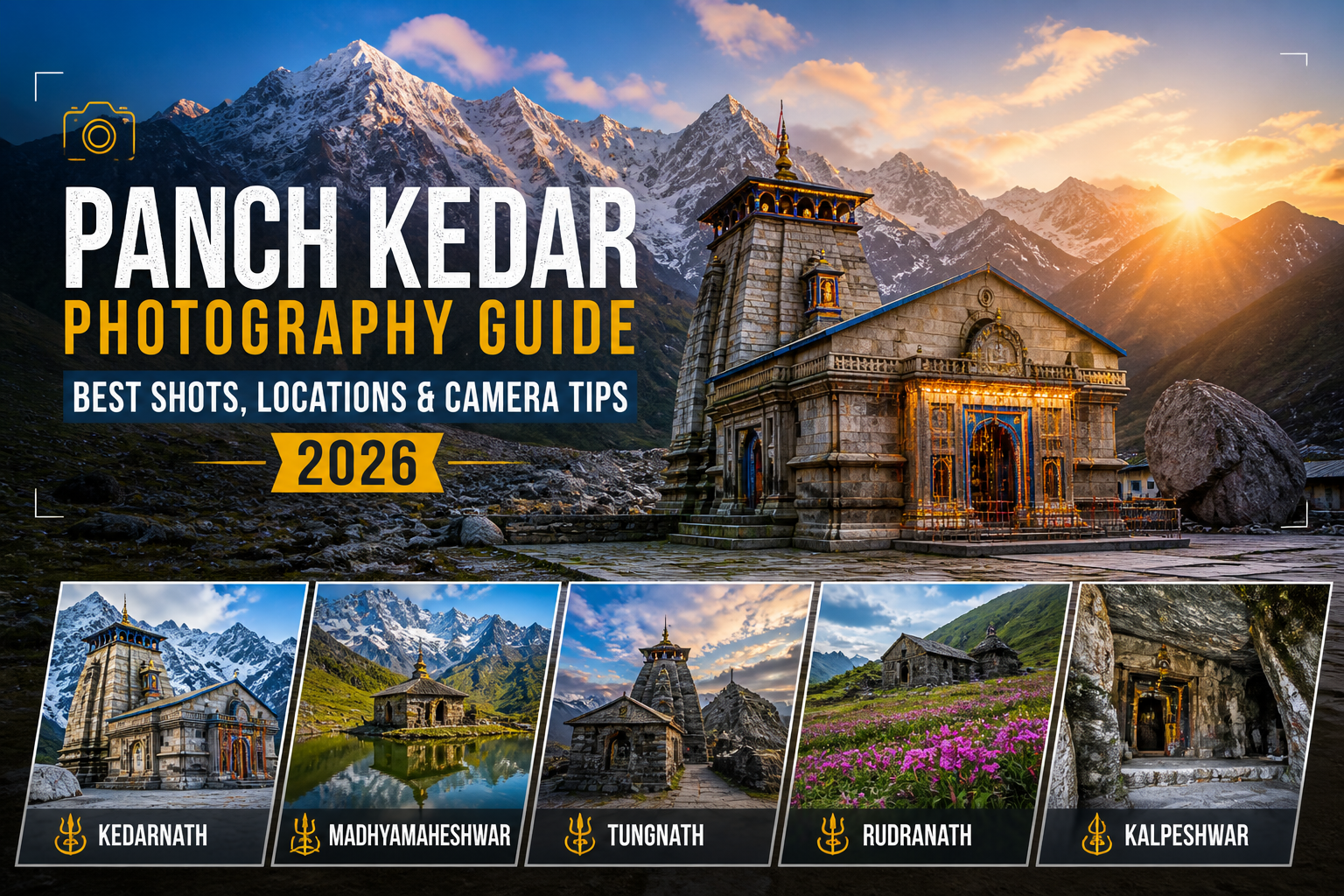
The Garhwal Himalayas hold stories that most cameras never get to tell. Five ancient Shiva temples, each positioned at elevations that demand genuine physical effort, reveal landscapes so raw and spiritually charged that even experienced photographers return humbled. From the dense oak and rhododendron forests of Kalpeshwar to the storm-cleared ridgeline of Chandrashila, the sacred Panch Kedar circuit offers photographic depth that few places in India can match.
What separates a memorable shot here from a forgettable one is not the camera body or the lens — it is timing, positioning, and an understanding of each location’s specific quality of light. The small glacial tarn above Madhyamaheshwar at dawn, Rudranath’s flower-draped meadows in late summer, and Kedarnath’s lantern-lit courtyard at Brahma Muhurta each demand a completely different photographic approach. Knowing where to stand and exactly when to press the shutter is everything in these mountains.
This Panch Kedar Photography Guide is built for trekkers who carry cameras with intention. Whether you are a landscape photographer planning your first Himalayan circuit or a seasoned travel photographer looking for India’s most under-documented sacred trail, this guide gives you location-precise shot lists, seasonal light intelligence, altitude-specific gear advice, and accurate information about drone regulations that most guides get wrong or skip entirely.
Why the Panch Kedar Circuit Is Among the Best Photography Treks in India
The five temples — Kedarnath, Madhyamaheshwar, Tungnath, Rudranath, and Kalpeshwar — span a geographic elevation range that moves from high-alpine glacial terrain above 3,500 metres to dense Himalayan forest at 2,200 metres. That variety alone gives photographers a subject range within a single circuit that is genuinely rare. Add the spiritual gravity of thousand-year-old stone temples, the unpredictable drama of Garhwal Himalayas photography, and a trail system that remains far less trafficked than the Char Dham pilgrim routes, and you have the conditions for exceptional, original work.
The Panch Kedar trek photography community is still small relative to better-marketed circuits like the Valley of Flowers or Roopkund. That means compositions that feel fresh and unrepeat. The five temples are architecturally distinct from one another, the ecological zones shift dramatically between each stage, and the faces of the Himalayan peaks visible from different points on the circuit — Nanda Devi, Trishul, Chaukhamba, Kedarnath Dome — change character as you move west to east across the range.
Patience is the most important piece of equipment you can bring. Weather systems at altitude move through in hours, converting a flat grey morning into a cloudscape of extraordinary drama before lunch. The photographers who wait are consistently rewarded.
Temple-by-Temple Shot Guide: Best Spots, Light Windows & Composition Notes
A temple-by-temple photography guide to Panch Kedar, outlining optimal shooting spots, precise light windows, and composition techniques to capture landscapes, reflections, alpine meadows, and cave interiors with clarity and visual impact.
1. Kedarnath — Brahma Muhurta, Sacred Lanterns & the Bhimshila Rock
Kedarnath is the most visited of the five temples, and that popularity creates a real photographic challenge: how do you frame a sacred site that millions of pilgrims and tourists have already photographed? The answer is time of day — specifically, Brahma Muhurta, the pre-dawn period, approximately 90 minutes before sunrise.
Arriving at the temple courtyard before 4:30 AM gives you amber lantern light falling across the stone temple facade, with Kedarnath peak and the Chorabari glacier forming a sharp, cold silhouette behind the spire. The contrast between the warm artificial glow of oil lamps and the deep blue of the pre-dawn sky is one of the most compelling natural light situations on the Panch Kedar Trek guide circuit, and it lasts for only 20 to 30 minutes before the sky lightens enough to flatten the drama.
Equally undershot is the Bhimshila — a massive boulder wedged between two larger rocks approximately 500 metres behind the main temple complex. Local belief holds that this rock sheltered the temple during the catastrophic 2013 floods. The photographic composition here is genuinely powerful: position the Bhimshila in the foreground mid-frame at golden hour and allow the temple spire to anchor the upper third of the frame. The warm amber light on the rock face during the first 40 minutes after sunrise makes this one of the most original shots available in panch kedar photography, Uttarakhand — and it appears in almost no existing published photography guide.
Best light: 4:00–5:30 AM for lantern frame; 5:30–7:00 AM for golden hour on peaks and Bhimshila. Best season: May to early June before the monsoon; late September through November for fresh snow dusting on surrounding peaks.
2. Madhyamaheshwar — The Hidden Tarn and Chaukhamba Reflection
Madhyamaheshwar is the most serene of the five temples and arguably the highest-reward destination for Garhwal Himalayas photography on the entire circuit. The temple rests at 3,497 metres with meadows on three sides and a direct sightline toward Kedarnath Dome, Chaukhamba, and Neelkanth peak on the fourth.
The most exclusive composition on this entire circuit sits roughly 20 minutes above the temple: an unnamed glacial tarn that, in the early morning before wind disturbs the surface, acts as a near-perfect mirror for Chaukhamba (7,138m). To capture the Chaukhamba tarn reflection, you must reach the water’s edge before 6:30 AM. Use a wide-angle lens, lower your tripod to within 20 centimetres of the water surface, and frame Chaukhamba centrally with the rough rocky shoreline providing foreground texture and scale.
This shot is not discussed in any existing photography guide for the region. The tarn is small, seasonal, and requires knowing it is there before you set out from camp. It is also the kind of frame that stops a portfolio review — a 7,000-metre peak perfectly doubled in still water, surrounded by silence.
The meadows around the temple produce wildflower compositions between June and August that offer a softer, more intimate photographic register — a welcome balance against the dramatic scale of the peak-and-sky imagery that dominates Himalayan photography portfolios.
Best light: 6:00–8:00 AM at the tarn; golden hour from the north meadow for temple-and-peak compositions. Best season: June to August for meadow flowers; late September for sharp post-monsoon peak clarity.
3. Tungnath and Chandrashila — Golden Hour at 4,130 Metres
Tungnath temple at 3,680 metres holds the distinction of being the world’s highest Shiva temple — but for chandrashila photography, it is the 45-minute ridge scramble above Tungnath to Chandrashila summit at 4,130 metres that delivers the most rewarding images on the circuit.
From the summit on a clear morning, a single 180-degree panoramic arc contains Nanda Devi (7,816m), Trishul (7,120m), Chaukhamba (7,138m), Kedarnath Dome, and on exceptional winter-clear days, Bandarpoonch to the northwest. This is one of the few accessible viewpoints in Uttarakhand that positions so many peaks above 7,000 metres in a single wide-angle frame. The light during blue hour — the 20 minutes before the sun breaks the eastern ridge — picks out the snow faces of Nanda Devi and Trishul in a cool lavender tone that is distinct from standard golden hour warmth and tends to produce more unusual images.
Summit winds at Chandrashila can be severe, particularly in spring and autumn. A carbon fibre tripod with a centre-column hook — where you can hang your loaded backpack as ballast — is essential for any long exposure work. Lightweight travel tripods regularly blow over at this elevation.
For the Tungnath approach trail itself, the rhododendron canopy in April and May creates strong leading-line compositions, with the red bloom forming a natural frame for the stone path ascending toward the temple.
Best light: Pre-dawn blue hour and first light, 5:30–7:00 AM at Chandrashila summit. Best season: April to June for clear skies and rhododendron bloom; late September to early November for post-monsoon peak definition.
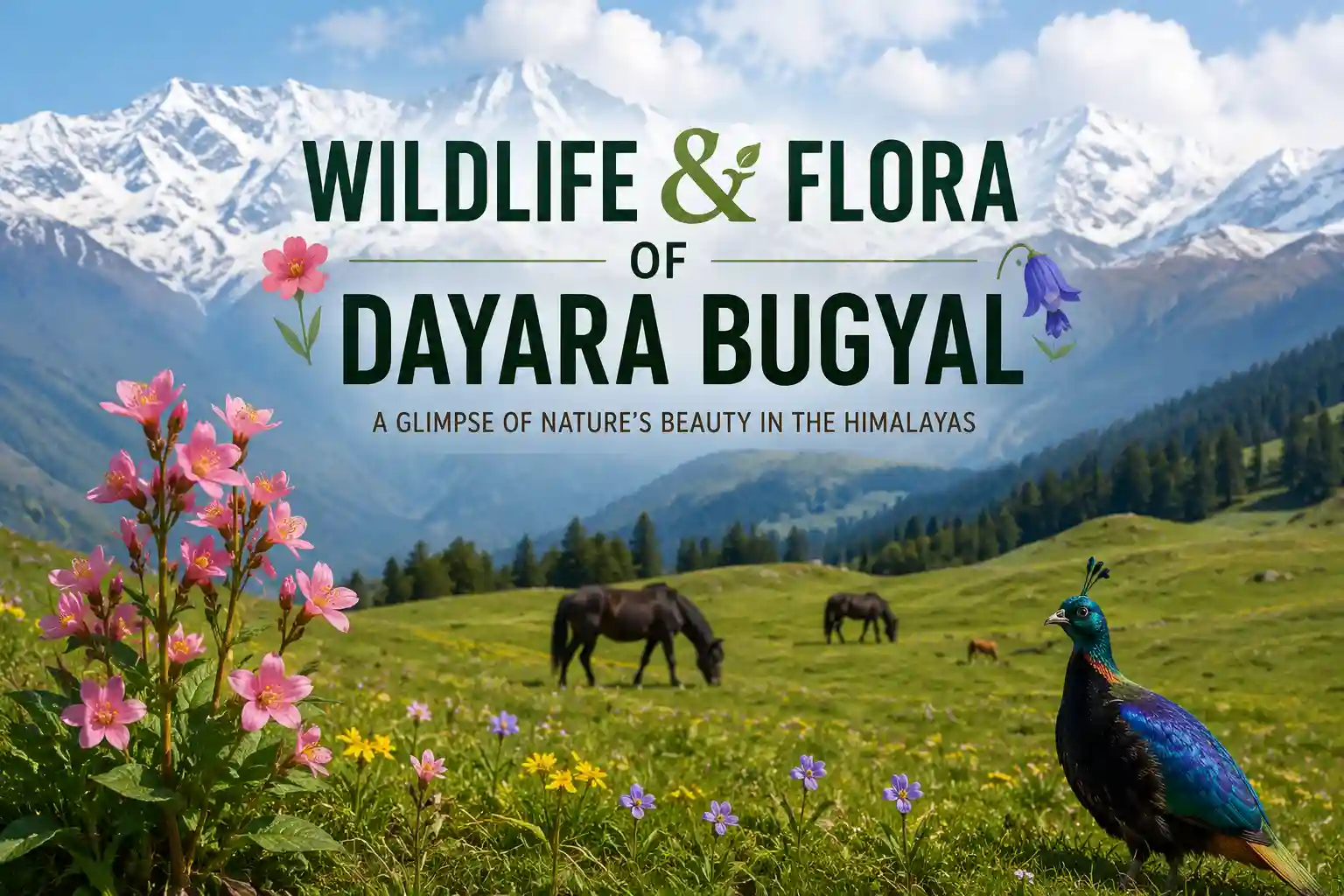
The ecological richness of the trail sections between the temples is itself a photographic subject that rewards preparation. From Himalayan monal pheasants in the oak forest below Kalpeshwar to bharal on the high ridges above Rudranath, the circuit passes through extraordinary habitat. A thorough read of the Wildlife & Flora of the Panch Kedar Circuit before your trek will help you anticipate species-specific photographic opportunities that purely temple-focused itineraries tend to miss entirely.
4. Rudranath — Panar Bugyal and the Pink Carpet of Late Summer
Rudranath is the most remote of the five temples, requiring the longest approach walk from any roadhead. It is also, for many photographers, the circuit’s single most rewarding location. The trail passes through Panar Bugyal — a vast, open high-altitude meadow that, between late August and mid-September, fills with ground-hugging pink primula in a density and extent that reads as a carpet from any elevated vantage point.
The Rudranath Panar meadow photography opportunity during this window is unlike anything else in the Indian Himalaya outside the regulated confines of the Valley of Flowers. The combination of the pink primula blanket in the foreground, the grey stone bulk of the surrounding ridgeline, and — on clear mornings — the distant white mass of Nanda Devi behind the ridge creates a composition that is genuinely among the best photography spots the Panch Kedar circuit has to offer.
Composition note: resist the instinct to stand above the flowers and shoot downward. Instead, drop to within 30 centimetres of the ground and use a wide-angle lens set between f/8 and f/11. This holds sharpness from the nearest blooms through to the distant ridgeline and creates a sense of total immersion in the flower field that elevated angles cannot replicate. This is the difference between a landscape photograph and a photograph that places the viewer inside the landscape.
Rudranath temple itself is partially built into a granite outcrop, and the first directional morning light falls on the temple entrance face between 7:30 and 9:00 AM. The warm, raking quality of this light brings out the texture of the stone carving in ways that midday flat light entirely suppresses.
Best light: 7:30–9:00 AM on the temple; all-day diffused light works well in the meadow on overcast days. Best season: Late August to mid-September for Panar Bugyal bloom; May to June for snow-dusted approach ridges.
5. Kalpeshwar — Cave Entrance Light and Forest Intimacy
Kalpeshwar is the only one of the five temples accessible year-round, and it sits at the lowest elevation of the circuit — approximately 2,200 metres — within a forest of oak, maple, and rhododendron that creates a completely different photographic environment from the high-alpine settings of the other four.
The defining photographic subject here is the cave entrance passage that leads to the temple interior. Between 8:00 and 10:00 AM, morning light strikes the entrance at an angle that illuminates the inner cave walls in warm amber while leaving the forest exterior in dappled, cooler shade. The result is a natural chiaroscuro — a dramatic light-and-shadow split that requires no filters, no artificial light, and no post-processing manipulation. The image is there; you simply need to be in position at the right time.
The forest trail approaching Kalpeshwar offers macro and botanical compositions that none of the higher temples can provide. Ferns, hanging mosses, lichens, and seasonal fungi thrive in the moisture-rich microclimate. During the mist months of July and August, the forest takes on an atmospheric depth — layers of light and shade — that suits both wide-angle environmental frames and tight telephoto isolations of individual subjects.
Aligning your photography schedule with the temple’s operational hours is practical. Reviewing Panch Kedar Darshan Timings before your circuit planning ensures your early-morning photography sessions at each site are not delayed by arriving before gates open — particularly relevant at Kalpeshwar and Kedarnath, where the light window and the opening hour sometimes conflict.
Best light: 8:00–10:00 AM at the cave entrance; overcast mornings are ideal throughout the forest trail. Best season: Year-round; July to August for forest mist and atmosphere; October to November for autumn foliage colour.
Best Light and Best Season — Location Quick Reference
| Location | Best Light Window | Peak Photography Season | Primary Subject |
| Kedarnath | 4:00–7:00 AM | May–June / Sept–Nov | Lanterns + Bhimshila rock |
| Madhyamaheshwar | 6:00–8:00 AM | June–Aug / Sept | Chaukhamba tarn reflection |
| Tungnath / Chandrashila | 5:30–7:00 AM | April–June / Sept–Nov | Nanda Devi and Trishul panorama |
| Rudranath / Panar Bugyal | 7:30–9:00 AM | Late Aug–mid Sept | Pink primula meadow carpet |
| Kalpeshwar | 8:00–10:00 AM | Year-round | Cave entrance chiaroscuro |
Camera Gear for High-Altitude Panch Kedar Trek Photography
High-altitude Panch Kedar photography demands lightweight, weather-sealed cameras, wide-angle lenses, spare batteries, and protective gear to handle cold, low oxygen, and unpredictable Himalayan conditions while ensuring optimal image quality.
Battery Management in Cold Conditions
At elevations above 3,500 metres, overnight temperatures drop sharply — often below -5°C in May and June. Lithium-ion batteries lose between 30 and 50 percent of their rated capacity in sub-zero conditions, and they do so without warning. The working approach is to carry a minimum of three fully charged batteries per camera body, store them in an inner jacket pocket or sleeping bag overnight, and swap them into the camera body only in the moments immediately before shooting. Never leave batteries in the camera overnight in freezing conditions.
Lens Fogging at Dawn
Moving from a warm tent or sleeping bag into cold pre-dawn air causes immediate condensation on lens elements, filter glass, and the viewfinder. The solution is acclimatization: remove camera equipment from its case 15 to 20 minutes before you plan to shoot and allow it to reach ambient outdoor temperature before mounting filters or attaching lens caps. Keep a clean microfibre cloth in an accessible outer pocket, not buried in your bag. At high altitude, fumbling for equipment in the dark costs you light.
ND Filters for Waterfall and Stream Shots
The panch kedar trek photography circuit crosses glacial streams and seasonal waterfalls on the Rudranath approach, the Madhyamaheshwar valley, and the Kedarnath corridor. An ND8 and an ND64 filter cover the range needed to slow-moving water to a silky blur without overexposing in the intense high-altitude light. A circular polariser reduces surface glare from wet rocks and intensifies the turquoise colour of glacial meltwater — one of the distinctive visual signatures of Himalayan mountain streams.
Tripod Selection for Summit Work
Do not carry a lightweight travel tripod to Chandrashila. Summit winds are strong enough to vibrate even mid-weight tripods during long exposures. A carbon fibre tripod with a hook at the centre column — from which you can hang a loaded backpack as ballast — is the practical choice. The weight penalty of a serious tripod is real, but the image quality difference at 4,130 metres is definitive.
Drone Regulations on the Panch Kedar Trek — What Every Photographer Must Know
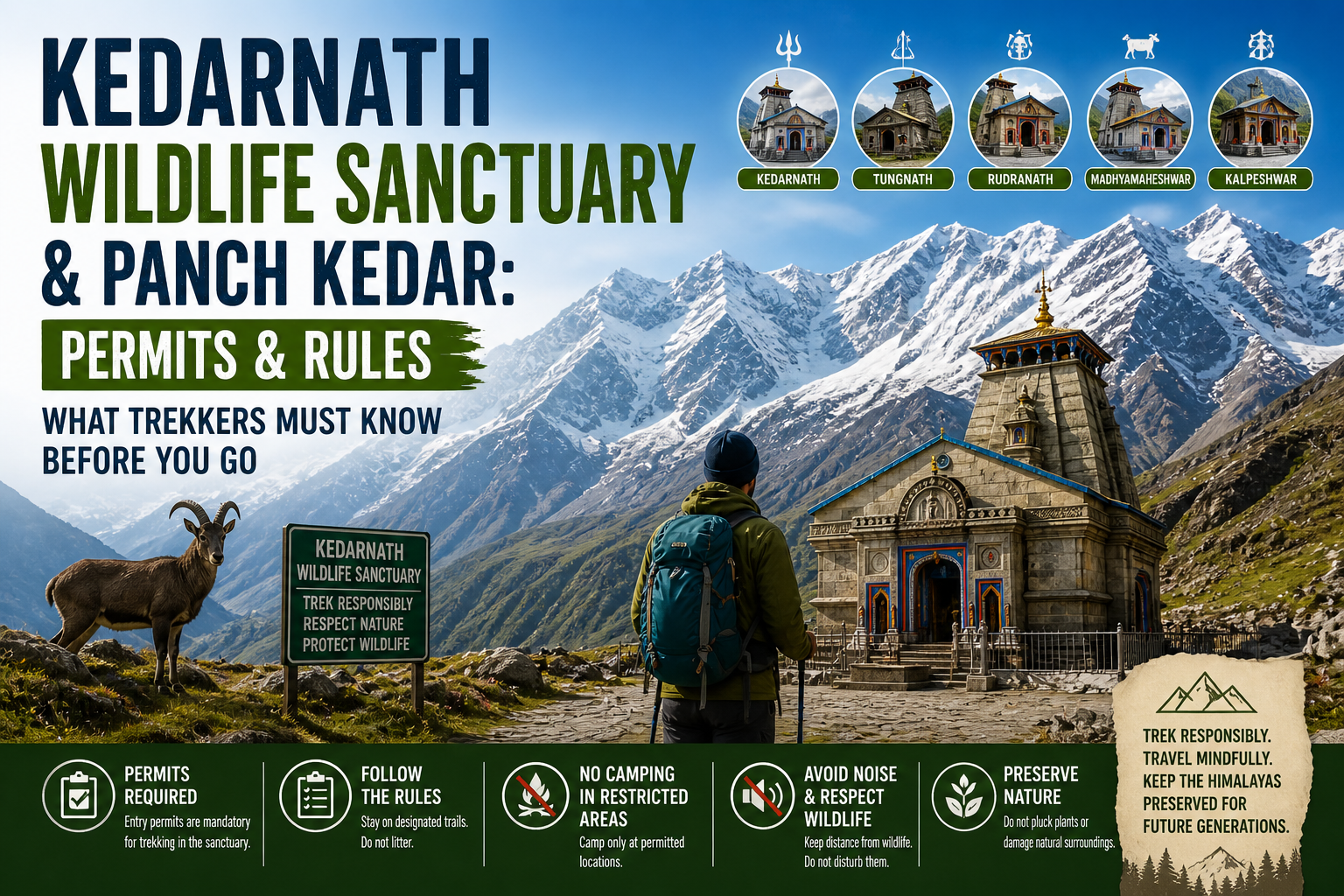
This is the piece of information most photography guides either omit or get wrong: drones are prohibited inside the Kedarnath Wildlife Sanctuary, which covers a substantial portion of the Panch Kedar circuit, including the approaches to Kedarnath, Madhyamaheshwar, and Tungnath.
The Kedarnath Wildlife Sanctuary is a protected area under India’s Wildlife Protection Act, 1972. Operating an unmanned aerial vehicle within sanctuary boundaries without explicit written permission from the Uttarakhand Forest Department constitutes a legal violation. There are documented cases of equipment confiscation. The area immediately around the Kedarnath temple complex carries additional restrictions related to security protocols and the sensitivity of active religious sites.
For Rudranath and Kalpeshwar, which fall outside the core sanctuary perimeter, operations are governed by the relevant district administration. Even in these areas, flying without prior documented clearance from the appropriate authority is not advisable. The practical guidance for most photographers visiting the circuit: do not carry drone equipment onto this trek. Ground-level compositions on the Panch Kedar circuit are demonstrably more original and emotionally compelling than aerial footage of terrain that has been aerially documented across many parts of the Himalaya.
Panch Kedar vs Valley of Flowers Photography — An Honest Comparison
The panch kedar vs valley of Flowers photography comparison is worth addressing directly because many photographers frame this as an either-or decision when planning a Uttarakhand trip.
Valley of Flowers National Park offers the highest concentration of Himalayan wildflower species in a defined and protected area. The UNESCO World Heritage status brings international photography attention and a well-worn approach to the photographic opportunity: enter, photograph the bloom, exit. The season is defined (July to September), the subject is defined, and the resulting images — while beautiful — tend to resemble each other closely.
The Panch Kedar circuit, as one of the best photography treks India offers to those willing to commit to a two-week journey, provides a substantially wider range of photographic subject matter: five architecturally distinct temples in five ecological zones at five different elevations, with cultural and devotional subjects available alongside landscape and botanical material. The Panar Bugyal bloom at Rudranath is arguably as impressive as the Valley of Flowers in its peak window and is far less photographed.
For photographers who want cultural depth, architectural variety, and landscape range across a sustained journey, Panch Kedar is the stronger choice. For a tight, focused wildflower shoot within a three-day window, Valley of Flowers delivers higher efficiency. Both have genuine merit; the choice depends on what kind of photographic story you want to tell.
Frequently Asked Questions
Q1: What is the best time for the Panch Kedar trek photography?
The circuit has two primary photography windows. May to June offers stable, clear skies, residual snow on the peaks, and no monsoon cloud cover — ideal for peak panoramas from Chandrashila and the Bhimshila frame at Kedarnath. Late September through November delivers the sharpest post-monsoon atmospheric clarity and the highest probability of clean, unobstructed peak views. The Rudranath Panar Bugyal bloom is available exclusively in late August through mid-September and requires a separate timing decision if it is a priority.
Q2: Can you use drones on the Panch Kedar trek?
No. Drones are prohibited inside the Kedarnath Wildlife Sanctuary, which covers the Kedarnath, Madhyamaheshwar, and Tungnath sections of the circuit. Operating a UAV without written permission from the Uttarakhand Forest Department is a legal violation that can result in equipment confiscation. Verify current district administration guidelines before carrying any aerial equipment onto the trek.
Q3: What camera gear should I carry on the Panch Kedar trek?
A weather-sealed mirrorless or DSLR body, a wide-angle lens in the 16–35mm range for panoramas and cave interiors, a mid-telephoto in the 70–200mm range for isolating distant peaks and wildlife subjects, three spare batteries minimum, ND8 and ND64 filters, a circular polariser, and a sturdy carbon fibre tripod for summit and long-exposure work.
Q4: Is Chandrashila accessible for sunrise photography?
Yes, but you must begin the summit scramble in darkness from the Chopta base or from the Tungnath trail. The climb takes approximately 45 minutes and requires a reliable headlamp and stable footwear. The effort is consistently rewarded — the sunrise panorama from Chandrashila at 4,130 metres, with Nanda Devi and Trishul fully lit against a clear sky, is among the finest accessible viewpoints in the Uttarakhand Himalaya.
Q5: Which of the five temples offers the best single photograph?
Both the Chaukhamba tarn reflection above Madhyamaheshwar and the Panar Bugyal pink primula carpet at Rudranath are the two compositions with the least replication in existing photography from the circuit. Both require precise seasonal timing and early-morning positioning. The Bhimshila rock frame at Kedarnath at golden hour is the third strongest option and the easiest to achieve logistically.
Summary
The Panch Kedar circuit rewards photographers who approach it with location-specific preparation rather than general enthusiasm. The Bhimshila rock frame at Kedarnath, the pre-dawn Chaukhamba reflection in the hidden tarn above Madhyamaheshwar, the Nanda Devi and Trishul panorama from Chandrashila at golden hour, the pink primula carpet across Panar Bugyal, and the cave entrance chiaroscuro at Kalpeshwar — these are five distinct photographs that exist almost nowhere else in the published landscape of Himalayan photography.
This Panch Kedar Photography Guide has given you the precise location, the correct time window, and the compositional approach for each of the five temples. The circuit demands fitness, patience, altitude adaptation, and a willingness to be in position before the light arrives rather than after. In return, it offers images of a sacred, living landscape that remains — by the standards of the Indian Himalaya — genuinely uncrowded, genuinely original, and genuinely extraordinary.
For trekkers planning this circuit later in life and wondering whether the physical demands are compatible with serious photography work, practical fitness and medical preparation resources are available at Panch Kedar Trek After 60 — a useful planning resource before committing to the full circuit with a camera kit.
With the Panch Kedar Yatra season approaching, it’s time to plan something truly extraordinary. From breathtaking Himalayan peaks to spiritually powerful temples hidden deep in remote valleys, this journey offers an experience that goes beyond a typical trek—it becomes a story you carry for life. To make your journey seamless and well-organized, choose the best trekking company in Uttarakhand for reliable trek packages, detailed itineraries, and hassle-free booking.
Visit this page for Trek Packages, Itinerary & Booking.