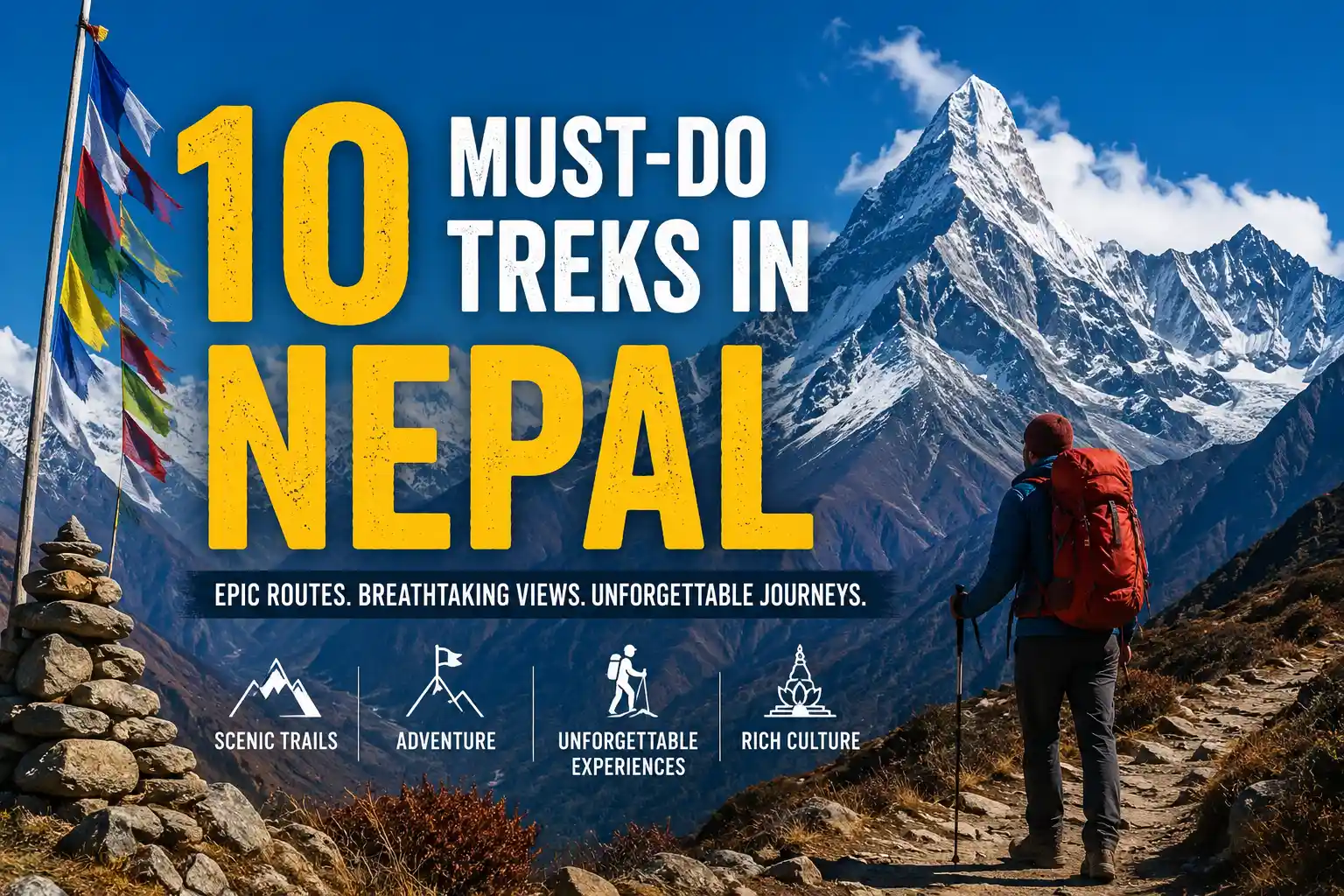
Nepal is home to eight of the world’s ten highest peaks, and no destination on earth offers this much variety in high-altitude trekking within a single country. From the glacier-fed amphitheatre of the Annapurna Sanctuary to the hidden valleys of Dolpo, every route tells a different story about the Himalayas.
If you are trying to shortlist your first or fifth Nepal trip, this guide to the 10 Must do treks in Nepal breaks down altitude, duration, difficulty and the best season for each route, so you can match a trail to your fitness level and travel window before you book.
Whether you are a first-time trekker eyeing Annapurna Base Camp or a seasoned high-altitude walker chasing Kang La Pass in Nar Phu, this list covers routes for every experience level.
Annapurna Base Camp Trek
The Annapurna Base Camp (ABC) Trek is one of Nepal’s most popular Himalayan treks, offering an unforgettable journey through terraced fields, rhododendron forests, and traditional Gurung villages before reaching the breathtaking Annapurna Sanctuary. It is an excellent choice for first-time high-altitude trekkers seeking spectacular mountain views without an extremely demanding expedition.
Key Details:
- Maximum Altitude: 4,130 m (13,549 ft)
- Duration: 7–12 days
- Distance: ~115 km
- Difficulty: Moderate
- Best Time to Visit: March–May and late September–November
- Highlights: Annapurna Base Camp, Machhapuchhre Base Camp, Annapurna Sanctuary, sunrise mountain views, Gurung villages, waterfalls, and rhododendron forests
- Ideal For: Beginners and intermediate trekkers looking for a classic Himalayan adventure with stunning scenery and manageable altitude gain
Points to know:
- Starts from Pokhara via Nayapul, passing through Gurung and Magar villages
- Trail runs through rhododendron forest and stone-stepped ridgelines before opening into the Annapurna Sanctuary
- Spring can bring patchy snow at higher altitude; autumn stays dry with clearer views
- Widely considered the best entry-level high-altitude Trek in Nepal for first-timers
2. Everest Base Camp Trek
The Everest Base Camp (EBC) Trek is Nepal’s most famous trekking adventure, leading through the heart of the Khumbu region to the base of the world’s highest mountain. Along the way, trekkers experience Sherpa culture, ancient monasteries, and breathtaking Himalayan scenery, with an optional climb to Kala Patthar for the best close-up views of Mount Everest.
Details:
- Maximum Altitude: 5,364 m (Everest Base Camp); 5,644 m with the Kala Patthar viewpoint
- Duration: 12–14 days
- Distance: ~130 km round trip
- Difficulty: Moderate to Strenuous
- Best Time to Visit: March–May and late September–November
- Highlights: Everest Base Camp, Kala Patthar, Namche Bazaar, Tengboche Monastery, Sherpa villages, and panoramic views of Everest, Lhotse, Nuptse, and Ama Dablam
- Ideal For: Trekkers with good fitness looking to experience Nepal’s most iconic high-altitude trek and the legendary Everest region
The trek climbs from Lukla (2,860m) to Everest Base Camp, with acclimatization built in at Namche Bazaar and Dingboche. A common pattern is an acclimatization hike above Namche followed by a return to sleep at the same altitude — the standard “climb high, sleep low” approach used across most itineraries.
Short pointers:
- No technical climbing skills required
- Namche Bazaar, Tengboche Monastery and Dingboche are the key cultural and acclimatization stops
- Kala Patthar (5,644m) offers the closest unobstructed Everest summit view
3. Annapurna Circuit Trek
The Annapurna Circuit Trek is one of Nepal’s most iconic long-distance treks, taking you through lush valleys, traditional mountain villages, and high-altitude deserts before crossing the famous Thorong La Pass. Known for its incredible landscape diversity and cultural richness, it remains a favorite among experienced trekkers.
Details:
- Maximum Altitude: 5,416 m (Thorong La Pass)
- Duration: 12–18 days
- Difficulty: Difficult
- Best Time to Visit: March–May and September–November
- Highlights: Thorong La Pass, Annapurna Massif, Muktinath Temple, Manang Valley, diverse landscapes, and traditional Gurung and Tibetan-influenced villages
- Ideal For: Trekkers with good fitness and some high-altitude experience seeking a classic Himalayan circuit trek
The Annapurna Circuit crosses five climate zones, from subtropical forest to the high-altitude desert of Mustang. Its difficulty comes less from any single day and more from the cumulative distance — most trekkers add 2–3 extra days for the Tilicho Lake side trip.
Key stretch: Thorong Phedi to Muktinath, a single day involving a roughly 900m ascent followed by a steep descent to 3,760m. This is the most physically demanding day on the route and should not be rushed even by fit trekkers.
4. Manaslu Circuit Trek
The Manaslu Circuit Trek is a remote and rewarding journey around Mount Manaslu (8,163 m), Nepal’s eighth-highest peak. The trek combines dramatic mountain scenery, Tibetan-influenced culture, and the thrilling crossing of Larkya La Pass, making it one of the country’s best alternatives to the Annapurna Circuit.
Details:
- Maximum Altitude: ~5,160–5,213 m (Larkya La Pass)
- Duration: 14–18 days
- Distance: ~106 km
- Difficulty: Difficult
- Permit Required: Restricted Area Permit (plus conservation permits); licensed guide mandatory
- Best Time to Visit: March–May and September–November
- Highlights: Larkya La Pass, Mount Manaslu views, remote Himalayan villages, Tibetan Buddhist monasteries, suspension bridges, and diverse landscapes
- Ideal For: Experienced trekkers looking for a challenging, less-crowded Himalayan trek with exceptional mountain scenery and cultural immersion
Circling the world’s eighth-highest mountain, Manaslu sits in a restricted region near the Indo-Tibet border, so independent trekking is not permitted here — a licensed operator and special permit are required by law.
What sets it apart:
- Fewer crowds than Annapurna or Everest
- More basic teahouse infrastructure, so pack accordingly
- Overlaps geographically with parts of the Annapurna Circuit near Larkya La
5. Langtang Valley Trek
The Langtang Valley Trek is one of Nepal’s best short Himalayan treks, combining beautiful mountain scenery with rich Tamang culture. The trail passes through forests, traditional villages, and alpine meadows before reaching Kyanjin Gompa, with an optional hike to Tserko Ri for breathtaking panoramic views.
Details:
- Maximum Altitude: 3,870 m (Kyanjin Gompa); 4,984 m with the Tserko Ri extension
- Duration: 7–10 days
- Difficulty: Moderate
- Best Time to Visit: March–May and September–November
- Highlights: Kyanjin Gompa, Tserko Ri viewpoint, Langtang National Park, Tamang villages, glaciers, and snow-capped peaks
- Ideal For: Beginners and intermediate trekkers looking for a shorter Himalayan trek with rewarding scenery and cultural experiences
Langtang is the closest major Himalayan trek to Kathmandu, making it a strong pick for a shorter travel window. The valley runs through Langtang National Park, home to red pandas and Himalayan black bears, with the option to extend to Kyanjin Ri (4,773m) or Tserko Ri (4,984m) for a harder finish.
A short trekking note for cross-border planners: if you already trek regularly in the Indian Himalayas, several routes on our Best Treks in Uttarakhand list sit in a similar moderate-difficulty, similar-season bracket to Langtang, making it a useful stepping stone before a longer Nepal circuit.
6. Nar Phu Valley Trek
The Nar Phu Valley Trek is a remote Himalayan adventure that explores two secluded Tibetan-influenced villages before crossing the dramatic Kang La Pass. Known for its rugged landscapes, ancient monasteries, and authentic mountain culture, it is an excellent choice for experienced trekkers looking to venture beyond Nepal’s mainstream trails.
Details:
- Maximum Altitude: ~5,300–5,320 m (Kang La Pass)
- Duration: 12–16 days
- Difficulty: Strenuous
- Permits Required: Restricted Area Permit; licensed guide mandatory; minimum group of two trekkers (permit requirement)
- Best Time to Visit: Spring (March–May) and Autumn (September–November)
- Highlights: Nar and Phu villages, Kang La Pass, Tibetan Buddhist monasteries, dramatic alpine landscapes, fewer crowds
- Ideal For: Experienced trekkers seeking a remote, culturally rich trek with high-altitude challenges and off-the-beaten-path experiences
One of Nepal’s least-visited valleys, Nar Phu connects into the Annapurna Circuit near Manang once you cross Kang La. Highlights include:
- Phu village at ~4,150m, one of the highest permanent settlements on the route
- Centuries-old Buddhist gompas rarely seen by mainstream Annapurna trekkers
- Kang La becomes unreliable to cross after early snowfall, so timing matters
7. Upper Dolpo Trek
The Upper Dolpo Trek is one of Nepal’s most remote and adventurous trekking experiences. This camping-based expedition traverses high mountain passes, ancient Tibetan Buddhist villages, and the spectacular Shey Phoksundo National Park, offering a true wilderness journey far from the country’s popular trekking routes.
Details:
- Maximum Altitude: ~5,306 m (Kang La Pass)
- Duration: 20–27 days
- Difficulty: Strenuous (Camping-based)
- Permits Required: Restricted Area Permit (approximately USD 500 for the first week) plus Shey Phoksundo National Park Entry Permit
- Best Time to Visit: Late spring through early autumn (May–October)
- Highlights: Shey Phoksundo Lake, Kang La Pass, ancient monasteries, Tibetan culture, remote valleys, untouched Himalayan landscapes
- Ideal For: Experienced trekkers seeking a challenging, off-the-grid expedition with camping and remote wilderness travel
Nepal’s most remote trekking region, Upper Dolpo passes Shey Phoksundo Lake, Ringmo village and the ancient Shey Gompa. Teahouse infrastructure runs out beyond Ringmo, so camping and support staff are essential for the rest of the route.
Best suited for: trekkers who already have at least one multi-week high-altitude expedition behind them.
8. Kanchenjunga Base Camp Trek
The Kanchenjunga Base Camp Trek is one of Nepal’s most remote and rewarding trekking routes, leading to the base of the world’s third-highest mountain. The journey passes through pristine forests, alpine meadows, glaciers, and traditional villages, offering an authentic wilderness experience with far fewer trekkers than the Everest or Annapurna regions.
Details:
- North Base Camp Altitude: ~5,143 m (Pangpema)
- South Base Camp Altitude: ~4,730 m (Oktang)
- Duration: 20–26 days (both base camps); shorter itineraries are available for a single base camp
- Difficulty: Strenuous
- Best Time to Visit: March–May and September–November
- Highlights: Kanchenjunga North & South Base Camps, panoramic Himalayan views, glaciers, rhododendron forests, remote mountain villages, rich biodiversity
- Ideal For: Experienced trekkers seeking a long, challenging expedition in one of Nepal’s least-visited trekking regions
The world’s third-highest peak offers one of Nepal’s most remote base camp treks. Expect long daily walking hours, glacial moraine crossings and stretches with limited teahouse access — camping is usually built into the itinerary for parts of the route.
Best for: trekkers who have already completed a major Himalayan trek and want to move beyond the more commercial Everest and Annapurna trails.
9. Khopra Ridge Trek
The Khopra Ridge Trek is a peaceful alternative to the popular Annapurna trails, offering breathtaking views of Dhaulagiri, Annapurna South, Nilgiri, and Machhapuchhre. With fewer crowds, traditional mountain villages, and the optional hike to the sacred Khayer Lake, it is ideal for trekkers seeking a quieter Himalayan experience.
Details:
- Maximum Altitude: 3,660 m (Khopra Ridge); 4,660 m (Khayer Lake extension)
- Duration: 8–14 days
- Difficulty: Moderate
- Best Time to Visit: March–May and September–November
- Highlights: Panoramic Annapurna and Dhaulagiri views, Khayer Lake, rhododendron forests, community lodges, authentic village experience
- Ideal For: Beginners with good fitness and trekkers looking for an off-the-beaten-path Annapurna trek
Khopra Ridge is often positioned as a higher, quieter alternative to the popular Poon Hill viewpoint (3,210m), offering wider Annapurna and Dhaulagiri panoramas with far fewer trekkers on the trail.
Safety note: AMS risk becomes real above roughly 10,000 ft (3,000m), so a steady pace and proper acclimatization matter even on this comparatively moderate trek — carrying basic altitude-sickness awareness and a well-stocked first aid kit is standard practice on this route.
10. Gokyo Lakes Trek
The Gokyo Lakes Trek is one of Nepal’s most scenic high-altitude adventures, taking trekkers through the Everest region to a series of stunning turquoise glacial lakes. Compared to the Everest Base Camp Trek, it offers a quieter trail while still delivering spectacular views of Mount Everest, Cho Oyu, Lhotse, and Makalu from the summit of Gokyo Ri.
Details:
- Maximum Altitude: 5,357 m (Gokyo Ri)
- Duration: 12–14 days
- Difficulty: Moderate to Strenuous
- Best Time to Visit: March–May and September–November
- Highlights: Gokyo Lakes, Gokyo Ri viewpoint, Ngozumpa Glacier, Sherpa villages, Everest panorama
- Ideal For: Trekkers with prior high-altitude experience looking for a less-crowded alternative to Everest Base Camp
An alternative Everest-region route built around a chain of turquoise glacial lakes rather than the main Base Camp trail. Gokyo Ri offers views of Everest, Lhotse, Makalu and Cho Oyu in a single frame.
Extension options:
- Cross Cho La Pass (5,420m) to rejoin the main EBC trail
- Attempt the full Three Passes route via Renjo La and Kongma La for a longer, harder circuit
Choosing the Right Trek for Your Fitness Level
| Experience Level | Recommended Treks | Duration | Maximum Altitude | Difficulty | Why It’s Recommended |
| First Himalayan Trek | Annapurna Base Camp (ABC) | 7–11 Days | 4,130 m | Moderate | A well-marked trail with comfortable teahouses, gradual altitude gain, and spectacular mountain views. Ideal for beginners wanting their first high-altitude Himalayan experience. |
| Langtang Valley Trek | 7–10 Days | 3,870 m (Kyanjin Gompa) | Easy to Moderate | Less crowded than Annapurna, rich Tamang culture, beautiful alpine scenery, and relatively lower altitude, making it suitable for first-time trekkers. | |
| Khopra Ridge Trek | 8–10 Days | 3,660 m (Khopra Danda) / 4,660 m (Khayer Lake) | Moderate | Offers panoramic views of Dhaulagiri and Annapurna without the crowds. Flexible itinerary allows trekkers to skip the higher Khayer Lake section if needed. | |
| Have Completed One 4,000m+ Trek | Everest Base Camp (EBC) | 12–14 Days | 5,364 m | Moderate to Challenging | Suitable for trekkers familiar with altitude. Features iconic Himalayan landscapes, Sherpa villages, and the world’s highest mountain. |
| Manaslu Circuit Trek | 14–18 Days | 5,106 m (Larkya La Pass) | Challenging | A remote and less-commercialized trek offering dramatic scenery, Tibetan-influenced culture, and a rewarding high-pass crossing. | |
| Annapurna Circuit Trek | 12–18 Days | 5,416 m (Thorong La Pass) | Challenging | One of Nepal’s classic long-distance treks with diverse landscapes, varied climates, and excellent acclimatization opportunities. | |
| Gokyo Lakes Trek | 10–14 Days | 5,357 m (Gokyo Ri) | Moderate to Challenging | Ideal for trekkers seeking Everest-region views with fewer crowds, featuring pristine glacial lakes and panoramic Himalayan viewpoints. | |
| Experienced Multi-Week Trekker | Nar Phu Valley Trek | 15–18 Days | 5,320 m (Kang La Pass) | Challenging | Explores one of Nepal’s most isolated valleys with ancient Tibetan culture, rugged landscapes, and demanding mountain passes. |
| Upper Dolpo Trek | 20–27 Days | 5,350 m+ | Very Challenging | A remote wilderness expedition through high-altitude deserts, centuries-old monasteries, and traditional villages. Best suited for experienced trekkers with strong endurance. | |
| Kanchenjunga Base Camp Trek | 20–26 Days | 5,143 m (Pangpema) | Very Challenging | A demanding trek to the base of the world’s third-highest mountain, offering pristine forests, glaciers, and exceptional solitude far from popular trekking routes. |
If you’re building fitness in India before flying to Nepal, our Best Treks in Uttarakhand guide covers seasonal routes at comparable altitude bands — a practical way to test acclimatization and gear before a longer Nepal itinerary.
Frequently Asked Questions
1. Which is the easiest trek among these 10 for a complete beginner?
Khopra Ridge and Langtang Valley — both stay under 4,000m on their core itinerary and follow well-maintained teahouse trails.
2. Do I need a special permit for all these treks?
No. ABC, EBC, Annapurna Circuit, Langtang and Gokyo Lakes need standard national park or conservation area permits. Manaslu, Nar Phu, Upper Dolpo and Kanchenjunga are restricted regions requiring special permits, a minimum group of two, and a licensed guide.
3. What is the best season to trek in Nepal?
Spring (March–May) and autumn (late September–November) offer the clearest skies and most stable weather across nearly all ten routes.
4. How fit do I need to be for Everest Base Camp or the Annapurna Circuit?
Comfortable walking 5–7 hours daily on uneven terrain for 10-plus consecutive days. 6–8 weeks of cardio and loaded-daypack training beforehand is a common recommendation.
5. Can I combine two treks in one trip to Nepal?
Yes, if your schedule allows 3-plus weeks. Shorter routes like Khopra Ridge or Langtang pair well with a longer circuit trek.
Conclusion
Nepal’s ten must-do treks span everything from a first 4,000-metre teahouse walk to month-long restricted-region expeditions, so the right trek depends on your available time and prior altitude experience rather than any single ranking. Start with Annapurna Base Camp, Langtang or Khopra Ridge if this is your first Himalayan trip, move up to Everest Base Camp, Manaslu or the Annapurna Circuit once you’ve handled one high-altitude trek, and save Nar Phu, Upper Dolpo and Kanchenjunga for when you’re ready for a genuine expedition. Whichever route you choose, build in proper acclimatization days and travel in the spring or autumn window for the safest, clearest conditions.
Ready to plan your Nepal trek? Reach out to get help matching altitude, season and fitness level to the right route from this list, and build a realistic itinerary around your travel dates.