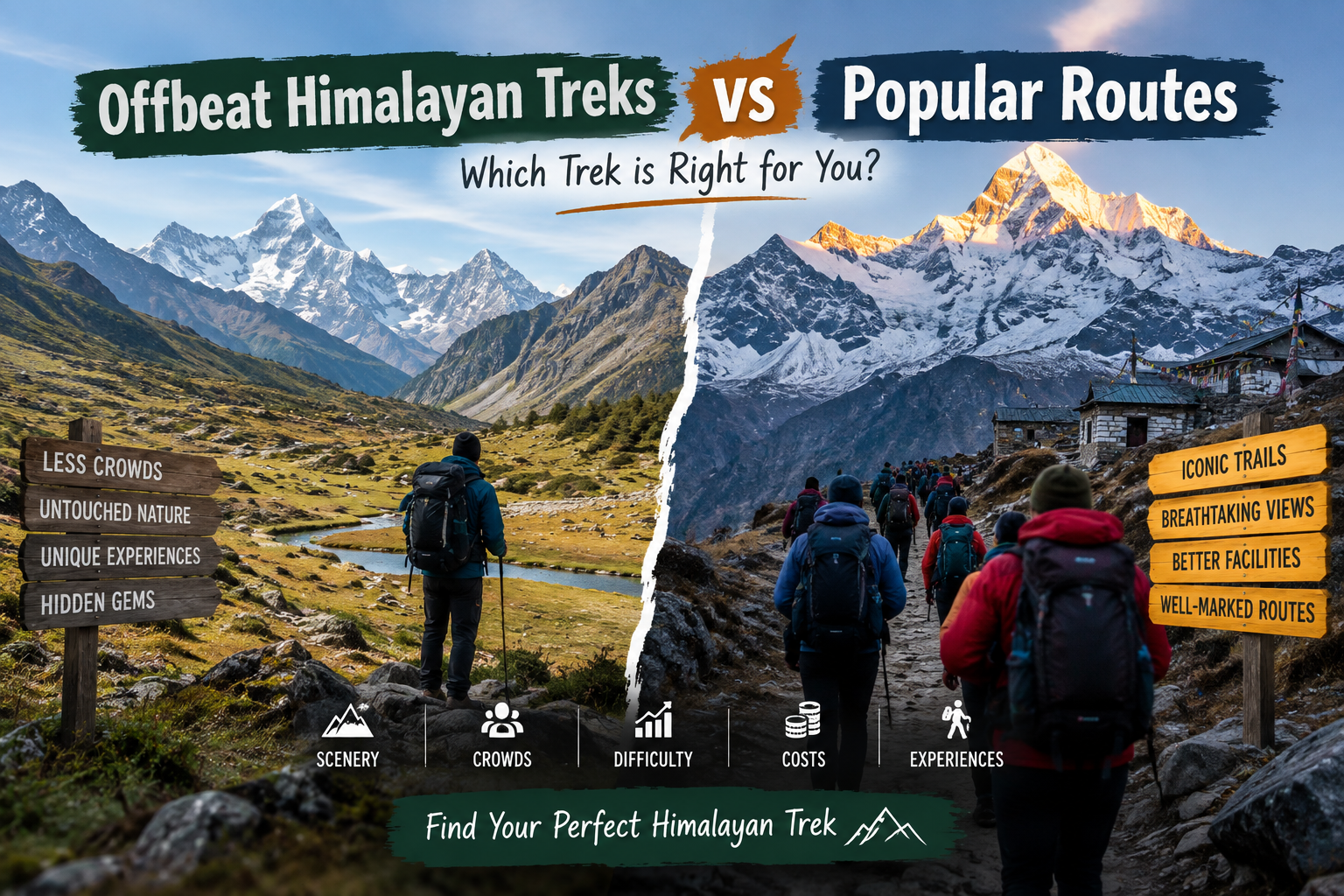
Every trekking season, thousands of hikers funnel into the same handful of Himalayan trails. You’ve seen the photos — queues of neon jackets snaking up a ridge, campsites packed shoulder to shoulder, and Instagram feeds that all look identical because everyone stood in the exact same spot for the exact same shot.
Somewhere along the way, “popular” started getting mistaken for “best.” But if you ask anyone who’s traded a crowded trail for a quiet one, they’ll tell you it’s not even close. This post breaks down exactly why offbeat Himalayan treks consistently deliver a richer experience than the well-known routes — and how to choose the right one for you.
The Problem With Popular Trekking Routes
Popular routes earn their fame for good reason — stunning views, well-marked trails, established infrastructure. But popularity has a cost that rarely makes it into the marketing brochure.
Overcrowded trails and campsites. During peak season, iconic routes can see hundreds of trekkers on the same day. That means queuing at narrow passages, jostling for photo spots, and campsites that feel more like a festival ground than a mountain retreat.
Environmental strain. High footfall means more waste, more soil erosion, and more pressure on fragile alpine ecosystems. Meadows that took centuries to form get trampled in a single season.
A diluted sense of adventure. Part of what makes trekking special is the feeling of discovery — of earning a view that few others have seen. That feeling is hard to hold onto when you’re trekking in a human traffic jam.
Inflated costs, generic service. High demand routes often attract high-volume operators who prioritize batch size over guide quality, food quality, or safety margins.
None of this means popular treks aren’t worth doing. It means they’re not automatically the best choice — especially if what you’re after is a genuine connection with the mountains.
Offbeat Himalayan Treks Worth Choosing Over the Usual Suspects
If everything above has you convinced, here are real offbeat trails in Uttarakhand worth putting on your list — each one an alternative to a route that’s become a little too well-trodden.
Pindari Glacier Trek: Walk to the Glacier’s Snout in Kumaon
The Pindari Glacier trek in Bageshwar, Kumaon, is a classic offbeat route for anyone who wants a real glacier without technical climbing. The trail begins near Khati, the last inhabited village on the route, and follows the Pindar River through rhododendron and oak forests via Dwali and Phurkia. The final stretch opens into wide alpine terrain and ends at Zero Point, the glacier’s snout, at roughly 3,660 m, with Nanda Khat and Nanda Kot standing close by. Ordinary trekkers stop at Zero Point, as going further needs mountaineering gear. Rated moderate, the trek suits fit beginners and takes about 6 days including travel. Best seasons are mid-April to mid-June and mid-September to mid-November, while winter and monsoon see closures due to snow and landslides.
Surya Top Trek: A Summit Above Dayara Bugyal
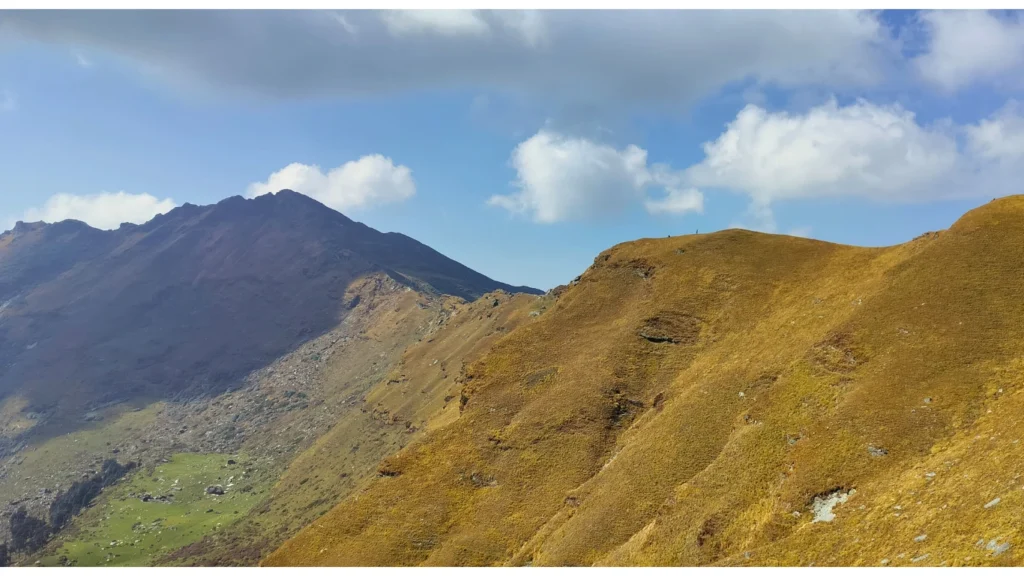
The Surya Top trek in Uttarkashi is a natural extension of the Dayara Bugyal trail, taking you higher to a summit at about 12,900 ft in the Garhwal Himalayas. Most itineraries start from Raithal or Barsu, climbing through oak and rhododendron forests into the open meadows of Dayara, then continuing along a long ridge above Devkund. The final push to the top is steep and sustained but not technical, so it is more demanding than the standard Dayara trek. From the summit, you get close views of the Gangotri range, including Bhagirathi and Kedardome, along with Bandarpoonch and Kalanag across the valley. Expect a moderate trek of around 5 days, with the meadows under snow in winter and colourful in spring and summer.
Dodital Trek: A Sacred Lake in the Oak Forests
The Dodital trek in Uttarkashi is a short, scenic trail that ends at a serene lake sitting at about 3,024 m, ringed by oak, deodar and rhododendron forest. Starting from Sangamchatti, the route passes through Agoda, a small Garhwali village that gives the trek its local flavour. Dodital is believed to be the birthplace of Lord Ganesha, so the lake carries real spiritual significance for local communities as well as trekkers. Experienced trekkers often extend the route to Darwa Top, around 4,100 m, for wider Himalayan views. The lake is also known for its trout, and the area is good for birdwatching. Easy to moderate in difficulty, Dodital works well for first-timers and can be done in most seasons except peak monsoon.
Phulara Ridge Trek: Hours on an Open Ridge
The Phulara Ridge trek starts from Sankri inside Govind Pashu Vihar National Park and offers something rare in Indian trekking: hours of walking along an open ridge at around 12,150 ft rather than a quick summit and descent. The trail rises through pine, oak and rhododendron forest, passes Sikolta and Bhoj Gadi, then emerges onto the ridge with views of Swargarohini, Bandarpoonch and Kalanag. From here you descend to the Pushtara meadows, a wide, quiet campsite, before finishing at Taluka village. Rated easy to moderate, it takes about 5 to 6 days including the drive from Dehradun. It shares its base with Kedarkantha but sees far fewer trekkers, so it suits anyone who wants solitude. Best months are May to June and September to October.
Ancha Top Trek: A Quiet Summit in the Yamunotri Region
The Ancha Top trek (also spelled Aancha Top) sits in the Yamunotri region of Uttarkashi and is one of the quieter summit treks in Garhwal. Starting from Ranachatti, the trail passes the Someshwar temple, climbs through oak and rhododendron forest and opens onto the wide Dinnala Bugyal, where shepherd huts dot the meadow. The summit day follows a long ridge, past three glacial lakes, to Ancha Top at about 12,525 ft. From the top you get a 360-degree panorama of Bandarpoonch, Swargarohini, Black Peak, Kedarnath and the Gangotri massif. The trek runs about 6 days at an easy to moderate level and works in most seasons, with April to June and September to November offering the clearest views.
Each of these can be tailored around your fitness level and the season — reach out to the Mountainiax team and they’ll match you to the right one.
What Makes Offbeat Treks Different (and Often Better)
1. You Actually Get the Silence You Came For
Offbeat trails through Uttarakhand’s lesser-known ridgelines and valleys offer something popular routes simply can’t: solitude. No queues, no waiting for your turn at the viewpoint, no strangers in every frame of your photos. Just you, your group, and the mountains.
2. Untouched, More Dramatic Landscapes
Because fewer people pass through, offbeat regions tend to stay more pristine — denser forests, cleaner alpine lakes, and meadows that haven’t been flattened by thousands of boots. The Dayara Bugyal Trek is a great example: a short, beginner-friendly trail through vast rolling meadows that stays noticeably quieter than routes like Valley of Flowers during monsoon, without sacrificing an ounce of scenic reward.
3. Closer Interaction With Local Culture
Less-trodden trails usually pass through small Himalayan villages that haven’t been reshaped by mass tourism. You get real conversations with locals, home-cooked meals instead of standardized trek food, and a far more authentic sense of what life in the mountains actually looks like.
4. Better Guide-to-Trekker Attention
Offbeat treks are typically run in smaller batches — partly because demand is lower, and partly because responsible operators keep group sizes intentionally small to protect the trail. Smaller groups mean guides can actually notice if someone’s struggling with altitude, pace, or gear, instead of managing a crowd.
5. A Genuine Sense of Discovery
There’s a psychological difference between checking off a trek everyone’s already done and standing somewhere that still feels a little bit undiscovered. Offbeat trails restore that “why I started trekking in the first place” feeling.
Offbeat vs Popular: A Quick Comparison
| Factor | Popular Routes | Offbeat Routes |
| Crowd density | High, especially in peak season | Low to moderate |
| Environmental impact | Higher due to footfall | Lower, better preserved |
| Campsite experience | Shared, often congested | Private, peaceful |
| Local interaction | Limited, commercialized | Genuine, community-based |
| Group sizes | Often large batches | Small, personalized groups |
| Sense of discovery | Diminished | High |
Does This Mean You Should Always Avoid Popular Treks?
Not necessarily. Routes like Valley of Flowers earned their reputation for a reason, and there’s real value in experiencing a UNESCO-recognized landscape at least once. The smarter approach is timing and operator choice: trekking popular routes in shoulder season with a small-batch operator, and actively seeking out offbeat alternatives for the “we want fewer people and more mountain” experiences.
If you’re weighing options like the Chopta Tungnath Chandrashila Trek — which manages to stay relatively peaceful despite growing popularity — against a true offbeat trail, it often comes down to what you want out of the trip: iconic views with reasonable crowd levels, or total solitude on a lesser-known path.
How to Choose the Right Offbeat Trek for You
A few honest questions to ask before you commit:
- What’s your fitness level? Offbeat trails are sometimes less maintained, so terrain can be more demanding. Match difficulty to your experience.
- How much comfort do you need? Offbeat treks may have simpler campsites and fewer amenities — that’s part of the appeal, but it’s worth knowing in advance.
- What season are you trekking in? Some offbeat trails are only accessible in specific windows due to snow or monsoon conditions.
- Who’s leading the trek? This is the one that matters most. A trail is only as good — and as safe — as the guide leading you through it.
Why the Operator Matters More on Offbeat Trails
On popular routes, there’s a safety net: other trekkers nearby, well-marked paths, frequent checkpoints. On offbeat trails, that safety net doesn’t exist in the same way — which means the quality of your guide and operator isn’t a nice-to-have, it’s the entire foundation of the experience.
Look for operators who are government-registered, use certified local guides who know the terrain (not outsiders reading a map), keep group sizes genuinely small, and carry proper safety equipment and altitude protocols. This is exactly the gap that separates a life-changing offbeat trek from a genuinely risky one.
If you’re exploring what’s out there, it’s worth browsing the full range of Himalayan treks available before deciding between a popular classic and something further off the map.
Final Thoughts
Chasing the most photographed trail isn’t the same as chasing the best experience. Offbeat Himalayan treks trade Instagram-famous crowds for something harder to package but far more valuable: silence, untouched landscapes, real local connection, and the kind of personal attention that only happens in small groups. The mountains you remember years later are rarely the ones that looked best in a photo — they’re the ones where you heard the wind instead of a hundred other conversations, where a local shared a meal with you instead of just serving one, and where your guide actually knew your name by day two.
None of this makes popular treks pointless — some views are worth the crowd, at least once. But if that quieter, more earned kind of trekking is what you’re after, the trail matters less than who you trek it with. The right operator, the right group size, and the right guide can turn even a lesser-known ridge into the most memorable trek you’ve done, while the wrong ones can make even a stunning trail feel forgettable.
FAQs
1. What exactly counts as an “offbeat” Himalayan trek?
An offbeat trek is any trail that sees significantly lower footfall than the well-known routes — usually because it’s less marketed, harder to access, or simply overshadowed by more famous neighbours. Think Dayara Bugyal instead of Valley of Flowers, or a lesser-known ridgeline instead of a bestseller trek.
2. Are offbeat treks safe for beginners?
Many are, but not all. Some offbeat trails are genuinely beginner-friendly (like Dayara Bugyal), while others are less maintained and more demanding since they don’t have the same infrastructure or footfall as popular routes. The right operator will match the trail to your fitness level rather than pushing everyone onto the same route.
3. Do offbeat treks cost more or less than popular ones?
It varies. Offbeat treks often run in smaller batches, which can mean a slightly higher per-person cost since expenses are split among fewer trekkers — but you’re also getting better guide attention and a less commercialized experience in return, so it’s rarely a straight comparison.
4. Is it true that popular treks are overcrowded even outside peak season?
Not necessarily — shoulder season on a popular route can actually be a good middle ground, giving you the iconic views with noticeably fewer crowds. Peak season is where the overcrowding really shows up.
5. Which is better for photography — offbeat or popular treks?
Offbeat trails tend to offer more unique, less “seen-a-thousand-times” shots simply because fewer people are photographing the same spot. Popular treks are scenic too, but you’re often working around crowds to get a clean frame.
6. How do I know if a trekking operator is reliable for an offbeat route?
Check that they’re government-registered, use certified local guides familiar with that specific terrain, keep group sizes genuinely small, and carry proper safety and altitude-sickness protocols. On offbeat trails, the operator is the safety net, so this matters more than on popular routes.
7. Can I do a popular trek and still avoid the crowds?
Yes — timing and operator choice make the biggest difference. Trekking a popular route in shoulder season with a small-batch operator gets you much closer to an offbeat-style experience without giving up the iconic scenery.
8. Which offbeat treks does Mountainiax recommend for someone tired of crowded trails?
It depends on your fitness level and the season you’re trekking in, but routes like Dayara Bugyal are a solid starting point for offbeat trekking in Uttarakhand. Reach out to the team and they can match you to a trail based on experience, timing, and what kind of solitude you’re actually looking for.
Ready to skip the crowds and experience the Himalayas the way they’re meant to be seen?
As the best trekking company in Uttarakhand, Mountainiax specializes in small-batch, safety-first expeditions led by local guides who’ve grown up on these very trails. Explore our treks or get in touch to plan your offbeat Himalayan adventure today.