Tucked deep within the remote Kumaon Himalayas of Uttarakhand, Adi Kailash is one of India’s most spiritually significant and visually breathtaking destinations. Often called “Chota Kailash,” this sacred peak sits close to the Tibet border and draws pilgrims, trekkers, and Himalayan adventurers from across the world. Unlike the more commercialised Himalayan circuits, Adi Kailash demands real preparation — and timing is perhaps the single most important factor that determines whether your journey becomes a memory of a lifetime or a logistical ordeal.
The Adi Kailash trek passes through high-altitude terrain, dense forests, river valleys, and border zones that are directly impacted by seasonal weather patterns. Heavy snowfall can shut down the route entirely in winter, while monsoon rains make the trails dangerously slippery and trigger frequent landslides on the approach roads. Understanding the rhythm of the seasons is not just practical advice — it is essential intelligence for anyone serious about completing this yatra safely and meaningfully.
The Best Time to Visit Adi Kailash is widely considered to be May through June and September through October, but each month carries its own distinct character, advantages, and trade-offs. This guide breaks down every month of the year so you can choose the window that perfectly aligns with your goals — whether you are a devotee seeking darshan, a trekker chasing summit views, or a traveller in search of raw Himalayan solitude.
Why Timing Your Adi Kailash Yatra Matters More Than You Think
Adi Kailash sits at an elevation of approximately 6,191 metres, while the base camp area around Jolingkong Lake hovers near 4,750 metres above sea level. The approach route from Dharchula in Pithoragarh district winds through several altitude zones, each with dramatically different microclimates. Add to this the fact that the area falls under restricted Inner Line Permit (ILP) jurisdiction due to its proximity to the Indo-Tibet border, and the seasonal timing of your visit becomes even more critical. Permits are issued only during certain windows, border roads are maintained sporadically, and helicopter services operate on weather-dependent schedules.
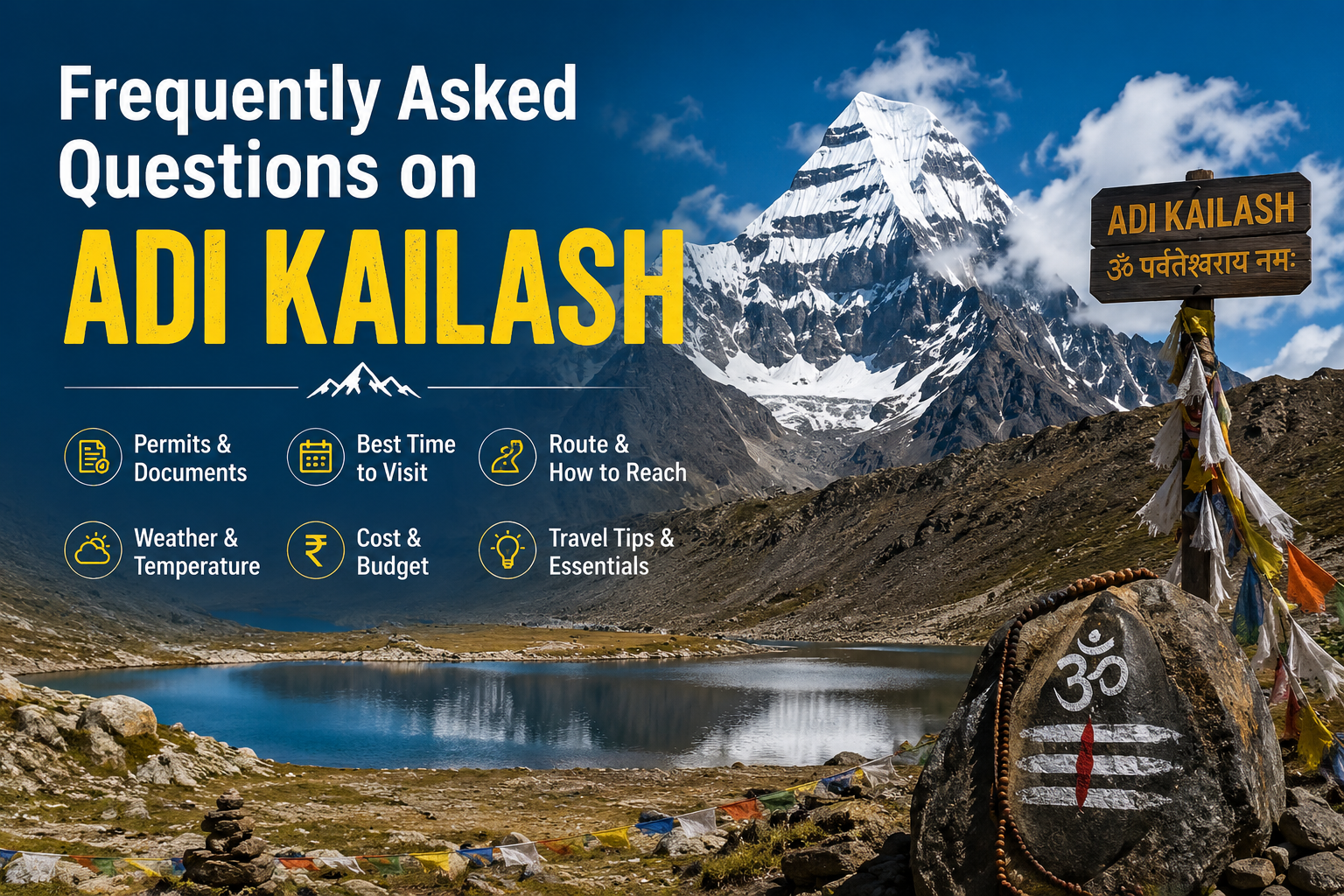
Experienced trekkers know that weather at this altitude shifts unpredictably. A clear morning can turn into a whiteout within hours. Planning around proven seasonal windows not only improves safety but also maximises your chances of clear Om Parvat views — the primary spiritual and visual centrepiece of the entire Adi Kailash Yatra. Without those clear skies, the sacred snowflake-shaped formation of snow on Om Parvat’s face remains hidden, leaving visitors with an incomplete experience.
For photographers, the relationship between season and light quality is everything. If you are planning a dedicated photographic expedition alongside your pilgrimage, exploring our Adi Kailash Photography Guide will give you a detailed understanding of golden hour timings, cloud formations, and the best months to capture the Panchachuli peaks, Om Parvat, and Jolingkong Lake in their most photogenic states.
Month-by-Month Guide to Visiting Adi Kailash
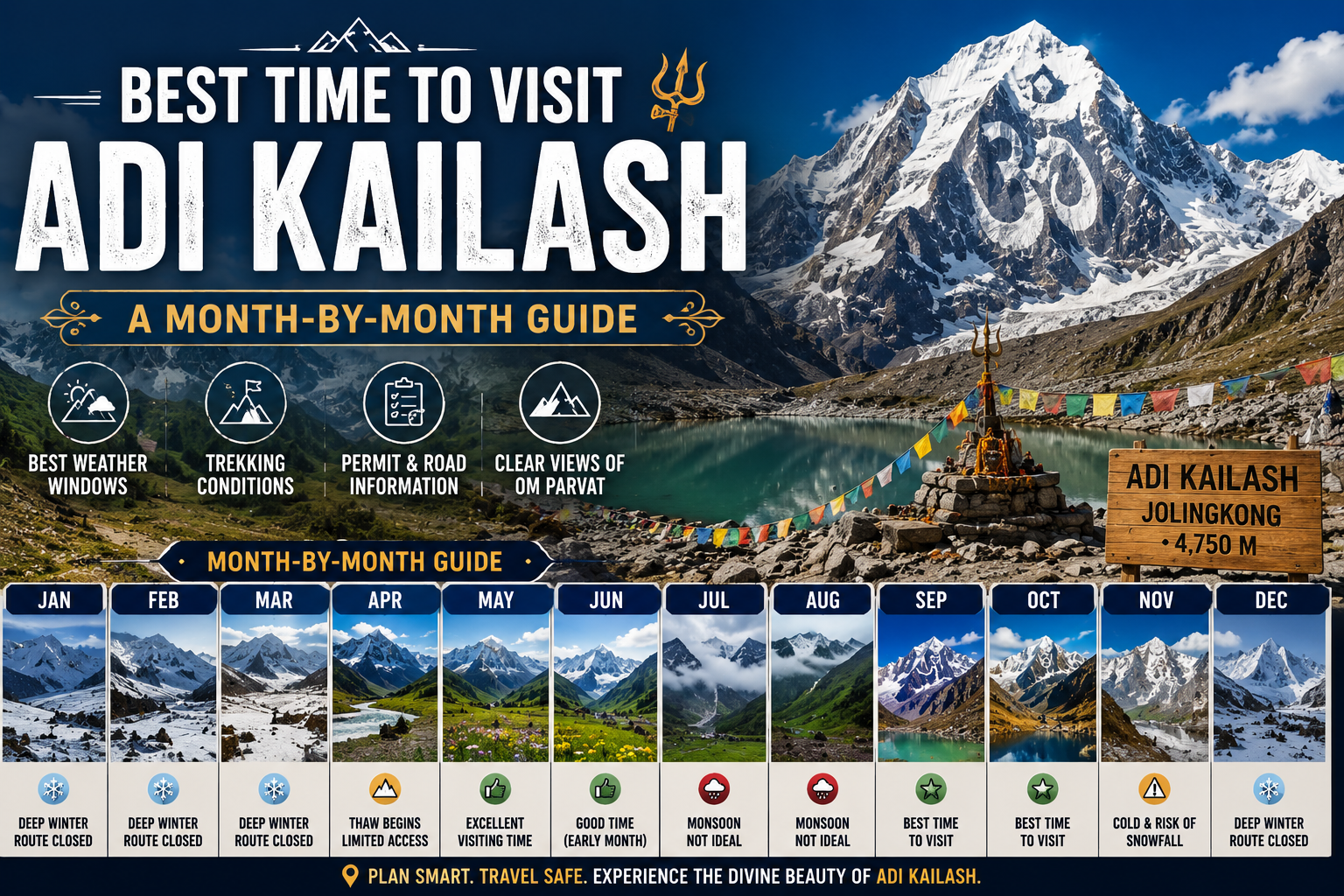
A month-by-month Adi Kailash guide helps travellers understand seasonal weather, road accessibility, trekking conditions, snowfall patterns, permit availability, and visibility for Om Parvat, making it easier to choose the safest and most rewarding time for the yatra.
January to March: Deep Winter, Closed Routes
The months of January, February, and March represent the harshest period across the Vyas Valley and surrounding Himalayan terrain. Heavy snowfall typically blankets the higher passes, and the road from Tawaghat to Gunji — the gateway to the Adi Kailash circuit — remains either impassable or under active snow clearance by the Border Roads Organisation (BRO).
- Temperatures at Jolingkong drop well below -15°C overnight
- Lipulekh Pass at 17,589 feet remains blocked with several feet of snow
- No permits are issued during this period
- Dharchula itself experiences biting cold, though the town remains accessible
Verdict: Not recommended for any visitor type. The route is officially closed.
April: The Thaw Begins
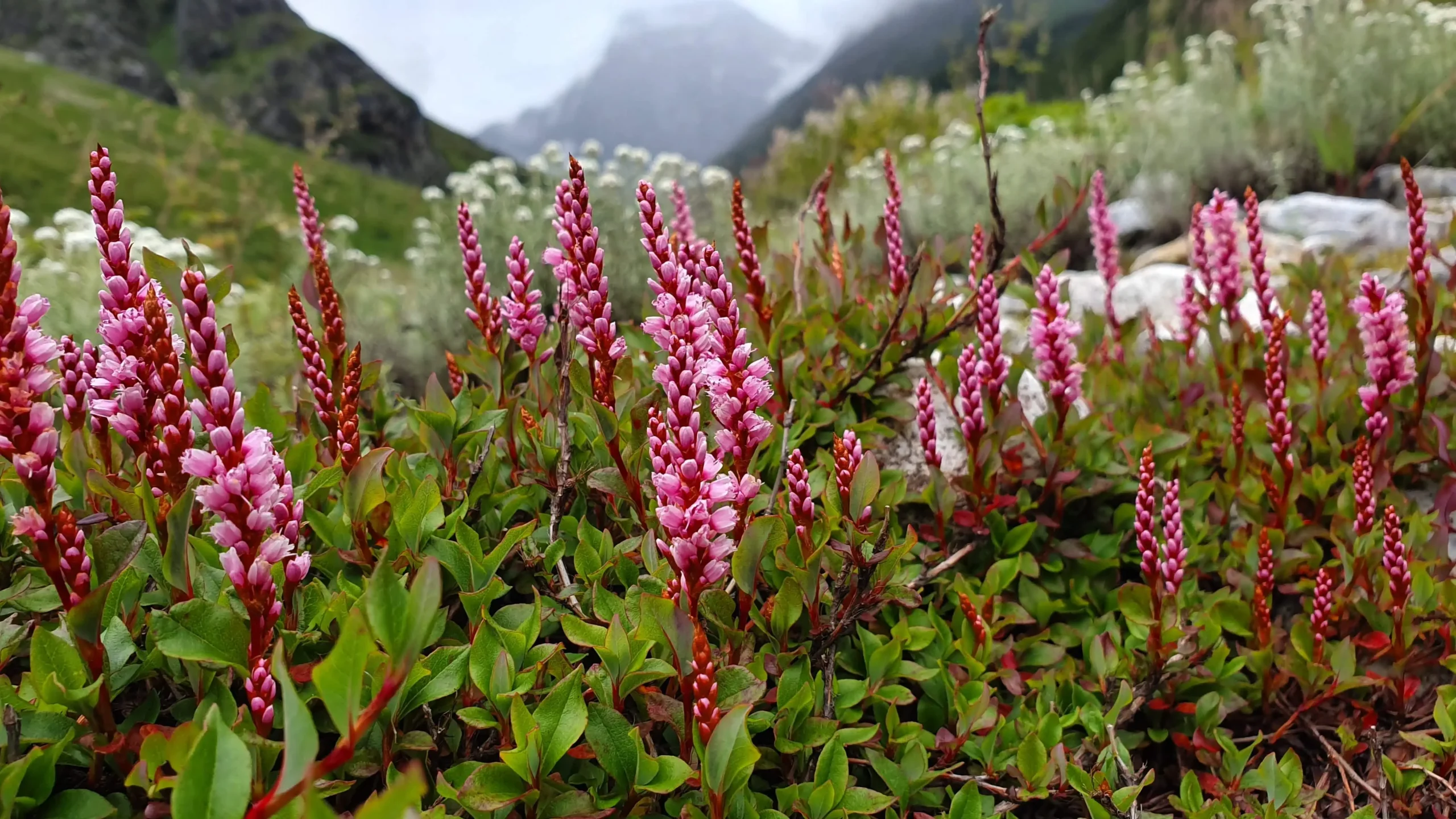
April marks the transition between winter and the brief Himalayan spring. BRO teams begin snow clearance operations on the Pithoragarh to Dharchula road and its upper extensions. Lower-altitude sections of the valley begin to green up, and the first wildflowers appear along the Kuti Valley trail.
However, higher passes remain dangerous. Snowmelt increases rockfall risk on exposed sections. As of 2026, the official Adi Kailash Yatra registration typically does not open before late April or early May, depending on road conditions confirmed by the district administration.
Verdict: Only for experienced recce trekkers with full winter gear. Not suitable for general pilgrims.
May: The Season Opens — An Excellent Window
May is widely regarded as one of the finest months to begin the Adi Kailash trek. Skies are reliably clear before the pre-monsoon cloud build-up, temperatures are manageable at all altitude zones, and the landscape transitions from barren snow to alpine meadows dotted with Himalayan wildflowers.
- Daytime temperatures at Jolingkong range between 5°C to 12°C
- Excellent visibility for Om Parvat darshan
- BRO roads are open and operational
- Permits are actively being issued
The trade-off is that late May can see the first hint of moisture from the approaching monsoon, occasionally causing afternoon cloud cover. Plan your summit viewpoint visits for early morning hours.
Verdict: Highly recommended. Ideal for first-time trekkers and pilgrims.
June: A Precious and Shrinking Window
June offers arguably the most dramatic scenery of any month. Rhododendrons have bloomed, the Kali River flows powerfully below, and the mountains stand sharply against deep blue skies in the first fortnight. The Chiyalekh meadows are at their lushest, and wildlife sightings — including Himalayan monal and bharal — are at their peak.
The second half of June is when the Indian Summer Monsoon begins its northward push. Trail conditions can deteriorate rapidly after the 20th of June, and the risk of landslides on the approach road between Tawaghat and Gunji increases significantly.
Verdict: First two weeks of June are outstanding. After June 20th, proceed only with expert guidance and a flexible itinerary.
July to August: Monsoon Season — High Risk, Low Reward
The monsoon arrives in full force across the Uttarakhand Himalayas through July and August. While the rainfall itself is sometimes lighter at very high altitudes compared to mid-mountain zones, the real danger lies in the approach road. Landslides are frequent, road closures can strand trekkers for days, and the already-narrow paths along river gorges become treacherous.
Visibility for Om Parvat drops to near zero on most days. The spiritual experience of the yatra is heavily diminished when the peak remains permanently cloud-draped. Most Adi Kailash Yatra operators officially suspend their services during this period.
Verdict: Not recommended. The safety risks outweigh the rewards for all but the most experienced high-altitude adventurers.
September: The Finest Month on the Entire Route
September is the unrivalled favourite among seasoned Kumaon trekkers. Post-monsoon skies are crystal clear, the landscape is saturated with green after months of rainfall, and the crowds are noticeably smaller than May. The air is fresh, waterfalls are thundering down every hillside, and the contrast between the blue sky and white peaks is at its photographic best.
- Temperatures stabilise between 4°C to 14°C across mid-altitude camps
- Landslide risk drops sharply after September 5th
- Jolingkong Lake reflects Om Parvat with mirror-like clarity on calm mornings
- The cultural atmosphere at Gunji and Nabhidhang is vibrant with returning pilgrims and local shepherds
This is also when travellers exploring the nearby border settlements — including Kalapani, the historically significant site at the confluence of three rivers near the source of the Kali River — find the landscape at its most dramatic and accessible. The ecosystem around Kalapani is in full bloom in September, offering context that deepens the spiritual geography of the entire Adi Kailash circuit.
Verdict: The single best month to visit. Book at least 90 days in advance.
October: Peak Season with a Crisp Edge
October continues the excellent conditions of September with the added drama of the first light dusting of snow on higher peaks. This fresh snow on Om Parvat is breathtaking against a cloudless October sky and is frequently cited by return visitors as the most visually arresting sight in the entire region.
- Nights become genuinely cold — sub-zero above 4,000 metres after mid-October
- Layered clothing and a quality sleeping bag rated to -10°C are non-negotiable
- Permits remain active through most of October
Trekkers who prefer cooler, crisper conditions with less moisture in the air consistently rate October as their top choice.
Verdict: Excellent. Best for those comfortable with cold nights and those prioritising photography.
November to December: Closing Season
By early November, temperatures drop sharply, BRO begins scaling back road maintenance, and the district administration typically closes the Adi Kailash Yatra route officially. Snow returns to the higher sections, and the last batches of pilgrims and trekkers complete their journeys before the closures take effect.
December marks the full return of winter. The route is inaccessible, and services in Dharchula and gateway towns wind down significantly.
Verdict: November first week is possible for experienced trekkers. After that, avoid.
Altitude, Terrain, and Acclimatisation by Season
Understanding altitude response is critical regardless of which season you choose. The Adi Kailash circuit involves rapid altitude gain from Dharchula at 915 metres to Jolingkong at 4,750 metres over roughly five to six days of trekking. In May and October, the drier, colder air can accelerate dehydration and worsen Acute Mountain Sickness (AMS) symptoms if ascent is rushed.
Key acclimatisation principles by season:
- Spring (May–June): Take an extra rest day at Nabhidhang before pushing to Jolingkong. The body acclimatises faster in warmer temperatures, but pollen and dust can irritate the respiratory system.
- Post-Monsoon (September–October): Lower oxygen partial pressure at altitude is more noticeable in October. Stay hydrated aggressively. A rest day at Gunji (3,325m) is non-negotiable.
- Any Season: Diamox is available at Dharchula pharmacies. Carry a portable pulse oximeter to monitor blood oxygen saturation throughout the trek.
Never attempt to push through summit sections if your SpO2 drops below 85% — descend immediately and consult the medical post at Gunji.
Permits, Regulations, and Seasonal Access
The Adi Kailash circuit falls within a Restricted Area Zone under the Ministry of Home Affairs jurisdiction. All domestic Indian nationals must obtain an Inner Line Permit (ILP) from the District Magistrate’s office in Pithoragarh or through authorised tour operators. Foreign nationals are currently not permitted on this route.
The ILP is issued only when the official yatra season is declared open — typically between early May and late October, subject to annual road and weather assessments. The exact dates vary each year, so always confirm with the Pithoragarh District Administration before booking flights.
For those considering an aerial approach, the Adi Kailash Yatra by Helicopter 2026 service is operated by state-approved aviation partners and covers the route from Pithoragarh to select landing zones, dramatically reducing the physical trekking demand while still requiring valid ILP documentation. Helicopter slots are extremely limited and tend to sell out months in advance, particularly for the September window. If this is your preferred mode of access, registrations should ideally be completed before March of the yatra year.
Key permit facts:
- ILP is mandatory for the entire circuit including Kuti village and Nabhidhang
- Group registrations (minimum 2 persons) receive slightly faster processing
- Carry physical copies of your permit at all checkposts — digital copies are not always accepted at remote checkposts
Quick-Reference: Best Season Summary
| Month | Suitability | Key Highlight |
| January–March | Closed | Heavy snow, no access |
| April | Experts only | Snowmelt, road clearance |
| May | Excellent | Clear skies, wildflowers |
| June (1st half) | Excellent | Peak greenery, sharp views |
| June (2nd half) | Risky | Monsoon onset |
| July–August | Not recommended | Landslides, poor visibility |
| September | Best overall | Crystal clarity, fewer crowds |
| October | Excellent | Fresh snow, crisp air |
| November–December | Closing | Sub-zero, route shutting |
Packing Essentials Based on Your Season
Your packing list for the Adi Kailash Yatra should change according to the season. Carry proper layered clothing, waterproof gear, trekking essentials, altitude medications, and cold-weather protection to handle unpredictable Himalayan conditions, temperature fluctuations, rough terrain, and limited facilities throughout the journey safely and comfortably.
For May and June trekkers:
- Lightweight merino base layers, waterproof shell jacket, trekking poles
- Sunscreen SPF 50+ (UV intensity is extreme above 4,000m)
- Rain poncho for afternoon showers in late June
For September and October trekkers:
- Down jacket rated to -15°C for evenings at Jolingkong
- Thermal inner gloves plus outer shell gloves
- Microspikes or traction cleats if visiting in late October when light snow returns to the trail
- High-calorie snacks — rhododendron tea and tsampa are available at local dhabas but options are limited
All seasons:
- Portable water purification tablets or filter
- Emergency bivouac bag
- First aid kit with AMS medication
- Valid photo ID copies (Aadhaar/passport) for all checkpoints
Frequently Asked Questions
Q1: Which is the absolute best month for first-time visitors to Adi Kailash?
September is the most universally recommended month. It combines post-monsoon clarity, moderate temperatures, lush green landscapes, and the best probability of clear Om Parvat views. The reduced crowd density compared to May also makes the spiritual experience more serene.
Q2: Is the Adi Kailash trek safe during June?
The first two weeks of June are generally safe and offer spectacular scenery. After June 15th, conditions become progressively riskier due to the monsoon. Always check the latest road and weather reports from the Pithoragarh District Authority before departing.
Q3: How many days does the Adi Kailash Yatra take?
The standard circuit takes 8 to 10 days from Dharchula, including travel, trekking, darshan at Jolingkong, and the return journey. Helicopter-assisted options can reduce the duration significantly.
Q4: Can beginners attempt the Adi Kailash trek?
Yes, but with preparation. The trail is rated moderate and does not require technical climbing skills. However, the altitude gain is significant. At least six weeks of cardiovascular conditioning prior to the trek is strongly recommended. Choose May or September for the most forgiving conditions if you are a first-timer.
Q5: What is Om Parvat and why is it significant?
Om Parvat is a peak adjacent to the Adi Kailash route that bears a natural formation of snow on its face that resembles the Sanskrit symbol “Om.” It is considered one of the most sacred naturally occurring phenomena in the Himalayas and is the primary point of darshan during the yatra.
Summary
Choosing the right season is the most important decision when planning the Adi Kailash Yatra. From clear post-monsoon skies in September to the vibrant alpine landscapes of May and June, every month offers a different Himalayan experience. However, weather conditions, altitude challenges, road accessibility, and permit regulations directly impact both safety and visibility during the journey.
For most trekkers and pilgrims, September and October provide the best balance of stable weather, breathtaking mountain views, and a smoother trekking experience. Whether you seek spiritual connection, Himalayan adventure, or photography opportunities, proper planning and seasonal awareness are essential for making the Adi Kailash journey safe, meaningful, and unforgettable.
With the Adi Kailash Yatra season approaching, it’s time to plan a journey that blends spirituality with raw Himalayan adventure. From sacred lakes to the divine presence of Adi Kailash, every moment feels profound and transformative. If you seek purpose beyond travel, this is your path.
Visit this page for Yatra Packages, Itinerary & Booking.