Deep in the remote folds of the Kumaon Himalayas, at an elevation of approximately 3,600 metres, lies a place that holds equal significance for the devout, the geographer, the historian, and the curious traveller. Kalapani is not merely a waypoint on a pilgrimage trail. It is where the ancient and the modern collide — where a revered Kali Mata temple stands at the confluence of sacred streams that give birth to the Kali River, the very waterway that forms India’s natural boundary with Nepal.
For pilgrims setting out on the Adi Kailash Yatra, Kalapani represents one of the most emotionally charged stops on the entire journey. The air here carries the weight of centuries — of soldiers who guarded this frontier, of saints who sought divine energy in the mountains, and of rivers that have carved borders into stone. It is a destination that rewards those who come prepared with both reverence and curiosity.
This guide covers everything you need to know about Kalapani: its spiritual meaning, geographical importance, the Sacred Confluence on Adi Kailash Route, the temple dedicated to Goddess Kali, its contested territorial history, and practical tips for your visit in 2026.
What Is Kalapani and Why Does It Matter?
Kalapani is a high-altitude settlement in the Pithoragarh district of Uttarakhand, India. It sits at the convergence of multiple tributaries that together form the Kali River, also known locally as Sharda or Mahakali. This river flows westward and eventually south, forming a natural, continuous border between India and Nepal for nearly 150 kilometres.
What makes Kalapani extraordinary is the convergence of three forces — spiritual, geographical, and political — in one single location. Few places in the Himalayas carry this triple weight, which is why it continues to attract not just pilgrims and trekkers, but also researchers, defence analysts, and travel writers from across the world.
The Kalapani temple Adi Kailash route has become a growing search query among travellers planning the Om Parvat and Adi Kailash circuits, and for good reason. Kalapani is an unmissable spiritual and strategic checkpoint on this ancient route.
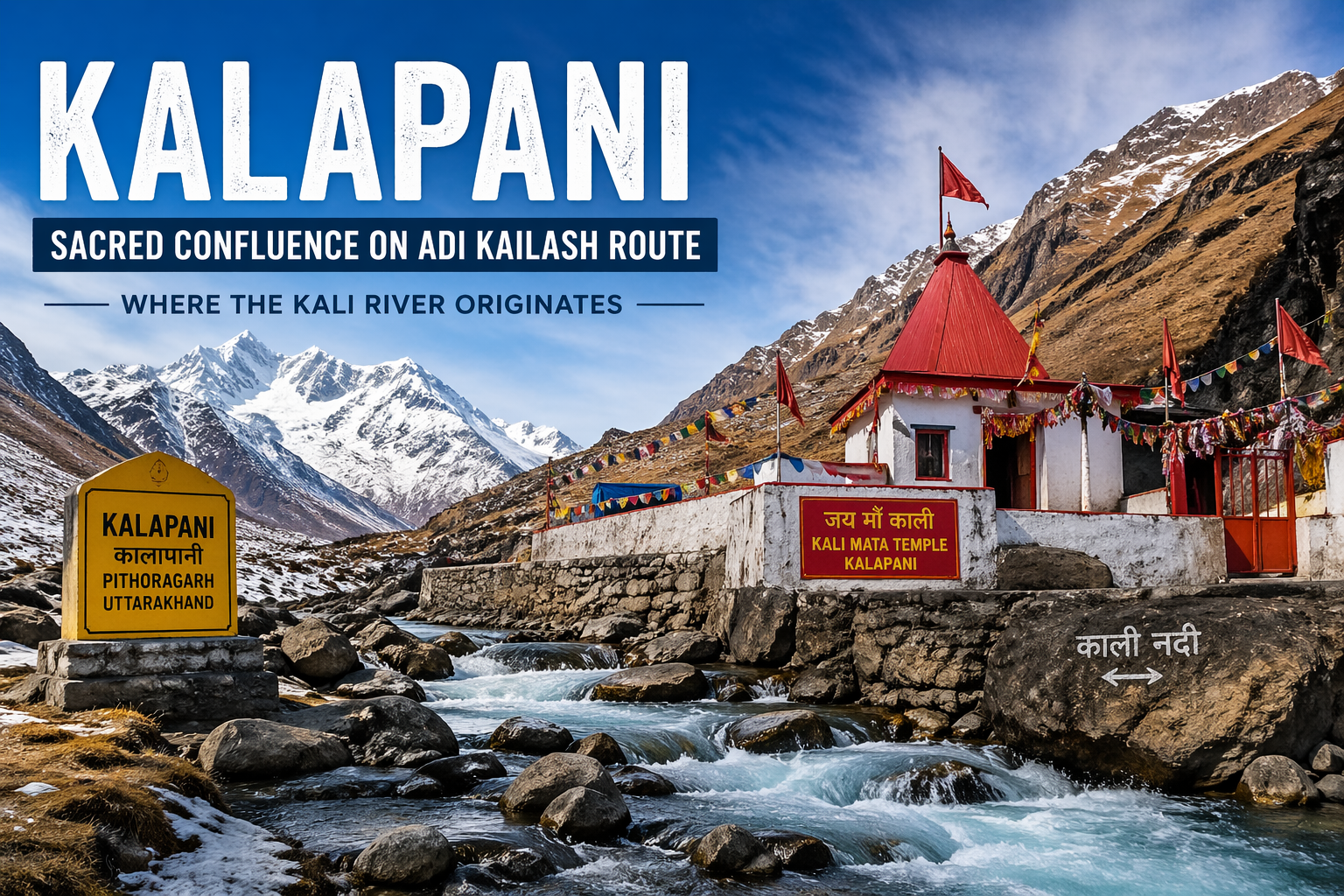
The Kali Mata Temple at Kalapani
The Kali Mata Temple at Kalapani is a revered shrine near the Indo-Tibet border, marking the origin of the Kali River and holding deep spiritual and cultural significance for pilgrims.
Spiritual Heart of the Confluence
At the centre of Kalapani stands the Kali Mata Temple, a modest yet deeply powerful shrine dedicated to Goddess Kali — the fierce, transformative form of the divine feminine in Hindu tradition. The temple is believed to be centuries old, and local lore holds that the goddess herself chose this confluence point to manifest her presence, blessing the waters and the land with protective energy.
The Kali River takes its name from this very deity. According to both religious texts and local oral traditions, the river that flows from Kalapani is considered a living embodiment of Goddess Kali’s power. Bathing in or offering prayers at this confluence is believed to absolve sins and bestow strength for the arduous Himalayan journey ahead.
Pilgrims on the Adi Kailash Yatra traditionally stop here to:
- Offer prayers and perform rituals at the Kali Mata Temple
- Take a holy dip at the confluence of the streams
- Seek the goddess’s blessings before ascending further toward Om Parvat and Adi Kailash
- Observe a moment of silence in honour of the ITBP (Indo-Tibetan Border Police) jawans stationed nearby
The temple itself is simple in structure — stone walls, a vermilion-smeared idol, and marigold offerings from devotees who have walked days to reach this point. Yet its energy is anything but ordinary. Even those who visit without a religious background often report a palpable stillness and gravitas at this site.
The Confluential Geography: Origin of the Kali River
From a purely geographical standpoint, the origin of the Kali River is a subject of significant academic and political debate, but Kalapani is widely regarded as the functional source of the main river channel. The streams that meet here descend from glaciers and snowfields high above, cutting through narrow gorges before pooling at this confluence.
The Lipulekh Pass, approximately 20 kilometres north of Kalapani at an elevation of 5,334 metres, sits at the very top of this drainage system. Meltwater from Lipulekh and surrounding glaciers feeds directly into the streams that converge at Kalapani, making the entire corridor a hydrologically significant zone.
For travellers who arrive from Gunji Village, the last inhabited settlement before the final push toward Adi Kailash, Kalapani marks the transition from the relatively accessible Himalayan zone into the truly remote, high-altitude sacred terrain. Gunji is approximately 4 kilometres from Kalapani by the trekking trail, and most organised yatra groups pause at Kalapani for prayers before continuing upward.
Historical Background: A Confluence of Civilisations
Kalapani has long been a crossroads of ancient trade routes linking India and Tibet, where cultures, religions, and traditions merged, leaving behind a rich legacy of spiritual exchange and historical significance.
Ancient Trade and Pilgrimage Routes
Long before Kalapani became a geopolitical flashpoint, it was a vital node on ancient trans-Himalayan trade routes. Merchants from Tibet would descend through the Lipulekh Pass carrying salt, wool, and borax to trade with lowland Indian communities. In return, they carried grain, spices, and cloth northward. Kalapani served as a natural resting point on this route — a place where traders could find water, shelter, and the blessings of the Kali Mata Temple before continuing their journey.
Pilgrims too have passed through Kalapani for centuries, drawn by the same route that connects Dharchula in the Kali Valley with the sacred peaks of Om Parvat and Adi Kailash. The distance from Dharchula to Kalapani is approximately 93 kilometres by road through Tawaghat, Sobla, and Gunji — a journey that today takes around five to six hours by jeep, but historically required several days on foot.
Colonial Era and the Treaty of Sugauli
The geopolitical significance of Kalapani is rooted in the Sugauli Treaty of 1816, signed between the British East India Company and the Kingdom of Nepal following the Anglo-Nepalese War. The treaty designated the Kali River as the western boundary of Nepal, with Nepal to the east and British India to the west.
The complication arose from a fundamental geographical ambiguity: where exactly does the Kali River begin? Nepal’s position is that the river originates further east, from a source near Limpiyadhura. India’s position is that the river originates at Kalapani, meaning the territory west of that point — including the Lipulekh area — has always been Indian.
This interpretive difference created what is now known as the Kalapani territorial dispute, a tri-junction area where India, Nepal, and Tibet (China) meet. The Indian Army has maintained a permanent post at Kalapani since the 1962 Sino-Indian War, treating it as Indian territory. Nepal disputes this claim and includes the Kalapani region in its own official maps.
Kalapani’s Strategic and Military Significance
The Indian ITBP (Indo-Tibetan Border Police) has a significant presence at Kalapani, and the road from Dharchula to Lipulekh — part of which passes through Kalapani — was formally inaugurated in 2020 to improve connectivity for both pilgrims and border security forces.
This road development, while celebrated in India as a milestone for Adi Kailash Yatra pilgrims and for national security, triggered diplomatic protests from Nepal, which reiterated its claim over the Kalapani-Lipulekh-Limpiyadhura triangle.
For travellers, it is important to understand that visiting Kalapani requires:
- Inner Line Permit (ILP) — mandatory for all Indian nationals entering the border zone
- Special permissions for foreign nationals (extremely restricted access)
- Coordination with registered tour operators who are authorised to conduct the Adi Kailash Yatra
The ITBP personnel stationed at Kalapani often interact warmly with pilgrims, and many yatra groups express deep gratitude to the soldiers who maintain vigil in one of India’s most remote and challenging border zones.
How to Reach Kalapani: Route and Distance Guide
Reaching Kalapani involves a structured Himalayan travel route with both road and restricted-access segments. It lies in the Pithoragarh district of Uttarakhand, close to the India–Nepal–China tri-junction.
From Dharchula
Dharchula is the primary base town for the Adi Kailash Yatra circuit and the nearest major town with hotels, ATMs, and medical facilities. The route to Kalapani from Dharchula is as follows:
- Dharchula to Tawaghat: approximately 20 km
- Tawaghat to Sobla: approximately 35 km
- Sobla to Nagling: approximately 12 km
- Nagling to Gunji: approximately 10 km
- Gunji to Kalapani: approximately 6 km
The entire road journey from Dharchula to Kalapani covers roughly 83 to 93 kilometres, depending on the specific route taken, and usually takes five to seven hours by jeep due to the narrow mountain roads and seasonal conditions.
The Adi Kailash Yatra by Helicopter 2026 option has made the journey dramatically shorter for those who prefer aerial access. Helicopter services typically operate between Dharchula or Pithoragarh and Gunji, from where Kalapani is accessible by a short road transfer or walk. This has opened the yatra to older pilgrims and those with limited mobility who would otherwise find the road journey prohibitive.
Best Time to Visit
The ideal window for visiting Kalapani as part of the Adi Kailash circuit is between mid-May and late October. The route is typically closed during winter due to heavy snowfall, and the monsoon months of July and August bring landslide risks, though some pilgrims still travel during this period with caution.
May, June, September, and October offer the most stable weather conditions, clearest mountain views, and best road accessibility.
The Spiritual Ecosystem Around Kalapani
Kalapani is not an isolated pilgrimage point—it functions as a spiritual ecosystem, where geography, mythology, and high-altitude Himalayan energy converge into a unified sacred landscape.
Connection to Om Parvat and Adi Kailash
Kalapani does not stand alone spiritually. It is embedded within a sacred ecosystem that includes some of the most revered peaks and pilgrimage sites in the Kumaon Himalayas:
- Om Parvat — a mountain whose snow face naturally forms the sacred Om symbol, visible from the Navidanya ridge
- Adi Kailash (Chhota Kailash) — considered a regional Kailash, deeply venerated by Shaivite pilgrims who cannot undertake the Tibet Kailash Yatra
- Joint Check Post at Gunji Village — the administrative gateway where pilgrims must register before proceeding further
- Parvati Sarovar — a glacial lake near Adi Kailash, considered supremely sacred
Each of these sites forms part of a deeply interconnected pilgrimage geography, and Kalapani’s position as the confluence of holy rivers makes it the energetic anchor of this entire sacred circuit.
Rituals and Practices at Kalapani
Pilgrims who stop at Kalapani typically engage in the following practices:
- Jal Abhishek (ritual water offering) using the confluential waters
- Lighting of oil lamps (diyas) before the Kali Mata idol
- Chanting of the Kali Chalisa or Durga Saptashati
- Silent meditation at the riverbank as the glacier-cold waters rush past
- Tying of sacred threads (mauli) on the temple tree as a sign of prayer and devotion
Many pilgrims describe the experience at Kalapani as one of the most intensely felt moments of their entire Himalayan journey — more emotionally resonant, in some cases, than the peaks themselves.
Visiting Tips for Kalapani in 2026
Planning a visit to Kalapani requires careful preparation. Here are the most important things to keep in mind:
- Obtain your Inner Line Permit through the Kumaon Mandal Vikas Nigam (KMVN) or a registered travel operator well in advance of your journey
- Book accommodation in Dharchula or Gunji in advance, especially if travelling during the peak yatra season (May-June)
- Carry warm, layered clothing even in summer — temperatures at Kalapani can drop sharply after sunset
- Acclimatise properly; if coming from the plains, spend at least one night in Dharchula before proceeding
- Carry sufficient cash — ATMs beyond Dharchula are non-functional or absent
- Do not litter or disturb the natural environment; Kalapani sits within an ecologically fragile and militarily sensitive zone
- Treat the ITBP post with respect; photography restrictions may apply near military installations
- Stay on marked trails and follow your guide’s instructions at all times
FAQ: Kalapani on the Adi Kailash Route
1. What is the religious significance of Kalapani?
Kalapani is home to the ancient Kali Mata Temple, situated at the sacred confluence of streams that give birth to the Kali River. It is a ritually significant stop for pilgrims on the Adi Kailash and Om Parvat Yatra.
2. Why is Kalapani a disputed territory?
The Kalapani dispute stems from differing interpretations of the 1816 Sugauli Treaty. India considers it part of Uttarakhand, while Nepal claims it falls within its territory based on a different definition of the Kali River’s origin point.
3. How far is Kalapani from Dharchula?
Kalapani is approximately 83 to 93 kilometres from Dharchula by road, depending on the route, and takes roughly five to seven hours by jeep.
4. Do I need a permit to visit Kalapani?
Yes. An Inner Line Permit is mandatory for Indian nationals entering this border zone. Foreign nationals face significant additional restrictions and must seek special clearances.
5. Can I visit Kalapani without doing the full Adi Kailash Yatra?
Technically, the road goes up to Kalapani as part of the same permitted zone. However, most travellers visit it as part of the yatra circuit rather than as an isolated destination.
Summary
Kalapani is far more than a transit point on a mountain trail. It is a place where geography, spirituality, history, and national identity merge into something that defies easy categorisation. The Sacred Confluence on Adi Kailash Route at Kalapani — where glacier-born streams meet at the feet of an ancient Kali Mata Temple — offers a profound and layered experience for any thoughtful traveller.
Whether you are a devotee seeking the blessings of the goddess before ascending to Adi Kailash, a geography enthusiast tracing the birth of the Kali River, or a history reader curious about the Sugauli Treaty’s long shadow, Kalapani will leave you with far more questions than answers — and that is exactly what the mountains intend.
Plan your journey wisely, respect the land and its guardians, and let Kalapani be not just a stop on your route, but a turning point in your understanding of what the Himalayas truly mean.
With the Adi Kailash Yatra season approaching, it’s time to plan a journey that blends spirituality with raw Himalayan adventure. From sacred lakes to the divine presence of Adi Kailash, every moment feels profound and transformative. If you seek purpose beyond travel, this is your path.
Visit this page for Yatra Packages, Itinerary & Booking.