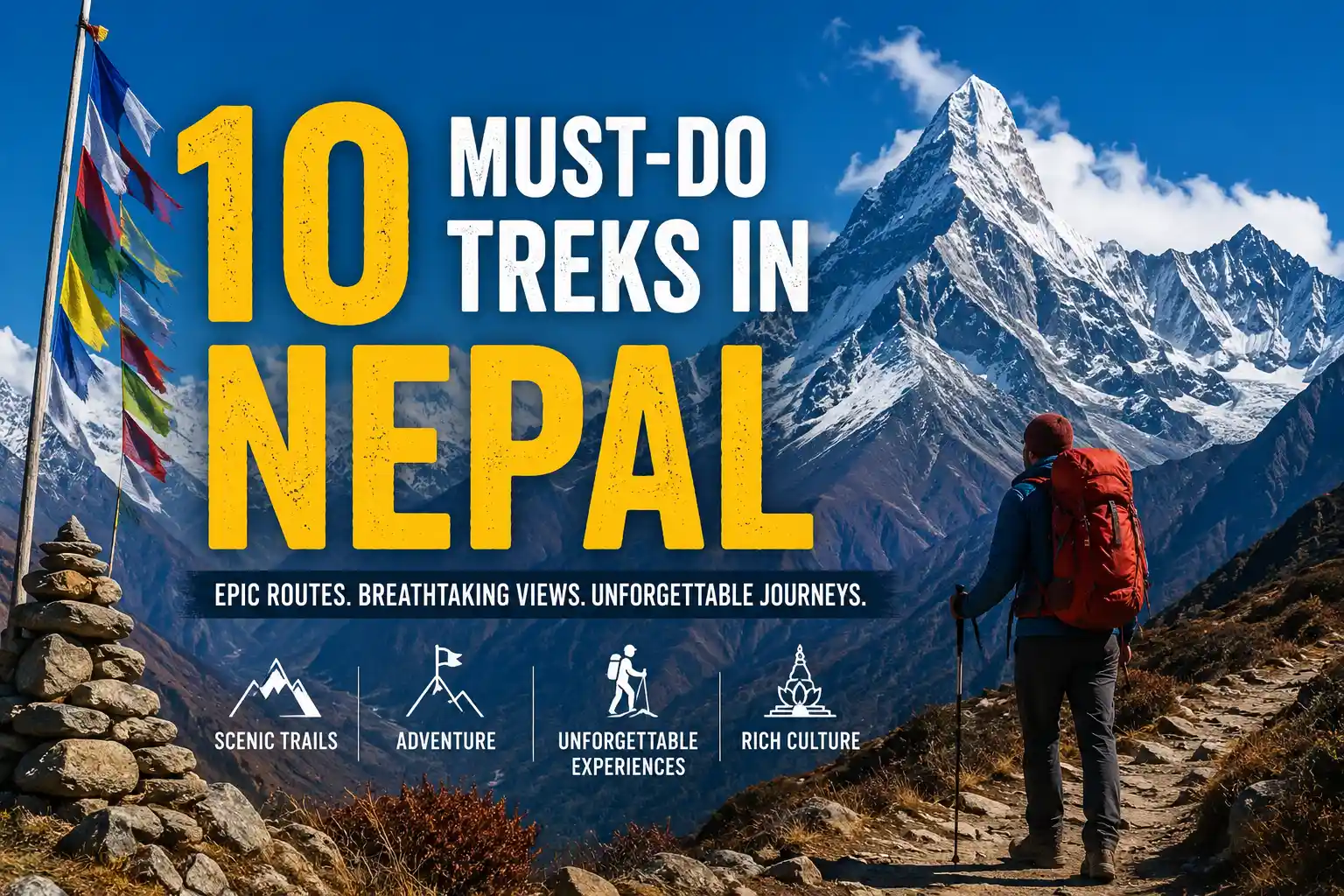
Nepal sits at a crossroads between plains and sky. Where else can you walk from subtropical forests into glacial valleys within a single week? For trekkers from around the world — and increasingly from India — Nepal remains unmatched as a destination where altitude, culture, and raw Himalayan landscape combine in ways no other country replicates.
This guide covers the best treks in Nepal across all experience levels: short teahouse routes, classic high-altitude circuits, remote wilderness trails, and sacred pilgrimage paths. Whether you have ten days or ten weeks, there is a route here built for your pace, your fitness, and your appetite for the mountains.
Why Nepal Remains the World’s Premier Trekking Destination
Nepal contains eight of the world’s fourteen peaks above 8,000 metres, including Everest, Kanchenjunga, Lhotse, and Makalu. But the country’s appeal for trekkers extends well beyond summit statistics.
The trail infrastructure here has matured over sixty years. Teahouse lodges, porter networks, permit systems, and rescue protocols are established and reliable. Languages are not a barrier on the major routes. Hot meals and basic accommodation appear every few kilometres on the busiest corridors. This combination of raw wilderness and functional logistics is rare anywhere on earth.
Nepal also offers cultural immersion that pure wilderness trekking cannot provide. Sherpa villages, Buddhist monasteries, Hindu shrines, and Magar and Gurung settlements sit directly along the trails. Trekkers move through living communities, not just landscapes.
For Indian trekkers specifically, Nepal requires no visa, no passport — only a government-issued photo ID. This administrative ease, combined with direct flight and bus connectivity from cities like Delhi, Lucknow, and Dehradun, makes Nepal an especially accessible destination.
Understanding Nepal’s Trekking Seasons
Season selection matters more in Nepal than in almost any other trekking region.
Pre-monsoon (March to May) offers warmer temperatures, blooming rhododendron forests from 2,000 to 3,500 metres, and generally stable weather at altitude. Some haze develops by late April, which can reduce distant panoramas.
Post-monsoon (October to November) delivers the clearest skies of the year. After months of monsoon rain, the atmosphere is scrubbed clean. Mountain views from passes and ridges are exceptional during this window. Trails are crowded but well-maintained.
Winter (December to February) is viable on lower-altitude routes below 3,000 metres and on routes in the rain shadow zones of Mustang and Dolpo, which receive minimal snowfall. High passes like Thorong La on the Annapurna Circuit require caution or avoidance during heavy snowfall months.
Monsoon (June to September) closes most high routes but opens the rain shadow regions. Trekkers in Upper Mustang, Dolpo, and Nar-Phu Valley find these months surprisingly favourable, as the Tibetan plateau geography blocks the bulk of monsoon moisture.
The Classic Routes: Established, Well-Supported, and Worth Every Step
Nepal’s classic trekking routes remain popular for good reason. They combine stunning mountain scenery, rich cultural experiences, reliable infrastructure, and well-marked trails, making them ideal for trekkers seeking a balanced Himalayan adventure with proven accessibility and support.
Everest Base Camp Trek
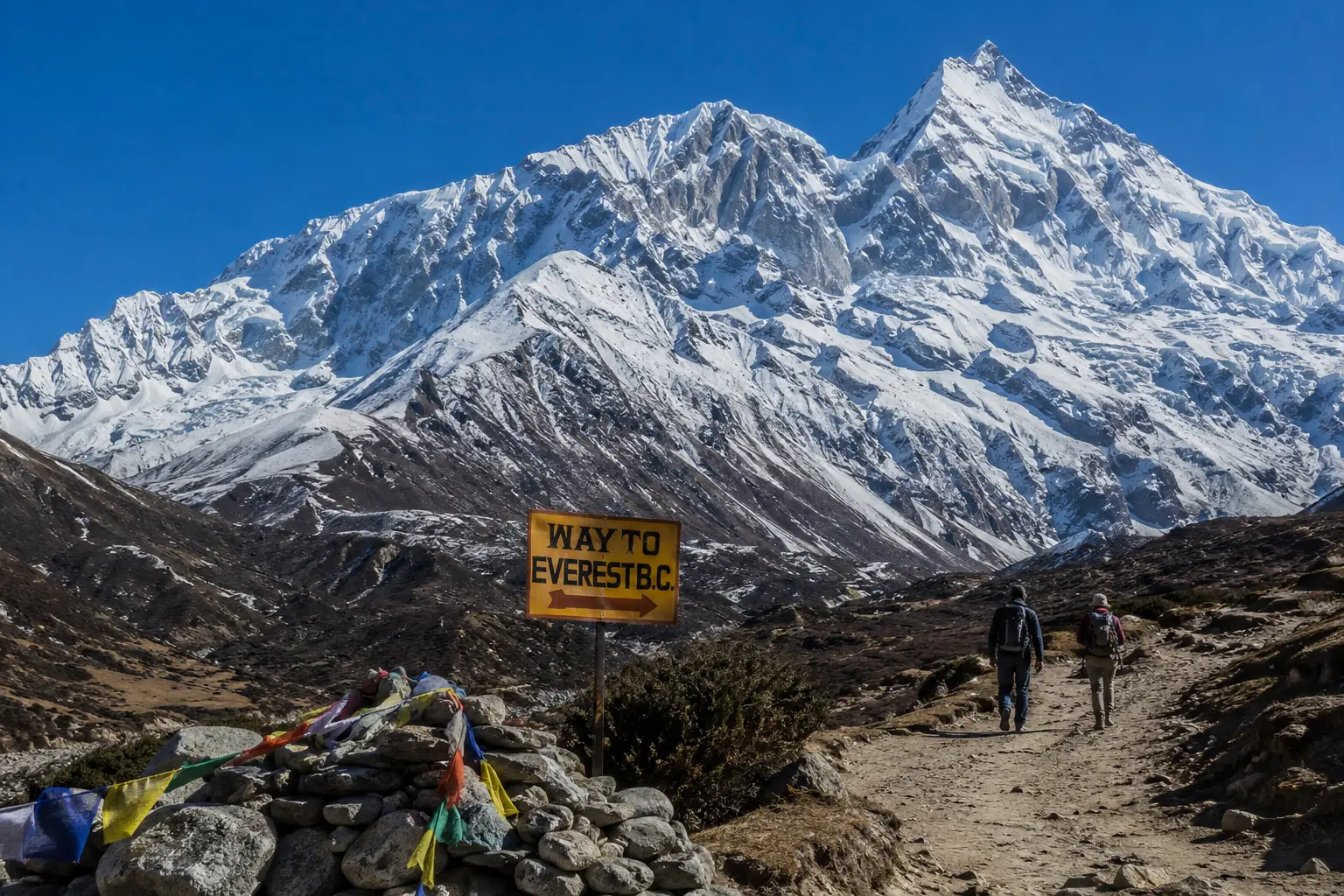
The Everest Base Camp trek remains Nepal’s most iconic journey. The standard route begins with a flight from Kathmandu to Lukla (2,840 m) and climbs through Namche Bazaar, Tengboche, Dingboche, and Lobuche before reaching Base Camp at 5,364 metres.
The return trek to Lukla takes most groups between twelve and sixteen days, including essential acclimatisation stops. The distance is roughly 130 kilometres round trip, and daily walking hours range from four to seven depending on the stage.
The route passes through the Khumbu region, home to Sherpa culture and a landscape increasingly shaped by glacial retreat and climate change. The Tengboche Monastery at 3,867 metres offers one of the most dramatic cultural stops of any trek in the world, framed by Ama Dablam on one side and the Everest massif on the other.
Key highlights:
- Kala Patthar viewpoint (5,545 m) for sunrise views directly across to Everest’s south face
- Gokyo Lakes and Gokyo Ri as an alternative extension (5,357 m)
- Namche Bazaar acclimatisation day with the Hillary Tenzing museum
- Interaction with working Sherpa communities
Permits required: Khumbu Pasang Lhamu Rural Municipality entry permit and Sagarmatha National Park permit. Both are obtainable in Kathmandu or at entry checkpoints.
Annapurna Circuit Trek
The Annapurna Circuit was once called the greatest trek in the world, and sections of that reputation remain fully justified even after road construction reduced the historically longer route.
The circuit loops around the Annapurna massif, crossing the Thorong La Pass at 5,416 metres — the highest point on the route and one of the highest trekable passes in the world that does not require technical climbing. The full circuit covers roughly 160 to 230 kilometres depending on the variant chosen, with most trekkers spending fourteen to twenty-one days on the trail.
The route transitions through dramatically different ecological and cultural zones. Lower sections pass through terraced rice paddies and Hindu villages in the Modi Khola and Marsyangdi valleys. Mid-altitude forests of oak and rhododendron give way to alpine meadows above 3,500 metres. North of the pass, the landscape shifts to Tibetan plateau conditions: dry, open, and lunar in character around Mustang and Manang.
The Annapurna Base Camp Trek is a shorter alternative that branches off the main circuit and ascends into the Annapurna Sanctuary — a glacial amphitheatre ringed by ten peaks above 7,000 metres. Most trekkers complete the round trip from Pokhara in nine to twelve days. Those wondering what is the Annapurna Sanctuary will find it is a high-altitude glacial basin enclosed almost entirely by mountains, accessible through a narrow gorge above Chhomrong village. The sanctuary sits at 4,130 metres and offers some of the most concentrated high-altitude scenery of any accessible trek in the Himalayas.
Permits: Annapurna Conservation Area Project (ACAP) permit and TIMS card.
Langtang Valley Trek
Langtang is often the most underrated of Nepal’s major trekking corridors. Located north of Kathmandu — within a day’s drive rather than a flight — the Langtang Valley offers high Himalayan terrain without the logistical complexity or crowd density of the Everest and Annapurna routes.
The valley was devastated by the 2015 earthquake, but has been substantially rebuilt. Trekking here directly supports recovery of local Tamang communities.
Standard itineraries run seven to ten days, reaching Kyanjin Gompa at 3,870 metres and optionally ascending Tserko Ri at 4,984 metres for a demanding but rewarding day hike. The Langtang Lirung (7,227 m) dominates the head of the valley.
The route is also notable for its access to Gosaikunda Lake (4,380 m), a sacred Hindu and Buddhist lake that can be added as an extension or traversed as a connecting route to the Helambu region.
Permits: Langtang National Park permit.
Remote and Advanced Routes: For Experienced Trekkers
Remote and advanced trekking routes in Nepal offer challenging terrain, high mountain passes, and fewer crowds. These expeditions demand strong fitness, prior trekking experience, careful planning, and proper acclimatization while rewarding adventurers with exceptional Himalayan wilderness and cultural immersion.
Manaslu Circuit Trek
The Manaslu Circuit is what many trekkers describe as the Annapurna Circuit of fifteen years ago — before roads arrived. This restricted area route circumnavigates the world’s eighth-highest mountain (8,163 m) through remote Gurung and Tibetan Buddhist communities with minimal tourist infrastructure relative to the main corridors.
The circuit covers approximately 177 kilometres and crosses the Larkya La Pass at 5,106 metres. Most groups spend fourteen to seventeen days on the route. A restricted area permit is required in addition to the national park entry fee, and trekkers must be accompanied by a licensed guide.
Trail conditions are rougher, teahouse standards are basic, and the sense of remoteness is genuine. Seasons mirror the Annapurna Circuit, with October and November ideal.
Upper Mustang Trek
Upper Mustang occupies a unique position in Nepal’s trekking landscape. This former Tibetan kingdom sits north of the Annapurna and Dhaulagiri ranges in a protected rain shadow zone, giving it a high-altitude desert character entirely unlike the forested valleys to the south.
The landscape is strikingly Tibetan: eroded cliffs, ochre canyons, whitewashed villages, and ancient cave monasteries cut into the rock faces. The walled city of Lo Manthang at 3,840 metres is the cultural centrepiece, containing four active gompa and the palace of the former Mustang royal family.
Access requires a special Restricted Area Permit (currently USD 500 for the first ten days, plus USD 50 per additional day as of 2025 rates). A registered guide is mandatory. The permit cost limits tourist volume, which protects both the cultural landscape and trail quality.
The best season is June through August — the monsoon months — when the rain shadow keeps conditions dry and the rest of Nepal’s high routes are washed out.
Kanchenjunga Base Camp Trek
For trekkers seeking genuine remoteness, the Kanchenjunga Base Camp route in far eastern Nepal represents a frontier experience. The route requires a restricted area permit and licensed guide, approaches the world’s third-highest mountain from both its north and south base camps, and passes through some of the least-visited terrain in the country.
Itineraries typically run three to four weeks. The Taplejung entry point is accessed by domestic flight or multi-day overland journey. Communities along the route include Rai and Limbu villages — distinct culturally from the Sherpa communities of the Khumbu.
This trek rewards trekkers willing to invest time and logistical effort with complete trail solitude and extraordinary mountain views across the Sikkim border.
Shorter Treks and Entry-Level Options
Not every Nepal trekker has three weeks or the fitness for a high-altitude pass. Several excellent routes suit shorter schedules or lower acclimatisation requirements.
Poon Hill Trek (Ghorepani): Four to five days, maximum elevation approximately 3,210 metres. The sunrise view from Poon Hill encompasses Dhaulagiri, Annapurna South, Machapuchare, and Annapurna I in a single panorama. Highly recommended for first-time Nepal trekkers.
Mardi Himal Trek: Five to seven days, reaching Mardi Himal Base Camp at 4,500 metres. Less frequented than Poon Hill but in the same region, with views directly into the Annapurna Sanctuary. This is a route gaining significant traction among trekkers seeking the Annapurna Base Camp Trek experience with fewer crowds.
Mohare Danda Community Trek: Five to six days through Gurung villages in the Magar Highland area. This off-the-main-circuit route was developed as a community tourism initiative and stays below 3,300 metres.
Tamang Heritage Trail: Five to seven days in the Langtang region, focused on Tamang culture, traditional villages, and lower elevations suitable for spring and autumn trekking without high-altitude stress.
Understanding what is the Annapurna Sanctuary matters for choosing between these shorter routes — Mardi Himal and the ABC trek both approach the same high basin but from slightly different angles and at different difficulty levels.
Practical Essentials for Nepal Trekking in 2026
Planning a trek in Nepal in 2026 requires more than choosing a route. Understanding permits, trekking seasons, altitude safety, accommodation, transportation, packing essentials, and travel insurance helps ensure a smoother, safer, and more enjoyable trekking experience in the Himalayas.
Permits and Regulations
Nepal’s permit system was revised in 2023 and underwent further updates through 2025. As of 2026, the primary documents most trekkers require are:
- Trekking permit requirements vary by region: Annapurna, Langtang, Everest, and restricted areas have different permit structures. Travelers should verify current permit requirements through the Nepal Tourism Board before departure.
- National Park or Conservation Area Entry Permit: Route-specific (Sagarmatha, Langtang, Annapurna, Makalu Barun, etc.)
- Restricted Area Permits: Required for Mustang, Manaslu, Tsum Valley, Kanchenjunga, Dolpo, and Nar-Phu
Indian nationals can enter Nepal using a valid Passport or Election Photo Identity Card (Voter ID). Travelers should verify the latest entry requirements before departure. Passport is not required for Indian nationals entering Nepal by land, but is recommended and sometimes requested at permit checkpoints.
Hiring Guides and Porters
Nepal requires licensed guides on all restricted area routes. On open routes, guides are optional but strongly recommended for navigation, logistics, and safety. Porters typically carry loads of 25 to 30 kg and are contracted through trekking agencies or found at major trailhead towns.
Fair porter treatment — including adequate wages, accommodation, and equipment — is a documented issue in the Nepal trekking industry. Working with reputable agencies that follow Porters’ Progress or similar ethical employment guidelines is encouraged.
Altitude Sickness Awareness
Acute Mountain Sickness (AMS) is a risk on any route that exceeds 2,500 metres. Symptoms include headache, nausea, loss of appetite, and sleep disturbance. The cardinal rule: never ascend if symptoms are present.
Most serious AMS cases on Nepal’s popular routes result from inadequate acclimatisation — ascending too quickly, skipping rest days, or ignoring symptoms in the interest of schedule. The Gamow bag, Diamox (acetazolamide), and access to helicopter evacuation should all be understood before departure.
Nepal Trek Comparison at a Glance
| Route | Duration | Max Elevation | Difficulty | Best Season |
| Everest Base Camp | 12–16 days | 5,364 m | Moderate–Strenuous | October–November, March–May |
| Annapurna Circuit | 14–21 days | 5,416 m (Thorong La Pass) | Moderate–Strenuous | October–November, March–April |
| Annapurna Base Camp | 9–12 days | 4,130 m | Moderate | October–November, March–May |
| Langtang Valley | 7–10 days | 4,984 m (Tserko Ri) | Moderate | October–November, March–May |
| Manaslu Circuit | 14–17 days | 5,106 m (Larkya La Pass) | Strenuous | October–November |
| Upper Mustang | 12–16 days | 3,840 m (Lo Manthang) | Moderate | June–August |
| Poon Hill | 4–5 days | 3,210 m | Easy–Moderate | October–November, March–May |
Frequently Asked Questions
1. Which is the easiest trek in Nepal for beginners?
The Poon Hill trek in the Annapurna region is widely considered the best entry point for first-time Nepal trekkers. It reaches a maximum elevation of about 3,210 metres, involves well-marked trails with teahouse lodges throughout, and delivers panoramic views of the Annapurna and Dhaulagiri ranges.
2. Do Indian nationals need a visa for Nepal trekking?
No. Indian nationals can enter Nepal without a visa or passport using a valid government-issued photo ID such as a voter card or Aadhaar. A permit system specific to each trekking route applies separately from entry documentation.
3. What is the best time to trek in Nepal?
October and November offer the clearest mountain views and stable weather across most trekking routes. March and April are the second-best window, with the advantage of rhododendron blooms at mid-altitude.
4. How fit do I need to be for the Everest Base Camp trek?
Moderate cardiovascular fitness is required. Trekkers should be comfortable walking five to seven hours per day on uneven terrain for consecutive days. Prior trekking experience at altitude is beneficial but not strictly required if acclimatisation days are respected.
5. Is it safe to trek in Nepal without a guide?
Regulations regarding solo trekking may change. Trekkers should verify current Nepal Tourism Board requirements before travel. On restricted area routes, a licensed guide is mandatory. In terms of safety rather than regulation, having an experienced guide significantly reduces risks related to weather, route-finding, and altitude emergencies.
Final Thoughts
Nepal does not offer one great trek. It offers dozens — each shaped by a different mountain, a different culture, and a different kind of challenge. Whether you are crossing the Thorong La under a clear October sky, walking the moraine edge toward Everest Base Camp, or sitting quietly at a teahouse in Langtang watching clouds pour over the ridge, the experience leaves something permanent.
The routes covered in this guide represent some of the most rewarding walking terrain on the planet. But no article captures what the trail actually feels like underfoot. That part requires you to show up, lace your boots, and move.
Plan carefully, acclimatise properly, hire ethically, and respect the communities your route passes through. Nepal’s mountains reward preparation and humility in equal measure.
Choose Mountainiax, the best trekking agency in Uttarakhand, for expert guidance, safe routes, and unforgettable Himalayan adventures. Book your trek today and explore with confidence.