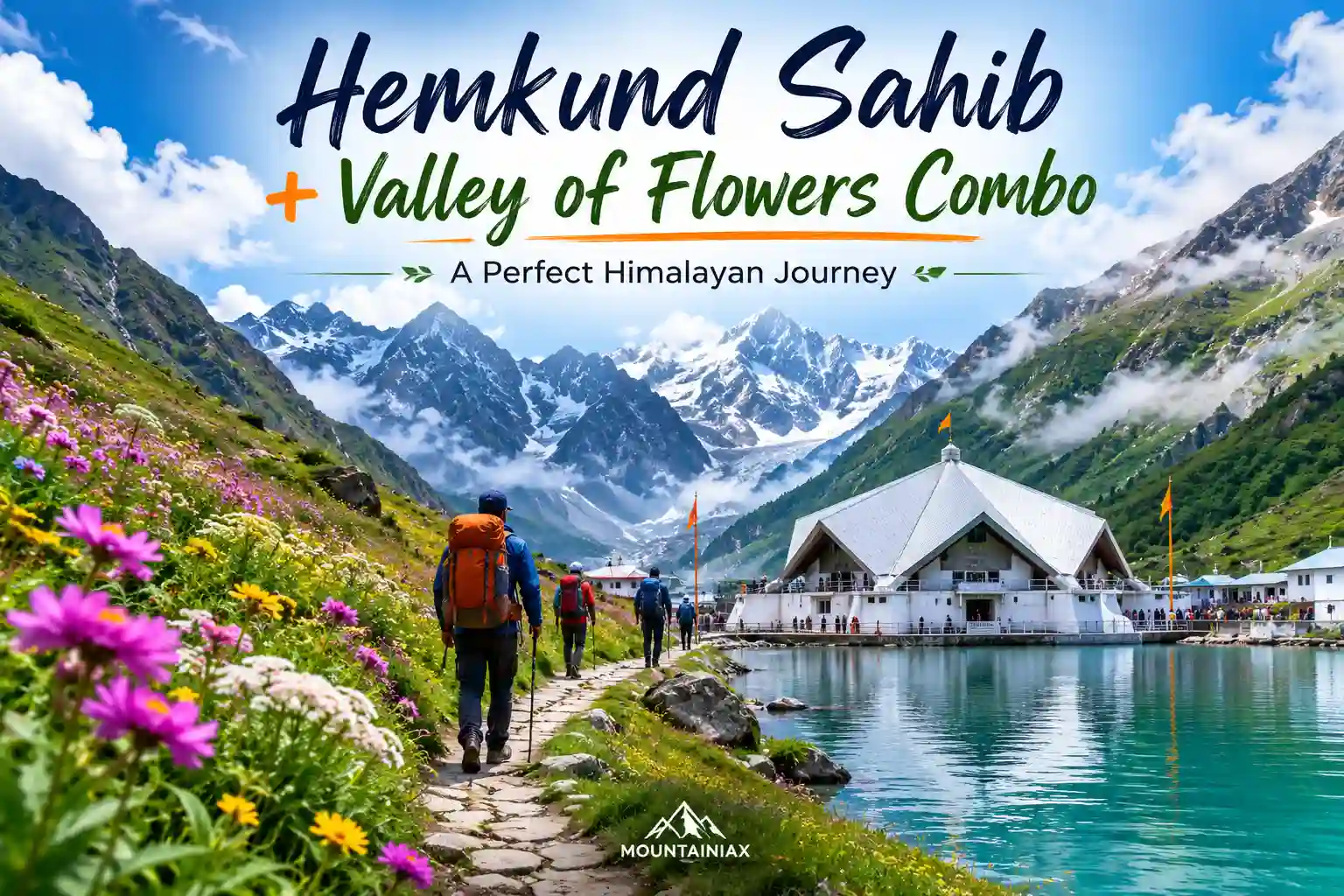
The Hemkund Sahib + Valley of Flowers Combo is one of Uttarakhand’s most rewarding Himalayan journeys, combining spiritual significance with breathtaking natural beauty. Located in the Garhwal Himalayas, this 5-night, 6-day trek takes you through the UNESCO-listed Valley of Flowers, famous for its vibrant alpine blooms, and to the sacred Hemkund Sahib Gurudwara beside a pristine glacial lake at 4,329 metres.
Whether you’re a beginner trekker, nature enthusiast, photographer, or pilgrim, the Hemkund Sahib + Valley of Flowers Combo offers an unforgettable experience. This guide covers everything you need to know, including the itinerary, best time to visit, permits, packing essentials, difficulty level, and planning tips.
Why the Combo Trek Makes Perfect Sense
Planning two separate trips to the same region would be expensive, time-consuming, and honestly unnecessary. The Valley of Flowers and Hemkund Sahib share the same trailhead at Govindghat, the same forest trail to Ghangaria (the base camp village at 3,050 m), and the same logistical setup. From Ghangaria, one trail leads east into the Valley; another climbs steeply north to Hemkund.
By combining both into one trek, you get:
- Two contrasting experiences — botanical wonder and spiritual stillness — without doubling your travel effort
- Better value from your permits, accommodation, and guided support
- A richer sense of the region, including its ecology, history, and religious significance
- The flexibility to allocate one day to each destination with a shared base
The combo is also the standard format most reputed operators use, which means guides, itineraries, and logistics are well-optimised for it.
Where Are These Places and What Makes Them Special?
The Valley of Flowers and Hemkund Sahib offer a unique blend of natural beauty and spirituality. From vibrant alpine meadows filled with rare Himalayan flowers to a sacred glacial lake surrounded by towering peaks, this trek delivers an unforgettable Himalayan experience.
The Valley of Flowers
Located in the Chamoli district of Uttarakhand, the Valley of Flowers National Park sits at around 3,658 metres above sea level and spans approximately 87 square kilometres. It is part of the Nanda Devi Biosphere Reserve — a UNESCO World Heritage Site since 1988 — and is home to over 500 documented species of wildflowers that bloom during the monsoon months.
The valley was introduced to the outside world in 1931 by British mountaineer Frank S. Smythe, who stumbled upon it during a descent from Mt. Kamet. He was so captivated by the landscape that he returned the following year to document the flora and eventually published a book that gave the valley its name. Today, the trail he once walked alone receives thousands of trekkers each season.
What makes this place genuinely special is the sheer density and diversity of the bloom. During peak season, every square metre of the valley floor is occupied — Brahmakamal (Uttarakhand’s state flower), cobra lilies, crimson bistort, golden potentilla, anemones, primulas, geraniums, and of course the unmistakable Blue Himalayan Poppy (Meconopsis aculeata) — all flowering simultaneously across an 8 km long bowl framed by snow-draped peaks. No garden, no photograph, and frankly no description fully prepares you for it.
Hemkund Sahib
About 6 kilometres uphill from Ghangaria, at an elevation of 4,329 metres, sits one of the world’s highest Sikh gurudwaras. Hemkund Sahib is built on the shores of a glacial lake — Hemkund Sarovar — encircled by seven Himalayan peaks collectively called Sapt Sring. The name itself is descriptive: “Hem” means ice and “Kund” means bowl.
The site holds deep religious significance in the Sikh tradition. According to the Dasam Granth, Guru Gobind Singh ji meditated at this very lake in a previous birth. The gurudwara was formally established in the late 19th century and today welcomes hundreds of thousands of pilgrims and trekkers each season. A small Laxman temple also stands nearby, making the site sacred to Hindu devotees as well.
What sets Hemkund apart from a purely trekking standpoint is the landscape at the top — the still, mirror-like lake, the surrounding peaks, the sound of prayers emanating from the gurudwara, and the Brahmakamal flowers blooming on the slopes above 4,000 metres. The langar (community kitchen) inside the gurudwara serves free hot food to all visitors, which, after a steep climb at altitude, feels like nothing short of a miracle.
Best Time to Do the Hemkund Sahib + Valley of Flowers Combo Trek
Timing this trek correctly is critical. Both the Valley of Flowers National Park and Hemkund Sahib operate on a seasonal schedule dictated by snowmelt and the monsoon.
| Season | Months | Conditions | Recommended For |
| Early Season | June | Light blooms, some snow patches near Hemkund, fewer crowds | Photographers, those who prefer quieter trails |
| Peak Bloom | Mid-July to Mid-August | 500+ species in full bloom, monsoon rains daily | First-timers, nature lovers, peak experience seekers |
| Late Season | September | Bloom thins, late-season asters and gentians, clearer skies | Those wanting better visibility and fewer people |
| Closed | October to May | Deep snow, National Park officially closed | Not accessible |
The best time to visit Valley of Flowers is undoubtedly the peak bloom window of mid-July to mid-August. Yes, it rains during this period — often every afternoon — but rain is what creates the bloom. The flowers don’t exist in spite of the monsoon; they exist because of it. Pack good waterproofs, embrace the mist, and you’ll find that overcast light often produces the best photographs — soft and shadowless, making the colours pop.
Hemkund Sahib typically opens in the second or third week of June and closes in October. The exact opening date depends on snowmelt conditions and is announced by the Gurudwara Management Committee each year. If you’re planning an early June visit, confirm the current year’s opening dates before booking.
One thing worth noting for pilgrims: late July to early August is ideal for combining both the Valley and Hemkund Sahib, as both are fully operational and the Gurudwara sees its highest attendance during this window.
Complete Day-by-Day Itinerary for the Combo Trek
This is the standard 5 Nights / 6 Days itinerary run by Mountainiax, departing and returning from Dehradun.
Day 1 — Dehradun to Govindghat (Drive: ~270 km, 9–10 hours)
The journey begins early morning with a pickup near Dehradun Railway Station. The drive is long but rewarding — you pass through the sacred Panch Prayag confluences at Devprayag, Rudraprayag, Karnaprayag, and Nandaprayag before climbing through Chamoli and Joshimath to reach Govindghat (1,830 m) by evening. The Alaknanda and Dhauliganga rivers accompany the road for much of the way. Check in, have an early dinner, and rest well — the trekking begins tomorrow.
Pro tip: Carry motion sickness tablets if you’re sensitive on winding mountain roads. The stretch from Joshimath onwards is particularly twisty.
Day 2 — Govindghat to Ghangaria (Trek: 14 km, 5–6 hours, reaching 3,050 m)
This is your first proper trekking day. The trail starts at Govindghat bridge, follows the Pushpawati River gorge through oak, maple, and birch forests, and passes the small village of Pulna (vehicle access has extended here in recent years, reducing the walk to around 9–10 km from Pulna). Hanging bridges, small waterfalls, mule caravans, and the occasional marmot sighting keep the trail interesting. Ghangaria — a cluster of guesthouses and dhabas at 3,050 m — is your home for the next three nights.
Day 3 — Ghangaria to Valley of Flowers and Back (8 km round trip, 5–6 hours)
Start early — by 7 am if possible. The trail from Ghangaria to the Valley gate is about 3 km with a gentle climb. Past the Forest Department checkpost, the valley opens up dramatically. In peak bloom, the first proper view of the meadow is genuinely arresting — a wide, flat bowl filled edge to edge with colour, surrounded by snowfields and peak ridges. Explore at your own pace; most trekkers go 3–4 km into the valley before turning back. No camping or overnight stays are allowed inside the Valley. Return to Ghangaria by late afternoon.
Day 4 — Ghangaria to Hemkund Sahib and Back (12 km round trip, 7–8 hours)
The most physically demanding day. The trail climbs steeply from Ghangaria — roughly 1,280 metres of ascent over 6 km — through switchbacks, rocky terrain, and fields of Brahmakamal as you gain altitude. The last kilometre can be icy even in July. At the top, Hemkund lake appears suddenly and the gurudwara comes into view reflected in the still water. Visit the gurudwara, have langar, rest, and then descend carefully. Trekking poles are strongly recommended for this day. Return to Ghangaria.
Altitude note: At 4,329 metres, some trekkers experience mild altitude symptoms — headache, light breathlessness. Take it slow on the ascent, hydrate consistently (3–4 litres daily), and do not push through genuine discomfort. The summit can wait; your wellbeing cannot.
Day 5 — Ghangaria to Govindghat, then to Joshimath (Trek + Drive)
Retrace the river trail back to Govindghat. The descent is faster than the ascent but demands care on wet and rocky sections. From Govindghat, an optional side trip to Badrinath temple — one of the four Char Dham sites, just 25 km away — is worth considering before driving to Joshimath for the overnight stay.
Day 6 — Joshimath to Dehradun (Drive: ~270 km, 9–10 hours)
The return drive follows the same route in reverse — same rivers, same mountains, but seen through the eyes of someone who has just spent five days in one of the most beautiful corners of the Himalayas. Drop at Dehradun Railway Station by evening.
How to Reach the Trek Starting Point
The trek starts from Govindghat, which is most conveniently accessed from Dehradun. Here’s how to get there:
| Mode | Route | Approx. Time |
| By Air | Fly to Jolly Grant Airport, Dehradun (~292 km from Govindghat) | Fly + 9–10 hr drive |
| By Train | Haridwar or Dehradun Railway Station, then road | Train + 9–10 hr drive |
| By Bus | Overnight Volvo from Delhi to Rishikesh/Haridwar (₹500–₹1,000), then shared taxi or GMOU bus to Joshimath | ~12–14 hrs total |
| With Us | Pickup from Dehradun Railway Station on Day 1 — everything handled | Most convenient |
If you’re joining a guided group departure with Mountainiax, all transport is arranged from Dehradun to Dehradun. You don’t need to figure out buses or shared taxis — the team handles pickups, drop-offs, and everything in between.
Many trekkers who search for the Valley of Flowers Trek from Dehradun are specifically looking for this kind of all-in package, where the hassle of coordination is taken off their plate entirely. Our 5N/6D package starting at ₹9,499 per person does exactly that — transport, meals, certified guide, accommodation, permits, and 24/7 support throughout the trek.
Trek Difficulty and Who Can Do It
The Valley of Flowers + Hemkund Sahib combo is rated Easy to Moderate overall, though the two destinations sit at different points on that spectrum.
| Trek Day | Segment | Difficulty | Why |
| Day 2 | Govindghat → Ghangaria | Moderate | 14 km gradual climb, well-maintained trail |
| Day 3 | Valley of Flowers day | Easy | Mostly flat meadow, gentle approach trail |
| Day 4 | Hemkund Sahib day | Moderate–Challenging | Steep 1,280 m ascent at altitude, possible icy patches |
| Day 5 | Descent to Govindghat | Easy–Moderate | Same trail in reverse, load on knees |
The Valley day is genuinely accessible to beginners. Hemkund is where the trek earns its moderate rating. Anyone who is reasonably active — can walk 8–10 km at a comfortable pace — can complete the Valley days without issue. For Hemkund, you need a base level of cardiovascular fitness and ideally some prior hill walking experience.
Fitness preparation: Start 4–6 weeks before the trek. Walk or jog 4–5 km daily, include stair climbing or uphill sections, and train with your loaded backpack (aim for 7–8 kg comfort). Avoid alcohol 48 hours before departure as it impairs acclimatisation.
Permits Required for the Combo Trek
Entry into the Valley of Flowers requires a permit from the Forest Department of Uttarakhand. Here’s what you need to know:
| Category | Entry Permit Fee (2026) |
| Indian Adults | ₹200 per person per day |
| Indian Students (18+) | ₹100 |
| Indian Students (12–18) | ₹50 |
| Children under 12 | Free |
| Foreign Nationals | Higher rate — confirm with operator |
The permit is checked at the forest checkpost approximately 1.5 km before the Valley entrance. Carry your government-issued photo ID (Aadhaar, Passport, or Voter ID) and 2 passport-sized photographs. Photocopies are not accepted at the checkpoint — original documents only.
Hemkund Sahib does not require the same Forest Department permit. However, some operators handle a registration formality at Ghangaria for the Hemkund trail — confirm this with your trek operator at booking.
No camping or overnight stays are permitted inside the Valley of Flowers National Park. All trekkers must return to Ghangaria the same day. Cooking and eating inside the Valley boundaries are also prohibited to protect the fragile ecosystem.
The Forest Reserve entry permit for Indian nationals is included in the package price — no separate arrangement needed.
What to Pack for the Trek
The Valley of Flowers and Hemkund Sahib are monsoon-season treks. Packing is less about volume and more about preparedness — weather can shift from sunshine to heavy rain to cold fog within hours.
Essential clothing and gear:
- Waterproof rain jacket or poncho — non-negotiable in monsoon season
- Waterproof cover for your backpack
- 2 trek pants and full-sleeve dry-fit t-shirts
- Thermal inner layers (one pair is sufficient)
- Fleece jacket or warm mid-layer
- Synthetic gloves and woollen cap
- Sturdy ankle-support trekking shoes with grip (not trail runners)
- Trekking poles — especially important for the Hemkund ascent and descent
- LED headtorch with extra batteries
- 1-litre water bottle (minimum 2 on the Hemkund day)
- Sunscreen SPF 50+ and lip balm with SPF (UV intensity at altitude is high even on cloudy days)
- Sunglasses with UV protection
Documents and essentials:
- Government-issued photo ID (original) + 2 passport-sized photographs
- Printed copies of permits (2–3 copies for checkpoints)
- Any prescribed medications plus a basic first-aid kit
- Offline maps downloaded before leaving Joshimath (Jio network available intermittently in Ghangaria; no signal in the Valley or on the Hemkund trail)
- Cash — the last ATM is in Joshimath. Carry enough for the full duration.
Accommodation and Food at Ghangaria
Ghangaria is the only settlement in the region and functions as the base camp for both the Valley and Hemkund. It has a range of guesthouses catering to all budgets, from basic dormitories to private rooms. Electricity is available but limited. Mobile connectivity is sketchy — Jio works intermittently, and beyond Ghangaria, there is no network.
Food options at Ghangaria include local dhabas serving simple vegetarian meals — dal, rice, roti, sabzi, maggi, and chai. All vegetarian meals from dinner on Day 1 through dinner on Day 5 are included. The quality of food is wholesome and filling, which is exactly what you need after long trekking days.
The Hemkund Sahib Gurudwara serves free langar to all visitors. It’s typically dal, roti, and khichdi — simple, warm, and genuinely welcome at 4,329 metres.
Costs: What to Budget for the Combo Trek
Here is a realistic cost breakdown for the Hemkund Sahib + Valley of Flowers Combo Trek:
| Component | Estimated Cost |
| Guided package (5N/6D with Mountainiax) | Starting ₹10,500 per person |
| Includes transport, meals, accommodation, guide, permits, gear | All included |
| Additional personal expenses (tips, souvenirs, medicines) | ₹500–₹1,500 |
| Porter/mule for personal luggage (optional) | ~₹500/day |
| Badrinath temple visit (optional, Day 5) | Covered by proximity — minimal extra cost |
The ₹10,500 price point with Mountainiax covers return transport from Dehradun, all vegetarian meals, guesthouse accommodation at Ghangaria, a certified and experienced trek guide, Forest Reserve entry permits for Indian nationals, sleeping bags and camping equipment, and 24/7 support throughout the trek. Group discounts apply for parties of 8 or more — contact the team directly for custom pricing.
Photography Tips for the Valley of Flowers
If you’re trekking with a camera, this is one of the most rewarding destinations in the Indian Himalayas. A few things worth knowing:
Shoot on cloudy days. This sounds counterintuitive, but monsoon clouds diffuse harsh sunlight and produce soft, even light that makes flower colours appear more saturated. Don’t let an overcast morning discourage you from heading out early.
Go wide and go macro. The valley rewards both compositions — wide-angle shots capture the scale of the meadow against the surrounding peaks, while macro lenses reveal the intricate detail of individual flowers like the Blue Poppy or Brahmakamal.
Golden hour is viable at the valley entrance. While you can’t be inside the Valley after evening hours, the light on the surrounding ridges and the Pushpawati River in the late afternoon can be spectacular.
For Hemkund, the reflection of the gurudwara in the lake in early morning — before other pilgrims arrive — is one of the most striking images you can capture at this altitude.
Drone photography requires a special permit and is generally restricted inside the National Park. Check current regulations with the Forest Department before planning any aerial work.
Responsible Trekking: Leave No Trace
The Valley of Flowers is a protected ecosystem. The rules are not bureaucratic formalities — they exist to protect one of the world’s most ecologically sensitive alpine meadows. Trekkers have a direct responsibility here.
- Carry all waste out. No burning, no littering inside or near the Valley.
- Do not pick flowers. This is illegal inside the National Park and carries significant fines.
- Stay on marked trails. Trampling off-trail destroys ground cover that took decades to establish.
- Do not disturb wildlife. The region is home to Himalayan black bear, musk deer, blue sheep, and snow leopard (rare sightings). Keep noise down and give animals space.
- Avoid single-use plastics wherever possible. Carry a reusable water bottle and fill up at natural springs.
Our guides follow a strict no-waste protocol throughout the trek, which is part of the company’s commitment to sustainable Himalayan tourism.
The Spiritual Dimension: More Than Just a Trek
It’s easy to frame this combination purely as a nature trek, but that misses something important. The best time to visit Valley of Flowers happens to coincide with the peak of the Hemkund Sahib pilgrimage season, which means the trails are shared with thousands of Sikh devotees making their way to the Gurudwara. The energy on the trail — particularly on the Hemkund ascent — is unlike anything you’ll experience on a purely recreational trek.
Elderly pilgrims climbing at their own pace, Gurdwara volunteers offering water and encouragement along the way, the distant sound of Gurbani carrying down the slope long before you reach the top — these elements add a human and spiritual texture to the trek that no amount of alpine scenery can replicate on its own.
Whether or not you come from a religious background, the experience of arriving at Hemkund Sahib after a steep climb, sitting by the lake, and listening to the prayers echo off the surrounding peaks is one that stays with people long after the flowers have faded from memory.
Frequently Asked Questions
Q1: Can I do the Valley of Flowers and Hemkund Sahib in a single day?
No. They require separate days from Ghangaria. The Valley is an 8 km round trip with exploration time; Hemkund is a 12 km round trip with a steep 1,280 m climb. Attempting both in one day is not advisable and would not allow adequate time in either location.
Q2: Is the trek suitable for beginners?
Yes, for the Valley of Flowers days. The Valley trail is one of the most accessible in the Himalayas — no technical sections, well-marked paths, and manageable daily distances. The Hemkund day is moderate-challenging but optional for those who are not confident about the altitude gain.
Q3: What is the altitude of Hemkund Sahib?
Hemkund Sahib sits at 4,329 metres (approximately 14,206 feet) above sea level, making it one of the highest Sikh gurudwaras in the world.
Q4: Do I need prior trekking experience?
Not for the Valley of Flowers. Some fitness preparation is recommended (4–6 weeks of regular walking or jogging). For Hemkund, prior experience with hill walking helps but is not mandatory if you are physically fit and willing to take the ascent slowly.
Q5: Is camping allowed inside the Valley of Flowers?
No. Camping, cooking, and overnight stays are strictly prohibited inside the Valley of Flowers National Park. All trekkers must base themselves at Ghangaria and return there the same day after visiting the Valley.
Summary
The Hemkund Sahib + Valley of Flowers Combo Trek offers a rare opportunity to experience two of Uttarakhand’s most iconic destinations in a single journey. From the colorful alpine meadows of the Valley of Flowers to the serene glacial lake at Hemkund Sahib, this trek combines natural beauty, adventure, and spiritual significance like few others in the Himalayas. With proper planning, the right season, and adequate preparation, trekkers of all experience levels can enjoy an unforgettable Himalayan experience that leaves lasting memories long after the journey ends.
With the Valley of Flowers trek season approaching, it’s time to plan something truly extraordinary. From breathtaking Himalayan peaks to spiritually powerful temples hidden deep in remote valleys, this journey offers an experience that goes beyond a typical trek—it becomes a story you carry for life. To make your journey seamless and well-organised, choose the best trekking company in Uttarakhand for reliable trek packages, detailed itineraries, and hassle-free booking.
Visit this page for Trek Packages, Itinerary & Booking.