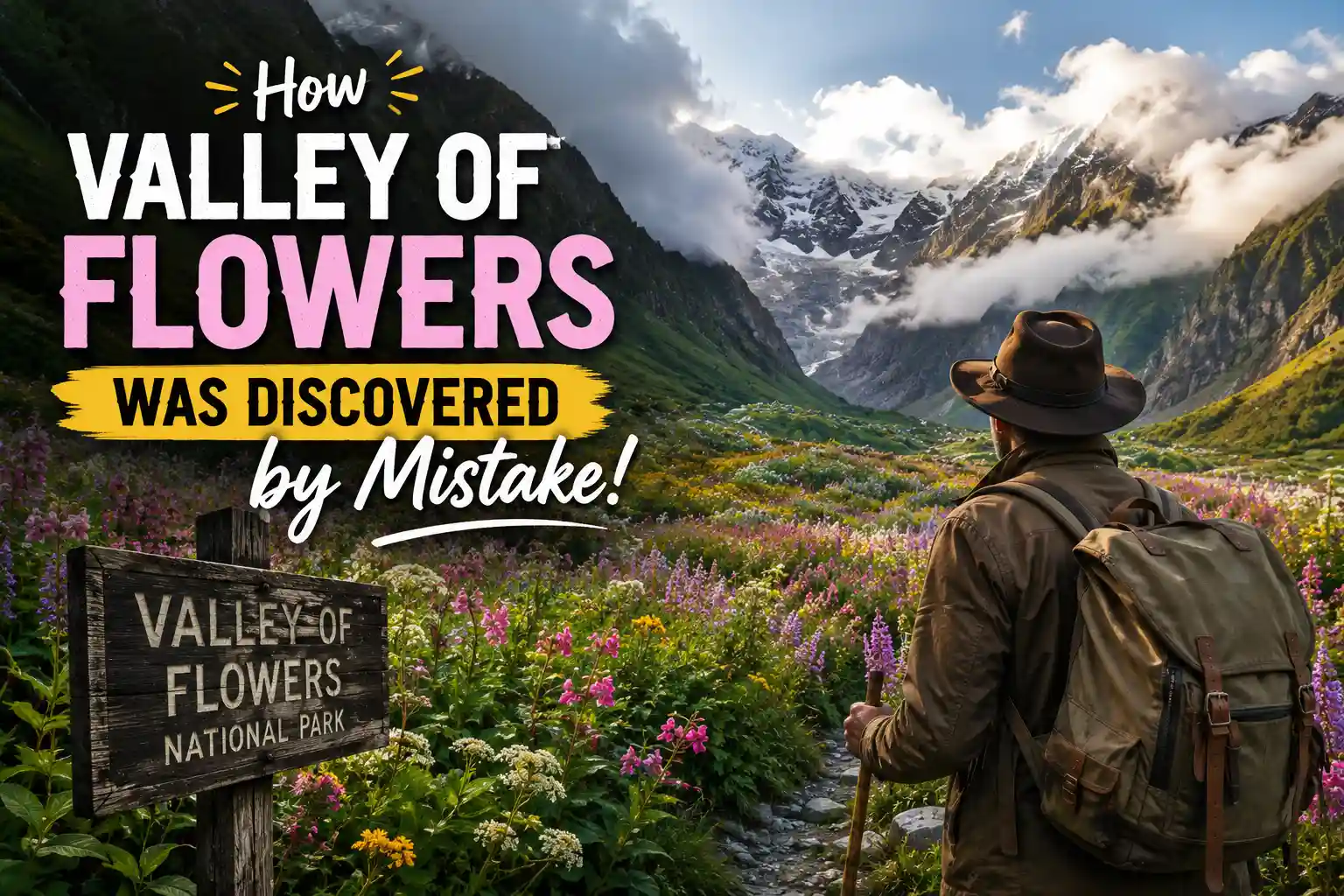
Some of the world’s most extraordinary places were never meant to be found. They existed quietly, undisturbed, until someone wandered off the beaten path — quite literally. The story of how Valley of Flowers came to be known to the outside world is exactly that kind of tale: a mountaineer’s wrong turn that led to one of the Himalayas’ most breathtaking discoveries.
In 1931, a British climbing team wasn’t searching for a flower-filled paradise. They were trying to get home safely after a gruelling mountain expedition. Bad weather, poor visibility, and an unfamiliar pass changed everything. What followed was an accidental discovery that eventually shaped an entire trekking culture in Uttarakhand and put a remote Himalayan valley on the global map.
Meet Frank Smythe: The Man Who Almost Walked Past History
Frank S. Smythe wasn’t a casual traveller. He was a British mountaineer, photographer, and botanist, known for his climbs across the Alps and the Himalayas, and one of the most accomplished climbers of his generation. He had attempted Mount Everest multiple times and summited peaks considered near-impossible at the time.
A Mountaineer With a Botanist’s Eye
Smythe had a rare combination of skills. He climbed like a mountaineer but observed the world like a naturalist. This is exactly why his accidental discovery didn’t just end with “I found a pretty valley.” He documented it, studied its flora, and eventually wrote an entire book about it.
His interest in botany wasn’t accidental either. Fellow mountaineer R.L. Holdsworth had earlier written about the botanical richness of the Garhwal Himalayas in his own account, “Kamet Conquered,” hinting that these mountains held floral treasures worth documenting. Smythe took that observation seriously, even though his own discovery came from a very different circumstance — one that had nothing to do with plants at all.
Mount Kamet, 1931 — Where it all begin
Smythe was part of a British expedition attempting to summit Mount Kamet, then the highest peak ever climbed by humans. The team succeeded. But the real story wasn’t the summit. It was the descent.
As the team made their way back, they chose a different route than the one they had used on the way up, a fairly common practice among mountaineers exploring new terrain. This particular decision came with consequences no one anticipated.
Then They Got Lost
The weather turned, visibility dropped. Somewhere along the Western Pass, Smythe and his fellow climbers lost their bearings entirely. What was supposed to be a straightforward return journey turned into a disorienting trek through unfamiliar terrain, with no clear sense of which direction would lead them back to safety.
This is the point where most expeditions would simply note “we got lost” as a footnote. Instead, this navigational error became the opening chapter of one of India’s most iconic trekking stories.
As the team searched for a way back, they stumbled into a valley they had never seen before. It wasn’t marked on their route. It wasn’t part of the plan. And yet, there it was, spread out in front of them.
Smythe later described the experience as almost surreal, comparing it to a fairyland. The comparison wasn’t dramatic for the sake of storytelling. Standing at over 3,600 metres, surrounded by an explosion of colour after weeks of grey rock, ice, and snow on the Kamet expedition, the emotional impact would have been genuine and immediate.
Three Reasons This “Wrong Turn” Became Legendary
- The valley was completely unmarked on any expedition map at the time
- It sat conveniently between Bhyundar village and the Alaknanda valley, making it geographically accessible once known
- The flowering meadows stretched across the landscape, seemingly without end
For anyone planning their own trek today, this is one of the reasons the region continues to fascinate visitors. If you want a deeper breakdown of the route, permits, and trekking logistics, our Complete Guide to Valley of Flowers covers everything you need before you go.
Naming a Valley That Named Itself
Smythe wasn’t simply looking at a pretty meadow. He was looking at one of the richest concentrations of high-altitude flora found anywhere in the Himalayas. His own writing describes a landscape where it was genuinely difficult to walk without stepping on a flower, such was the density of blooms covering the ground.
The valley is now known to host more than 600 documented species of flowering plants, including orchids, poppies, primulas, marigolds, daisies, and anemones. Sub-alpine forests of birch and rhododendron frame the meadows, while the Pushpavati river cuts through the landscape, feeding the soil that supports this unusual biodiversity.
Smythe was so struck by what he saw that he returned to the valley in 1937, this time with the specific intention of documenting it properly. He spent an extended period there, collecting seeds and specimens, some of which were eventually sent to the Royal Botanic Garden in Edinburgh. This return visit transformed a personal experience into a documented, scientific account, the foundation of everything trekkers and researchers know about the valley today.
The name itself emerged from Smythe’s own writing, first appearing in his account “Kamet Conquered,” and later becoming the title of his dedicated book, “The Valley of Flowers,” published in 1938. The name stuck because it was accurate in the simplest way possible. A valley genuinely filled with flowers needed nothing more than a literal description to capture attention.
The Story Nobody Talks About: Joan Margaret Legge’s Tragedy
While Smythe’s discovery is the beginning of the story, it isn’t the only chapter worth knowing. In 1939, botanist Joan Margaret Legge travelled to the valley specifically to study and collect its flora, inspired by the accounts Smythe had published.
Her visit ended tragically. While collecting flower specimens, she slipped from a rock and lost her life in the valley she had come to study. In 1944, her sister travelled to the same location to honour her memory, placing a small memorial stone that still exists in the valley today.
This part of the history adds a layer of human depth to the destination. It’s a reminder that this landscape, however beautiful, is a genuine high-altitude environment that demands respect, careful footing, and proper trekking preparation, something we always emphasise to trekkers joining our small-group departures.
1982 to 2005: From Forgotten Valley to World Heritage Site
What started as an accidental discovery eventually received formal recognition on a global scale. In 1982, the area was declared Valley of Flowers National Park, protecting its unique alpine ecosystem from unchecked human activity.
Two decades later, in 2005, UNESCO designated the valley as part of the Nanda Devi and Valley of Flowers National Parks World Heritage Site, recognising its exceptional biodiversity and its role in preserving rare and endangered high-altitude species.
This transformation, from an unmarked valley stumbled upon during a snowstorm to an internationally protected heritage site, is a rare example of how a single moment of disorientation on a mountainside can influence conservation policy nearly a century later.
So, What Does This Mean If You’re Planning a Trek?
Understanding the origin story of the valley isn’t just interesting trivia. It shapes how trekkers should approach the experience today. Because the valley was discovered through a navigational error in changing weather conditions, it’s a strong reminder that this region remains genuinely remote and weather-sensitive.
A few practical realities worth keeping in mind:
- Weather in this region can shift rapidly, even during peak trekking months
- The terrain, while well-marked today, still requires a reasonable level of fitness
- Flower blooming patterns change week by week through the monsoon season
- Local guides and experienced trek operators significantly reduce risk on unfamiliar terrain
If timing your visit around peak bloom is a priority, checking the Best time to visit Valley Of Flowers before booking your trek will save you from arriving too early or after the flowers have faded.
Altitude, Permits, and Duration at a Glance
Nearly a century after Smythe’s accidental discovery, the Valley of Flowers trek remains one of the most sought-after Himalayan experiences for a good reason. The trail typically begins from Govindghat, with Ghangaria serving as the base for both the valley trek and the onward route to Hemkund Sahib.
Altitude and difficulty: The valley sits at approximately 3,600 metres, and the trek itself is considered moderate, suitable for reasonably fit beginners with some prior trekking experience.
Permits: Since the valley falls within a national park, an entry permit is mandatory, and the park typically closes during the harsh winter months.
Duration: Most itineraries span five to six days round trip, factoring in acclimatisation and travel to and from the base points.
Group size: Trekking in smaller groups tends to result in a more mindful, less rushed experience, particularly given the fragile ecosystem being explored.
Before You Book: Plan It Right
For travellers who want the full breakdown, including day-wise itinerary planning and packing essentials, our Complete Guide to Valley of Flowers lays out everything in one place, so nothing about your own trek needs to happen by accident.
Frequently Asked Questions
1. Who discovered the Valley of Flowers?
Frank S. Smythe, a British mountaineer and botanist, is credited with discovering the Valley of Flowers in 1931 while returning from an expedition to Mount Kamet.
2. How was the Valley of Flowers discovered by mistake?
Smythe and his team lost their way while descending from Mount Kamet after taking an unfamiliar route through the Western Pass during poor weather. They stumbled upon the flower-covered valley by accident while trying to find their way back.
3. When was the Valley of Flowers officially recognised?
It was declared a national park in 1982 and later designated a UNESCO World Heritage Site in 2005, as part of the Nanda Devi and Valley of Flowers National Parks.
4. What happened to Joan Margaret Legge?
Joan Margaret Legge was a botanist who visited the valley in 1939 to study its flora. She died after slipping from a rock while collecting flower specimens, and a memorial stone was later placed in her honour by her sister.
5. What is the best time to see the valley in full bloom?
The valley is at its most vibrant between mid-July and mid-August, though different flower species bloom at different points across the monsoon season from June to September.
Summary
What makes this story genuinely compelling isn’t just the beauty of the valley itself. It’s the reminder that some of the most remarkable places on Earth aren’t found through careful planning. They’re found when things don’t go according to plan, when a team of exhausted climbers, disoriented by weather and terrain, stumbles into something far more valuable than the summit they had just conquered.
Frank Smythe didn’t set out in 1931 to discover a botanical wonder. He set out to survive a mountain descent. That the two outcomes converged into one of India’s most celebrated trekking destinations is part of what makes the Valley of Flowers story so enduring, nearly a hundred years later.
With the Valley of Flowers trek season approaching, it’s time to plan something truly extraordinary. From breathtaking Himalayan peaks to spiritually powerful temples hidden deep in remote valleys, this journey offers an experience that goes beyond a typical trek—it becomes a story you carry for life. To make your journey seamless and well-organised, choose the best trekking company in Uttarakhand for reliable trek packages, detailed itineraries, and hassle-free booking.
Visit this page for Trek Packages, Itinerary & Booking.