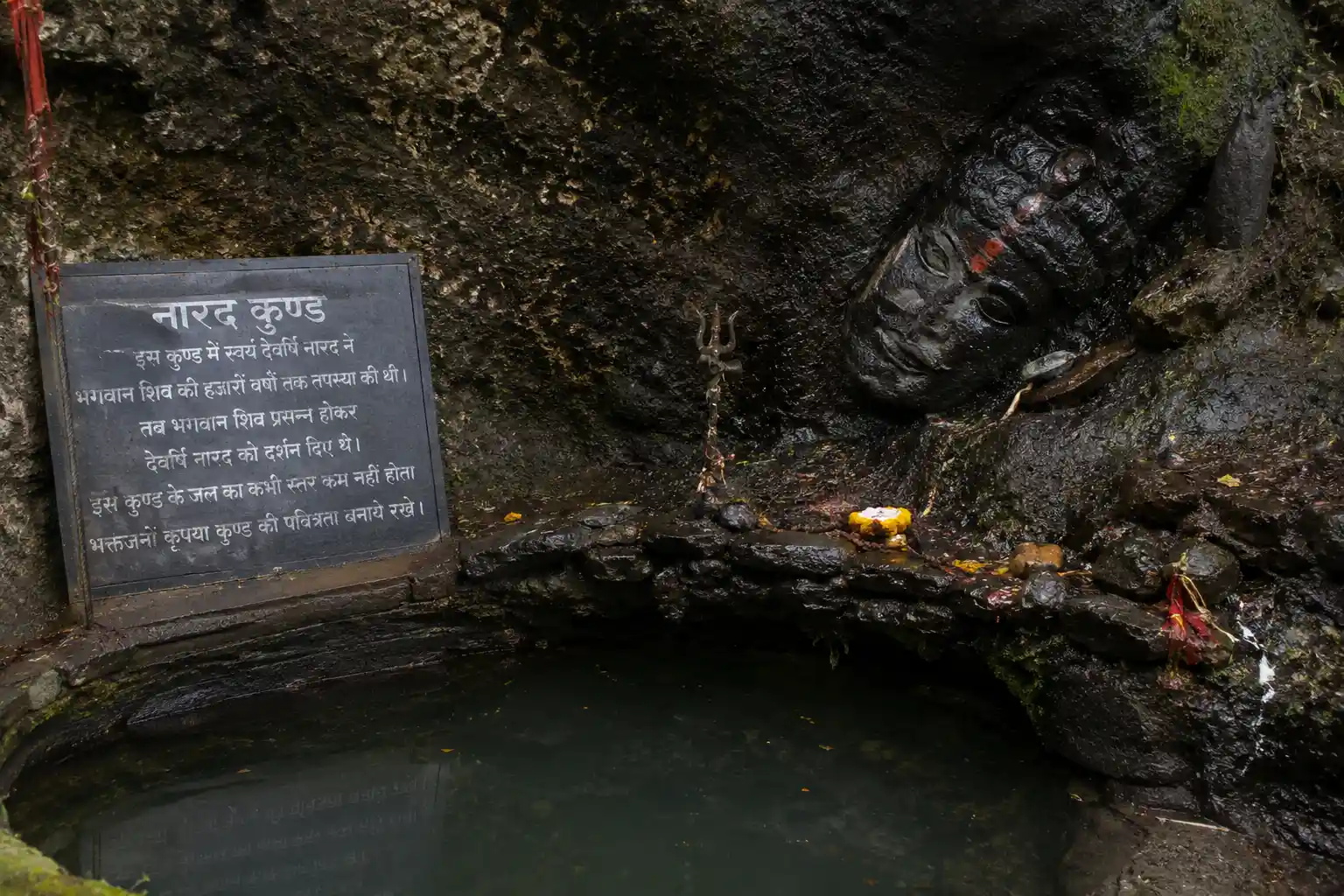
Deep in the Garhwal Himalayas, past dense rhododendron forests and windswept bugyals, sits one of the most quietly powerful spots in the entire Panch Kedar circuit — Narad Kund. Most trekkers walk past it in a hurry to reach the Rudranath temple itself, not realising that this small sacred pool holds one of the most fascinating legends tied to the rudranath shivling.
The story of Narad Kund and the Tilted Shiva Face at Rudranath isn’t just temple folklore passed around by local priests. It explains something visitors actually notice the moment they stand in front of the sanctum — the strange, deliberate angle at which the sacred rock formation sits, and why a nearby stone slab seems to face the opposite direction entirely.
For anyone planning a pilgrimage here, understanding this legend adds real depth to the darshan. It’s the difference between glancing at a rock formation and understanding exactly why it looks the way it does, why the water ritual matters, and why this particular spot has held spiritual weight for centuries.
Narad Kund: The Sacred Pool Beside the Temple
Narad Kund sits just beside the Rudranath temple complex, part of a cluster of small natural water bodies that also includes Surya Kund, Chandra Kund, and Tara Kund. While the other three are tied to solar and lunar deities, Narad Kund’s name comes directly from the sage Narada, a recurring figure in Shaivite mythology known for both his devotion and his habit of stirring events into motion wherever he appears.
Pilgrims draw water from this kund to perform the abhisheka, the ritual bath offered to the rudranath shivling before darshan. There’s no elaborate ceremony involved — just cold mountain water, a few quiet minutes, and a ritual that has likely changed very little in generations. That simplicity is part of what makes Rudranath feel different from busier pilgrimage circuits closer to the plains.
How Rudranath’s Sacred Sites Compare
Each kund and stone formation around the temple carries its own role in the pilgrimage. Here’s how they line up:
| Sacred Site | Associated With | Primary Ritual Use |
| Narad Kund | Sage Narada | Water for shivling abhisheka |
| Surya Kund | Sun deity | Purification bathing |
| Chandra Kund | Moon deity | Purification bathing |
| Tara Kund | Stars/celestial worship | Reflection and offerings |
| Narada Shila | Sage Narada’s presence | Symbolic marker, no ritual bathing |
Visitors often assume all four kunds serve the same purpose, but locals distinguish between them clearly, and Narad Kund is the only one tied directly to the shivling’s own worship ritual rather than general pilgrim bathing.
The Legend: Why the Shiva Face Turned Mid-Stone
Here’s where the story gets specific, and where most general temple guides stop short of explaining the actual mechanics of it.
After the Kurukshetra war, the Pandavas set out searching for Lord Shiva across the Himalayas, hoping to seek forgiveness for the bloodshed. Shiva, unwilling to face them, had disguised himself and gone underground, with different parts of his form said to have emerged at five separate locations — the wider legend behind the entire Panch Kedar sequence.
It was sage Narada who eventually pointed the Pandavas toward the cave where Shiva was hiding. According to the version of the story told at Rudranath, Shiva overheard that conversation from inside the cave and turned his face toward the entrance to see who was approaching. That was the exact moment his form is believed to have solidified into stone — fixing the shivling’s face at an angle rather than facing forward, the way most temple deities are carved or positioned.
Priests who’ve spent decades at the temple still describe the rudranath shivling as looking caught mid-turn, as though the stone froze him a second too soon.
Why Narada Shila Faces the Other Way
Directly opposite the sanctum sits a separate rock formation called Narada Shila, believed to represent the sage himself. What catches most visitors off guard is its orientation.
Rather than facing the shivling, Narada Shila points away from it. Local tradition explains this as the same frozen moment continuing outward — Narada, having just alerted the Pandavas, is positioned as though caught mid-step, not in direct communion with Shiva. It’s a small architectural detail, easy to walk past without noticing, but it’s one of the reasons the site draws genuine researchers of temple mythology alongside trekkers chasing altitude and views.
What Makes This Legend Different from Other Panch Kedar Stories
Every temple in the Panch Kedar sequence carries a version of the same underlying myth, but each site interprets it differently depending on which part of Shiva’s form is said to have appeared there.
Kedarnath’s legend centres on the hump. Tungnath’s on the arms. Madhyamaheshwar’s on the navel, and Kalpeshwar’s on the hair. Rudranath stands apart because its legend isn’t just about a body part appearing — it’s about a captured moment of motion, a face turning mid-escape. That narrative detail gives Rudranath a kind of storytelling depth the other four sites don’t quite match, which is part of why pilgrims completing the full panch kedar trek often say this particular stop stays with them the longest.
Ritual Life Around Narad Kund Today
The kund isn’t just a historical footnote. Priests belonging to the Bhatt and Tiwari families of Gopeshwar, who have overseen worship at Rudranath for generations, still draw water from here for the abhisheka performed before the idol makes its seasonal journey between Gopeshwar and Rudranath during the Doli Yatra.
A few things pilgrims should know before visiting:
- Water is meant for ritual use, not for filling bottles or general collection.
- The kund’s depth shifts with the season, usually fuller shortly after the monsoon retreats.
- The surrounding area is treated with the same reverence as the temple sanctum, so visitors are expected to keep it undisturbed.
Many first-time trekkers don’t realise how close Narad Kund sits to the main temple until they’re standing right beside it, which is exactly why knowing this beforehand makes the visit feel intentional rather than accidental.
Best Time to Witness the Rituals
Timing shapes the experience here more than at most Himalayan pilgrimage sites, mainly because of how weather-sensitive the region is.
Late May through mid-June marks the early season, right after snowmelt, with quieter trails but occasional lingering snow near the temple. September into mid-October is generally considered the strongest window, offering clear skies and the most stable trail conditions once monsoon-related landslide risk has passed. July and August bring the Rudranath Mela, drawing larger crowds of devotees, though this overlaps with heavier rainfall and slicker trail surfaces.
If seeing an active ritual at Narad Kund matters to you, timing a visit around the Doli Yatra or the Shravan-month mela offers the best chance of watching the water ceremony performed firsthand rather than finding the kund quiet and unattended.
Field Notes for Trekkers Heading This Way
A few honest, field-tested points worth carrying with you:
The final stretch from Panar Bugyal to the temple, where Narad Kund sits, is exposed to sudden weather shifts, so a windproof layer earns its place in your pack even in September. Mobile network disappears almost entirely past Sagar village, so offline maps and confirmed homestay arrangements need sorting in advance, not en route. Photography near the kund is generally welcomed, though flash photography inside the sanctum is discouraged out of respect for ongoing worship. Altitude here sits around 3,600 metres, so two to three days of gradual acclimatisation beforehand matters more than most first-timers expect.
Trekkers who’ve done both Rudranath and the more accessible Kedarnath route often mention that the absence of crowds makes Narad Kund feel far more personal — there’s rarely a queue, and priests are often willing to share the legend firsthand if you simply ask.
Frequently Asked Questions
1. What is the story behind the tilted face of the Rudranath shivling?
Local legend holds that Shiva turned toward the cave entrance upon hearing sage Narada guide the Pandavas closer, and his form solidified into stone at that exact angle, permanently fixing the shivling’s tilted appearance.
2. Why does Narada Shila face away from the temple?
It’s believed to represent sage Narada, positioned facing away from the shivling to reflect the same frozen moment from the legend, when the two were caught apart rather than in direct communion.
3. Is Narad Kund water safe to use during rituals?
Yes, it’s used traditionally for the abhisheka by resident priests, though visitors are generally expected to treat it as sacred rather than a general water source for collection.
4. When is the best time to visit Narad Kund during the Rudranath yatra?
September through mid-October offers the most stable weather, while the Shravan month mela in July and August gives visitors the chance to witness active rituals, though with heavier rainfall.
5. How difficult is the trek to reach Narad Kund and the Rudranath temple?
It’s one of the more demanding legs of the wider pilgrimage circuit, typically requiring a multi-day approach through forest trails and alpine meadows before the temple complex comes into view.
Conclusion
Narad Kund isn’t just a footnote on the way to the Rudranath temple — it’s the piece that explains why the shivling looks the way it does, and why Narada Shila sits turned away rather than facing the sanctum. Once you know the legend, the visit stops feeling like a quick photo stop and starts feeling like the reason people undertake this pilgrimage in the first place.
That said, none of this is easy to reach. The trail to Rudranath is remote, weather can shift fast at 3,600 metres, and network drops out well before the temple comes into view. Going in prepared — right season, right acclimatisation, right local guidance — is what turns a difficult trek into a meaningful one. Whether you’re visiting Rudranath on its own or as part of the wider panch kedar trek, a little groundwork beforehand makes the darshan at Narad Kund and the tilted rudranath shivling land the way it’s meant to.
Plan Your Rudranath Yatra with Local Expertise
Ready to see the tilted rudranath shivling for yourself? Mountainiax has walked this trail — let us help you plan the right season, the right route, and a yatra you won’t forget. Get in touch and start your Rudranath journey today.