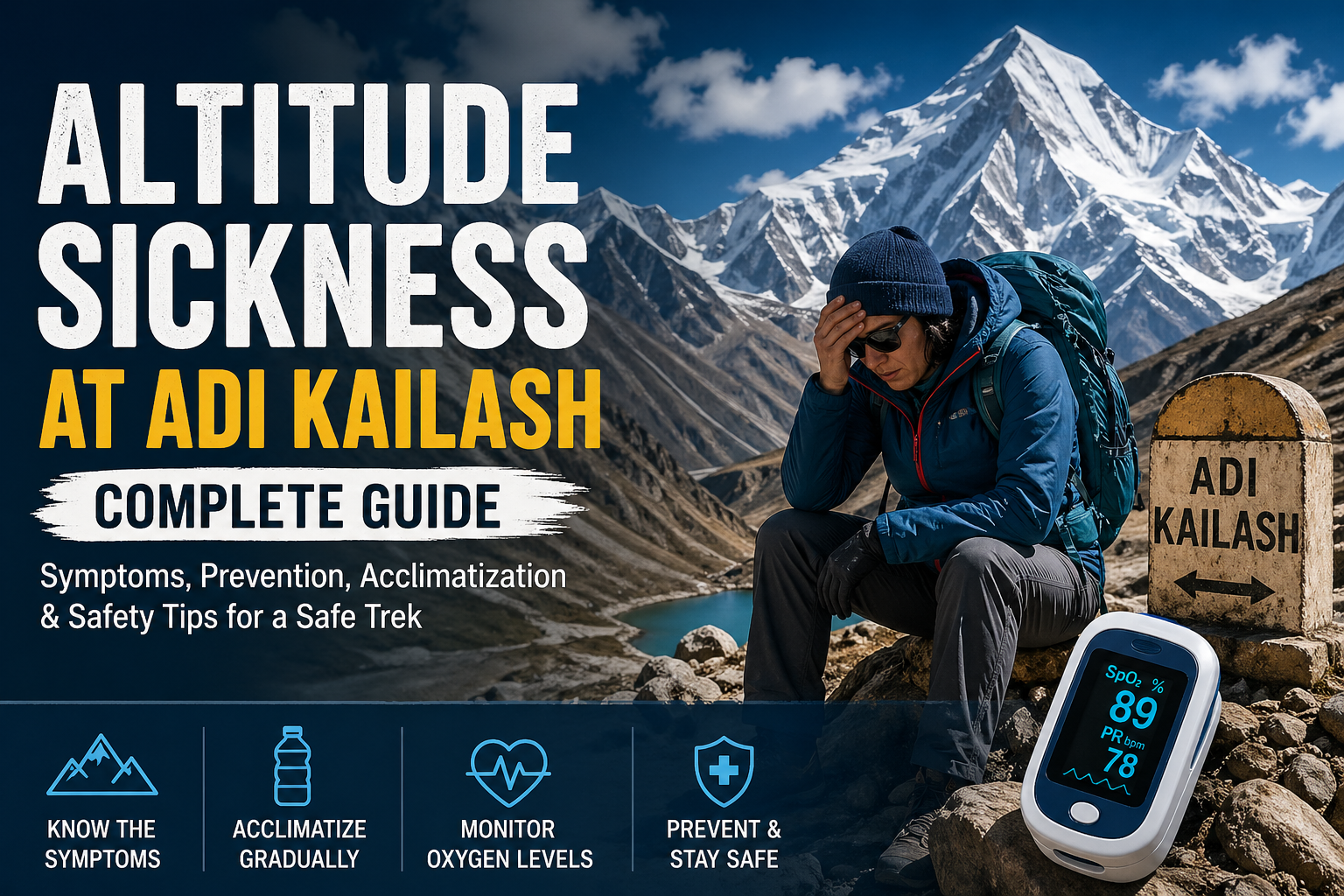
The Adi Kailash trek is one of the most spiritually charged and physically demanding Himalayan journeys in India. Rising from the foothills of Dharchula to the sacred Jolingkong Lake, the route pushes trekkers to altitudes exceeding 5,500 metres. For many pilgrims and adventure travellers, this is their first encounter with such extreme elevation, making the risks of Altitude Sickness at Adi Kailash a critical topic that deserves serious attention before you set a single boot on the trail.
Understanding how altitude affects your body is not fear-mongering — it is responsible travel. The Kumaon Himalayas do not forgive complacency. What begins as a mild headache at Gunji can escalate into a life-threatening emergency within hours if ignored. The difference between a successful pilgrimage and a dangerous medical evacuation often comes down to preparation, awareness, and the willingness to listen to your body above everything else.
This guide is a standalone medical reference for anyone planning the Adi Kailash yatra. We cover everything from early Acute Mountain Sickness (AMS) symptoms to HACE and HAPE warning signs, Diamox dosage, oxygen cylinder rules, a day-by-day acclimatisation schedule from Dharchula to Jolingkong, and exactly what KMVN and trek operators do when a medical emergency unfolds on the route. Read this before you pack.
What Happens to Your Body at High Altitude
When you ascend rapidly to high altitude, the partial pressure of oxygen drops. Your lungs take in less oxygen with each breath, your blood oxygen saturation falls, and your body enters a state of physiological stress. The heart beats faster, breathing becomes laboured, and the brain — highly sensitive to oxygen deprivation — can begin to swell.
This is not a condition limited to unfit trekkers. Elite athletes, experienced mountaineers, and physically healthy pilgrims have all succumbed to altitude illness on Himalayan routes. Fitness does not determine susceptibility. Prior acclimatisation history, ascent rate, hydration, and individual genetics are far more reliable predictors.
The Adi Kailash route spans an elevation range from roughly 915 metres at Dharchula to 5,500+ metres at Jolingkong. The critical danger zone begins above 3,500 metres — and the route crosses that threshold quickly once you move past Budhi.
Altitude Ranges on the Adi Kailash Trek
| Location | Altitude (Metres) |
| Dharchula | 915 m |
| Tawaghat | 1,100 m |
| Pangu | 1,600 m |
| Sobla | 1,524 m |
| Sirkha | 1,950 m |
| Dugtu | 2,815 m |
| Budhi | 3,240 m |
| Gunji | 3,595 m |
| Nabhi | 3,700 m |
| Kalapani | 3,600 m |
| Nabhidhang | 3,856 m |
| Jolingkong | 4,574 m |
| Om Parvat Viewpoint | 5,500+ m (day excursion) |
The biggest elevation gain happens between Budhi and Gunji, and then again on the push from Nabhidhang toward Jolingkong. These two segments are where most altitude-related incidents occur.
Understanding AMS — Acute Mountain Sickness
AMS is the most common form of altitude illness on the Adi Kailash route. It typically sets in within six to twelve hours of reaching a new elevation. Using the Lake Louise Score — a standard diagnostic tool used globally — AMS is diagnosed when a trekker presents with a headache in addition to at least one of the following symptoms upon ascent.
Primary AMS Symptoms
- Persistent headache that worsens with movement or lying down
- Nausea or vomiting
- Dizziness or lightheadedness
- Fatigue that is disproportionate to physical exertion
- Loss of appetite
- Difficulty sleeping or unusual restlessness
Mild AMS is manageable with rest, hydration, and no further ascent. Moderate AMS requires medication and close monitoring. Severe AMS is a medical emergency that demands immediate descent.
A key rule taught by high-altitude medical practitioners: if you feel unwell above 3,000 metres, assume it is altitude-related until proven otherwise. Trekkers at Gunji frequently mistake AMS for dehydration or travel fatigue, delaying necessary action.
When AMS Becomes an Emergency — HACE and HAPE
There are two life-threatening altitude illnesses that every Adi Kailash trekker must be able to recognise.
High Altitude Cerebral Oedema (HACE)
HACE occurs when the brain swells due to fluid accumulation. It is the end-stage progression of severe AMS. Symptoms include:
- Severe, unrelenting headache that does not respond to paracetamol or ibuprofen
- Loss of coordination (ataxia) — the person cannot walk in a straight line
- Confusion, disorientation, or altered consciousness
- Slurred speech or unusual drowsiness
- In advanced cases: coma
HACE is fatal if not treated immediately. The golden rule is descent first, treatment second. Do not wait for morning. Do not wait for a vehicle. Begin descent the moment HACE is suspected.
High Altitude Pulmonary Oedema (HAPE)
HAPE involves fluid accumulation in the lungs and is the leading cause of altitude-related death globally. It can develop without prior AMS symptoms, making it particularly dangerous. Warning signs include:
- Persistent dry cough that progresses to a productive cough with pink or frothy mucus
- Shortness of breath at rest (not just during exertion)
- Crackling or gurgling sounds when breathing deeply
- Extreme fatigue and inability to complete simple tasks
- Cyanosis — a blue or grey tinge to the lips or fingernails
HAPE is most likely to develop at night. If a trekker wakes up gasping, struggling to breathe, or producing an unusual cough at Gunji, Nabhidhang, or Jolingkong — this is a HAPE emergency. Administer supplemental oxygen immediately if available and begin descent without delay.
Day-by-Day Acclimatisation Schedule: Dharchula to Jolingkong
Structured acclimatisation is your most powerful defence against altitude illness. The principle is simple: climb high, sleep low, and never gain more than 300–500 metres of sleeping altitude per day above 3,000 metres.
Here is a practical, medically aligned schedule for the Adi Kailash yatra.
Day 1 — Kathgodam or Pithoragarh to Dharchula (915 m). Arrive and rest. Eat a light dinner. Begin hydrating aggressively. Avoid alcohol entirely for the duration of the trek.
Day 2 — Dharchula to Tawaghat / Pangu (1,100–1,600 m) Gentle ascent through lower foothills. No altitude concerns yet. Focus on hydration and good sleep.
Day 3 — Drive to Sirkha or Dugtu (1,950–2,815 m). Road travel covers much of this gain. Avoid strenuous walking today. Observe how your body responds.
Day 4 — Dugtu to Budhi (3,240 m) You are now entering the moderate altitude zone. Headaches at this stage are common. Rest upon arrival. Drink three to four litres of water. A light walk in the evening at Budhi helps mild acclimatisation.
Day 5 — Budhi to Gunji (3,595 m). This is a critical transition day. The ascent to Gunji is manageable but the altitude jump is significant. On arrival, do not push further. This is a mandatory rest point on most organised itineraries. Monitor all group members for AMS symptoms through the evening and overnight.
Day 6 — Acclimatisation Day at Gunji Gunji is strategically positioned as the primary acclimatisation halt on the Adi Kailash route. Spend this day on a short walk toward Kalapani, ideally gaining 200–300 metres before returning to sleep at Gunji. This classic acclimatisation protocol — widely used on Himalayan treks — helps your body produce more red blood cells and improves oxygen utilisation. For a deeper understanding of how weather and temperature at this altitude affect your body, refer to our detailed guide on Adi Kailash Weather and Temperature, which explains how cold nights compound altitude stress and what to pack for thermal regulation.
Day 7 — Gunji to Nabhidhang via Kalapani (3,856 m) Pass through Kalapani — a historically and spiritually significant settlement — before ascending to Nabhidhang. Take this day slowly. The trail beyond Kalapani becomes more demanding, and the altitude increases steadily. Nabhidhang is the final major camp before Jolingkong.
If you are interested in the strategic and historical significance of this region, our dedicated article on Kalapani, Final Stop Before Adi Kailash, covers the geography and cultural importance of this remarkable location in detail.
Day 8 — Nabhidhang to Jolingkong (4,574 m) The highest sleeping altitude on the standard Adi Kailash route. Ascend slowly and take deliberate rest breaks every thirty to forty-five minutes. On arrival, avoid lying down immediately — walk gently for fifteen to twenty minutes. Monitor oxygen saturation with a pulse oximeter if available. A reading below 80% SpO2 at rest warrants serious concern and should prompt discussion with your guide about descent readiness.
Day 9 — Om Parvat Viewpoint Excursion (5,500+ m) and return. This is the highest point on the yatra and a day excursion only — you do not sleep here. Move slowly. If any group member begins showing HACE or HAPE symptoms, they must descend to Jolingkong immediately and not attempt the viewpoint. Summit day is not the time for heroism.
Diamox (Acetazolamide) — Dosage, Timing, and Precautions
Diamox (acetazolamide) is the most widely used pharmacological aid for AMS prevention and treatment. It works by stimulating faster and deeper breathing, which raises blood oxygen levels.
Standard Prevention Dosage
- 125 mg twice daily, beginning 24 hours before significant ascent (typically the night before departing for Budhi or Gunji)
- Continue until you have been at your highest altitude for two full days or begin descending
Treatment Dosage for Active AMS
- 250 mg twice daily until symptoms resolve or descent begins
Important Precautions
Diamox is a sulfonamide drug. Anyone with an allergy to sulpha drugs or sulphonamide antibiotics must not take it. Consult a physician before the trek, not on the mountain. Common side effects include increased urination (carry extra toilet supplies), tingling in the fingers and toes (harmless), and mild nausea. Carbonated drinks taste flat while on Diamox — a minor inconvenience.
Diamox does not mask HACE or HAPE. If severe symptoms develop despite taking Diamox, that is a descent emergency, not a reason to increase the dose.
Dexamethasone as Emergency Treatment
For HACE specifically, dexamethasone (8 mg initial dose, followed by 4 mg every six hours) is the emergency drug of choice while preparing for evacuation. It is not a substitute for descent — it buys time. Trek operators and KMVN camp managers on the Adi Kailash route are increasingly trained in administering emergency dexamethasone. Confirm this with your operator before departure.
Oxygen Cylinders on the Adi Kailash Route
Supplemental oxygen is the fastest non-pharmacological treatment for all three altitude illnesses — AMS, HACE, and HAPE. On the Adi Kailash route, oxygen availability varies significantly.
What KMVN Provides
KMVN (Kumaon Mandal Vikas Nigam) manages most camps and rest houses along the route. As of recent yatra seasons, KMVN camps at Gunji and Nabhidhang maintain emergency oxygen cylinders for critical cases. However, availability is not guaranteed at every camp and cylinders are not available for personal recreational use.
Private Operator Responsibility
Reputable private operators running the Adi Kailash yatra are required to carry portable oxygen cylinders — typically a minimum of one per group. Verify this before booking. Ask specifically: How many cylinders? What litre capacity? Who in your team is trained to administer them?
Personal Oxygen Options
Personal pulse oximeters are strongly recommended for all trekkers. Small portable oxygen canisters (such as those available in Indian pharmacies) offer short-term relief for mild AMS but are insufficient for HACE or HAPE emergencies. They can, however, provide comfort during a mild episode while the decision to descend is being made.
What to Do If You Feel Sick at Gunji, Nabhidhang, or Jolingkong
This section addresses one of the most searched queries by anxious trekkers: “Feeling sick at Gunji, what to do?”
At Gunji (3,595 m)
- Stop all ascent immediately
- Drink one litre of water over the next hour
- Take 500 mg paracetamol for a headache (avoid ibuprofen on an empty stomach)
- Rest in a horizontal position, but avoid sleeping for the first two hours
- If symptoms do not improve within four hours, begin descent to Budhi
- Inform your guide or KMVN camp manager immediately
At Nabhidhang (3,856 m)
- Do not attempt to push to Jolingkong if symptomatic
- Mild AMS — rest, hydrate, and reassess in four hours
- Moderate AMS (vomiting, severe headache, difficulty walking) — descend to Gunji the same day
- Any HACE or HAPE signs — emergency descent immediately, with oxygen if available
At Jolingkong (4,574 m)
- This is the highest camp. Medical evacuation from here is logistically complex
- All HACE and HAPE cases require immediate descent — there is no medical facility here
- KMVN camp staff are trained to assist in emergencies and can coordinate with the district administration at Pithoragarh for helicopter evacuation in life-threatening cases
KMVN and Operator Medical Emergency Protocols
KMVN has established a basic emergency framework for the Adi Kailash route over recent yatra seasons. Camp managers at key stops — particularly Gunji, Nabhi, and Nabhidhang — maintain contact with district disaster management authorities. In extreme cases, helicopter evacuation can be coordinated through the Pithoragarh district administration.
What operators are expected to provide:
- At least one trained first-aid certified staff member per group
- Emergency oxygen cylinder (minimum one per group)
- Diamox and dexamethasone in the medical kit
- Pulse oximeters for daily SpO2 monitoring of all trekkers
- A written emergency response plan is shared with trekkers at the briefing
What trekkers should confirm before departure:
Ask your operator for their emergency protocol in writing. Know the nearest helicopter landing point (currently, Gunji has a limited flat area used in emergencies). Ensure your travel insurance covers high-altitude rescue and evacuation — many standard policies do not.
Essential Gear for Altitude Safety on Adi Kailash Trek
| Gear | Description / Usage |
| Pulse Oximeter | Non-negotiable above 3,500 metres. Normal SpO2 at altitude is 85–95%. Below 80% at rest indicates serious concern |
| Diamox | Carry only after consulting a physician and follow the prescribed dosage |
| Personal First-Aid Kit | Include paracetamol, ibuprofen (for mild symptoms with food), ORS, and anti-nausea medication |
| Warm Layers | Essential for insulation, as cold increases altitude stress and affects sleep quality |
| Hydration System | Maintain 3–4 litres of water intake daily above Gunji |
| High-Calorie Snacks | Appetite drops at altitude, so consistent calorie intake is necessary |
| Personal Oxygen Canister | Useful for temporary relief during mild AMS (Acute Mountain Sickness) episodes |
Frequently Asked Questions
Q1: Is altitude sickness common at Adi Kailash?
Yes. Given that the route exceeds 4,500 metres and includes day excursions above 5,500 metres, mild AMS affects a significant percentage of trekkers — particularly those who ascend too quickly or arrive poorly hydrated. Structured acclimatisation dramatically reduces this risk.
Q2: Can I do the Adi Kailash trek without Diamox?
Many trekkers complete the yatra without Diamox by following a conservative acclimatisation schedule and ascending slowly. However, for anyone with a history of altitude illness, flying in from sea level, or trekking for the first time above 4,000 metres, Diamox is strongly recommended as a preventive measure after medical consultation.
Q3: What is the best sleeping altitude strategy for the Adi Kailash route?
Follow the “climb high, sleep low” principle. The acclimatisation halt at Gunji — including the sidewalk toward Kalapani — is the most important strategic rest day on the entire route. Do not skip it, even if you feel well.
Q4: How fast can HAPE develop on the Adi Kailash trek?
HAPE can develop within twelve to twenty-four hours of reaching a new altitude, often at night. A trekker who felt fine at dinner can wake up in respiratory distress. This is why nightly symptom checks and oximeter readings are non-negotiable above 3,500 metres.
Q5: What should I do if a fellow trekker shows HACE symptoms?
Begin descent immediately — even at night if safe to do so. Administer supplemental oxygen at a rate of two to four litres per minute if available. Do not leave the person alone. Alert your guide, who should contact KMVN camp staff and district emergency services for evacuation coordination.
Summary
Altitude sickness at Adi Kailash is a real, preventable, and manageable risk — but only for trekkers who take it seriously before arriving at the mountain. The key pillars of safety are a structured acclimatisation schedule from Dharchula to Jolingkong, recognition of early AMS symptoms before they escalate, informed use of Diamox with medical guidance, daily pulse oximeter monitoring, and an unwavering commitment to descend when the body demands it.
The Adi Kailash yatra is an extraordinary experience — spiritually, culturally, and physically. Thousands of pilgrims complete it safely every season. The ones who return safely are those who respect the mountain’s altitude and plan accordingly.
Do not let pride or pilgrimage pressure override your health. The mountain will always be there for another season. Your body must last a lifetime.
With the Adi Kailash Yatra season approaching, it’s time to plan a journey that blends spirituality with raw Himalayan adventure. From sacred lakes to the divine presence of Adi Kailash, every moment feels profound and transformative. If you seek purpose beyond travel, this is your path.
Visit this page for Yatra Packages, Itinerary & Booking.