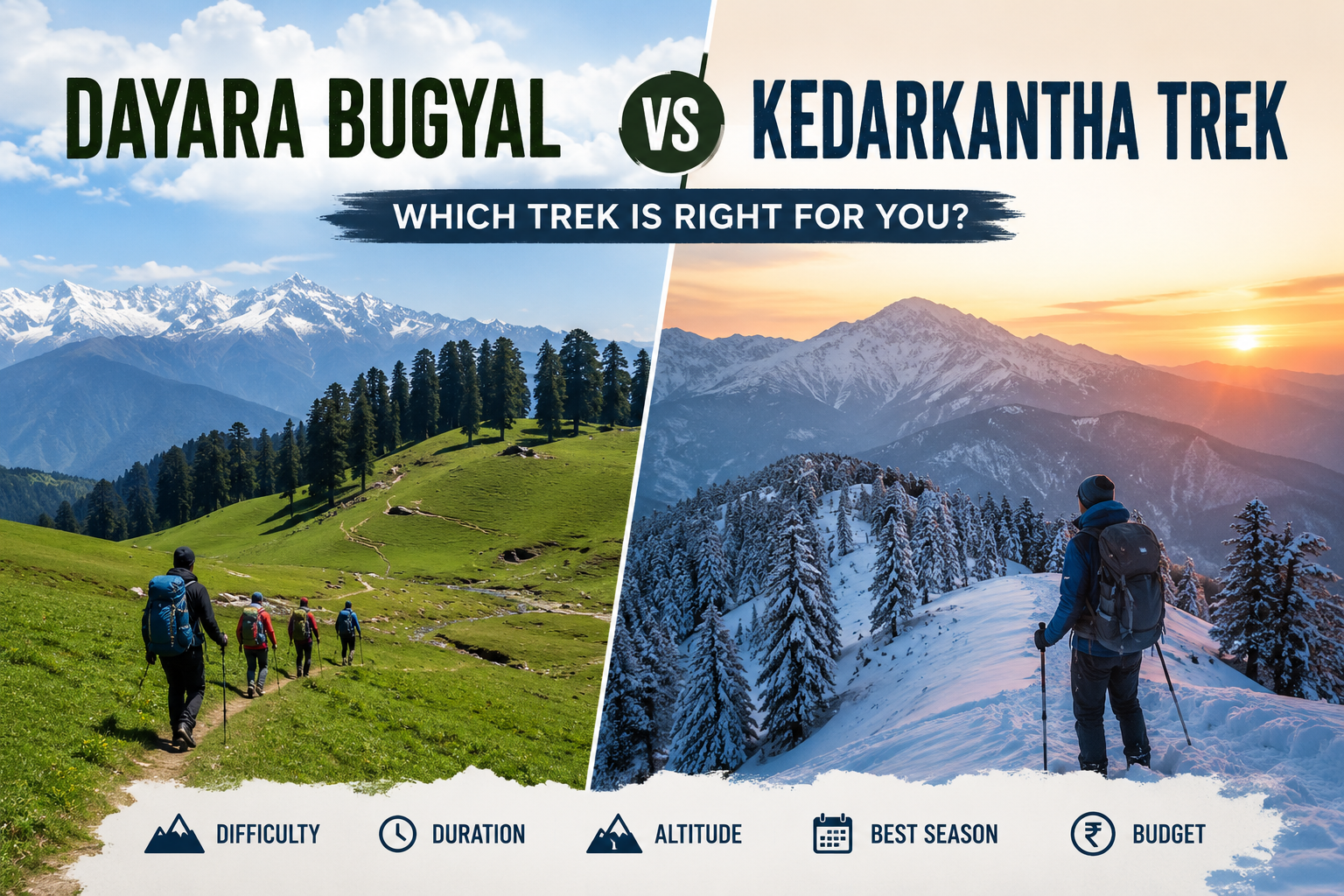
Choosing your first Himalayan trek is one of the most exciting — and occasionally overwhelming — decisions a new trekker faces. With Uttarakhand’s trails drawing thousands of enthusiasts every season, two names consistently rise to the top of every shortlist: Dayara Bugyal and Kedarkantha. This comprehensive guide breaks down the Dayara Bugyal vs Kedarkantha Trek debate so you can move from confusion to clarity and reach the trailhead with genuine confidence.
Both trails are located in the Uttarkashi district of Uttarakhand, both are achievable without technical mountaineering experience, and both deliver Himalayan scenery that stays with you long after you return to the plains. Yet they are fundamentally different kinds of experiences — one is a sweeping alpine meadow immersion, the other a classic winter summit conquest — and that difference matters enormously when deciding which to attempt first.
This guide draws on deep knowledge of Uttarakhand’s trekking landscape to compare both trails across difficulty, duration, altitude, season, cost, and scenic character. By the time you finish reading, you will know exactly which trail fits your current fitness level, available season, and the kind of Himalayan memory you want to carry home.
A Quick Overview of Both Treks
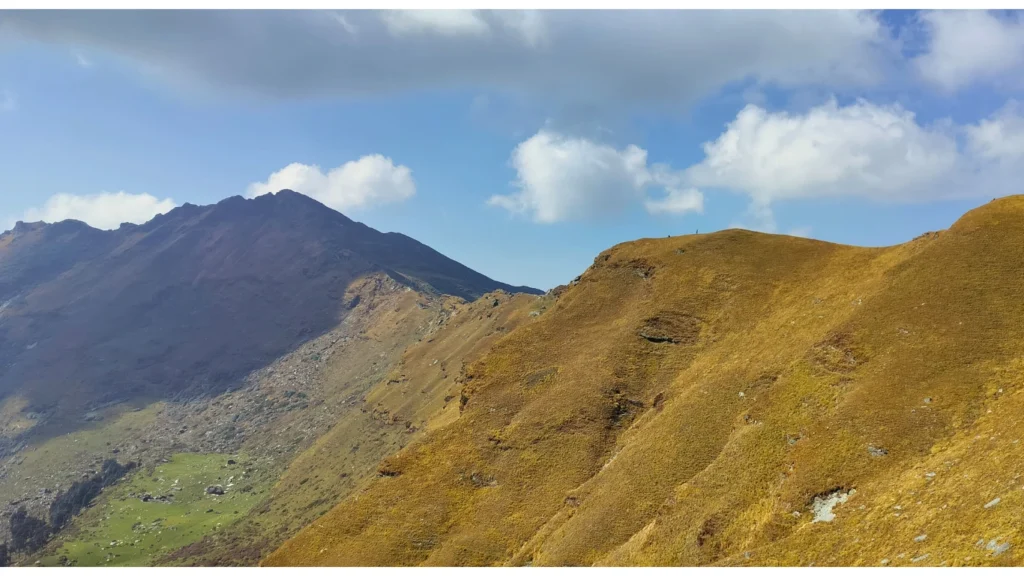
The Dayara Bugyal trek sits at the heart of the Uttarkashi district and leads trekkers through birch and rhododendron forests to one of the most expansive high-altitude meadows in the Indian Himalayas. The bugyal — a Garhwali word for high-altitude grassland — stretches at 3,408 metres and opens onto sweeping views of Bandarpunch, Black Peak, and the Gangotri range. What defines this trek is not a single summit but a vast, open landscape that holds you within it.
The Kedarkantha trek is a summit experience rising to 3,810 metres in the same district. Widely recognised as one of the finest winter treks in India, it draws thousands of trekkers between December and April each year. Snow-laden pine forests, a frozen lake, and a panoramic summit view spanning more than a dozen named Himalayan peaks make it one of the most rewarding high-altitude trails at this difficulty level in all of Uttarakhand.
Terrain and Trail Character: What Each Trek Actually Feels Like
Terrain and trail character define the real trekking experience. Some routes feel rugged and demanding with steep ascents, while others offer gradual meadow walks, forest sections, rocky paths, river crossings, and high-altitude mountain exposure.
Dayara Bugyal — The Meadow Trek
The trail to Dayara Bugyal begins at Barsu village, approximately 25 kilometres from Bhatwari in Uttarkashi. From the first steps out of the village, the path carries you through dense oak and rhododendron forest before gradually thinning into alpine terrain and finally opening onto the bugyal — a moment trekkers consistently describe as one of the most visually striking in Uttarakhand trekking.
At Bakaria Top (3,750 m), the highest accessible viewpoint on the standard route, you are rewarded with a broad, unbroken panorama of Gangotri I, II, and III, Bandarpunch, and Black Peak. The view is vast and unhurried — it does not rush at you from a narrow summit but spreads across every direction like a wide-screen landscape.
The route also threads through the traditional Garhwali villages of Barsu and Raithal, where centuries-old stone architecture and terraced fields offer cultural depth alongside natural beauty. For trekkers who find as much meaning in forest sounds, village conversations, and gradual landscape reveals as in summit panoramas, Dayara Bugyal delivers on every level.
Kedarkantha — The Summit Trek
Everything about Kedarkantha is designed around reaching the top. The trail from Sankri village passes through the Govind Pashu Vihar Wildlife Sanctuary, where the atmosphere of deep winter forest — silent, snow-covered, occasionally interrupted by birdlife — is unlike anything in the lower Himalayas. Juda Ka Talab, a small frozen lake encountered partway through the trek, adds a storybook quality to the journey that many trekkers cite as their favourite single moment on the route.
The summit push on the final ascent day gains approximately 600 to 700 metres of elevation over a few concentrated hours. In winter, with packed snow and ice underfoot, the climb demands careful footing and genuine physical effort. But the moment you reach the top — with Swargarohini, Bandarpunch, Kalanag, and the Gangotri group laid across the horizon in every direction — the effort becomes irrelevant. It is the kind of view that permanently recalibrates how you think about scale and distance.
Head-to-Head Comparison: Difficulty, Duration, Altitude, and Season
This comparison helps trekkers evaluate each route based on trekking difficulty, total duration, maximum altitude, terrain challenges, weather conditions, and the best trekking season for safety, scenery, and overall mountain experience.
Difficulty
Both treks fall in the easy-to-moderate category, making them suitable for beginners and early-stage Himalayan trekkers. The meaningful difference is like a challenge.
Dayara Bugyal presents a consistent, moderate gradient with no single section dramatically harder than the others. This makes it exceptionally good for building confidence — you are never thrown into difficulty that the preceding days have not prepared you for.
Kedarkantha’s summit push is a different experience. The concentrated altitude gain in winter snow conditions requires physical endurance, solid balance, and the right footwear. It is not technically demanding, but it represents a genuine intensity spike for first-time trekkers — one worth accounting for in your preparation plan.
Duration and Distance
Both treks can be completed in 5 to 7 days, depending on the itinerary. Kedarkantha is commonly packaged as a focused 5 to 6-day trek from Sankri. Dayara Bugyal benefits from 6 to 7 days, allowing unhurried time across the meadow and a proper exploration of Bakaria Top without feeling rushed.
Altitude Profile
Kedarkantha reaches 3,810 metres at the summit; Dayara Bugyal reaches 3,750 metres at Bakaria Top. The difference in absolute altitude is minimal. However, Kedarkantha concentrates its significant altitude gain into a single day, while Dayara Bugyal distributes the gain more evenly, which is physiologically gentler and allows natural acclimatisation for trekkers who have never spent nights above 3,000 metres.
Seasonal Window
Kedarkantha is at its finest from December to April when deep snow defines the entire experience. Dayara Bugyal is a multi-season trek — spectacular in summer for wildflowers (May to June), outstanding in autumn for crystal-clear mountain views (September to November), and scenic in winter for snow-covered meadows (December to February). This seasonal flexibility makes Dayara Bugyal considerably more accessible for trekkers who cannot plan around a specific winter window.
Who Should Do Dayara Bugyal First?
Dayara Bugyal is the stronger starting choice if you recognise yourself in any of the following.
- You are a first-time high-altitude trekker — the gradual terrain and absence of a steep summit push make Dayara Bugyal a confidence-building introduction to Himalayan trekking.
- You are trekking between May and November — Dayara Bugyal remains rewarding across most non-winter months, unlike Kedarkantha, which depends heavily on snowfall conditions.
- You value immersion over a single dramatic moment — forests, villages, cultural interactions, birdlife, and vast meadows make the entire Dayara Bugyal journey engaging from start to finish.
- You are travelling with a mixed-fitness group — the consistent gradient helps trekkers with different stamina levels move comfortably without intense summit pressure.
- Before starting the trek, preparing a proper Dayara Bugyal Trek Packing List is essential because carrying the right gear directly affects comfort, energy management, and safety at high altitude.
Who Should Do Kedarkantha First?
You are available between December and April. Kedarkantha in full winter snow is a categorically different experience from any other season. If this window suits your schedule, it is the single most compelling reason to choose Kedarkantha as your starting point.
You are motivated by a defined summit goal. Kedarkantha’s trail narrative is purposeful — every day closes the gap to the top, and the top delivers without ambiguity. For trekkers who find structured goal-oriented experiences more motivating than open landscape journeys, this trail works perfectly.
You have a baseline of physical fitness. With 6 to 8 weeks of preparation behind you and reasonable leg strength and cardio endurance, the Kedarkantha summit push is well within reach and deeply rewarding.
You want your first Himalayan memory to be panoramic and dramatic. The Kedarkantha summit view on a clear winter morning — with the white mass of the greater Himalaya visible from horizon to horizon — is among the most celebrated in Indian trekking and a genuinely formative place to begin your mountain journey.
Planning Your Budget: Understanding Trek Costs
Understanding trek costs helps travellers plan realistically by comparing packages inclusions, transportation, permits, accommodation, gear expenses, seasonal pricing variations, and personal spending requirements for a smoother and financially manageable trekking experience.
- Kedarkantha trek packages are generally more affordable because the itinerary is compact, usually lasting 5 to 6 days with lower overall logistical requirements.
- Most Kedarkantha packages include guided trekking, camping or guesthouse stays, meals during the trek, porter support, and forest permits.
- Dayara Bugyal packages usually operate for 5 to 7 days, which can slightly increase the total trekking cost compared to Kedarkantha.
- Dayara Bugyal does not require specialised technical equipment during most seasons, helping trekkers manage expenses more efficiently.
- Multi-season accessibility allows budget-conscious trekkers to choose off-peak travel windows with comparatively lower package prices.
- Common personal expenses for both treks include transportation from Dehradun or Delhi, trekking gear, travel insurance, snacks, and miscellaneous village expenses.
- Reviewing the complete Dayara Bugyal Trek Cost before booking helps trekkers understand guide charges, permits, accommodation, meals, and transportation expenses without unexpected budget issues.
Getting to the Trailhead: Logistics for Both Routes
Both trails begin in the Uttarkashi district and are accessible from Dehradun, which connects to Delhi by road in approximately 5 to 6 hours.
For Kedarkantha, the base village is Sankri, roughly 200 kilometres from Dehradun. Most operators run overnight buses or early morning shared cabs on the Yamuna Valley route, with a total journey of 9 to 10 hours on mountain roads. The drive through the Yamuna Valley itself offers early views of the Himalayan foothills that effectively begin the trekking experience before you reach the trailhead.
For Dayara Bugyal, the trek begins at Barsu village, approximately 190 kilometres from Dehradun via Bhatwari. Road conditions are reliable up to Bhatwari, with the final stretch to Barsu comfortably navigable by SUV. Total travel time from Dehradun is 8 to 9 hours.
We provide comprehensive trailhead logistics for both routes, including pre-trek briefings, base village accommodation the night before departure, and early-stage acclimatisation guidance during the drive and first night at altitude.
Winter Trekking: Which Trail Delivers More in Snow?
For trekkers planning specifically within the winter trekking season, this comparison deserves a direct, clear answer.
Kedarkantha wins on summit drama. Deep snow cover from December through February transforms the entire route — snow-weighted pine branches, a frozen Juda Ka Talab, and a summit view that expands across the white Himalayan horizon on clear winter mornings. If concentrated summit drama in snow is your definition of the ideal winter trek in Uttarakhand, Kedarkantha is the sharper, stronger choice.
Dayara Bugyal in winter offers something equally valid but fundamentally different — a vast, snow-covered meadow that feels ancient and immense, flanked by the Gangotri peaks and filled with the deep quiet of Himalayan winter. The meadow functions as a natural skiing ground during this season, adding an experiential dimension that no other trek at this difficulty level in Uttarakhand provides.
The real distinction is temperamental. Kedarkantha gives you the intensity of a summit in snow. Dayara Bugyal gives you the serenity of an open meadow in winter. Both are extraordinary. The better choice depends on which kind of memory you most want to carry home.
Can You Do Both Treks in One Trip?
Yes — and for trekkers with two weeks available, combining these two trails into a single Uttarakhand trip is one of the most rewarding itinerary decisions you can make.
Both trails are in the same district, making logistics straightforward. A rest day in Uttarkashi town between the two treks is all the transition you need. The recommended sequence is Dayara Bugyal first, Kedarkantha second. Dayara’s gentler terrain serves as excellent physical preparation for Kedarkantha’s summit push, and the acclimatisation gained over several days above 3,000 metres carries over directly to improve your summit day performance.
If you are planning this combination and want to calibrate your preparation precisely, understanding the difficulty level of the Dayara Bugyal Trek in full detail allows you to design a training programme with the right intensity to cover both trails, giving you the physical foundation to complete the sequence comfortably rather than just survive it.
This combination approach delivers two contrasting Himalayan landscapes in a single trip and provides a more complete introduction to Uttarakhand trekking than most trekkers accumulate across years of separate visits.
Practical Tips from Experienced Himalayan Trekkers
Start physical preparation 6 to 8 weeks before your trek. Daily walking with a loaded backpack, stair climbing, and cycling build the specific endurance these trails demand. Leg strength and cardiovascular fitness are the two most critical physical attributes for both routes.
Book through a certified, experienced operator. Both treks involve overnight camping at altitude and trail sections with no mobile connectivity. A certified guide trained in altitude sickness management and emergency response is a genuine safety requirement — not an optional add-on.
Invest in the right sleeping bag. Even in shoulder seasons, temperatures at camp drop sharply after sunset. A sleeping bag rated to at least -10 degrees Celsius and a quality down or synthetic insulating mid-layer make the difference between genuinely restful nights and exhausted mornings on the trail.
Hydrate actively above 3,000 metres. The body loses moisture faster at altitude. Target 3 to 4 litres of water daily on the trail, regardless of how thirsty you feel. Oral rehydration salts are useful if appetite drops at higher elevations.
Build a buffer day into your itinerary. An acclimatisation day mid-trek or a rest day at the base village before departure reduces pressure and significantly improves how much you actually enjoy the experience versus simply enduring it.
Respect the environment and local communities. Both trails pass through ecologically sensitive zones and traditional Garhwali villages. Carry all waste out of the forest, stay on marked trails, and engage with village life with genuine respect and curiosity.
Frequently Asked Questions
1. Which trek is easier — Dayara Bugyal or Kedarkantha?
Both fall in the easy-to-moderate category, but Dayara Bugyal is marginally easier overall due to its consistent gradient and absence of a steep summit push. Kedarkantha is equally accessible for fit beginners but demands more on summit day, particularly in winter snow conditions.
2. Is Kedarkantha suitable for complete beginners?
Yes, with adequate preparation. For beginners with reasonable fitness who have trained specifically for 6 to 8 weeks beforehand, Kedarkantha is entirely achievable — particularly with an experienced guide who manages pace carefully on summit day.
3. What is the best time to visit Dayara Bugyal?
Dayara Bugyal rewards trekkers across multiple seasons. May to June for wildflower bloom, September to November for the clearest mountain views and golden autumn light, and December to February for snow-covered meadow landscapes and natural skiing conditions.
4. Which trek is less crowded?
Dayara Bugyal sees significantly fewer trekkers than Kedarkantha, which draws large groups — particularly between December and March at peak winter season. For trekkers who value solitude and a quieter trail experience, Dayara Bugyal is the clear choice.
5. Can I do both treks in a single Uttarakhand trip?
Yes. Both trails are in the same district and can be combined over 12 to 15 days with a rest day between them. Mountainiax offers customised combined itineraries — visit our website to explore package options tailored to your schedule and budget.
Summary — Which Trek Should You Do First?
The answer depends on three things: when you are available, what kind of experience you are chasing, and how you like to be challenged.
Choose Dayara Bugyal first if you are new to high-altitude trekking, trekking outside the December-to-April window, or looking for a rich, immersive experience that builds genuine confidence and delivers extraordinary panoramic rewards without a steep summit push. It is one of the finest introductory treks in the Indian Himalayas — generous in scenery, gentle in terrain, and unforgettable in the sense of open space it provides.
Choose Kedarkantha first if you are available between December and April, motivated by a defined summit goal, and ready for the purposeful, goal-oriented challenge that winter trekking in Uttarakhand delivers at its most dramatic. The summit view on a clear winter morning is a genuinely formative Himalayan experience.
And if you can, do both. Two weeks between Dayara Bugyal and Kedarkantha gives you more knowledge, experience, and lasting memory than almost any single trek can. The Uttarakhand Himalayas are endlessly generous to those who show up prepared.
With the dayara bugyal trek season approaching, it’s time to plan something truly extraordinary. From breathtaking Himalayan peaks to spiritually powerful temples hidden deep in remote valleys, this journey offers an experience that goes beyond a typical trek—it becomes a story you carry for life. To make your journey seamless and well-organised, choose the best trekking company in Uttarakhand for reliable trek packages, detailed itineraries, and hassle-free booking.
Visit this page for Trek Packages, Itinerary & Booking.