Most trekkers who walk the Panch Kedar circuit come for the temples. They leave having experienced something far older and far more quietly profound — the living culture of the Garhwal Himalayas. Beyond the sacred shrines and the alpine meadows, this route passes through some of Uttarakhand’s most resilient villages, where ancient customs, seasonal rhythms, and a fierce sense of devotion have survived centuries of isolation, hardship, and the slow creep of modernity.
Garhwali Culture Along the Panch Kedar Route is not a backdrop to the pilgrimage — it is the pilgrimage itself. The deities do not exist in isolation from the people. Every priest, every dhaba owner, every shepherd grazing her flock on a high bugyaal, every grandmother spinning wool outside a stone home in Ukhimath — they are all woven into the same fabric of spiritual and cultural life that gives this route its extraordinary depth.
This guide goes beyond distances and altitudes. We move through the major stops on the Panch Kedar route with deliberate attention to what is culturally significant at each one — the rituals, the food, the village architecture, the seasonal festivals, and the unscripted moments of Garhwali hospitality that no itinerary can fully prepare you for. If you are the kind of traveller who needs to understand a place, not just complete it, this is the guide you have been looking for.
Understanding the Garhwal Himalayas Before You Trek
The Garhwal region of Uttarakhand is not simply a geographical division. It is a distinct civilisational world — one with its own language (Garhwali, a language spoken by millions and distinct from Hindi in cadence, vocabulary, and song), its own folk traditions, its own caste and clan systems rooted in the Rajput and Brahmin heritage of the mountains, and a cosmological worldview in which every peak, river, and rock formation carries divine significance.
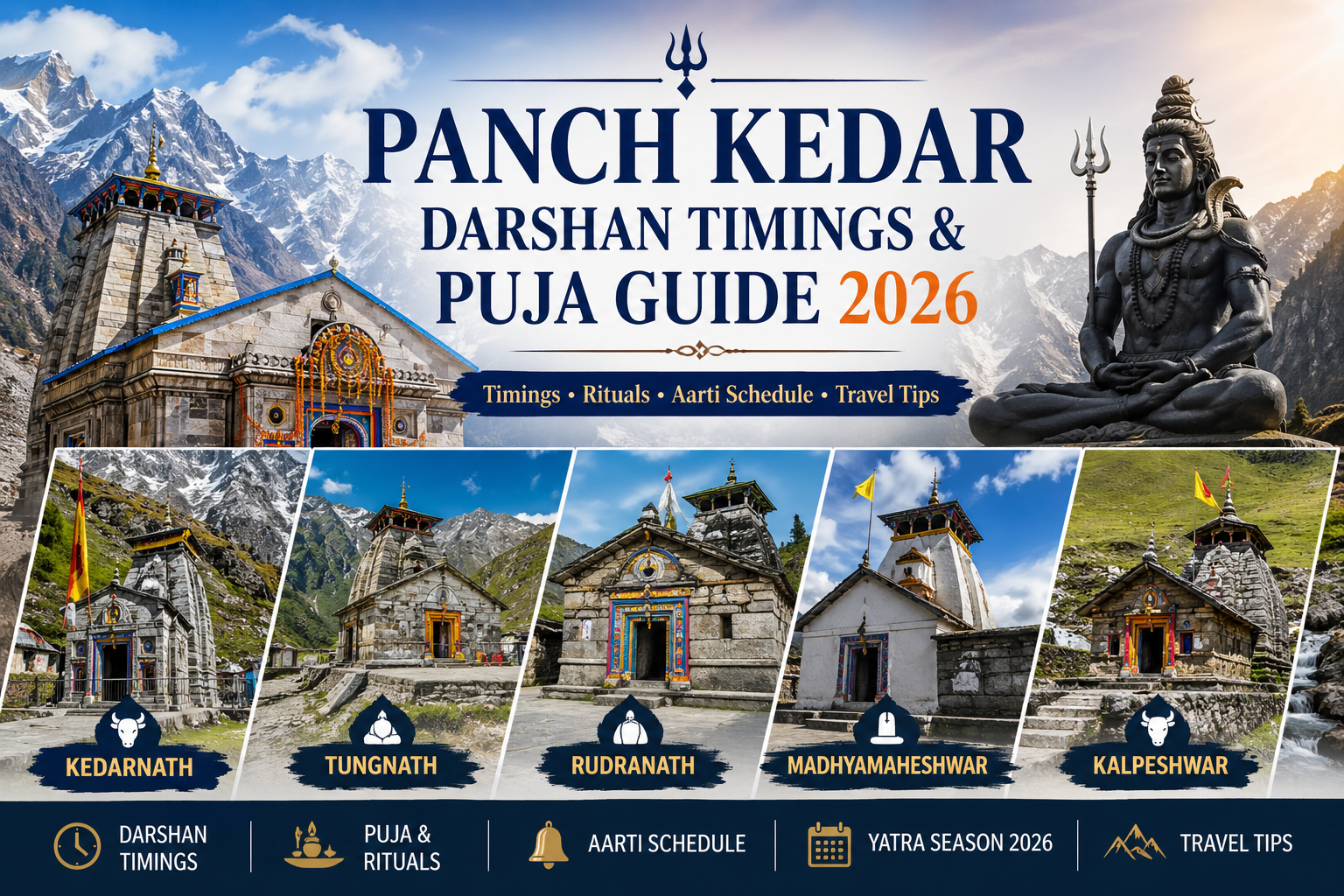
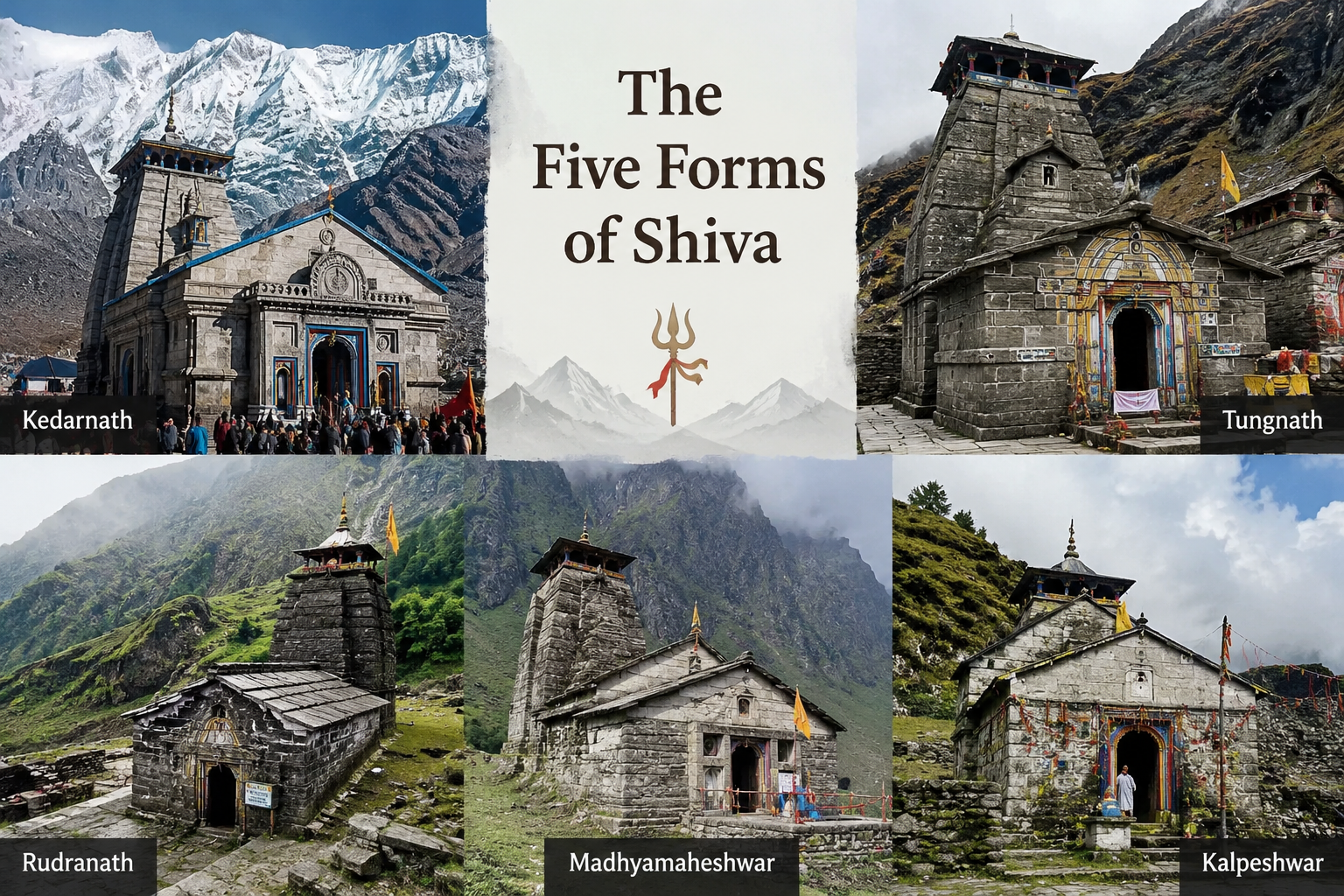
The Panch Kedar — Kedarnath, Tungnath, Rudranath, Madhyamaheshwar, and Kalpeshwar — represent five aspects of Lord Shiva, enshrined at five different points across the Garhwal Himalayas. But the religious geography extends far beyond the shrines themselves. The villages that serve these temples, the priests who tend them, and the pilgrims who arrive each season are all participants in a living tradition that predates written history.
The distinction between Garhwal and Kumaon — Uttarakhand’s two cultural regions — is worth noting for the culturally curious trekker. While both share Himalayan geography and Hindu devotional traditions, Garhwali culture is more closely tied to Shaivite pilgrimage, martial Rajput heritage, and a dialect with roots traceable to Sanskrit. Kumaon has stronger ties to the Kumaoni folk tradition, different temple rituals, and a distinct culinary identity. On the Panch Kedar route, you are in unmistakably Garhwali territory.
Ukhimath — Where the Gods Spend Winter
Every devoted pilgrim knows that the Kedarnath shrine sits at 3,583 metres and remains snowbound for nearly six months of the year. But few know what happens to the deity during that time.
Every winter, in a ceremony of extraordinary ritual significance, the utsav murti (ceremonial idol) of Lord Kedarnath is carried down from the high shrine in a palanquin procession and installed at the Omkareshwar Temple in Ukhimath — a small village at around 1,300 metres in the Rudraprayag district. The idol of Madhyamaheshwar also descends to Ukhimath for the winter months. This makes Ukhimath the singular winter capital of two of the five Kedar deities — a fact that gives this quiet, unassuming village an outsized spiritual weight.
The Omkareshwar Temple itself is ancient, its stonework worn smooth by generations of worshippers. During winter, it becomes the only place in Uttarakhand where you can receive the darshan of the Kedarnath deity — something that draws devoted pilgrims from across the region even in the coldest months.
For the culturally attentive traveller, Ukhimath also offers:
- Traditional Garhwali stone and wood architecture in its older residential quarters
- Village lanes where daily life — women carrying water, men chopping wood, children in school uniforms — unfolds with no awareness of being observed
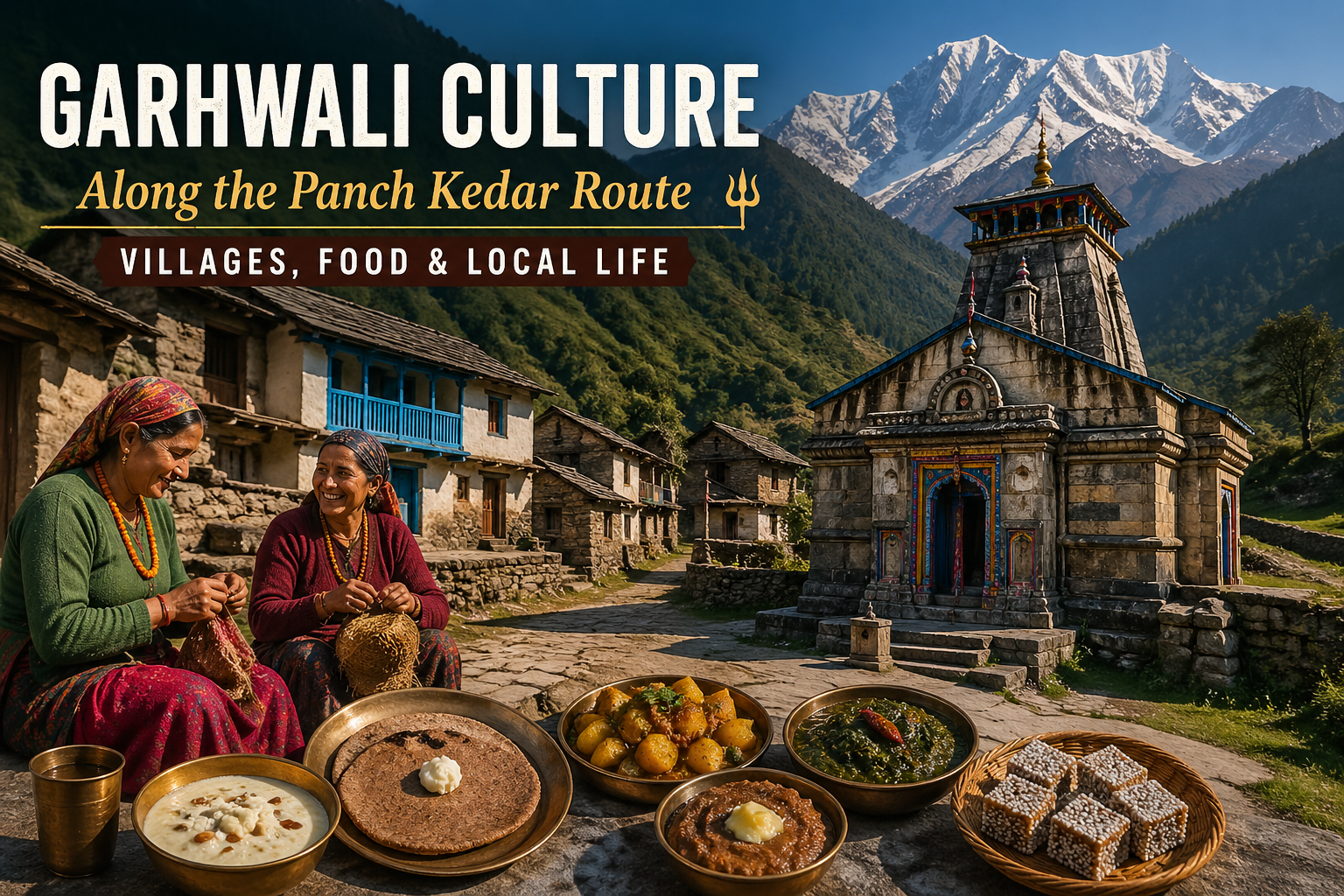
- Local dhabas serving jhangora ki kheer (a pudding made from barnyard millet, one of Garhwal’s traditional crops) and mandua ki roti (flatbread made from finger millet, high in iron and calcium)
- The opportunity to speak with local priests who can explain the winter deity ritual in detail — a rare form of cultural learning unavailable in any guidebook
If your route begins at Ukhimath or passes through it, build in time to walk the village slowly. It rewards patience.
Ransi Village and the Rakeshweri Temple Ritual
Ransi is the base village for the Madhyamaheshwar trek — a small settlement perched at around 2,100 metres above the Markanda valley. For most trekkers, it is simply the roadhead where the trail begins. But Ransi has its own devotional identity rooted in the Rakeshweri Devi Temple, which sits at the edge of the village.
The daily puja at Rakeshweri follows a structure that has remained largely unchanged for generations. The morning aarti is performed at sunrise, with a small gathering of local women — often the most consistent participants — offering flowers, incense, and rice in a ritual that is entirely local, entirely unhurried, and entirely unselfconscious. No tourists are being performed for. This is simply life at the threshold of the sacred.
Trekkers who arrive at Ransi the evening before their Madhyamaheshwar ascent and wake early enough to witness this puja carry something back from the experience that photographs cannot convey. The ritual is not grand. It is intimate and deeply rooted — and that is precisely what makes it remarkable.
Ransi also sits at the edge of rhododendron and oak forest, and local guides from this village — many of whom have been leading treks here for decades — carry an encyclopaedic knowledge of both the route ecology and the mythology of every natural feature along the trail. Hiring a local guide from Ransi rather than a city-based agency is both a cultural act and a practical one.
For families considering this region, it is worth noting that the lower sections of the Madhyamaheshwar trail from Ransi are accessible to older children and seniors. Our guide on Panch Kedar with Kids covers which segments are appropriate for younger trekkers and what to expect at village stays along the way.
Chopta — The Dhaba Culture of the Himalayas
Chopta, at roughly 2,680 metres, is the base for the Tungnath and Chandrashila trek — and it is famous among trekkers for one thing above all else: its dhabas. These are not the roadside eateries of the plains. Chopta’s Himalayan dhabas occupy a category entirely their own.
Run almost exclusively by local Garhwali families — many of whom migrate up from lower villages for the trekking season and return when the snow arrives — these simple wood and tin structures serve as social hubs, warming shelters, gossip exchanges, and feeding stations in one. The food is plain, hot, generous, and profoundly comforting at altitude.
What to eat at Chopta’s dhabas:
- Aloo ke gutke — potatoes tempered with cumin seeds, dried red chilli, and mountain herbs; a Garhwali staple that appears at nearly every meal
- Rajma chawal — local red kidney beans slow-cooked with ginger and minimal spicing, served over rice; completely different in texture and flavour from the urban version
- Garhwali thali — when available, this might include dal baati (lentil soup with wheat dumplings), seasonal saag, rice, and a small serving of jhangora ki kheer as dessert
- Chai — brewed with ginger and cardamom, served in glasses blackened from years of wood-fire use, and somehow the best tea you will drink on the entire trek
The dhaba owners of Chopta are also extraordinary informal historians. Ask about the Tungnath temple’s age — it is believed to be over a thousand years old — and you will receive a story that weaves together mythology, glacial memory, and personal family history in a way that no academic text quite replicates.
Chopta is also one of Uttarakhand’s finest locations for watching the Himalayan sunset. The high meadows above the village face west toward Kedarnath and Chaukhamba, and on clear evenings the light on those peaks becomes something that stays with you. Trekkers interested in this experience will find our guide on Sunset Treks in Uttarakhand useful for planning the best timing and vantage points along the Panch Kedar corridor.
Urgam Valley and Kalpeshwar — Apple Orchards and Ancient Stone
Kalpeshwar is the most remote of the five Kedar shrines and the only one accessible year-round. It sits within the Urgam Valley — a deeply green, agriculturally rich pocket of the Chamoli district that feels entirely different in character from the high-altitude terrain of Kedarnath or Tungnath.
The Urgam Valley is known for its apple orchards, which produce a small-fruited, intensely flavoured variety of apple well-adapted to Himalayan conditions. In late summer and early autumn — roughly August to October — the valley is thick with apple trees in various stages of ripening, and it is common to see local families harvesting fruit that will be sold in Joshimath or Chamoli markets or pressed into local juice.
The villages of Urgam are among the most architecturally intact in all of Garhwal. Stone houses with carved wooden balconies (known locally as kholi doors, featuring intricate deity carvings at the entryway) line narrow lanes that have accommodated foot traffic, not vehicles, for centuries. These are working homes, not heritage displays — and that authenticity is exactly what makes them worth exploring slowly and respectfully.
The Kalpeshwar shrine itself is unusual. Unlike the other four Kedar temples, which sit in open alpine settings, Kalpeshwar is housed within a natural cave. The approach through the narrow cave corridor to the Shiva lingam — said to represent the matted hair (jata) of Lord Shiva — is intimate in a way that the grander shrines cannot replicate. Local priests here are often willing to explain the iconographic significance of each Kedar aspect and how the five together constitute a complete body of the divine.
Cultural sensitivity note for visitors to Urgam: This valley receives far fewer outsiders than Kedarnath or Chopta. Behaviour that is acceptable in tourist-heavy areas may feel jarring here. Walk quietly, ask before photographing, and accept invitations to tea if offered — they are genuine.
The Garhwali Festival Calendar and Temple Opening Season
The Panch Kedar temples open and close according to the traditional Hindu calendar, and the dates are determined each year by the head priest (Rawal) based on astrological calculations. The general pattern is:
- Kedarnath: Opens on Akshaya Tritiya (April/May), closes on Bhai Dooj (October/November)
- Tungnath: Opens around the same period as Kedarnath
- Rudranath: Opens in May, closes in November
- Madhyamaheshwar: Opens in May, closes in November
- Kalpeshwar: Open year-round
The opening ceremonies (and to a lesser extent, the closing ceremonies) are among the most culturally significant events on the Panch Kedar route. Local communities participate in processions, traditional music (dhol-damau — the paired drum and oboe ensemble that is the sonic signature of Garhwali ritual life), and temple rituals that are not replicated at any other time of year.
Other important festivals along the route include:
- Hariyali Devi Mela (near Ukhimath, monsoon season) — a local deity festival with folk singing and dance
- Magh Mela (January/February at Ukhimath) — winter gatherings around the Omkareshwar Temple during the resident deity season
- Phool Dei (March) — a Garhwali spring festival in which children place flowers at doorsteps as an offering of seasonal blessings
For physically active pilgrims over sixty who wish to participate in temple opening ceremonies, our detailed guide on Panch Kedar Trek After 60 covers acclimatisation strategies, appropriate shrine pairings, and how to time your visit to coincide with the opening rituals without overextending physically.
What Garhwali Hospitality Actually Looks Like on the Trail
There is a Garhwali phrase — “Atithi Devo Bhava” — that is widely quoted across India. On the Panch Kedar route, it is not a phrase. It is a practice.
Trekkers who have walked the route with open attention consistently report the same experience: a glass of tea offered unprompted at a doorstep. A shepherd redirects you to a better trail without being asked. A family in a village stays adjusting their own dinner so a vegetarian guest can eat without compromise. These are not performances of hospitality. They are expressions of a cultural value so deeply embedded that it operates without self-consciousness.
A few practical notes on Garhwali hospitality as a trekker:
- Accept offered tea or food whenever safely possible. Declining without reason is considered impolite
- If staying in a village home (homestay), offer to help with small tasks — carrying wood, washing dishes — as a gesture of respect, even if the offer is declined
- Learn a handful of Garhwali phrases: “Namaskar” (greeting), “Dhanyavaad” (thank you), “Khana achha tha” (the food was good). These land differently from Hindi equivalents in deeply local contexts
- Do not compare village conditions unfavourably to urban comforts in front of hosts. Mountain people carry enormous pride in their land
Physical and logistical preparation is equally important for engaging fully with the cultural richness of this route. Our comprehensive guide on How To Prepare For The Panch Kedar Trek covers fitness benchmarks, gear selection, village homestay protocols, and how to structure your itinerary to allow cultural exploration rather than just distance completion.
A Mini Food Guide — Traditional Garhwali Cuisine on the Route
- Jhangora ki Kheer
Prepared using barnyard millet, milk, and jaggery. Lightly sweet with a slightly grainy texture. Acts as an energy-dense dessert, commonly served in village homes and quality dhabas. - Mandua ki Roti
Flatbread made from finger millet flour. Dark, dense, and nutritionally rich with a subtle nutty taste. Typically paired with ghee and local chutneys, a staple carbohydrate source in the region. - Aloo ke Gutke
Spiced, pan-fried mountain potatoes. Crisp on the outside with a soft interior. Widely available and considered reliable trekking food due to its taste and caloric value. - Kafuli
Slow-cooked blend of spinach and fenugreek leaves, thickened with rice flour. High in iron and micronutrients. More accessible in homestays than commercial eateries. - Chainsoo
Made from roasted black gram dal, ground and cooked with ghee and spices. Dense, protein-rich, and strongly flavoured. Typically part of winter or homestay meals. - Bal Mithai
A fudge-like sweet made from roasted khoya and coated with sugar balls. Though originating in Kumaon, it is widely available throughout Garhwal and serves well as a portable snack.
Frequently Asked Questions
Q1: What is unique about Garhwali culture compared to other Himalayan regions?
Garhwali culture is defined by its deep Shaivite devotional tradition, its Rajput and Brahmin social heritage, its distinct language and folk music traditions, and a remarkable integration of daily life with temple ritual. Unlike many Himalayan cultural zones, Garhwal’s pilgrimage culture is not seasonal theatre — it is lived daily by the communities who inhabit these villages year-round.
Q2: Where does the Kedarnath deity go in winter?
Every winter, the ceremonial idol (utsav murti) of Lord Kedarnath is installed at the Omkareshwar Temple in Ukhimath, where it remains for approximately six months. Madhyamaheshwar’s deity also winters in Ukhimath. This makes Ukhimath the primary site for Kedarnath darshan during the closed season — a little-known fact of significant spiritual importance.
Q3: Is it appropriate to visit Garhwali villages as a tourist?
Yes, provided you approach with respect and cultural sensitivity. Remove footwear before entering temples and many homes. Ask permission before photographing people or rituals. Dress modestly, particularly near religious sites. Accept the offered hospitality graciously. Village communities along the Panch Kedar route generally welcome respectful visitors and benefit economically from responsible tourism.
Q4: What language is spoken in Garhwali villages along the route?
Garhwali is the primary local language. Hindi is widely understood and spoken. English is understood by some younger residents, guides, and dhaba owners in higher-traffic areas like Chopta, but less commonly in remote villages like those in the Urgam Valley.
Q5: Are there vegetarian food options throughout the Panch Kedar route?
The Panch Kedar route is almost entirely vegetarian by default. Given the sacred nature of the temples and the overwhelmingly Hindu pilgrimage population, non-vegetarian food is rare to absent along most of the trail. Dhabas and village homestays serve vegetarian meals; some higher-quality operators provide multi-course Garhwali thalis.
Summary
The Panch Kedar is one of India’s great pilgrimage circuits — but Garhwali Culture Along the Panch Kedar Route is what elevates it from a trekking itinerary into a genuine civilisational encounter. From the winter deity ritual at Ukhimath’s Omkareshwar Temple to the apple orchards of Urgam Valley, from the dawn puja at Ransi’s Rakeshweri shrine to the wood-fire tea at a Chopta dhaba, the cultural fabric of this route is as rich and as worth engaging with as any high-altitude landscape or ancient shrine.
Walk slowly. Eat locally. Ask questions and listen completely. The Garhwal Himalayas will meet you more than halfway.
With the Panch Kedar Yatra season approaching, it’s time to plan something truly extraordinary. From breathtaking Himalayan peaks to spiritually powerful temples hidden deep in remote valleys, this journey offers an experience that goes beyond a typical trek—it becomes a story you carry for life. To make your journey seamless and well-organised, choose the best trekking company in Uttarakhand for reliable trek packages, detailed itineraries, and hassle-free booking.
Visit this page for Trek Packages, Itinerary & Booking.