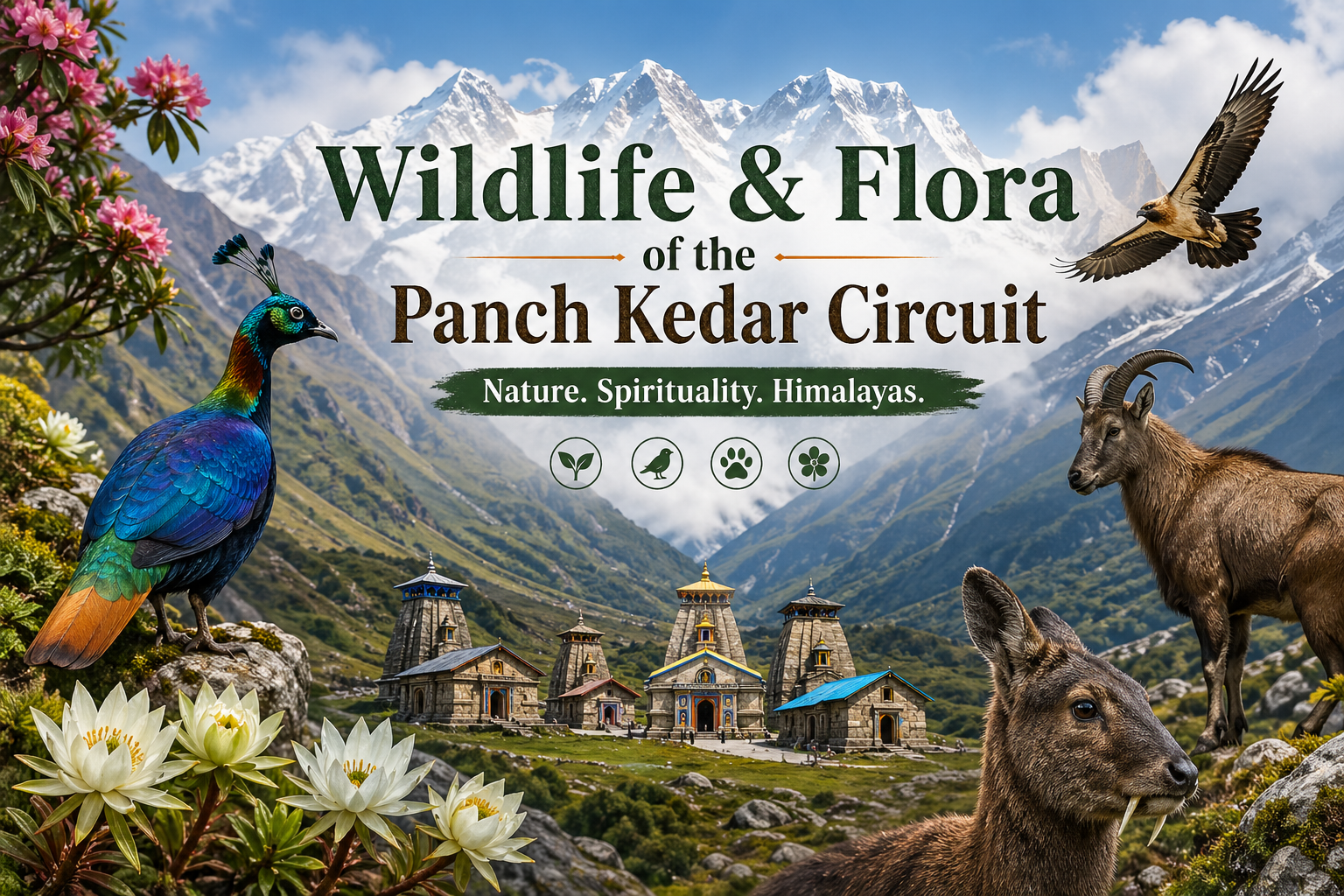
The Panch Kedar Circuit is revered as one of the most spiritually charged pilgrimage routes in the Garhwal Himalayas. Yet beyond its ancient shrines and stone-paved trails lies a natural world of staggering richness — one that most trekkers walk right through without ever fully registering. The Wildlife & Flora of the Panch Kedar Circuit is not a footnote to the pilgrimage experience. For those who know what to look for, it is the experience itself.
Stretching across multiple ecosystem zones — from dense oak-rhododendron forests to open subalpine bugyals and glacier moraines — the circuit passes through terrain that the Kedarnath Wildlife Sanctuary Uttarakhand, has protected since 1972. Covering over 975 square kilometres and spanning elevations from 1,160 metres to beyond 7,000 metres, this sanctuary shelters one of the most intact biodiversity corridors in the entire Western Himalayan arc.
Whether you are a committed birdwatcher, a botanical photographer, or simply a trekker who wants to know what that shape in the meadow actually was, this guide breaks down exactly what you will encounter on each leg of the circuit — which animals, which birds, which flowers, in which seasons, and on which trail sections you are most likely to find them.
The Kedarnath Wildlife Sanctuary: Why It Matters
Most travellers know the Kedarnath name from its famous Shiva temple. Far fewer understand that the surrounding sanctuary is classified under UNESCO’s World Heritage tentative list for natural heritage, and that it forms a critical buffer zone of the Nanda Devi Biosphere Reserve.
The sanctuary’s dramatic altitudinal range — more than 5,800 vertical metres compressed into a relatively compact geographic footprint — creates overlapping climate zones where subtropical, temperate, subalpine, and alpine species coexist within a single protected landscape. This stacking of habitats is the core reason for its extraordinary biodiversity.
Before setting out, it is worth noting that pilgrimage access and wildlife observation share a rhythm. The temples open at specific times each year based on the Hindu calendar, and the best wildlife viewing windows at dawn and dusk often coincide directly with those opening hours. Checking Panch Kedar Darshan Timings before finalising your daily schedule ensures you can align temple visits with the early-morning hours that consistently deliver the finest sightings.
Mammals of the Panch Kedar Circuit
Mammals across the Panch Kedar circuit include Himalayan tahr, musk deer, black bear, and snow leopard, adapted to steep terrains, dense forests, and high-altitude alpine ecosystems with seasonal movement patterns.
Musk Deer — The Ghost of the Meadow
The musk deer Himalaya population within the Kedarnath sanctuary is among the healthiest and most stable remaining in India, protected by both altitude and strict anti-poaching enforcement. This small, tusked deer — entirely deer-like in appearance despite lacking antlers — is crepuscular by habit, moving most actively at first light and dusk.
Your strongest sightings on the Panch Kedar trek guide are concentrated on the Rudranath meadow wildlife section between Mandal village and the Ansuya Devi ridge, and along the upper reaches of the Madhyamaheshwar trail approaching the bugyal. Look for movement at forest edges between 3,000 and 4,000 metres — the musk deer favours dense cover punctuated by open grazing patches.
The male’s musk pod — historically one of the most valuable substances in the global fragrance trade — made this species a prime poaching target for centuries. The Kedarnath sanctuary’s protected status has allowed populations to stabilise, making the circuit one of the few places in India where naturalist sightings of wild musk deer are realistic rather than aspirational.
Himalayan Tahr — Owner of the Ridgeline
If the musk deer haunts forest edges, the Himalayan tahr commands the exposed rocky terrain above the treeline. Large, heavy-bodied, with curved horns and a distinctive mane of reddish-brown fur, tahr move in herds and are highly conspicuous when feeding on the moraines and boulder fields above 4,000 metres.
The Kedarnath glacier zone and the rocky approach to Vasuki Tal are the circuit’s most reliable tahr habitat. When you spot one, slow down — herds typically scatter across a slope, and the first animal you see is usually not the last. Males are considerably larger than females and tend to occupy the most exposed, windswept positions on the skyline.
Snow Leopard — Documented but Elusive
The snow leopard is the Panch Kedar Circuit’s most legendary resident. Camera trap surveys by the Wildlife Institute of India have confirmed resident individuals in the upper sanctuary above Kedarnath and Tungnath. However, sightings are genuinely rare for trekkers visiting during the standard May–October window.
Your most realistic expectation is secondary evidence: pugmarks in snow or wet soil, scratch marks on prominent rocks used for scent-marking, or the disturbed, scattered remains of a tahr killed on a ridgeline. Early-season trekkers in May, when snow lingers at altitude and prey species are still concentrated at lower elevations, report the highest frequency of direct sightings — still rare, but meaningfully more likely than mid-summer.
Red Fox, Common Langur, and Himalayan Black Bear
Two animals you will almost certainly encounter: the red fox and the Himalayan grey langur. Red foxes have developed a confident familiarity with trekking camps, and their bold, curious behaviour around cooking areas makes camp cleanliness essential — keep food secured at all times. Langurs are present throughout the lower forest sections of every trail leg, their silver fur and black faces instantly recognisable in the oak canopy.
The local reverence for langurs on this trail has deep roots. According to stories associated with the Pandava Trail — the ancient path the five Pandava brothers walked while seeking Shiva’s forgiveness after the Kurukshetra war — the monkeys were considered forest guardians, and villagers along the route still maintain this respect today. Himalayan black bear sightings are less predictable but documented across multiple legs; bear awareness is standard trekking protocol in the sanctuary.
Birds of the Panch Kedar Circuit
The Panch Kedar circuit hosts diverse Himalayan birdlife, including monal, snow pigeon, and lammergeier, thriving across forests, meadows, and alpine zones with seasonal migrations and altitude-driven habitat shifts.
The Himalayan Monal Pheasant — Uttarakhand’s Living Jewel
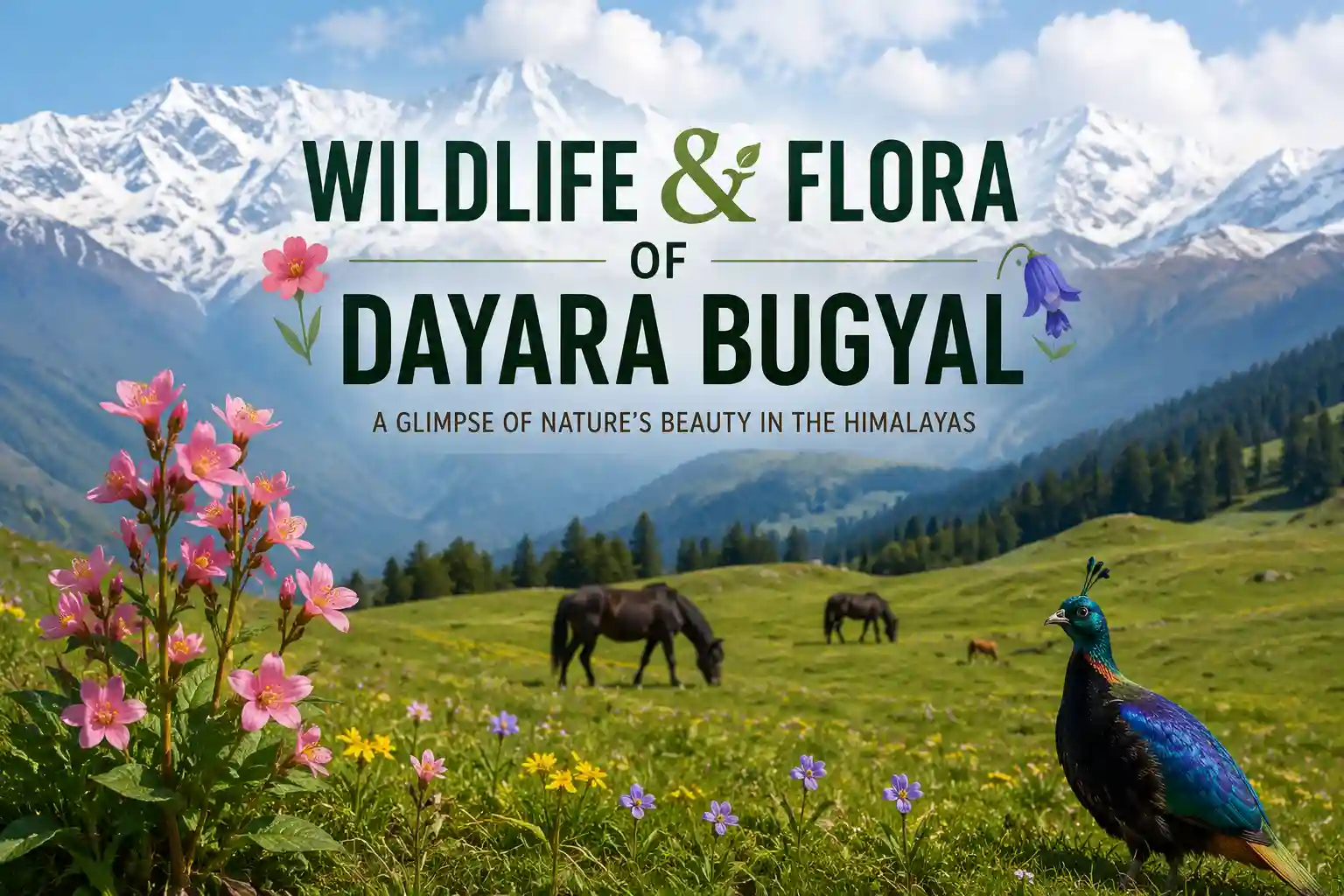
No bird on this circuit — arguably no bird in the entire Himalayan arc — matches the sheer visual drama of the Himalayan monal pheasant. The state bird of Uttarakhand, the monal is an iridescent creature whose plumage shifts between deep cobalt blue, metallic green, copper, and purple depending on the angle of light. Seeing a male monal catch morning sun on an open ridge is an experience that frequently stops trekkers mid-stride.
Chopta birdwatching is the gold standard for monal sightings on the entire circuit. The rhododendron and conifer forests on the approach to Tungnath temple provide ideal habitat, and early-morning walks between Chopta and Chandrashila peak regularly produce reliable encounters. April through early June is peak season, when males display openly on exposed ridges during breeding activity.
Additional Bird Species Worth Watching For
The Garhwal Himalayas flora fauna zone hosts over 180 recorded bird species within the sanctuary boundaries. Key species by trail section:
Chopta and Tungnath approach: Koklass pheasant (dense conifers below 3,500 m), streaked laughingthrush, fire-tailed sunbird feeding on rhododendron blooms, and multiple species of warbler in the undergrowth.
Kedarnath valley and glacier zone: Snow pigeon in large flocks on the moraines, red-billed chough (the conspicuous, noisy corvid found at every temple complex on the circuit), bearded vulture (lammergeier) riding thermals above the valley, and Himalayan snowcock calling from rocky slopes above 4,000 metres — heard far more often than seen.
Lower forest sections (Kalpeshwar, Sari, Mandal): Asian paradise flycatcher (summer visitor, extraordinary tail streamers), Himalayan griffon vulture, and various species of laughingthrush and babbler in the bamboo-rhododendron belt.
For dedicated birders, the 12-kilometre stretch between Chopta and Dugalbitta is the circuit’s single most productive segment, with more than 80 species recorded across multiple seasons.
Flora of the Panch Kedar Circuit — Season by Season
Seasonal flora across the Panch Kedar circuit shifts from spring rhododendrons and alpine blooms to monsoon-rich meadows, autumnal grasses, and sparse, snow-bound winter vegetation above tree line zones.
The Rhododendron Bloom Calendar
Rhododendrons define the visual identity of the Garhwal Himalayas between March and June, and the Panch Kedar Circuit traverses multiple species across a stacked elevation sequence that creates a rolling bloom extending from the valley floor to near treeline.
March to mid-April (below 2,500 m): Rhododendron arboreum, the tree rhododendron, blazes in deep crimson. The forests around Sari village and the Mandal valley approach are genuinely spectacular at this time, with mature trees reaching eight to ten metres in height.
Late April to May (2,500–3,500 m): Pink and white rhododendron varieties dominate the subalpine transition zone. The trail approaching Rudranath through Panar meadow becomes one of the most photographed landscapes in the Garhwal in late April.
May to early June (above 3,500 m): Dwarf rhododendron species carpet the ground at and above the treeline, creating a dense mat of purple-pink across the upper slopes approaching each summit shrine.
The Brahmakamal — Kedarnath’s Sacred and Protected Flower
No botanical feature of this circuit generates more genuine wonder than the Brahmakamal (Saussurea obvallata). Creamy white, translucent-petaled, housed within distinctive papery lavender bracts that function as a natural greenhouse at extreme altitude — the Brahmakamal blooms only at night, between July and September, at elevations above 4,000 metres.
At Kedarnath, it grows naturally around the temple precincts and on the moraines above the settlement. It is a legally protected species under Uttarakhand’s Forest Protection regulations, and collecting or damaging it carries serious penalties. Local vendors near the temple sometimes sell blooms — purchased from licensed sources under strict quotas — but buying from unlicensed sellers is actively discouraged by conservation authorities and forest officials.
Seeing Brahmakamal in bloom near the Kedarnath shrine on a clear night — glowing faintly against dark stone, surrounded by peaks catching starlight — combines natural wonder with cultural depth that no other flower on the circuit replicates.
Trekkers planning the floral peak season around both the Brahmakamal bloom and temple access should note that the shrines open on specific dates each year determined by the Hindu calendar. Cross-referencing the Panch Kedar Darshan Timings for your travel year ensures you arrive during both peak bloom and full temple opening, which fall in the same broad July–September window.
The Pink Saussurea Carpet at Panar Meadow
Between late August and mid-September, Panar meadow on the Rudranath trail undergoes a transformation that few trekking blogs have ever described in detail. Saussurea simpsoniana and related alpine species create what local naturalists call the pink carpet — a dense, low-growing mat of purple-pink flowers across the open bugyal, set against a backdrop of ridgelines and distant snowfields.
This is one of the most visually striking and least documented natural spectacles in the entire Western Himalayan trekking network. Its near-total absence from mainstream trail content is precisely why it rewards those who arrive at the right time.
Additional Flora Worth Identifying
- Aconite (Monkshood): Deep violet, highly toxic, strikingly beautiful — common throughout the subalpine zone from June onwards. Do not touch.
- Himalayan Blue Poppy (Meconopsis): Rare, found in sheltered, rocky aspects above 4,000 metres. One of the most sought-after photographic subjects in Himalayan botany.
- Primula species: Multiple species bloom sequentially from May through July at different elevation bands — a rolling sequence of pink, purple, and yellow along every trail leg.
- Alpine Potentilla: Yellow-flowering, low-growing, abundant across all open bugyals throughout summer.
- Morchella (Morel Mushrooms): Foraged by local villagers in spring beneath the oak and rhododendron forest canopy — an important seasonal forest product in this region.
Best Trail Legs for Wildlife and Nature Sightings — Quick Reference
| Trail Leg | Best For | Optimal Season |
| Chopta → Tungnath & Chandrashila | Himalayan monal, birdwatching, rhododendron forests | April – June |
| Sari → Rudranath (via Panar) | Musk deer, Panar meadows, langurs, monsoon flora | May, August – September |
| Madhyamaheshwar Trail | Himalayan tahr, subalpine flora, musk deer | June – September |
| Kedarnath Glacier Zone & Vasuki Tal | Snow leopard traces, Brahmakamal, snow pigeons, tahr herds | June – September |
| Kalpeshwar Section | Oak forest birdlife, Himalayan butterflies, lichens | May – October |
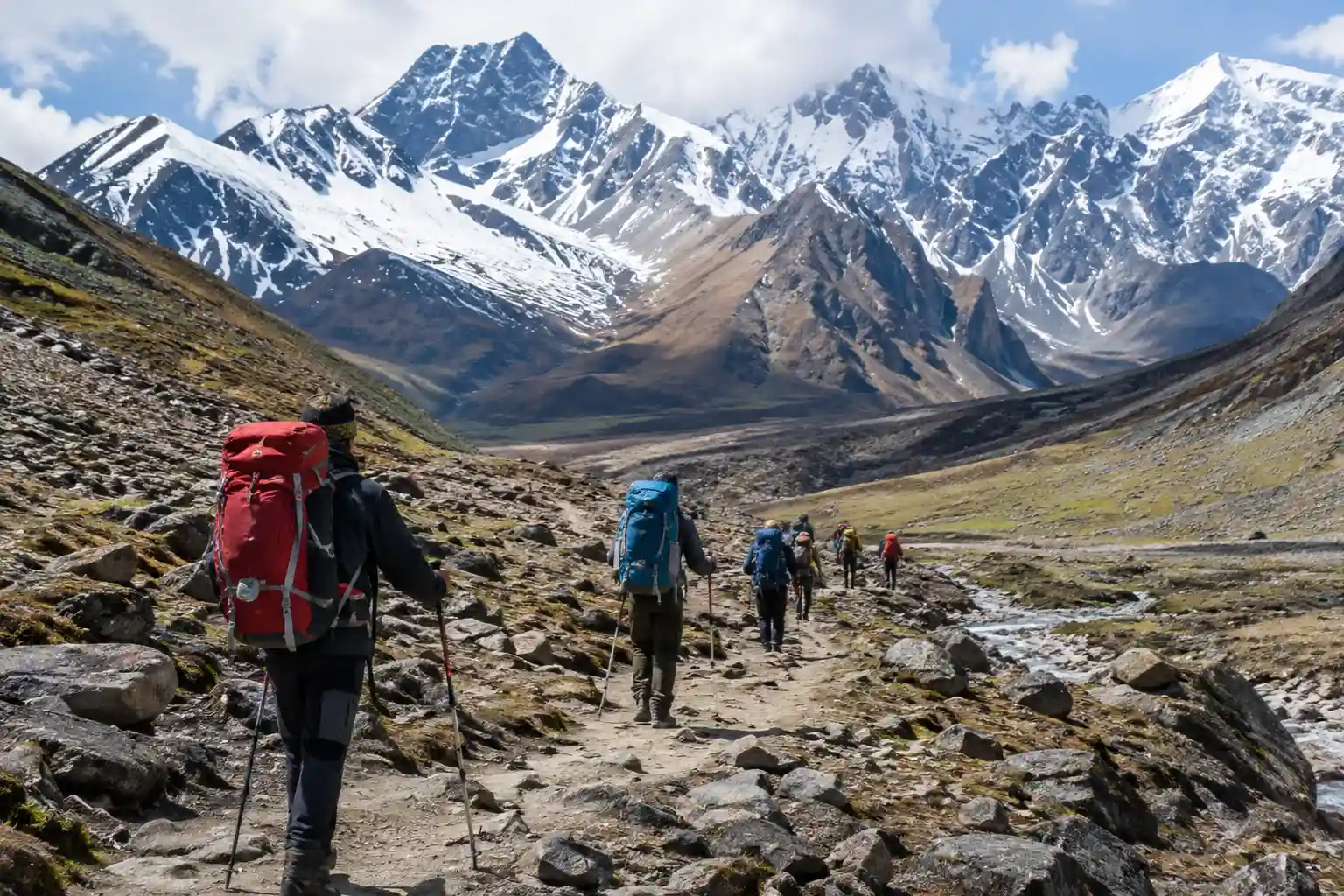
For trekkers wanting the richest combination of wildlife and cultural depth in a single day’s walking, the valley section following the ancient Pandava Trail through the Kedarnath approaches delivers birding on the moraines, Brahmakamal growing wild near the temple precinct, and the atmospheric immensity of the glacier zone at close range — all within one continuous route.
Panch Kedar vs Valley of Flowers — Which is Better for Wildlife?
This is the most common comparative question from naturalist trekkers, and the answer is genuinely nuanced.
Valley of Flowers wins on pure floral spectacle. Between July and September, the UNESCO-listed meadow delivers a concentrated, extraordinary display of alpine wildflowers within a compact area that has no rival in the Western Himalayas. However, the format — a day trek from Ghangaria, with visitor numbers that make it India’s most regulated flower valley — makes mammal sightings almost impossible, and the bird species diversity is considerably lower than the Kedarnath sanctuary.
The best wildlife trek in the Garhwal Himalayas for mammals, birds, and ecological variety is the Panch Kedar Circuit, without a significant contest. The circuit’s multi-day format across multiple ecosystem zones, lower visitor density on most trail legs, and the full suite of large mammals within the Kedarnath sanctuary means that a patient, observant trekker will accumulate a substantially broader and richer set of natural encounters.
The Panch Kedar vs Valley of Flowers wildlife comparison ultimately comes down to intent: if you have four days and want the most dramatic single floral experience, Valley of Flowers is the answer. If you have eight to fourteen days and want the Western Himalayas as a complete ecological and spiritual world, the Panch Kedar Circuit is in a different category entirely.
Practical Tips for Wildlife and Nature Observation on the Circuit
Move at dawn. The most reliable mammal sightings — musk deer, tahr, fox, occasional bear — happen within the first 90 minutes of daylight. Prioritise early starts on legs where wildlife is a stated goal.
Carry quality binoculars. A 10×42 or 8×42 pair is appropriate for this terrain. Birds at distance on high ridges and mammals on exposed slopes are routinely missed without them.
Wear neutral colours. Musk deer are acutely sensitive to colour contrast and movement. Bright jackets significantly reduce your chances of close sightings.
Walk quietly between campsites. The transition hours around camp stops — when other trekkers are focused on logistics — are often the best windows for wildlife encounters.
Request a naturalist guide. The difference between a generalist trekking guide and a specialist who understands the specific habitat preferences of musk deer or the vocalisation patterns of the monal is dramatic. Mountainiax can pair you with naturalist guides on the legs where wildlife observation is a priority.
If you are travelling with younger family members and wondering about the practical wildlife-viewing experience for children, it is worth researching Panch Kedar with Kids — the lower-elevation sections, particularly Kalpeshwar and the Chopta segment, offer engaging and age-appropriate wildlife encounters, including monal pheasant sightings, langurs, and vibrant rhododendron forest walks that younger trekkers find genuinely memorable.
FAQs — Wildlife and Flora of the Panch Kedar Circuit
1. What animals live in the Kedarnath Wildlife Sanctuary?
The Kedarnath wildlife sanctuary animals and birds list includes Himalayan tahr, musk deer, snow leopard, bharal (Himalayan blue sheep), serow, Himalayan black bear, red fox, and common langur among the primary mammal species. The bird list exceeds 180 species, including the Himalayan monal pheasant, lammergeier, snowcock, red-billed chough, snow pigeon, koklass pheasant, and numerous species of laughingthrush and sunbird.
2. When is the best time to see wildlife on the Panch Kedar Circuit?
For mammals, pre-dawn walks in May to June and September to October deliver the strongest sightings. June to September is the peak window for alpine flora, including Brahmakamal and the Panar meadow display. For Chopta birdwatching, April through early June is optimal, with monal pheasants most visible during the April–May breeding season.
3. Is Brahmakamal protected by law in Uttarakhand?
Yes. Brahmakamal is listed under Uttarakhand’s Forest Protection regulations as a protected species. Collecting, picking, or transporting it without authorisation is a punishable offence. Visitors may photograph and observe it freely, but must not disturb or remove it.
4. Can you actually see snow leopards on the Panch Kedar trek?
Snow leopard sightings are rare but documented within the Kedarnath Wildlife Sanctuary. Camera trap evidence confirms resident populations in the upper sanctuary zone. Realistic expectations for most trekkers should centre on secondary signs — pugmarks, scent markings, cached prey — rather than direct sightings. Early-season visits in May carry the highest probability of any encounter.
5. Is Chopta genuinely good for birdwatching, or is it overhyped?
Chopta is legitimately one of the finest birdwatching destinations in Uttarakhand, not a marketing claim. The combination of rhododendron forest and conifer belt at approximately 2,700 metres creates an ideal habitat for monal, koklass, laughingthrush, sunbirds, and raptors. Early morning walks on the Tungnath trail from March through June consistently produce strong species counts for visiting birders.
Summary
The Wildlife & Flora of the Panch Kedar Circuit represents one of the most underexplored and genuinely exceptional natural experiences available on any Himalayan trekking route in India. From the iridescent Himalayan monal pheasant calling from the rhododendron forest above Tungnath, to the ghostly musk deer crossing a meadow at Rudranath in the first grey light, from the legally protected Brahmakamal blooming in the shadow of an ancient temple, to the pink Saussurea carpet transforming Panar bugyal into something from another time — this circuit is not simply a pilgrimage route with some incidental scenery. It is a complete, living ecological archive of the Western Himalayas.
Plan your visit with the seasons in mind. Move slowly. Keep your binoculars close. The panch kedar wildlife that waits along this trail rewards observation over speed, and patience over itinerary.
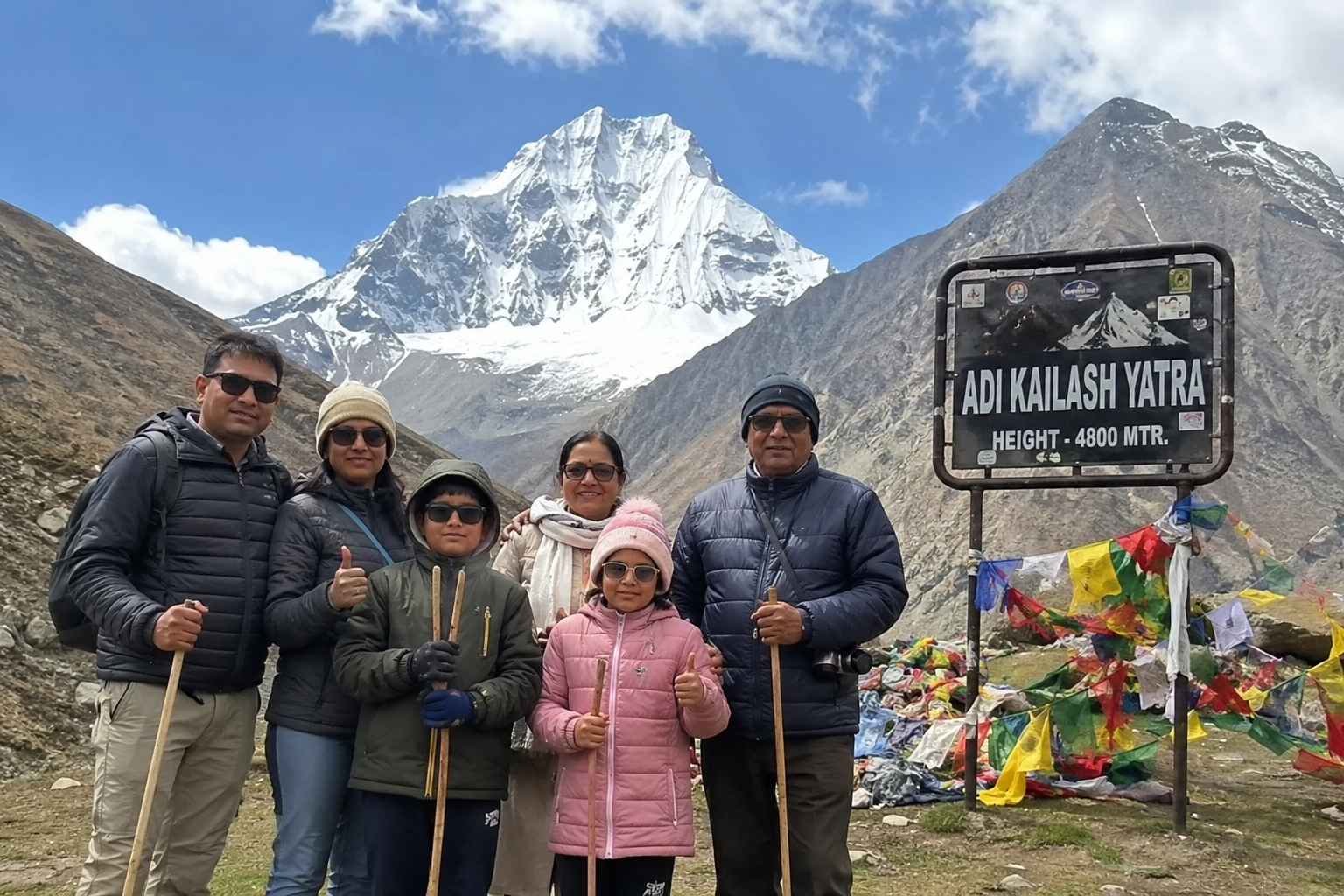
For families planning multigenerational adventures on this route, reviewing detailed guidance on Panch Kedar with Kids will help you identify which trail legs balance wildlife richness with appropriate terrain for mixed-age groups — because this is one circuit where the natural world is as much a reason to come as the temples themselves.
With the Panch Kedar Yatra season approaching, it’s time to plan something truly extraordinary. From breathtaking Himalayan peaks to spiritually powerful temples hidden deep in remote valleys, this journey offers an experience that goes beyond a typical trek—it becomes a story you carry for life. To make your journey seamless and well-organised, choose the best trekking company in Uttarakhand for reliable trek packages, detailed itineraries, and hassle-free booking.
Visit this page for Trek Packages, Itinerary & Booking.