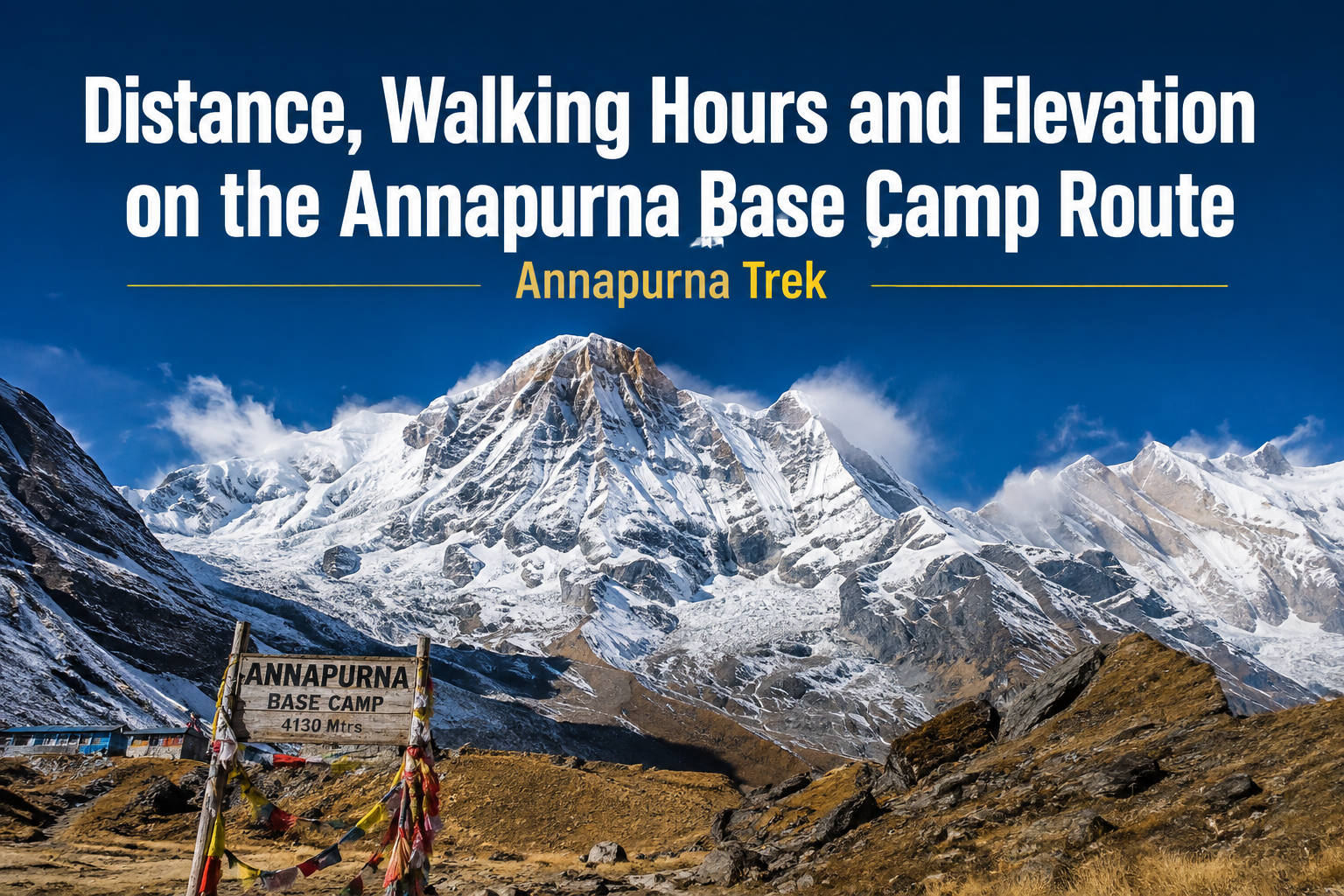
Every trekker planning the Annapurna Base Camp trek eventually asks the same three questions: how far will I actually walk, how many hours a day will I be on the trail, and how high does the route climb? These aren’t small details — they decide how you train, what you pack, and whether the trip feels like a holiday or a battle. Distance, Walking Hours and Elevation on the Annapurna Base Camp Route are the three numbers that shape every single day of this journey, and getting a clear picture of them before you book matters more than almost anything else.
Most blogs throw out a single figure — “70 km” or “moderate difficulty” — and leave it at that. But the ABC trek isn’t a flat 70 km stroll. It’s a rolling, stair-heavy, forest-to-glacier route where a 9 km day can take longer than a 14 km day, simply because of what’s underfoot. Understanding the day-by-day breakdown changes how you prepare.
This guide breaks the entire route down stage by stage, using the standard 9-day itinerary followed on the Annapurna Base Camp trek from Pokhara, so you know exactly what each day demands before you lace up.
How Far Is the Annapurna Base Camp Trek, Really?
The standard Annapurna Base Camp trek distance on the classic 9-day route from Pokhara runs to approximately 70 km round trip, covering the walk from Nayapul through Ghorepani, Poon Hill, Chhomrong and the Annapurna Sanctuary to Base Camp and back down to Jhinu Danda. This figure varies depending on the itinerary — routes that skip Poon Hill, or that start from a closer roadhead like Ghandruk or Kimche, can be shorter, while routes that add extra acclimatisation loops can stretch beyond 90 km.
The takeaway: there is no single “correct” number floating around online, because the ABC trek distance depends entirely on the itinerary structure. What matters more for planning purposes is the daily distance, which typically ranges between 7 and 16 km depending on the terrain and the day’s altitude gain.
Annapurna Base Camp Trek Elevation: Where You Start and Where You End
The trek begins in Pokhara at roughly 820 m and climbs to Annapurna Base Camp at 4,130 m (13,550 ft), set inside the Annapurna Sanctuary and ringed by Annapurna I (8,091 m), Machapuchare and Hiunchuli. That’s a net gain of over 3,300 metres, but it isn’t a steady climb — the route repeatedly drops into river valleys and climbs back out, which is part of why the Annapurna Base Camp trek elevation profile feels tougher than the net altitude gain suggests.
For context on how this compares to other Himalayan classics, our Annapurna Base Camp vs Everest Base Camp breakdown is worth reading — ABC tops out nearly 1,200 metres lower than EBC, which is one reason it suits first-time high-altitude trekkers better.
Day-by-Day Distance, Walking Hours and Elevation
Here is how the standard 9-day itinerary breaks down, stage by stage:
Day 1 — Arrival in Pokhara. No trekking. Pre-trek briefing and gear check. Overnight in Pokhara (820 m).
Day 2 — Pokhara to Tikhedhunga. A short drive to Nayapul (roughly 1.5 hours), followed by a gentle trek of around 7 km along the Modi Khola river. Walking time: 4 to 5 hours. Altitude gain from Nayapul (1,070 m) to Tikhedhunga (1,570 m).
Day 3 — Tikhedhunga to Ghorepani. The toughest single day on paper. This is the famous Ulleri staircase — over 3,000 stone steps in one climb — followed by forest trail up to Ghorepani. Distance: around 10 km. Walking time: 6 to 7 hours. Altitude reached: 2,860 m.
Day 4 — Ghorepani to Tadapani via Poon Hill. An early pre-dawn climb to Poon Hill (3,210 m) for sunrise over Dhaulagiri and Annapurna, then back to Ghorepani for breakfast before continuing to Tadapani. Combined walking time: 6 to 7 hours across roughly 10 km.
Day 5 — Tadapani to Bamboo via Chhomrong. The trail descends through forest to Chhomrong, then drops again toward Bamboo, deep inside the valley. Distance: approximately 11 km. Walking time: 6 to 7 hours. Altitude at Bamboo: 2,310 m — lower than the previous overnight stop, which is normal on this route.
Day 6 — Bamboo to Deurali. Through Dovan and Himalaya, the forest thins as the trail enters alpine terrain. Distance: around 9 km. Walking time: 5 to 6 hours. Altitude: 3,230 m — this is where the air noticeably thins.
Day 7 — Deurali to Annapurna Base Camp via MBC. The high point of the trek. Via Machhapuchhre Base Camp (around 3,700 m), the trail opens into the Sanctuary and climbs to ABC at 4,130 m. Distance: roughly 8 km. Walking time: 6 to 7 hours.
Day 8 — ABC to Jhinu Danda. A long descent day, retracing the route through MBC, Deurali and Bamboo before continuing to Jhinu Danda for the hot springs. Distance: the longest of the trek, often 15 km or more. Walking time: 7 to 8 hours.
Day 9 — Jhinu Danda to Pokhara. A final trek of around 4 hours down to the roadhead, followed by a 2-hour drive back to Pokhara.
Why Walking Hours Matter More Than Distance Alone
A day covering 8 km can take longer than a day covering 15 km, and this confuses first-time trekkers more than anything else on the route. The reason is elevation and terrain, not distance. Day 3, at just 10 km, takes 6 to 7 hours because of the Ulleri stone staircase. Day 8, nearly double the distance, is mostly gentle downhill on a well-worn trail.
This is exactly why the Annapurna Base Camp trek itinerary you choose matters more than the total kilometre count printed on a website. A well-paced 9-day plan spreads the walking hours sensibly across the week — typically 5 to 8 hours a day — rather than front-loading brutal days that leave no reserve for the final push to Base Camp.
Elevation Gain and the AMS Risk Zone
Altitude sickness becomes a genuine consideration once you cross roughly 3,000 metres, which happens on Day 6 of the standard itinerary. From Deurali onward, every trekker — regardless of fitness level — should walk at a measured pace, stay well hydrated, and watch for early symptoms like headache or disturbed sleep. Our full altitude sickness guide covers prevention, symptom recognition and what to do if symptoms appear on the trail.
The gradual gain profile built into the standard itinerary — climbing roughly 300 to 500 metres in sleeping altitude per day above 3,000 m — exists specifically to reduce this risk. Rushing a shorter itinerary to save a day or two significantly raises the chance of altitude-related problems, particularly on the final approach into the Sanctuary.
How Distance and Elevation Shape the Trek’s Difficulty
Combine the daily distances, the walking hours and the elevation gain, and you get a trek that is officially rated moderate — demanding, but achievable for reasonably fit beginners with proper preparation. The Annapurna Base Camp trek difficulty comes less from any single day and more from the cumulative effect of seven consecutive trekking days at altitude, with only limited flat sections.
Indian trekkers planning their trip should also budget travel days on either end; our guide to the Annapurna Base Camp trek from India covers how to fit the full 9-day route, plus travel time, into a realistic leave window.
Tips to Manage Daily Distance and Walking Hours
- Break in your trekking shoes well before departure — blisters on Day 2 will affect every day after.
- Train for stair climbing specifically, not just flat walking, given the Ulleri staircase on Day 3.
- Pace yourself deliberately above 3,000 m; speed doesn’t earn you anything on this trek, and rushing raises AMS risk.
- Use trekking poles on the long Day 8 descent — downhill strain on the knees is often underestimated.
- Check the best time to trek Annapurna Base Camp before booking — trail conditions in monsoon months add significantly to walking time on muddy, slippery sections.
Frequently Asked Questions
What is the total distance of the Annapurna Base Camp trek?
The standard 9-day itinerary from Pokhara covers approximately 70 km round trip, though this varies by 20 to 25 km depending on the starting point and whether Poon Hill is included.
How many hours do you walk each day on the ABC trek?
Most days involve 4 to 8 hours of walking, with the longest days (Day 3 and Day 8) requiring 6 to 8 hours due to steep terrain or extended descent.
What is the highest point on the Annapurna Base Camp trek?
Annapurna Base Camp itself, at 4,130 m (13,550 ft), inside the Annapurna Sanctuary.
Which day has the steepest elevation gain?
Day 3, from Tikhedhunga to Ghorepani via the Ulleri staircase, is widely considered the toughest single day due to the concentrated altitude gain over stone steps.
Is the daily walking distance the same as the trek’s difficulty?
No. Difficulty depends more on elevation gain, terrain, and altitude than raw kilometres — a shorter, steeper day can be harder than a longer, gentler one.
Do I need prior trekking experience to handle these distances?
No prior high-altitude experience is required, but 4 to 6 weeks of cardio and stair-climbing preparation is strongly recommended given the daily walking hours involved.
Conclusion
Distance, walking hours and elevation aren’t just numbers to skim past — they’re what decide how your ABC trek actually feels, day to day. A 70 km route sounds manageable on paper, but knowing that Day 3 hides 3,000 stone steps, or that Day 8 stretches past 7 hours of descent, is what lets you train right, pack right, and pace yourself when it counts. Go in with this breakdown in hand, and the Annapurna Sanctuary will feel like a reward, not a shock.
If you’re ready to experience this route for yourself, explore the complete Annapurna Base Camp trek package, day-by-day itinerary and current pricing. Get in touch with Mountainiax for a free trek consultation and a detailed itinerary built around your fitness level and travel dates.