Few places in the Indian Himalayas announce the arrival of summer the way Dayara Bugyal does. As the snow recedes from this vast alpine meadow above Barsu village in the Uttarkashi district, something quietly extraordinary begins. The grassland, frozen and white for five months, starts to breathe again — and within weeks it transforms into one of the most vivid wildflower landscapes anywhere in Uttarakhand. For trekkers timing their Himalayan journey to catch this exact window, the reward is immeasurable.
Most people arrive knowing that Dayara Bugyal is beautiful. Fewer know that May and June represent a very specific kind of beauty — one that is entirely different from its monsoon green or its winter white. This is the season of emergence: lingering snow patches alongside open meadow, the first wildflowers pushing through frost-softened soil, and skies so clear that Bandarpunch and Draupadi Ka Danda II appear close enough to touch. The trail through Barsu village is alive with birdsong and the smell of pine.
This guide is built for trekkers planning their visit during this pre-monsoon window. We cover everything about Dayara Bugyal in May & June — the wildflowers, the weather pattern, trail conditions, packing tips, and honest insights from those who have walked this meadow when it was still waking up from winter.
Why Dayara Bugyal Is One of Uttarakhand’s Most Rewarding Treks
At 3,660 metres above sea level, Dayara Bugyal is one of the highest and most expansive alpine meadows in the Garhwal Himalayas. Stretching across roughly 28 square kilometres, it belongs to a category of Himalayan landscapes that are genuinely rare — wide open, unobstructed, and ringed by snow-capped peaks that reveal themselves fully only above the treeline.
The Dayara Bugyal trek begins in Barsu village, which is reachable from Barkot or Uttarkashi. The trail rises steadily through dense forest — oak, rhododendron, and pine — before opening without warning onto the meadow. That moment of emergence from the forest into the open sky, with the Gangotri group of peaks ahead and nothing but rolling grassland beneath your feet, is one of the defining experiences of Garhwal Himalayas trekking.
What makes Dayara stand apart from other Uttarakhand bugyal treks is the combination of accessibility and scale. You do not need a week of acclimatisation or previous high-altitude experience. The maximum altitude is manageable, the trail is well-defined, and the camp at the bugyal itself sits in a position that allows panoramic views in every direction. It is genuinely one of the most democratically beautiful treks in all of northern India.
Understanding the Best Time for the Dayara Bugyal Trek is critical to experiencing it at its most spectacular. May and June sit in a sweet spot that most trekkers underestimate — neither the full crowds of the post-monsoon autumn season nor the ice-locked trails of deep winter. This pre-monsoon window offers conditions that are often ideal for meadow trekking: cool, crisp mornings, moderate daytime temperatures, high visibility, and the extraordinary bonus of wildflowers in full bloom.
Dayara Bugyal in May: The Meadow Wakes Up
May at Dayara Bugyal is a season of transition, and that transition is precisely what makes it so compelling to witness.
In early May, the upper sections of the meadow — particularly around the Bakaria Top ridge at 3,790 metres — still carry substantial snow cover from the winter. Patches of old snow, sometimes knee-deep in shaded gullies, sit alongside sections where the grass has fully emerged, and the first wildflowers are already in bloom. This contrast — frozen white next to vivid green and purple — is unique to the May window and simply does not exist at any other time of year.
What to expect on the trail in May:
- The Barsu to Dayara Bugyal trail is snow-free in the lower forested sections from early May onwards
- The upper meadow may have intermittent snow patches that require careful footing, especially on north-facing slopes
- Temperatures at the meadow camp range from approximately 5 to 15 degrees Celsius during the day
- Night temperatures drop sharply, often reaching 0 to minus 3 degrees Celsius — a proper sleeping bag rated to minus 5 is essential
- Sunrise and sunset visibility is exceptional in May; long, clear evenings with sharp mountain silhouettes are the norm
- Crowds are significantly lower than in October, giving the meadow an almost private quality
The dayara bugyal wildflowers in May begin with the bold ones: purple and blue primulas emerge first, followed by wild iris in shades from deep violet to pale lavender. Anemones dot the south-facing slopes. The rhododendron trees at the forest edge — having bloomed at lower altitudes in March and April — are still flowering in the higher sections as late as the first week of May, adding layers of deep red and pink to the forest approach.
For trekkers who have visited Dayara in autumn, May reveals an entirely different personality — quieter, wilder, and in many ways more honest about what a Himalayan meadow actually feels like when human activity is minimal.
Dayara Bugyal in June: The Wildflower Peak
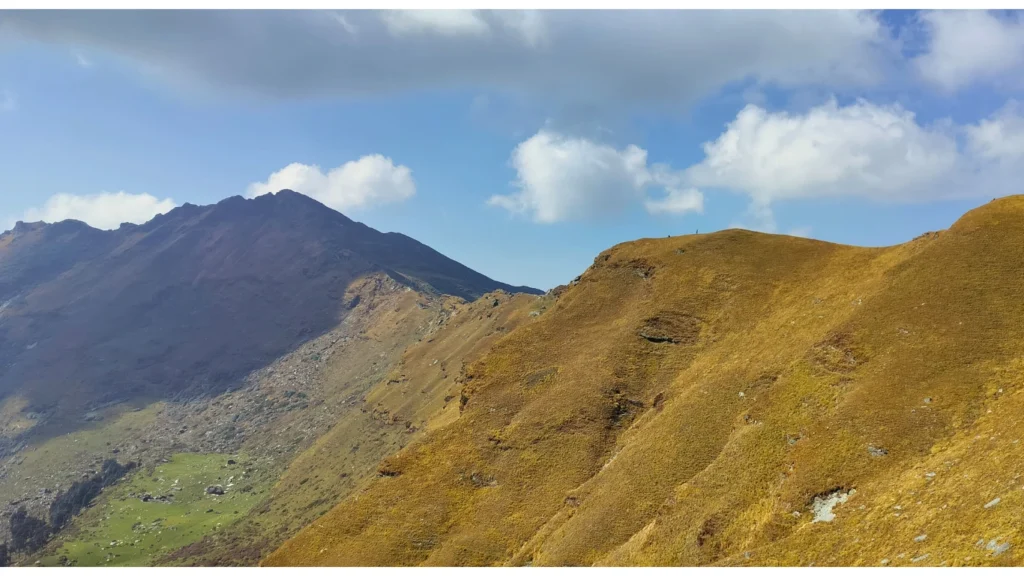
If May is the meadow awakening, June is its full expression. By early June, the snow at Bakaria Top has retreated significantly, and the entire extent of Dayara Bugyal is accessible on foot. The grassland has shifted from winter-yellow to a vivid, uniform green, and the wildflower bloom reaches its seasonal peak.
The diversity and density of flowers in June is striking even for experienced Himalayan trekkers. Across the meadow, you will find:
- Brahma Kamal (Saussurea obvallata) — Uttarakhand’s state flower, beginning to appear on rocky outcrops and ridges in late June. Sacred in Hindu tradition and one of the most sought-after sights on any Garhwal Himalayas trekking itinerary.
- Wild geraniums in pink and mauve, spreading in dense clusters across the open meadow
- Marsh marigolds (Caltha palustris) in brilliant yellow, clustering wherever snowmelt has created temporary streams
- Bistort and potentilla cover entire hillside sections in waves of white and yellow
- Blue poppies (Meconopsis) appearing in sheltered, rocky areas — one of the most prized sightings for any botanical trekker
- Dactylorhiza hatagirea — a wild orchid species found in alpine meadows, now protected under Indian law
June mornings at Dayara begin cold but warm rapidly as the sun clears the eastern ridgeline. Days are long — 14 to 15 hours of usable daylight — and the meadow receives full sunlight from mid-morning through late afternoon. The photographic quality of light in early June, with a combination of low-angle morning sun, clear skies, and intensely coloured flowers, makes this one of the most productive months for landscape photography at any Uttarakhand alpine meadow.
One important note about June: the monsoon arrives in Uttarakhand typically by the last week of June or the very first days of July. The final two weeks of June, therefore, carry a slightly higher risk of afternoon cloudiness and isolated rain showers. These do not usually affect the overall experience but do require attention to afternoon weather patterns on summit days.
For those building a broader Himalayan trekking list, comparing Dayara’s May–June experience with other high-altitude meadow treks is worthwhile. A review of the Top 10 Treks In Uttarakhand helps contextualise Dayara within the full spectrum of options available in the state — from the more technically demanding routes in the Kumaon to the beginner-friendly circuits of the lower Garhwal valleys.
Weather Patterns at Dayara Bugyal: May and June Breakdown
Understanding the micro-weather patterns at Dayara is crucial for planning a safe and enjoyable visit. The bugyal sits above 3,500 metres and is fully exposed on all sides above the treeline, which means weather changes can be rapid.
May Weather Summary
- Morning temperatures: 2 to 8 degrees Celsius at the meadow camp
- Afternoon temperatures: 10 to 16 degrees Celsius on sunny days
- Night temperatures: minus 3 to 2 degrees Celsius
- Precipitation: Very low. May is typically the driest month for this region.
- Wind: Moderate to strong on ridge sections, particularly around Bakaria Top
- Cloud pattern: Clear mornings with occasional afternoon cumulus buildup. Rarely results in rain in May.
- Visibility: Exceptional. Mountain views are often sharper in May than any other month.
June Weather Summary
- Morning temperatures: 5 to 12 degrees Celsius at the meadow camp
- Afternoon temperatures: 14 to 20 degrees Celsius in the lower forest sections
- Night temperatures: 1 to 6 degrees Celsius
- Precipitation: Increasing toward the end of the month as the monsoon approaches
- Wind: Generally lighter than May, with warmer daytime airflow
- Cloud pattern: Clear mornings with more reliable afternoon cloud development from mid-June onward. Isolated afternoon showers possible in the final week.
- Visibility: Excellent in the first three weeks; patchy in the final week as monsoon systems begin to influence the region
Trail Overview: Route, Duration, and Key Stops
The standard Dayara Bugyal trek route runs as follows:
Base: Barsu Village (2,745 m) — reachable from Barkot (34 km, approx 1.5 hr drive) or from Uttarkashi (approx 3 hr drive via Barkot)
Day 1: Barsu Village to Dayara Bugyal Camp (3,660 m) — approximately 5 km, 4–5 hours of trekking through dense mixed forest. The trail gains approximately 900 metres in altitude across a well-marked but moderately steep path. The forest section is heavily shaded and the trail passes through rhododendron groves that are spectacularly pink in early May.
Day 2: Dayara Bugyal exploration and ascent to Bakaria Top (3,790 m) — 3–4 hours round trip from camp. Bakaria Top offers the most complete panoramic views of the circuit, with Bandarpunch (6,316 m), Draupadi Ka Danda II (5,670 m), Black Peak (6,387 m), and the Gangotri group all visible on clear days.
Day 3: Descent from Dayara Bugyal to Barsu Village — 4–5 hours. The return trail is the same as the ascent. Many trekkers complete the descent before noon to allow comfortable road travel back to Uttarkashi or Dehradun.
Total trekking distance: Approximately 12–14 km return. Maximum altitude: 3,790 m at Bakaria Top. Total duration: 3 days / 2 nights minimum (4 days / 3 nights recommended for full exploration)
An extended variant continues from Bakaria Top toward Raithal village on the opposite side of the ridge, creating a point-to-point option for trekkers who prefer not to retrace the same trail.
The Dayara Bugyal Trek is Best as a Family Trek for groups that include teenagers, older adults, or anyone new to mountain walking. The altitude gain per day is gradual, the trail is well-defined, the camp sits on flat open ground, and emergency vehicle access via Barsu village is available if required. There is no technical section, no scrambling, and no river crossing — making it genuinely accessible in a way that many celebrated Uttarakhand treks are not.
What to Pack for Dayara Bugyal in May and June
Packing correctly for a May or June visit is where many first-time trekkers make preventable mistakes. The variable temperature swing between day and night — sometimes spanning 15 to 18 degrees — requires a layering approach rather than single heavy garments.
Clothing Essentials
- Moisture-wicking base layer (merino wool or synthetic, not cotton)
- Insulating mid-layer: a down or synthetic puffer jacket rated to at least minus 5 degrees for camp evenings
- Wind and waterproof outer shell — essential even in May for unexpected afternoon gusts at Bakaria Top
- Trekking trousers with a convertible option (zip-off legs) for temperature management
- Warm hat, buff/balaclava, and gloves — non-negotiable at night camp regardless of the month
- Gaiters for May visits, where snow patches may still be present on the upper sections
Footwear and Accessories
- Ankle-height waterproof trekking boots with good grip — trail runners are not recommended for the snow sections in May
- Trekking poles: highly recommended, especially on descent, where loose soil over rock can be slippery
- Sunglasses with UV400 or higher protection — at 3,660 metres, UV exposure is significantly higher than at sea level
- Sunscreen SPF 50+ and lip balm with SPF
Camping and Safety
- Sleeping bag rated to a minimum of -5 degrees Celsius
- Headlamp with spare batteries
- Water purification tablets or a filter (natural water sources are available on the trail but should be treated)
- Basic first aid kit, including altitude sickness medication (consult a doctor before departure)
- Portable power bank for device charging — there are no charging points at the meadow camp
Essential Tips for Trekking Dayara Bugyal in May and June
Start early every day. The trail from Barsu begins ideally by 7 AM to ensure you reach the meadow camp well before afternoon. Both months offer beautiful morning light and the cloud development that sometimes builds in afternoons is less concerning if you are already settled at camp.
Acclimatise in Uttarkashi or Barkot before ascending. Spending one night at the base town before beginning the trek significantly reduces the risk of altitude-related discomfort at the meadow camp.
Carry adequate cash. Barsu village has limited ATM access. Stock up in Uttarkashi before departing for the trailhead.
Hire a local guide from Barsu village. Not because the trail is technically difficult, but because local guides carry weather intelligence, know the snow conditions on the upper meadow in real time, and contribute meaningfully to the village economy that sustains the trail infrastructure.
Respect the meadow. Dayara Bugyal sits within a protected forest zone. Avoid picking wildflowers, stay on established trails to prevent soil erosion, carry all waste back to Barsu, and use biodegradable toiletries at camp.
Register at the forest check post. The Uttarakhand Forest Department requires trekkers to register before entering the bugyal zone. This is a straightforward process at the Barsu gate and should not be skipped.
Book accommodation in Barsu village in advance for May and June visits. While Dayara does not draw the crowds of some Uttarakhand treks, the small cluster of homestays and guesthouses in Barsu can fill quickly during long weekends and school holiday windows.
Frequently Asked Questions: Dayara Bugyal in May and June
1. Is Dayara Bugyal open in May?
Yes. The Dayara Bugyal trek is fully accessible from early May. The lower forest trail from Barsu is clear of snow by the first week of May. The upper meadow and Bakaria Top ridge may carry residual snow patches through mid-May, particularly in shaded north-facing sections.
2. Are wildflowers in bloom in May at Dayara Bugyal?
Yes. Primulas, wild iris, anemones, and early rhododendrons are typically in bloom across the meadow from early May. The bloom intensifies and diversifies through June, peaking in the first three weeks of June before the monsoon arrives.
3. What is the temperature at Dayara Bugyal in June?
Daytime temperatures at the meadow camp (3,660 m) typically range from 12 to 18 degrees Celsius in June. Night temperatures drop to 2 to 6 degrees Celsius. At Bakaria Top, expect temperatures 3 to 5 degrees lower than at the main camp.
4. Is Dayara Bugyal suitable for beginners?
Yes. The Dayara Bugyal trek is widely regarded as one of the most beginner-friendly high-altitude meadow treks in Uttarakhand. The altitude gain per day is gradual, the trail is clearly marked, and no technical skills are required. It is particularly well-suited to families, senior trekkers, and those attempting their first Himalayan meadow experience.
5. How do I reach Barsu village for the Dayara Bugyal trek?
Barsu village is accessible from Uttarkashi (approximately 3 hours by road) or from Dehradun via Barkot (approximately 6–7 hours). The nearest railhead is Dehradun; the nearest airport is Jolly Grant Airport, Dehradun. Shared jeeps from Barkot to Barsu are the most common local transport option.
Summary
Dayara Bugyal in May & June represents one of the most accessible and visually extraordinary trekking windows anywhere in the Uttarakhand Himalayas. The combination of late-season snow on the upper ridgeline, an extraordinary wildflower bloom across the open meadow, sharp mountain views from Bakaria Top, and comfortably cool temperatures makes this a season that rewards careful planning. Whether you are a first-time Himalayan trekker looking for a gentle but genuinely high-altitude experience, or a seasoned walker chasing wildflower landscapes, Dayara Bugyal in late spring and early summer delivers with consistency and beauty that few other Indian mountain destinations can match. Pack right, start early, hire a local guide, and let the meadow do the rest.
With the dayara bugyal trek season approaching, it’s time to plan something truly extraordinary. From breathtaking Himalayan peaks to spiritually powerful temples hidden deep in remote valleys, this journey offers an experience that goes beyond a typical trek—it becomes a story you carry for life. To make your journey seamless and well-organised, choose the best trekking company in Uttarakhand for reliable trek packages, detailed itineraries, and hassle-free booking.
Visit this page for Trek Packages, Itinerary & Booking.