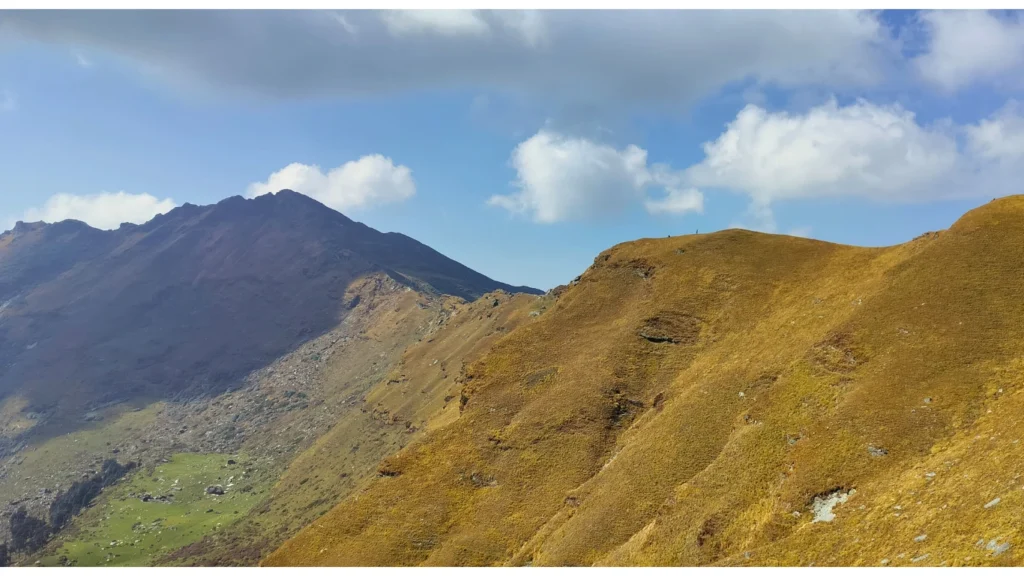

There is something about Dayara Bugyal that stays with people long after they return home. Not just the views, though those are extraordinary. It is the feeling of standing on a 3,408-metre meadow with the Bandarpunch peaks filling the sky in front of you, with no city noise, no deadline, and no ceiling. Trekkers come back from this trail describing it the way people describe places that quietly change them. The meadow does not announce itself dramatically. It earns its place in your memory through cumulative moments — the rhododendron tunnel on day one, the first glimmer of Barnala Tal through the trees, the exact second the forest canopy breaks and the grassland opens up.
What makes reading about this trail valuable is that the people who have walked it come from genuinely different walks of life. First-timers nervous about altitude. Solo women who had never camped above 2,000 metres. Retired couples who had been putting the trek off for a decade. College groups for whom it was the first time away from a city without parental oversight. Each of them experienced the same meadow differently, and each of them came back with something specific to say about it.
This collection of Dayara Bugyal Trekker Stories is drawn from first-hand accounts shared with the mountainiax.com community — trekkers who joined guided departures, seasoned independent hikers, and complete beginners. Their stories are honest, occasionally unexpected, and always worth reading before you book your own trip.
“I Did Not Think I Could Do It” — Priya’s First High-Altitude Trek
Priya, a 34-year-old schoolteacher from Pune, had never trekked above 1,800 metres before she signed up for a November departure to Dayara Bugyal. She had been researching the trail for months, reading every forum thread she could find, second-guessing herself at every step.
“I almost cancelled twice. My biggest fear was altitude sickness. I had read so many scary accounts of people being turned around at much lower altitudes than this.”
— Priya, Pune
She describes the forest walk from Raithal on day one as immediately reassuring. The path was clear, the gradient was manageable, and the oak forest was genuinely beautiful. By the time she reached Barnala Tal that evening, the anxiety had completely dissolved.
The second morning was what she calls the turning point. Waking at 5:30 AM for the sunrise push to the meadow, stepping out of her tent to see the stars reflected over Barnala Tal — she describes it as the moment she understood why people do this.
On the meadow itself, she walked in near silence for nearly two hours. Nobody in the group said very much. They were all looking at Bandarpunch.
Her advice to other first-timers: go in October or November, start cardio training at least six weeks before, and bring more warm layers than you think you need for the early morning.
A Retired Couple’s Dream Trek: Suresh and Kavitha’s Story
Suresh, 61, and Kavitha, 58, had been talking about trekking in the Himalayas since their honeymoon in 1989, when they had visited Mussoorie and looked at the peaks from a distance. Three and a half decades later, they finally did it.
“We chose Dayara Bugyal specifically because we were told it was not too demanding but would still give us the real Himalayan experience. Our children thought we were slightly mad. Our doctor said we were fine as long as we were honest about pace.”
— Suresh, Bengaluru
The couple chose to trek at their own pace, letting the younger members of the group move ahead. They stopped wherever they liked, sat by the stream for twenty minutes on day two eating oranges and saying nothing. Kavitha calls it one of the happiest moments of recent years.
Suresh had mild breathlessness on the final approach to the meadow top, which he managed by slowing down and taking deliberate rest breaks. The guide checked on them every thirty minutes without ever making them feel like a burden.
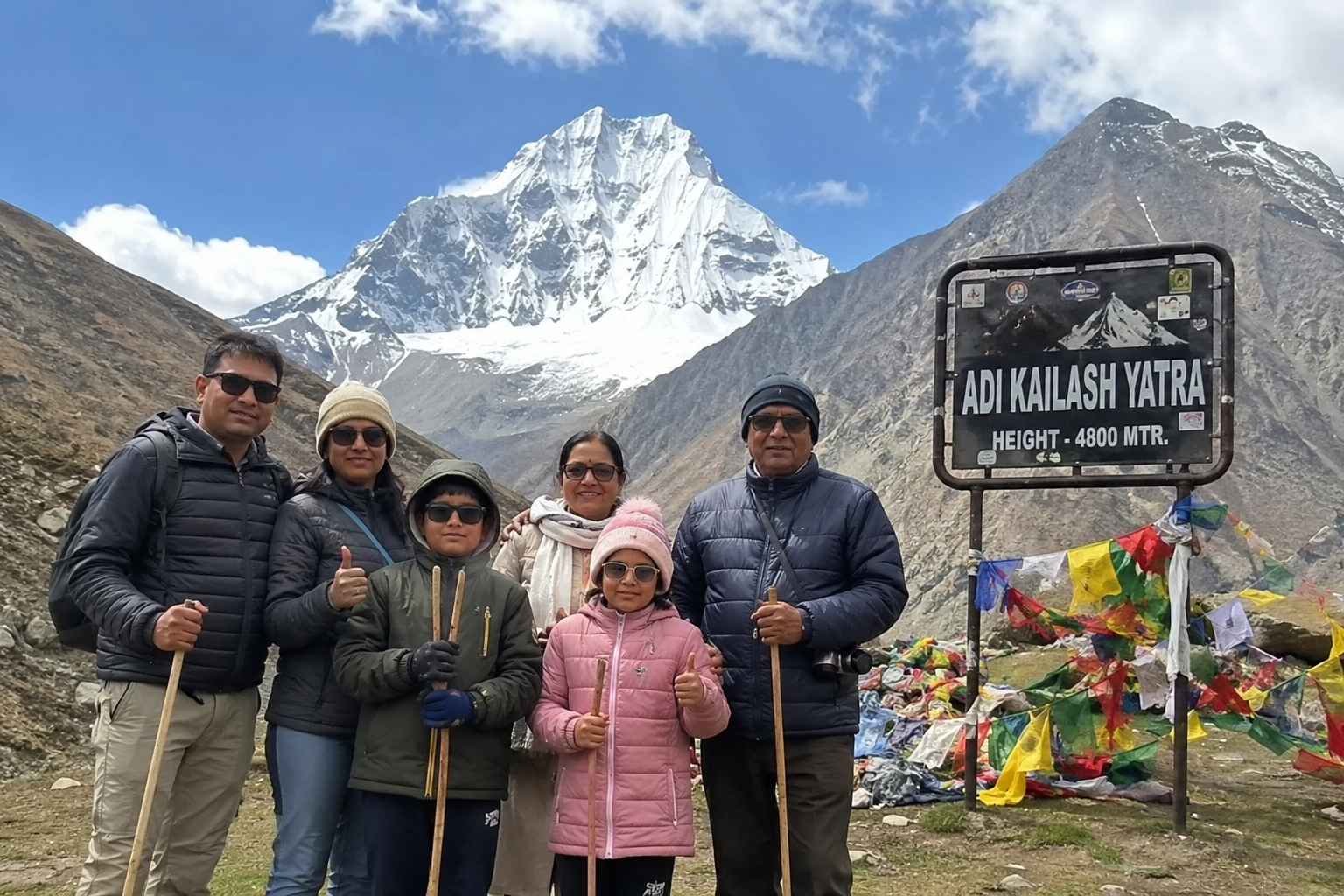
Their verdict is unambiguous: they have already started planning Kedarkantha for next year. Dayara Bugyal opened something in them that they did not know was still there. This kind of story is exactly why the trail continues to attract a wide age range — and it connects naturally with what many trekkers discover when they explore Why Dayara Bugyal Trek is Best as a Family Trek. The route is genuinely inclusive, offering something meaningful to everyone who walks it regardless of pace or prior experience.
Solo in the Snow: Aarav’s Winter Attempt
Aarav, a 27-year-old software engineer from Bengaluru, visited Dayara Bugyal in late January, during full winter conditions. He had done Kedarkantha the previous winter and wanted the meadow without other people on it. He got exactly that — and considerably more.
“The trail was under 60 to 70 centimetres of snow from the first hour out of Barsu. My gaiters were earning their place every single step. The forest was absolutely silent. No birds, no wind, just the sound of my own feet in the snow.”
— Aarav, Bengaluru
At Barnala Tal, the lake was partially frozen. He describes standing at its edge at 5 AM watching a pre-dawn sky shift from black to deep indigo to a burning strip of orange along the eastern ridgeline, the frozen lake surface catching the first colours.
The meadow in full winter snow conditions was an entirely different visual experience. Everything was white. The grassland had disappeared. The snow had formed sculpted drift shapes and the Bandarpunch peaks were so sharp against the blue sky that they looked almost artificial.
He does not recommend the winter version to anyone who has not trekked in snow before. Temperatures at night were around -12°C. He went through three thermal layers, a down jacket, and a fleece — and was still cold.
Key gear that made the trek possible:
• Waterproof gaiters and double-layer insulated boots
• A four-season sleeping bag rated to -15°C
• Chemical hand warmers — used exclusively to keep phone and camera batteries alive
• A thermos for hot water filled at every camp
The Group Trip That Became a Friendship
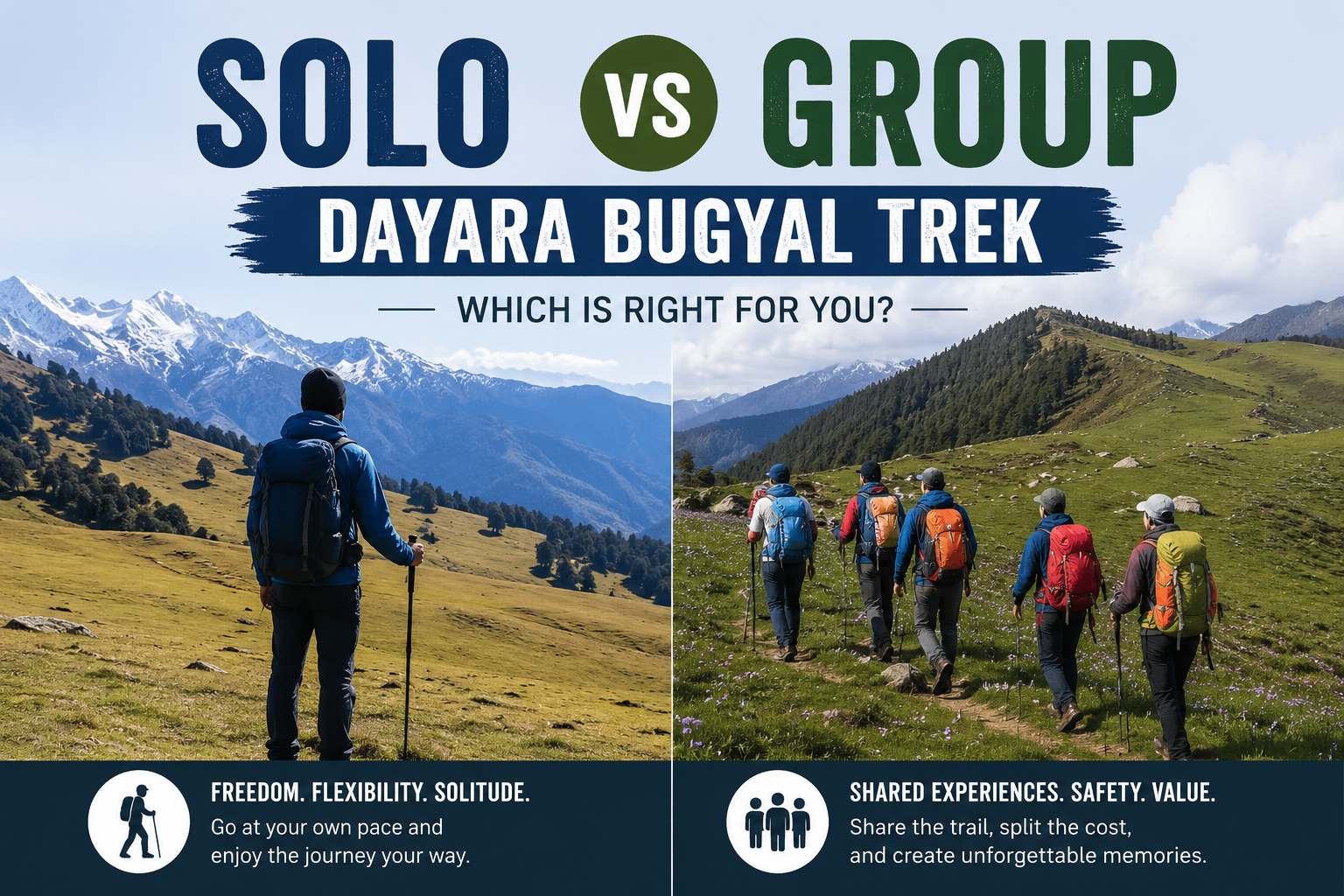
Meera, Tanvi, Rohit, and Kabir were four people who had registered independently for the same October departure through a guided operator. They had never met before the pick-up at Uttarkashi.
“By the end of day one, we had already started sharing snacks and trail recommendations. There was no awkward warm-up period. The trail removes all that. You are all doing the same hard thing together and that creates a shortcut to honesty.”
— Meera, Mumbai
The four of them now trek together twice a year. Tanvi says Dayara Bugyal was the beginning of a friendship that has genuinely changed her life.
What they remember most vividly is the evening when an unexpected cloudbank rolled in from the west just before sunset. For forty minutes, the meadow was completely inside a cloud. Then it passed and the entire sky opened into an extraordinary red and gold Himalayan sunset over Bandarpunch. The four of them were completely speechless.
This is the texture of real Himalayan trekking experiences that no highlight reel quite captures — the waiting, the weather, the unexpected, and the person standing next to you when it all comes together.
What First-Timers Always Get Wrong (And Right)
Across dozens of trekker accounts from the Dayara Bugyal trail, several patterns emerge consistently. Understanding them before you go is the most practical takeaway from any collection of real experiences.
Things First-Timers Consistently Underestimate
• Early morning cold — even in October, temperatures regularly drop below 5°C at Barnala Tal campsite after sunset
• The importance of acclimatisation — even at 3,400 metres, the air is noticeably thinner than anything most urban trekkers have experienced
• Sleeping bag quality — bags not rated below 0°C are one of the most common sources of genuinely miserable nights
• How much the photography slows you down — trekkers consistently underestimate stops and overestimate ground covered per hour
Things First-Timers Consistently Get Right
• Packing light — most first-timers actually pack fairly sensibly when guided by a good operator
• The walking pace — most find a natural slow rhythm that serves them well at altitude
• Trusting the guide — almost universally the right instinct on pacing, weather, and route conditions
This insight has a direct connection to the question trekkers most often ask before booking — specifically, Dayara Bugyal Trek: How Difficult Is It? The honest answer, based on real trekker experience, is that the trail is well within reach for most reasonably fit adults. The challenge is less about technical difficulty and more about physical conditioning and mental preparation for the altitude.
The Photographer Who Stayed Two Extra Days
Divya, a 29-year-old documentary photographer from Delhi, originally booked a standard four-day trek to Dayara Bugyal. She ended up staying six.
“I reached the meadow on day three and I could not leave. I paid for two extra nights of camping and arranged a different return vehicle.”
— Divya, Delhi
She had arrived on a clear afternoon but wanted to see the meadow in three different light conditions — sunrise, golden hour, and overcast. The overcast day was the one she had not planned for. By 10 AM she was shooting some of the best images she had ever taken. Soft, diffused, no harsh shadows. The meadow grass turned an extraordinary silver-green.
Her practical advice for photographers on this trail:
• Arrive with a full battery and two backups — cold nights drain batteries and you cannot afford to miss the pre-dawn window
• The northwest edge of the bugyal offers the best sunrise alignment with Bandarpunch
• Barnala Tal reflections are best captured between 6 AM and 7:30 AM before wind disturbs the surface
• The rhododendron forest section on the descent has a light quality in late afternoon that most trekkers rush past
Her final observation: she came to take photographs. What she left with was the feeling that some landscapes are bigger than photographs.
What Every Trekker Mentions Without Being Asked
There is one detail that appears in almost every Dayara Bugyal trekker account, regardless of when they went or how experienced they were. Nobody prompts it. It comes up on its own.
The silence.
Not the absence of noise — because there is wind and birdsong and the sound of your own breathing — but a particular quality of quiet that is specific to high-altitude open spaces. Multiple trekkers describe it as the feeling of the world pausing.
“There was a moment on the meadow when I sat down on a boulder and realised I could not hear a single human sound. No engine. No voice. No phone. Just the wind and the grass. I sat there for almost an hour and when I stood up I felt like something had been cleaned out of me.”
— Nishant, Hyderabad
“My daughter stopped walking in the middle of the meadow and said ‘Amma, the mountain is listening.’ I have been thinking about that sentence ever since.”
— Rashida, Chennai
“I have done Roopkund, Hampta Pass, and Har Ki Dun. Dayara Bugyal has the most peaceful energy of any place I have trekked. I do not know how else to describe it.”
— Vikram, Mumbai
Frequently Asked Questions
1. Is Dayara Bugyal suitable for first-time trekkers?
Yes, and the trekker stories above reflect this consistently. The trail is rated easy to moderate, and multiple first-timers completed it without significant difficulty. Physical preparation — particularly cardio fitness over four to six weeks before the trek — makes a meaningful difference to the experience.
2. What is the best season to visit Dayara Bugyal for a memorable experience?
October and November are the most consistently praised in trekker accounts for clear skies, golden meadow colours, and sharp peak visibility. December through February offers a completely different but equally powerful snow experience. April to June brings wildflowers and soft forest light.
3. How long does the Dayara Bugyal trek take?
The standard trek is completed in four to five days including travel from the base village. Most trekkers spend one to two nights on the meadow and one night at Barnala Tal. Some choose to extend, as Divya’s story shows.
4. Can solo women trek Dayara Bugyal safely?
Multiple solo women feature in trekker accounts from this route. The trail is well-established, has regular forest department presence, and experienced guides are available through registered operators. Trekking with a group departure from a trusted operator is the most recommended approach for first-time solo women trekkers.
5. What do trekkers most often wish they had brought?
Extra warm layers for early morning hours, a better sleeping bag than they packed, a physical power bank for camera batteries, and more memory cards than they thought they would need.
Your Story Starts at the Trailhead
Every trekker in this collection came to Dayara Bugyal with a different expectation. Every single one of them left with something they had not anticipated. That is not a coincidence — it is the consistent character of the place.
The meadow asks very little of you. Show up fit, show up curious, and show up willing to slow down. The rest happens on its own.
If you are ready to add your chapter to the growing record of Dayara Bugyal experiences, mountainiax.com runs verified, guide-led departures across every major season. Browse current departure dates, read detailed gear guidance, and connect with the trekking community that has been bringing people to this meadow for years. Your story begins the moment you decide to go.
With the dayara bugyal trek season approaching, it’s time to plan something truly extraordinary. From breathtaking Himalayan peaks to spiritually powerful temples hidden deep in remote valleys, this journey offers an experience that goes beyond a typical trek—it becomes a story you carry for life. To make your journey seamless and well-organised, choose the best trekking company in Uttarakhand for reliable trek packages, detailed itineraries, and hassle-free booking.
Visit this page for Trek Packages, Itinerary & Booking.