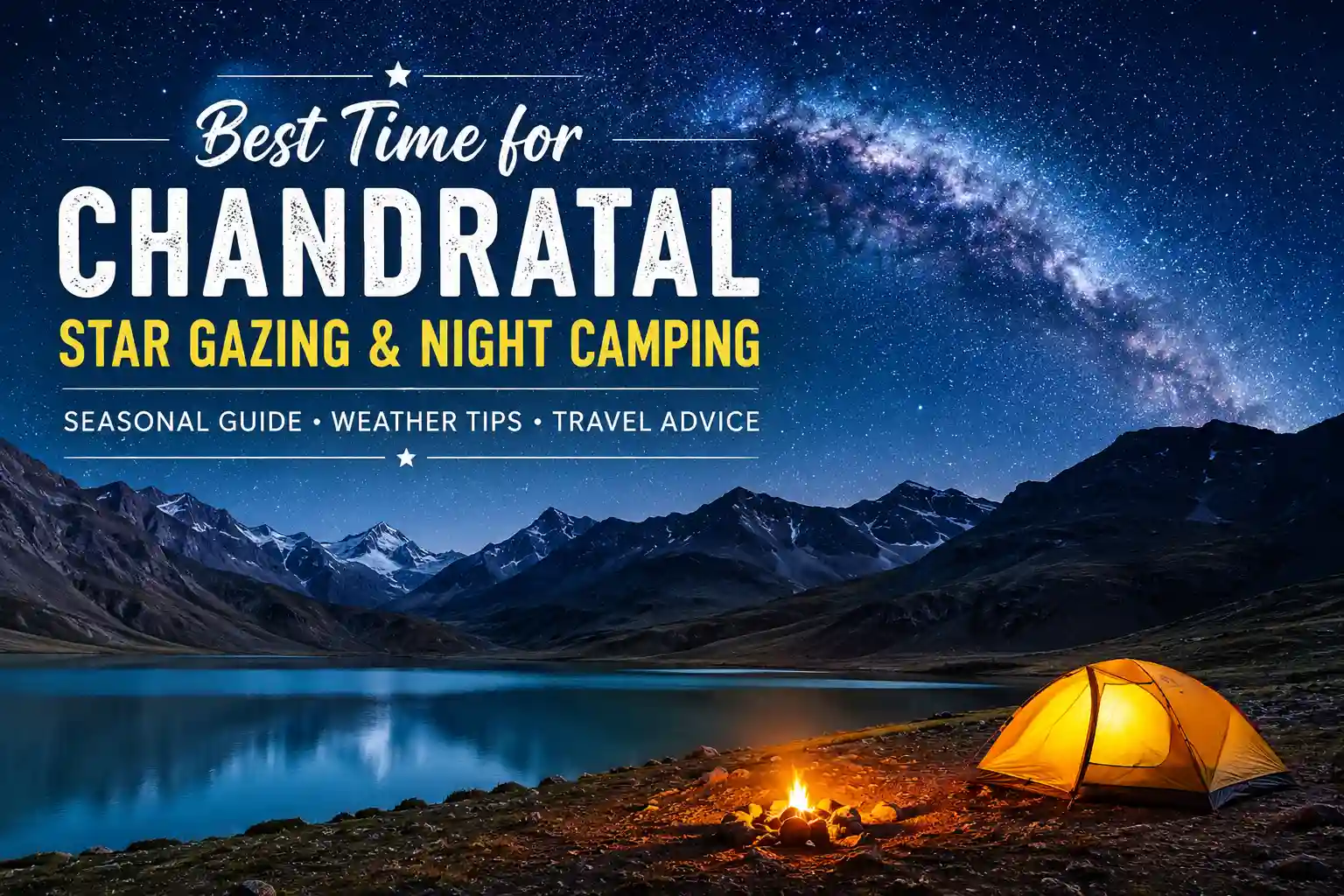
There is a particular kind of silence at Chandratal that most trekkers never forget — the moment the sun drops behind the Kunzum range, the cold desert air goes still, and the sky above the lake fills with more stars than most of us have ever seen at once. At 4,300 metres (14,100 ft) in the Lahaul-Spiti region of Himachal Pradesh, Chandratal is one of the few places in India where you can watch the Milky Way stretch from one horizon to the other with the naked eye.
But timing matters. Chandratal is open to visitors for barely three and a half months a year, and within that short window, some nights deliver a sky full of galaxies while others deliver nothing but cloud or a washed-out full moon glow. If you are planning this trip specifically for star gazing and night camping, and not just a day visit, getting the season and the moon phase right is the difference between an average trip and the kind of night you talk about for years.
This guide breaks down exactly when to go, why the sky here is so exceptionally clear, and how to camp safely at this altitude — based on the same season patterns that operators like IndiaHikes and Trek The Himalayas follow for their own Chandratal batches.
When Can You Actually Camp at Chandratal?
Chandratal is a seasonal destination. The road from Batal, and the Kunzum Pass route from Kaza, stay buried under snow for most of the year and are cleared by the Border Roads Organisation only once winter snowfall recedes. In practice, this means:
- Mid-June to early October is the only window when camps operate near the lake
- The road usually opens between the second and third week of June, though this shifts slightly every year depending on snowfall
- By the first week of October, temperatures fall sharply and camps begin shutting down for winter
- From November to May, the entire area is snowbound and inaccessible
If star gazing and camping are your priority, this narrow window is non-negotiable — outside these months, there simply is no camping option at Chandratal.
Month-by-Month: Best Time for Stargazing at Chandratal
Mid-June: The season has just opened. Skies are usually clear and crisp, but nights are bitterly cold, and some years still see leftover snow patches around the lake. Good for stargazing if you can handle sub-zero night temperatures.
July: This is peak monsoon in the plains, but Chandratal sits in the rain shadow of the Pir Panjal range, so the Spiti side generally stays dry even when Manali gets heavy rain. Wildflowers bloom around the meadows, and clear nights are common — though occasional monsoon clouds can drift in from the Manali side.
August: Weather at the lake itself remains cool and stable, but approach roads (Manali–Gramphu and the Kinnaur route) can see landslides. If road access goes smoothly, August nights are excellent for stargazing.
September: Widely considered the best month for Chandratal stargazing. Monsoon has withdrawn, the air is at its driest, skies are consistently clear, and crowds thin out after the August rush. Many photographers specifically time their trip for September.
Early October: A short, cold shoulder season. Skies are exceptionally clear, but night temperatures can drop well below freezing, and there’s a real risk of an early snowfall closing the road without warning.
New Moon vs Full Moon: Why the Date You Pick Matters More Than the Month
This is the detail most first-time visitors miss. Even in peak season, a full moon night will wash out the Milky Way almost completely — the moonlight is bright enough to outshine the fainter stars and the galactic core.
For genuine dark-sky stargazing:
- Aim for the 5–7 nights around the new moon in your chosen month
- On a clear, moonless night between June and September, the galactic core of the Milky Way is visible to the naked eye as a dense, textured band of light
- Around the full moon, you’ll still see bright stars and planets, but the fainter detail disappears
- Check a lunar calendar before booking your exact dates — this single adjustment matters more than which of the four peak months you choose
If astrophotography is your main goal, build your entire itinerary around the new moon window rather than the month alone.
Why Chandratal’s Night Sky Is So Exceptionally Clear
A few factors combine here in a way that’s rare even by Himalayan standards:
- Altitude: At over 4,000 metres, you’re looking through significantly less atmosphere than at sea level
- Cold desert climate: Spiti Valley has very low humidity, so there’s minimal haze or moisture to scatter light
- Zero light pollution: The nearest towns are hours away, and there are no permanent settlements, streetlights, or buildings near the campsites
- Open horizon: No tree cover and no surrounding hills close enough to block the view — you get a genuine 360-degree sky from almost anywhere around camp
- The lake itself: On a still night, Chandratal’s calm surface reflects the stars, doubling the visual effect
Together, these conditions make it one of the most reliable dark-sky locations in the country during its short open season.
Camping Rules You Need to Know Before You Go
Chandratal is an ecologically protected wetland, and the camping rules here are strictly enforced:
- Camping directly on the lakeshore is banned. All designated campsites are located roughly 2–3 km away from the water
- The final stretch to the lake itself is a mandatory walk — vehicles cannot go all the way in
- Swimming, bathing, or entering the lake water is prohibited; it’s considered a sacred site locally
- Littering is taken seriously, and campsite operators are expected to carry out all waste
- Fixed campsites are only set up for the June–early October season and are dismantled before winter
This 2–3 km distance from the lake doesn’t take away from the stargazing experience — the sky is just as dark from the campsite as it is lakeside.
Preparing for a Freezing Night at 4,300 Metres
This is where most first-timers underestimate Chandratal. Even in the middle of July, night temperatures at the campsite can fall below freezing, and the altitude itself brings a real risk of altitude sickness if you ascend too quickly without acclimatising.
A few essentials for a safe night out:
- Layer aggressively — a base thermal layer, insulated mid-layer, and a heavy down jacket are the minimum for after sunset
- Carry a sleeping bag rated for sub-zero temperatures, even in peak season
- Avoid strenuous activity on your first evening at the lake to let your body adjust to the elevation
- Watch for early symptoms of altitude sickness — headache, nausea, dizziness — and descend if they don’t improve with rest
- Keep your camera batteries warm; cold drains them fast during long-exposure night shots
If you’re new to high-altitude travel, it’s worth reading a proper altitude sickness guide before you go, since the same acclimatisation principles that apply on Himalayan pilgrim treks apply here too, just at a slightly different elevation.
How Chandratal Compares to High-Altitude Camping in the Indian Himalayas
Chandratal isn’t the only place in the Indian Himalayas where cold desert conditions create these near-perfect stargazing skies, but it’s one of the most consistent, precisely because it sits above the monsoon’s reach for most of the season. Trekkers who’ve done high-altitude camping on the best treks in Uttarakhand — at meadows like Bedni Bugyal or Dayara Bugyal, where the terrain opens up above the tree line — will recognise the same formula: altitude, open sky, and distance from artificial light. The main difference is that Chandratal’s rain-shadow location makes its clear-sky window slightly more predictable through July and August, when several Uttarakhand high-altitude routes are dealing with monsoon cloud cover instead.
For trekkers building a season calendar that includes both regions, this is a useful distinction — Chandratal fills the stargazing gap during the exact months when Uttarakhand’s high-altitude camps are less reliable for clear skies.
Frequently Asked Questions
1. What is the single best month for Chandratal stargazing?
September is generally considered the best overall month — driest air, most consistent clear skies, and thinner crowds than July or August.
2. Can you camp right next to Chandratal Lake?
No. Camping on the lakeshore is banned for ecological reasons. All campsites are located 2–3 km away, and the final stretch to the lake is done on foot.
3. Do you need a full moon or new moon for the best experience?
New moon. A bright moon washes out the Milky Way and fainter stars. Plan your trip around the new moon dates for the clearest possible view of the galaxy.
4. How cold does it get at night at Chandratal even in summer?
Night temperatures can fall below freezing even in July and August, so heavy layering and a sub-zero sleeping bag are essential regardless of the month.
5. Is Chandratal accessible all year for camping?
No. Camps operate only from roughly mid-June to early October. The rest of the year, snow makes the road and the lake area inaccessible.
Conclusion
Chandratal rewards planning more than most Himalayan destinations. Get the season right — mid-June to early October — and you’re in with a chance. Get the moon phase right too, timing your visit around the new moon between July and September, and you move from “nice trip” to one of the clearest night skies you’ll ever see in India. Add proper cold-weather gear and a realistic acclimatisation plan for the 4,300-metre altitude, and camping by the lake stops being a gamble and becomes one of the most reliable dark-sky experiences in the country.
The short window is exactly what makes it special — this isn’t a sky you can see on a whim any weekend of the year. Plan around it, and Chandratal delivers.
Plan Your Himalayan Camping Trip with Mountainiax
Whether you’re chasing dark skies at Chandratal or planning a high-altitude camping trek closer to home in Uttarakhand, timing your trip around the right season and the right weather window makes all the difference. Get in touch with the Mountainiax team to plan a guided, safe, and well-timed Himalayan adventure.