Uttarakhand has always been more than a travel destination. It is a living map of devotion, where every ridge, river, and forest trail leads toward something sacred. The Garhwal Himalayas hold within them two of the most spiritually significant pilgrimage networks in all of India — each demanding something different from the seeker, and each giving back something irreplaceable.
Two divine circuits define the heart of this region. The Panch Kedar pilgrimage traces five manifestations of Lord Shiva across high-altitude terrain in Panch Kedar, Uttarakhand, demanding genuine physical effort as part of the devotional act. The Panch Badri yatra in Uttarakhand follows five sacred shrines of Lord Vishnu — most of them road-accessible — spread across the magnificent Panch Badri Chamoli Uttarakhand corridor, offering a spiritually rich but physically gentler journey.
If you are standing at a crossroads wondering which circuit calls to you more strongly in 2026, this guide brings clarity. We place Panch Kedar vs Panch Badri side by side — comparing deities, trail length, duration, difficulty, cost, and devotional character — so you leave with a confident plan and a journey that truly fits your faith and your fitness.
Understanding the Two Circuits at a Glance
Before diving into temple-by-temple details and trekking logistics, it helps to understand what each circuit represents at its core — both devotionally and geographically.
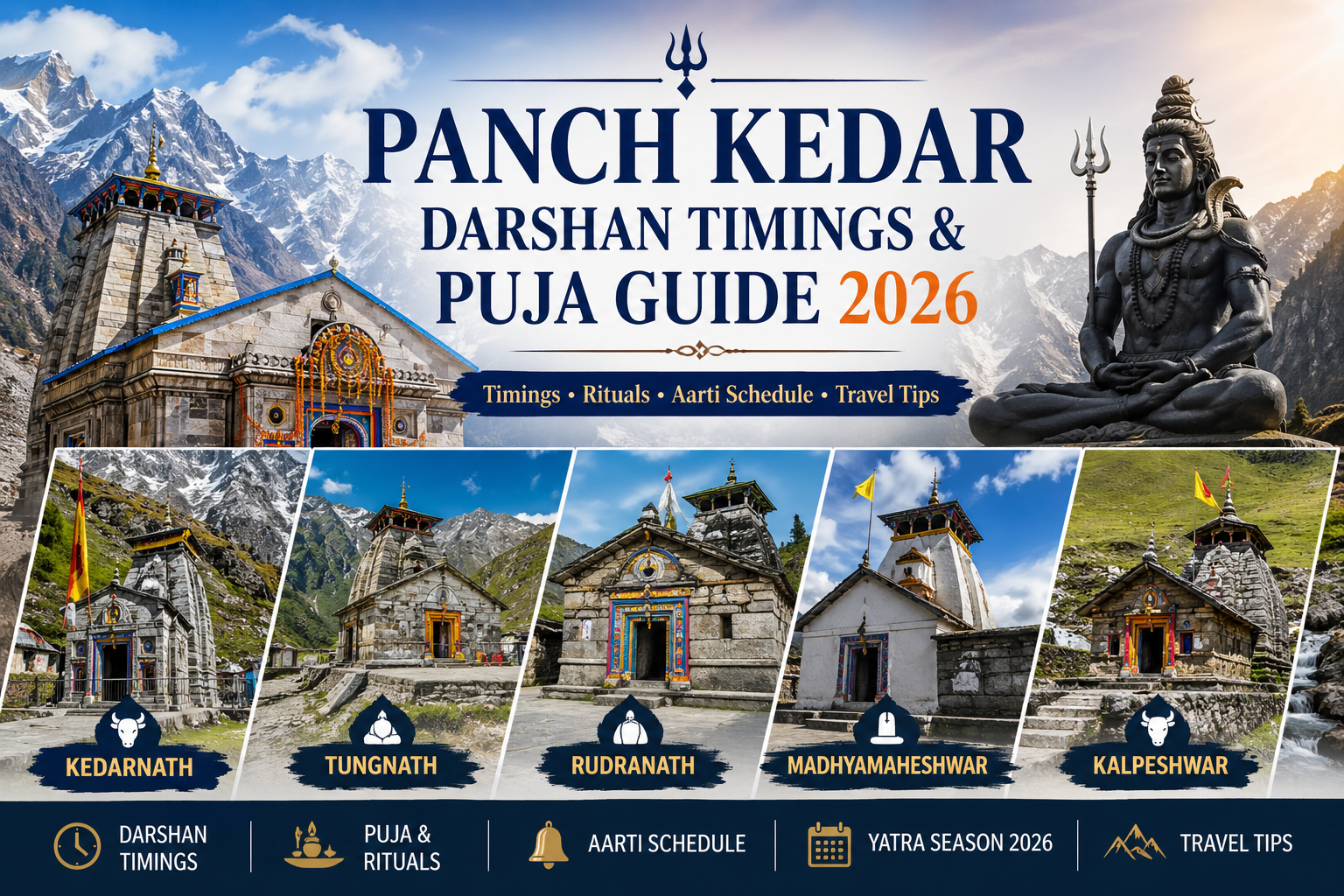
Panch Kedar, Uttarakhand, traces five locations where different body parts of Lord Shiva are believed to have appeared from the earth. These are Kedarnath (hump), Tungnath (arms), Rudranath (face), Madhyamaheshwar (navel), and Kalpeshwar (matted locks). Spread across the Rudraprayag and Chamoli districts, these temples sit between 2,200 and 3,680 metres above sea level. Reaching them requires multi-day trekking through dense oak and rhododendron forests, open alpine meadows, and rocky ridgeline approaches that are as breathtaking as they are demanding.
The Panch Badri temples, by contrast, are five Vishnu shrines scattered across the Garhwal pilgrimage circuit: Badrinath (the principal shrine at 3,133 m), Yogadhyan Badri at Pandukeshwar, Bhavishya Badri near Subhain village outside Joshimath, Vridha Badri at Animath, and Adi Badri in the Chamoli district. Critically, most of these shrines sit beside motorable roads or require only short walks. This makes Panch Badri Chamoli Uttarakhand accessible to pilgrims of all ages and fitness levels — from young families to elderly devotees seeking the blessings of Vishnu in his many forms.
The Five Temples of Panch Badri: A Clear Reference
Badrinath — The anchor of the entire Panch Badri yatra and one of the four Char Dham shrines. Located at 3,133 metres in the Chamoli district, it draws lakhs of devotees every season. The temple opens in late April or early May and closes by mid-November with the iconic Diwali-season closing ceremony.
Yogadhyan Badri — Situated at Pandukeshwar village on the main Badrinath highway, this serene temple enshrines Lord Vishnu in deep meditative form. The ancient stone idol here is believed to date back to Pandava times. Road-accessible year-round, and often quiet even during peak season.
Bhavishya Badri — Known as the “future Badri,” this temple sits in dense forest near Subhain village beyond Joshimath. A manageable 3 km forest trek from the road leads to this atmospheric shrine — the only Panch Badri temple requiring foot travel. The trail through oak and rhododendron canopy is short but deeply meditative.
Vridha Badri — The “elder Badri” at Animath, just 7 km from Joshimath on the Helang-Tapovan road. According to legend, Lord Vishnu first appeared here as an elderly man before sage Narada. Road-accessible, often uncrowded, and architecturally distinctive.
Adi Badri — A complex of 14 temples near Karnaprayag, believed to be where Lord Vishnu originally appeared in the Satya Yuga. The main shrine houses a striking black stone idol of Vishnu, and the entire complex has been beautifully maintained. Road-accessible and considered an essential start or end point for the Panch Badri yatra in Uttarakhand.
Side-by-Side Comparison: Panch Kedar vs Panch Badri
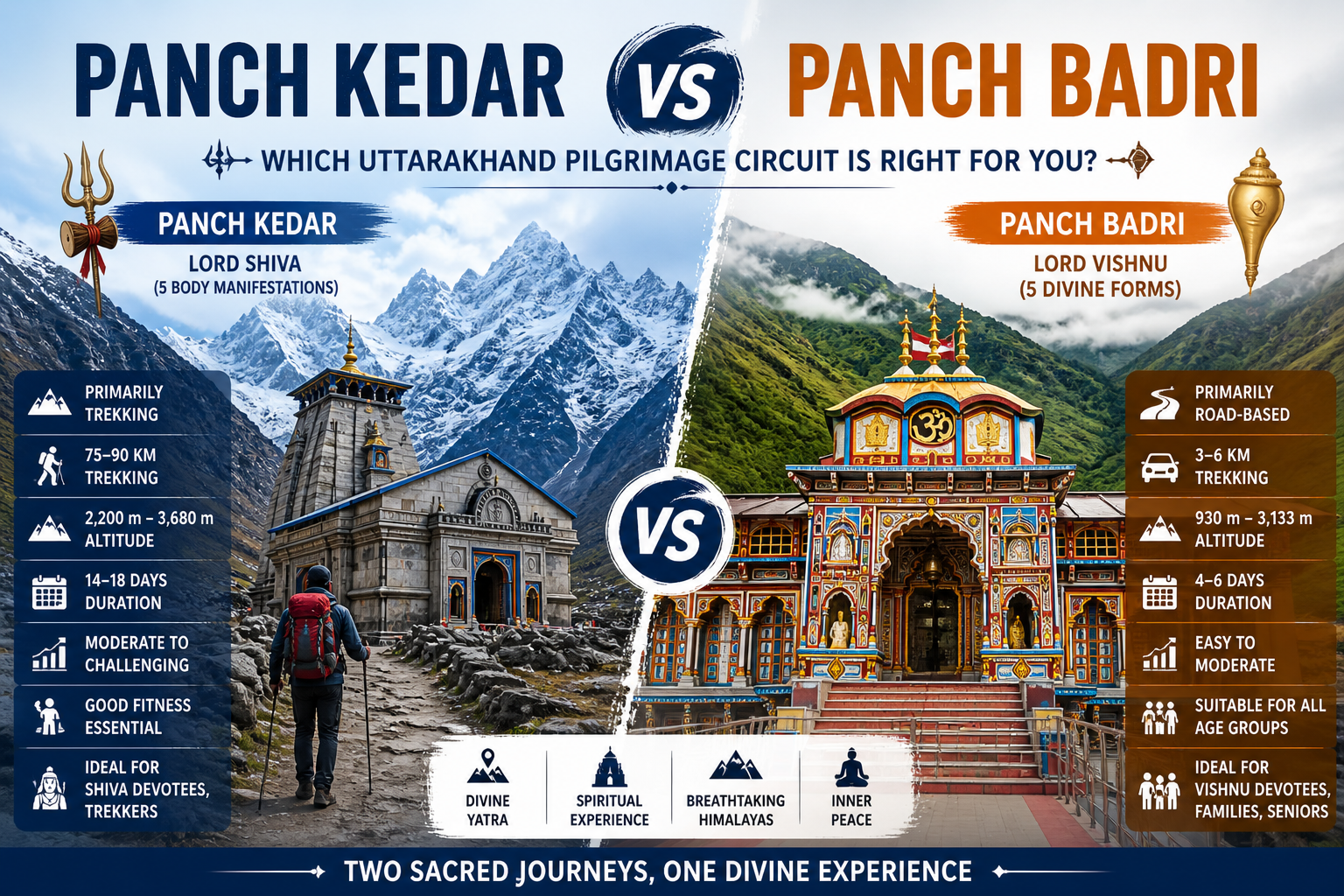
The comparison table below is designed as a quick-reference guide for pilgrims and trekkers choosing between the two circuits for the 2026 season.
Factor Panch Kedar Panch Badri
| Parameter | Panch Kedar | Panch Badri |
| Deity Worshipped | Lord Shiva (5 body manifestations) | Lord Vishnu (5 divine forms) |
| Number of Temples | 5 | 5 |
| Circuit Type | Primarily trekking | Primarily road-based |
| Total Trekking Distance | 75–90 km (combined) | 3–6 km (Bhavishya Badri only) |
| Altitude Range | 2,200 m – 3,680 m | 930 m – 3,133 m |
| Duration Required | 14–18 days (ideally) | 4–6 days (ideally) |
| Difficulty Level | Moderate to Challenging | Easy to Moderate |
| Best Season | May–June, Sept–Oct | May–June, Sept–Nov |
| Approximate Cost | ₹25,000 – ₹45,000 per person | ₹12,000 – ₹22,000 per person |
| Crowd Level | Moderate (high at Kedarnath) | Moderate–High at Badrinath, quiet elsewhere |
| Fitness Required | Good physical fitness essential | Suitable for all age groups |
| Ideal For | Shiva devotees, trekkers | Vishnu devotees, families, and senior pilgrims |
Who Should Choose Panch Kedar?
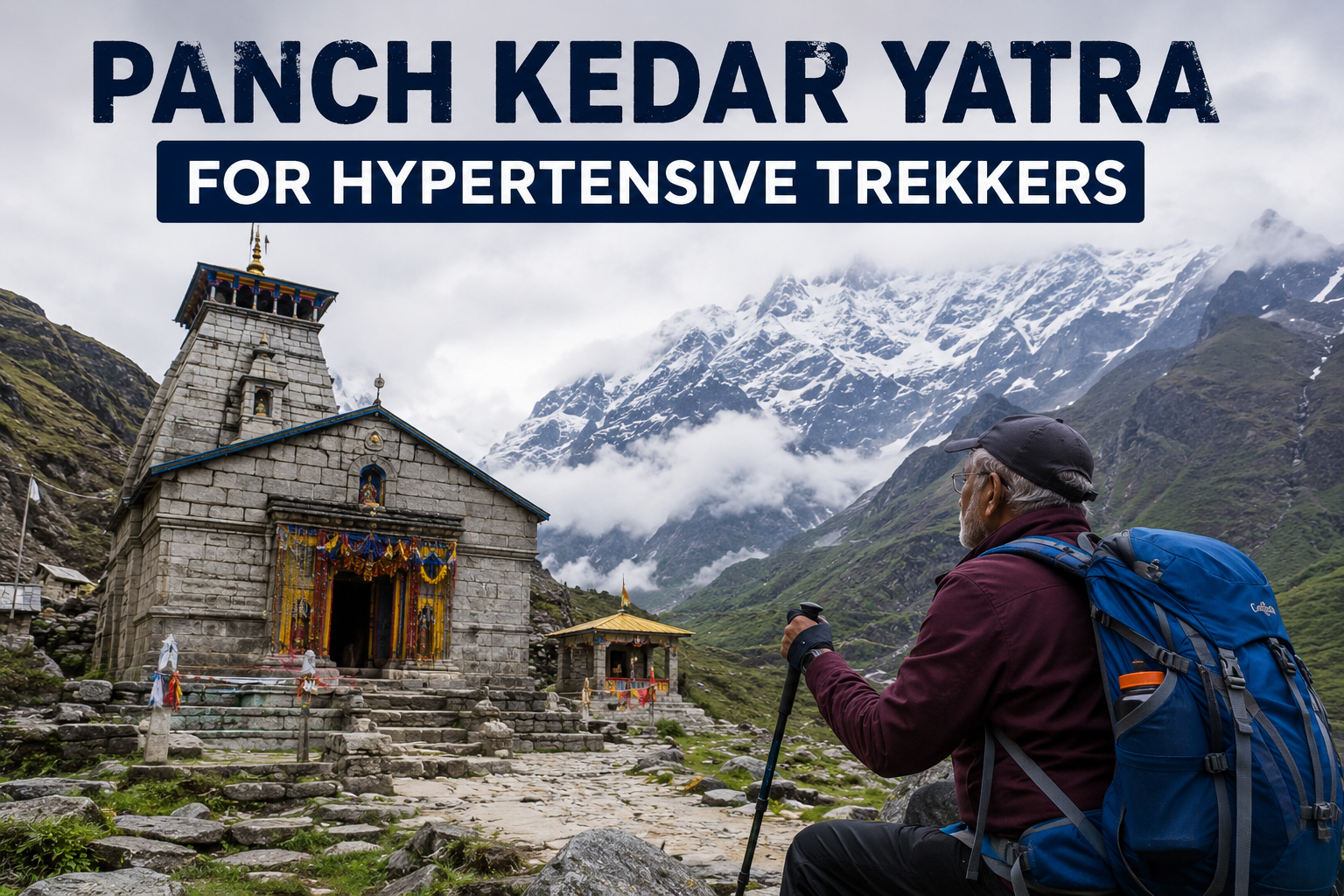
The Panch Kedar trek guide has a very clear ideal reader: someone who believes that earning a darshan through physical effort is itself a form of worship. If waking before dawn at a forest campsite, climbing rocky ridgelines at 3,500 metres, and arriving at an ancient stone temple after two days on trail sounds like the kind of pilgrimage that stirs your soul, then Panch Kedar is your answer.
Choose the Panch Kedar pilgrimage if you are:
- A Shiva devotee seeking darshan at all five divine manifestations in their original mountain settings
- Physically fit and comfortable with 6–12 km daily trekking at altitude
- Someone with 14–18 days available for a fully immersive circuit
- A trekker looking for the best Uttarakhand pilgrimage 2026 that doubles as a genuine Himalayan adventure
- Comfortable with basic teahouse or tent accommodation at altitude
- Interested in high-altitude meadows like Tungnath-Chandrashila and Madhyamaheshwar Bugyal
Beyond the spiritual reward, the Panch Kedar trek passes through some of the most visually stunning landscapes in the entire Garhwal Himalayas. The trail to Rudranath winds through oak forests draped in cloud; the Madhyamaheshwar valley opens into a vast alpine bowl backed by Kedarnath and Chaukhamba peaks. For those who love to document their journeys through the lens, Panch Kedar Photography offers some of the most dramatic Himalayan and devotional photography opportunities in all of Uttarakhand — from mist-shrouded pre-dawn aarti at Kedarnath to the rock-carved sanctum of Kalpeshwar deep in the forest.
The one honest caveat: the Panch Kedar trek guide should make clear that the circuit is not something to rush. Altitude acclimatisation, proper footwear, a knowledgeable guide, and realistic daily targets are non-negotiable for a safe and fulfilling journey.
Who Should Choose Panch Badri?
The Panch Badri yatra in Uttarakhand is built for pilgrims who want spiritual depth without extreme physical demand. It is not a lesser circuit — it is a differently calibrated one, and in many ways more historically layered than its Shiva counterpart.
Choose Panch Badri if you are:
- A Vishnu devotee seeking all five divine forms in the Garhwal hills
- Travelling with elderly parents, grandparents, or young children
- Working with a 4–6 day window and want a time-efficient, high-meaning pilgrimage
- Planning to include Badrinath as part of a Char Dham journey and want to extend it naturally
- A first-time visitor to the Garhwal pilgrimage circuit who is building confidence for longer journeys
- Someone who prefers proper hotel or guesthouse stays over camping
The Panch Badri circuit also offers exceptional cultural richness that does not require a single strenuous step. Adi Badri alone — with its complex of 14 interlocking shrines — can fill an entire day of worship, architecture study, and quiet contemplation. Yogadhyan Badri is one of the most peaceful temple settings in all of Uttarakhand. And Bhavishya Badri’s 3 km forest walk is a gentle enough introduction to trail walking that even first-time trekkers find it entirely comfortable.
For those who want to understand where Panch Badri fits within the wider landscape of Himalayan trails before planning future journeys, a look at the Top 10 Treks In Uttarakhand is a useful starting point for calibrating your interests and building toward longer circuits in future seasons.
Can You Combine Both Circuits in a Single Garhwal Trip?
This is the question that serious pilgrims and seasoned Himalayan travellers are increasingly asking in 2026 — and the answer is yes, with careful planning and the right operator guiding the itinerary.
A combined Panch Kedar + Panch Badri circuit is essentially a compressed version of what Mountainiax and other specialist operators are beginning to call the Garhwal Himalaya Mega-Circuit. When paired with the Char Dham — Kedarnath, Badrinath, Gangotri, and Yamunotri — this becomes one of the most complete devotional journeys possible in the Indian Himalayas.
A realistic combined framework for 15–18 days looks like this:
Days 1–3: Adi Badri, Vridha Badri, and Yogadhyan Badri — road-based Panch Badri start from Haridwar via Karnaprayag. Days 4–6: Badrinath darshan and Bhavishya Badri — complete all five Panch Badri shrines. Days 7–10: Kedarnath (helicopter or trek) and Madhyamaheshwar — begin the Shiva circuit. Days 11–15: Tungnath-Chandrashila, Rudranath, and Kalpeshwar — complete all five Panch Kedar temples
This sequence is ambitious but genuinely achievable for fit travellers in the May–June pre-monsoon window. The practical advantage of combining both circuits is not just spiritual completeness — it is also logistically efficient. Transport infrastructure in the Chamoli-Rudraprayag corridor is shared across both circuits, and accommodation clusters in towns like Joshimath, Ukhimath, and Gopeshwar serve both routes. A combined trip reduces per-day costs significantly compared to doing each circuit on a separate visit.
The Panch Kedar vs Char Dham vs Panch Badri question also clarifies naturally here: Char Dham is the overarching framework. Panch Kedar extends its Kedarnath dimension into four more Shiva shrines. Panch Badri extends its Badrinath dimension into four more Vishnu shrines. They are concentric circuits, not competing ones — and the best spiritual circuit in the Garhwal Himalayas for a first-time pilgrim is Char Dham, while Panch Kedar and Panch Badri reward the returning devotee who wants to go deeper.
Best Season and Practical Planning Tips
Both circuits open in late April or early May, timed to the auspicious Akshaya Tritiya muhurta. Both close before the Himalayan winter arrives — typically by late October or early November, though Panch Badri temples at lower altitudes like Adi Badri and Yogadhyan Badri remain accessible for longer.
Best months for Panch Kedar: May–June (pre-monsoon, clear trails, snow-dusted peaks) and September–October (post-monsoon, fewer crowds, brilliant visibility)
Best months for Panch Badri: May–June and September–November (the Badrinath highway stays open later into the season than high trekking routes)
Avoid July and August if possible. Both circuits are technically open during the monsoon, but heavy rainfall brings trail erosion on Panch Kedar routes, leeches in forested sections, and regular landslide closures on the roads serving Panch Badri.
For shrine-specific scheduling — including morning aarti timings, special darshan windows during festivals like Navaratri or Somvati Amavasya, and registration requirements at Kedarnath — checking the Panch Kedar Darshan Timings in advance ensures you do not miss the sacred rituals that define the experience at each temple.
Book accommodation and guide services at least 6–8 weeks ahead for May and October visits, when both circuits see their highest footfall.
Frequently Asked Questions: Panch Kedar vs Panch Badri
1. What are the Panch Badri temples?
The five Badri shrines are Badrinath, Yogadhyan Badri at Pandukeshwar, Bhavishya Badri near Subhain, Vridha Badri at Animath, and Adi Badri in Chamoli. All are dedicated to Lord Vishnu and form the Panch Badri Chamoli Uttarakhand circuit.
2. Is Panch Badri easier than Panch Kedar?
Yes, significantly. Panch Badri requires minimal walking — only Bhavishya Badri involves a 3 km forest trail. Panch Kedar demands 75–90 km of mountain trekking spread across multiple days at an altitude. Panch Badri is suitable for all age groups; Panch Kedar requires solid physical preparation.
3. How many days does the Panch Badri yatra take?
The complete Panch Badri yatra in Uttarakhand can be completed in 4–6 days from Haridwar, making it one of the most time-efficient major pilgrimages in the entire region.
4. Can I do Panch Kedar and Panch Badri in the same trip?
Yes. A 15–18 day combined circuit is both possible and increasingly popular. The most logical sequence is to start with the road-based Panch Badri temples, then transition to the trek-based Panch Kedar shrines. Mountainiax offers curated itineraries for this exact combination.
5. What is the cost difference between the two circuits?
Panch Kedar typically costs Rs 25,000–Rs 45,000 per person, depending on accommodation type, guide, and porter services. Panch Badri runs Rs 12,000–Rs 22,000 per person. The combined circuit can be done for Rs 50,000–Rs 70,000 per person with a specialist operator, with significant savings on shared transport.
Summary
The Panch Kedar vs Panch Badri decision ultimately comes down to four things: your chosen deity, your available time, your fitness level, and the kind of experience you want from the mountains. Panch Kedar rewards the trekker-devotee willing to earn each darshan through altitude, distance, and honest effort. Panch Badri opens the same sacred Garhwal Himalayas to every pilgrim, regardless of age or physical ability. Both circuits are deeply meaningful, historically layered, and among the best Uttarakhand pilgrimage 2026 options for Indian and international travellers alike. Whichever path you walk — or whether you walk both — the mountains will meet you where you are.
With the Panch Kedar Yatra season approaching, it’s time to plan something truly extraordinary. From breathtaking Himalayan peaks to spiritually powerful temples hidden deep in remote valleys, this journey offers an experience that goes beyond a typical trek—it becomes a story you carry for life. To make your journey seamless and well-organised, choose the best trekking company in Uttarakhand for reliable trek packages, detailed itineraries, and hassle-free booking.
Visit this page for Trek Packages, Itinerary & Booking.