Every year, thousands of devout pilgrims and adventure seekers across India face the same deeply personal crossroads: which sacred Himalayan journey should they undertake — the ancient pilgrimage to Kailash Mansarovar in Tibet, or the spiritually equivalent and increasingly celebrated Adi Kailash in Uttarakhand? Both destinations carry immense religious weight. Both involve high-altitude Himalayan terrain. And both promise an experience that fundamentally changes the people who complete them.
Yet beyond the surface similarities, these two journeys are profoundly different — in geography, in logistics, in cost, in physical demand, and in the kind of traveler each one suits best. The confusion between them is understandable. Marketing language, social media posts, and even some travel operators blur the distinctions in ways that can lead pilgrims to choose the wrong journey for their fitness level, budget, or spiritual intent.
This guide exists to remove that confusion entirely. Whether you are a first-time pilgrim, a seasoned Himalayan trekker, or a devotee researching options for a once-in-a-lifetime yatra, understanding the full comparison of Adi Kailash vs Kailash Mansarovar — point by point, category by category — will help you make the right decision with clarity and confidence.
What Is Kailash Mansarovar? A Brief Overview
Kailash Mansarovar is arguably the most sacred pilgrimage destination in the entire Asian subcontinent. Located in the Tibet Autonomous Region of China at an altitude of 6,638 meters, Mount Kailash is revered by four major world religions — Hinduism, Buddhism, Jainism, and Bon. It is considered the earthly abode of Lord Shiva in Hindu tradition, the site of enlightenment in Buddhist cosmology, and the spiritual center of the universe across multiple faiths.
The Kailash Mansarovar Yatra involves traveling through Tibet to circumambulate Mount Kailash — a ritual parikrama of approximately 52 kilometers — while also visiting the sacred Mansarovar Lake, which sits at around 4,590 meters. The journey has been undertaken by pilgrims for over a thousand years and carries a level of religious prestige that is unmatched in the Hindu pilgrimage circuit.
Key facts at a glance:
- Location: Tibet Autonomous Region, China
- Peak altitude: 6,638 m (Mount Kailash)
- Lake altitude: ~4,590 m (Lake Mansarovar)
- Parikrama distance: ~52 km around Mount Kailash
- Religions: Hindu, Buddhist, Jain, Bon
- Governing authority: Requires Chinese government approval via the Indian MEA
What Is Adi Kailash? Understanding India’s Own Sacred Summit
Adi Kailash, also known as Chhota Kailash or Baba Kailash, is located in the Pithoragarh district of Uttarakhand, India. Rising to approximately 6,191 meters, it shares a striking visual resemblance to the original Kailash in Tibet — a fact that has led many scholars and devotees to regard it as equally sacred. The Jolingkong lake at its base mirrors the relationship between Mount Kailash and Mansarovar Lake, adding to the spiritual parallel.
The Adi Kailash Yatra is conducted entirely within Indian territory, making it accessible without international travel permits or foreign government approvals. The route passes through the breathtaking Kumaon Himalayas, and the journey also offers a close-up view of Om Parvat — the mountain whose snowfields naturally form the shape of the Hindu sacred symbol Om — making it a double pilgrimage of immense spiritual value.
Key facts at a glance:
- Location: Pithoragarh district, Uttarakhand, India
- Peak altitude: 6,191 m (Adi Kailash)
- Lake altitude: ~4,700–4,800 m (Jolingkong Lake)
- Trek distance: ~60 km round trip (Gunji to Jolingkong)
- Religions: Primarily Hindu
- Governing authority: Indian government, Inner Line Permit (ILP)
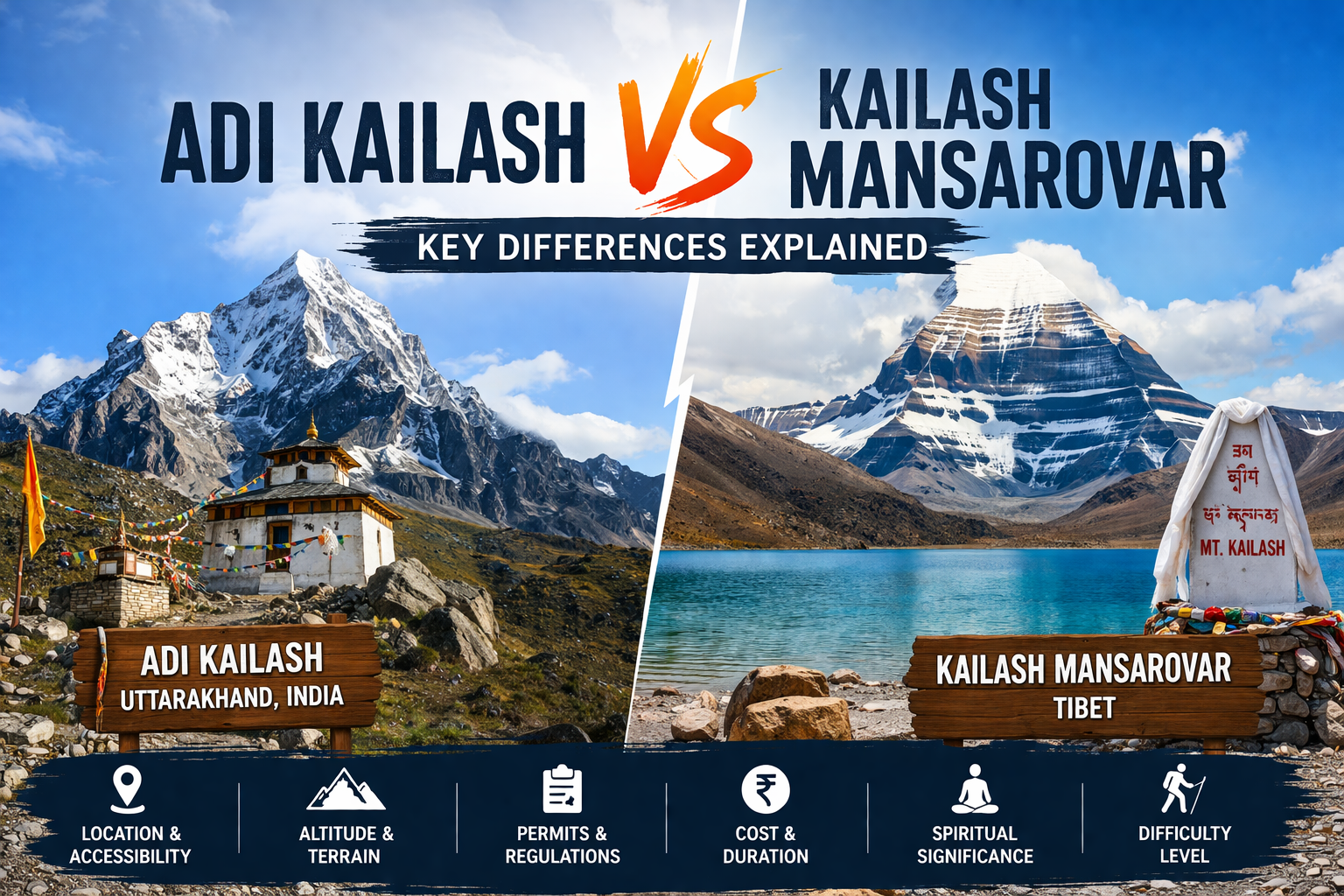
Head-to-Head Comparison: Adi Kailash vs Kailash Mansarovar
Adi Kailash and Kailash Mansarovar both offer profound spiritual Himalayan journeys, yet differ in accessibility, altitude, and scale. Adi Kailash is more reachable within India, while Kailash Mansarovar in Tibet provides a grander, more demanding pilgrimage experience for devotees and trekkers.
1. Location and Accessibility
This is the most fundamental difference between the two pilgrimages and the one that shapes everything else.
Kailash Mansarovar sits inside Tibet, which means Indian pilgrims must travel through either Nepal (Kathmandu route) or through the Lipulekh Pass in Uttarakhand (the traditional land route). Both routes cross international boundaries and require coordination with the Chinese government. Access has historically been contingent on diplomatic relations between India and China — a fact that makes the yatra susceptible to sudden cancellations, as was witnessed repeatedly in recent years when the route was suspended due to geopolitical tensions.
Adi Kailash, by contrast, lies entirely within Indian sovereign territory. There are no international crossings, no dependency on Chinese government approvals, and no risk of last-minute political cancellations. The trailhead at Gunji in Uttarakhand is reachable from Delhi within 2–3 days by surface transport. For a complete breakdown of the road journey, the Adi Kailash from Delhi travel guide on Mountainiax covers every segment in detail.
Verdict: Adi Kailash wins decisively on accessibility, reliability, and logistical simplicity.
2. Altitude Comparison
Altitude is where the two pilgrimages diverge most sharply in terms of physical risk.
Kailash Mansarovar parikrama reaches its highest point at Dolma La Pass — 5,630 meters — which trekkers must cross during the circumambulation. The surrounding terrain remains above 4,500 meters for virtually the entire circuit, and Lake Mansarovar itself sits at 4,590 meters. The sustained high altitude, combined with the remoteness of the Tibetan Plateau, makes this one of the most physiologically challenging pilgrimages in the world.
Adi Kailash trek reaches approximately 4,700–4,800 meters at the Jolingkong base camp. While this altitude still carries genuine AMS risk and demands proper acclimatization, it is meaningfully lower than the altitudes involved in the Kailash Mansarovar circuit. The body has more margin for adjustment, and descent to safer elevations is easier and faster if symptoms develop.
Altitude comparison summary:
- Highest point — Kailash Mansarovar: Dolma La Pass, 5,630 m
- Highest point — Adi Kailash: Jolingkong basin, ~4,800 m
- Sustained altitude — Kailash Mansarovar: 4,500–5,600 m throughout
- Sustained altitude — Adi Kailash: 3,600–4,800 m across trekking days
Verdict: Adi Kailash is significantly lower in peak and sustained altitude, making it substantially safer for those without prior high-altitude experience.
3. Physical Difficulty
Kailash Mansarovar Yatra is classified as difficult to very difficult. The 52 km parikrama around Mount Kailash involves steep climbs, thin air at extreme altitude, and a single day crossing of the Dolma La Pass that many pilgrims find to be the most physically grueling experience of their lives. The sustained exertion at 5,000+ meters, combined with the remote location and limited evacuation options, places this firmly in the category of expeditions requiring serious preparation.
The Indian government historically required medical fitness certification for the Kailash Mansarovar Yatra precisely because the route has claimed lives, not through accidents, but through cardiac and altitude-related emergencies among unprepared pilgrims.
Adi Kailash Yatra is classified as moderate to difficult. The trail demands genuine fitness and prior trekking experience, particularly on the steep Day 2 ascent from Nabhidhang to Jolingkong. However, the lower altitude ceiling, the shorter daily distances, and the proximity of lower camps make it far more manageable — and far safer for first-time high-altitude pilgrims.
Full trail details, including the day-wise breakdown, are covered in the Adi Kailash Yatra Distance & Route guide on Mountainiax.
Physical difficulty comparison:
- Kailash Mansarovar: 52 km parikrama, Dolma La crossing at 5,630 m — Very Difficult
- Adi Kailash: 60 km round trek, maximum ~4,800 m — Moderate to Difficult
- Age suitability — Kailash Mansarovar: Typically restricted to ages 18–70, with strict medical screening
- Age suitability — Adi Kailash: Broader age range possible with appropriate fitness preparation
Verdict: Adi Kailash is significantly more accessible for a wider demographic of pilgrims and trekkers.
4. Cost Comparison
The cost difference between these two pilgrimages is dramatic and represents a major decision factor for most Indian families.
Kailash Mansarovar Yatra cost for the government-organized tour (KMVN/MEA route) has historically ranged from ₹1.8 lakh to ₹2.5 lakh per person for the standard overland route. This includes transportation, accommodation, meals, Chinese visa processing, and group logistics. Private operators charge significantly more — premium packages can reach ₹3.5–5 lakh per person. The helicopter route via Lucknow and Kathmandu is even more expensive, often exceeding ₹2 lakh excluding international flight costs.
Adi Kailash Yatra cost is far more accessible. A well-organized guided trek with a reputable operator like Mountainiax typically falls in the range of ₹18,000 to ₹35,000 per person, inclusive of permits, accommodation, meals, guide, and porter support. Even a premium, fully supported package rarely exceeds ₹50,000. For budget-conscious pilgrims or families traveling together, Adi Kailash represents extraordinary value without sacrificing the depth of the spiritual experience.
Cost breakdown comparison:
- Kailash Mansarovar (government route): ₹1.8–2.5 lakh per person
- Kailash Mansarovar (private/helicopter): ₹2.5–5 lakh per person
- Adi Kailash (standard guided): ₹18,000–35,000 per person
- Adi Kailash (premium package): Up to ₹50,000 per person
Verdict: Adi Kailash is 5 to 10 times more affordable than Kailash Mansarovar, making it the only realistic option for the majority of Indian pilgrims.
5. Permit Requirements
The Kailash Mansarovar permit process is among the most complex of any pilgrimage destination in the world. It involves:
- Application through the Indian Ministry of External Affairs (MEA)
- Chinese government visa and travel permit approval for Tibet
- Group travel restrictions (individual travel to Tibet is prohibited for most nationalities)
- Lottery-based selection in oversubscribed years
- Separate permits for the Lipulekh Pass route through Uttarakhand
The entire process can take months and offers no guarantee of approval. Pilgrims frequently apply multiple times before being selected.
Adi Kailash’s permit process is comparatively streamlined:
- An Inner Line Permit (ILP) is required for the restricted border zone near Gunji
- Obtainable through official Uttarakhand government portals or at designated checkpoints
- No foreign government involvement
- No lottery system — available on a first-come basis within operational limits
- KMVN registration or private operator registration is required for organized groups
For those planning the 2026 season, completing your Adi Kailash Yatra Registration 2026 early is advisable as peak-season slots with quality operators fill quickly. The registration process is now largely digital and straightforward.
Permit complexity comparison:
- Kailash Mansarovar: MEA application + Chinese Tibet permit + potential lottery — High complexity
- Adi Kailash: ILP + KMVN/operator registration — Low to moderate complexity
Verdict: Adi Kailash is dramatically easier to access from a permit and administrative standpoint.
6. Spiritual Significance: Are They Equally Sacred?
This is the question that matters most to devout pilgrims, and it deserves an honest, nuanced answer.
Mount Kailash in Tibet is universally recognized as the supreme sacred mountain in Hindu cosmology. The Puranas describe it explicitly as the abode of Lord Shiva and Parvati. Its four faces are said to be made of crystal, ruby, gold, and lapis lazuli. The Mansarovar Lake is described in ancient texts as the mind-born lake of Brahma. The spiritual prestige of this site spans millennia and is shared across four major world religions. For many Hindus, the Kailash Mansarovar parikrama represents the ultimate spiritual achievement of a lifetime.
Adi Kailash carries its own profound sacred identity. “Adi” translates to “first” or “primordial” in Sanskrit, and many Hindu traditions hold that Adi Kailash predates the discovery of the Tibetan Kailash as a pilgrimage site — making it the original Kailash of the ancient texts. The Shiva temple at Jolingkong, the sacred Parvati Sarovar lake, and the naturally occurring Om symbol on Om Parvat collectively create a pilgrimage experience that many describe as spiritually complete in its own right.
Local Kumaoni tradition and several Puranic interpretations assert that a pilgrimage to Adi Kailash carries equivalent spiritual merit (punya) to the Kailash Mansarovar Yatra — a belief that has brought this destination increasing recognition among religious scholars and pilgrimage authorities.
Verdict: Kailash Mansarovar holds broader universal religious recognition, but Adi Kailash carries deep and legitimate sacred significance within Hindu tradition, particularly in the Kumaon and Garhwal regions. For many pilgrims, especially those who cannot access Tibet, Adi Kailash provides spiritually complete fulfillment.
7. Best Time to Visit
Kailash Mansarovar Yatra season typically runs from May to September, with July and August being the most popular months despite monsoon risk. The Tibetan Plateau has its own weather patterns distinct from the Indian monsoon, and conditions can shift rapidly at extreme altitude.
Adi Kailash Yatra season follows a similar window — mid-May to mid-October — with June and September being particularly recommended. The route avoids the worst of the monsoon instability while offering optimal visibility for Om Parvat and Adi Kailash views.
Both pilgrimages share a broadly similar seasonal window, giving pilgrims flexibility in timing.
8. Duration
Kailash Mansarovar Yatra via the overland route from Delhi typically takes 22 to 24 days, including travel to and from Kathmandu or the Lipulekh route, acclimatization days, the parikrama circuit, and the return journey. The helicopter route condenses this to approximately 10–14 days, but at a much higher cost.
Adi Kailash Yatra from Delhi and back typically takes 10 to 14 days in total — including 2–3 days of travel each way, acclimatization time in Gunji, and the 5-day core trek. This makes it a realistic option for working professionals with limited leave.
Duration comparison:
- Kailash Mansarovar (overland): 22–24 days total
- Kailash Mansarovar (helicopter): 10–14 days
- Adi Kailash: 10–14 days total
Who Should Choose Which Pilgrimage?
Choose Kailash Mansarovar if:
- You have prior experience at altitudes above 5,000 meters
- You have 22–24 days available and the financial capacity for the full cost
- You are in excellent physical condition with medical clearance
- A lifelong spiritual aspiration to complete the Kailash parikrama drives you
- Geopolitical access to Tibet is currently open, and permits are available
Choose Adi Kailash if:
- You are undertaking a high-altitude pilgrimage for the first or second time
- You have 10–14 days available and a budget under ₹50,000
- You want a spiritually profound experience without international travel complexity
- You have family members who wish to join, including older parents in reasonable health
- You want the unique added experience of viewing Om Parvat
- Tibet access is currently unavailable due to geopolitical conditions
Can You Do Both? The Combined Pilgrimage Approach
A growing number of serious devotees choose to complete both pilgrimages over successive years — treating Adi Kailash as the preparation and spiritual foundation for the eventual Kailash Mansarovar journey. This approach has practical merit: the Adi Kailash trek acclimatizes your body and mind to high-altitude Himalayan conditions, builds trekking confidence, and deepens your understanding of the pilgrimage tradition before the greater physical and financial commitment of the Kailash Mansarovar Yatra.
If your ultimate goal is Tibet’s Mount Kailash, beginning with Adi Kailash is not a compromise — it is a strategy.
Practical Planning Checklist: Before You Book Either Journey
Before committing to either pilgrimage, work through these preparation points:
- Medical assessment: Consult a physician familiar with high-altitude medicine. An ECG and stress test are advisable for anyone over 45.
- Fitness baseline: Begin a dedicated cardio and strength program at least 8 weeks before departure.
- Gear audit: Both treks require layering systems, quality trekking boots, and cold-weather sleeping gear. A comprehensive Adi Kailash yatra packing list is available on Mountainiax for reference.
- Permit timeline: For Kailash Mansarovar, begin the MEA application process at least 6 months ahead. For Adi Kailash, 2–3 months of lead time is generally sufficient.
- Operator selection: Choose operators with verifiable track records on these specific routes. Read genuine reviews, not curated testimonials.
- Insurance: Ensure your travel insurance covers high-altitude trekking, medical evacuation, and trip cancellation due to geopolitical reasons — the last clause being particularly important for Kailash Mansarovar.
Frequently Asked Questions
1. Is Adi Kailash the same as Kailash Mansarovar?
No. They are two distinct sacred mountains. Kailash Mansarovar is located in Tibet at 6,638 m and is considered the supreme abode of Lord Shiva. Adi Kailash is located in Uttarakhand, India, at 6,191 m and is revered as equally sacred in ancient Hindu texts, particularly within the Kumaoni tradition.
2. Which is easier — Adi Kailash or Kailash Mansarovar?
Adi Kailash is significantly less demanding. The maximum altitude on the Adi Kailash route is approximately 4,800 m, compared to the Dolma La Pass crossing at 5,630 m on the Kailash Mansarovar parikrama. Adi Kailash is rated moderate to difficult; Kailash Mansarovar is rated difficult to very difficult.
3. What is the cost difference between Adi Kailash and Kailash Mansarovar?
Kailash Mansarovar typically costs between ₹1.8 to ₹5 lakh per person, depending on the route and operator. Adi Kailash costs between ₹18,000 and ₹50,000 per person — making it 5 to 10 times more affordable.
4. Do I need a passport to go to Adi Kailash?
No. Adi Kailash is located entirely within India. You need an Inner Line Permit (ILP) for the restricted border zone, but no passport, visa, or international travel is involved.
5. Which has more spiritual merit — Adi Kailash or Kailash Mansarovar?
Traditional Hindu texts ascribe the highest spiritual merit to the Kailash Mansarovar Yatra. However, many Puranic scholars and Kumaoni religious traditions hold that pilgrimage to Adi Kailash carries equivalent punya, particularly for those unable to access Tibet.
Summary
The comparison of Adi Kailash vs Kailash Mansarovar ultimately comes down to one honest question: what is your pilgrimage ready for right now? Kailash Mansarovar is the supreme Himalayan pilgrimage — unmatched in altitude, in universal religious recognition, and in the sheer magnitude of the journey. But it demands exceptional preparation, significant financial investment, geopolitical patience, and a body capable of withstanding extreme altitude for extended periods.
Adi Kailash is not a lesser journey. It is a different and deeply complete one — sacred in its own ancient right, breathtaking in its Himalayan setting, enriched by the Om Parvat experience, and accessible to a far wider community of pilgrims and trekkers. For most Indian families planning a spiritual Himalayan journey in 2026, Adi Kailash represents the more achievable, more affordable, and equally transformative path.
Whichever mountain calls to you — prepare with honesty, travel with humility, and approach with devotion. The Himalayas receive everyone equally.
With the Adi Kailash Yatra season approaching, it’s time to plan a journey that blends spirituality with raw Himalayan adventure. From sacred lakes to the divine presence of Adi Kailash, every moment feels profound and transformative. If you seek purpose beyond travel, this is your path.
Visit this page for Yatra Packages, Itinerary & Booking.