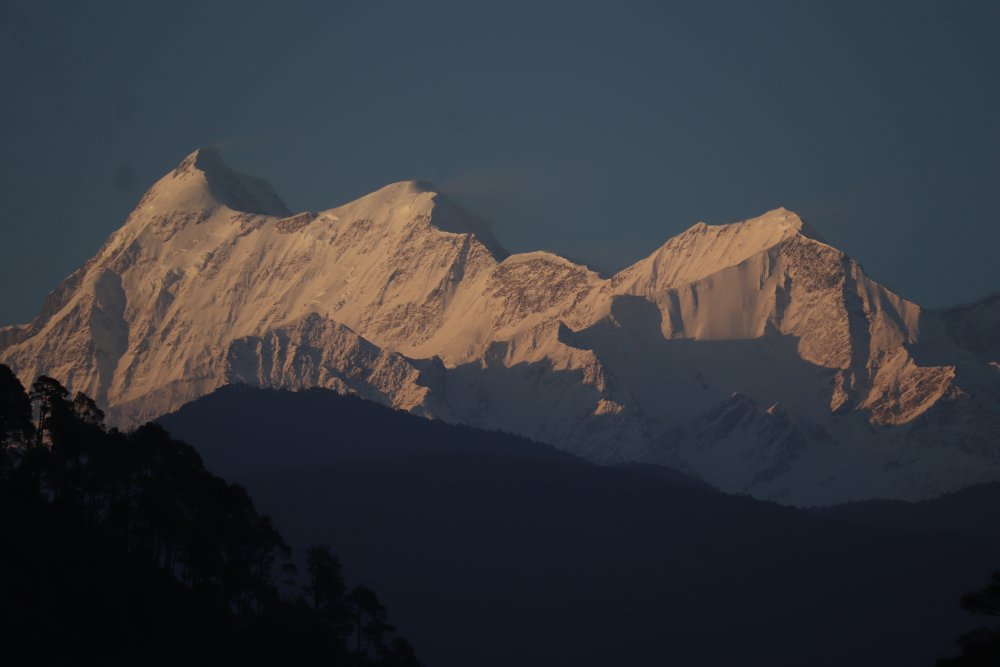
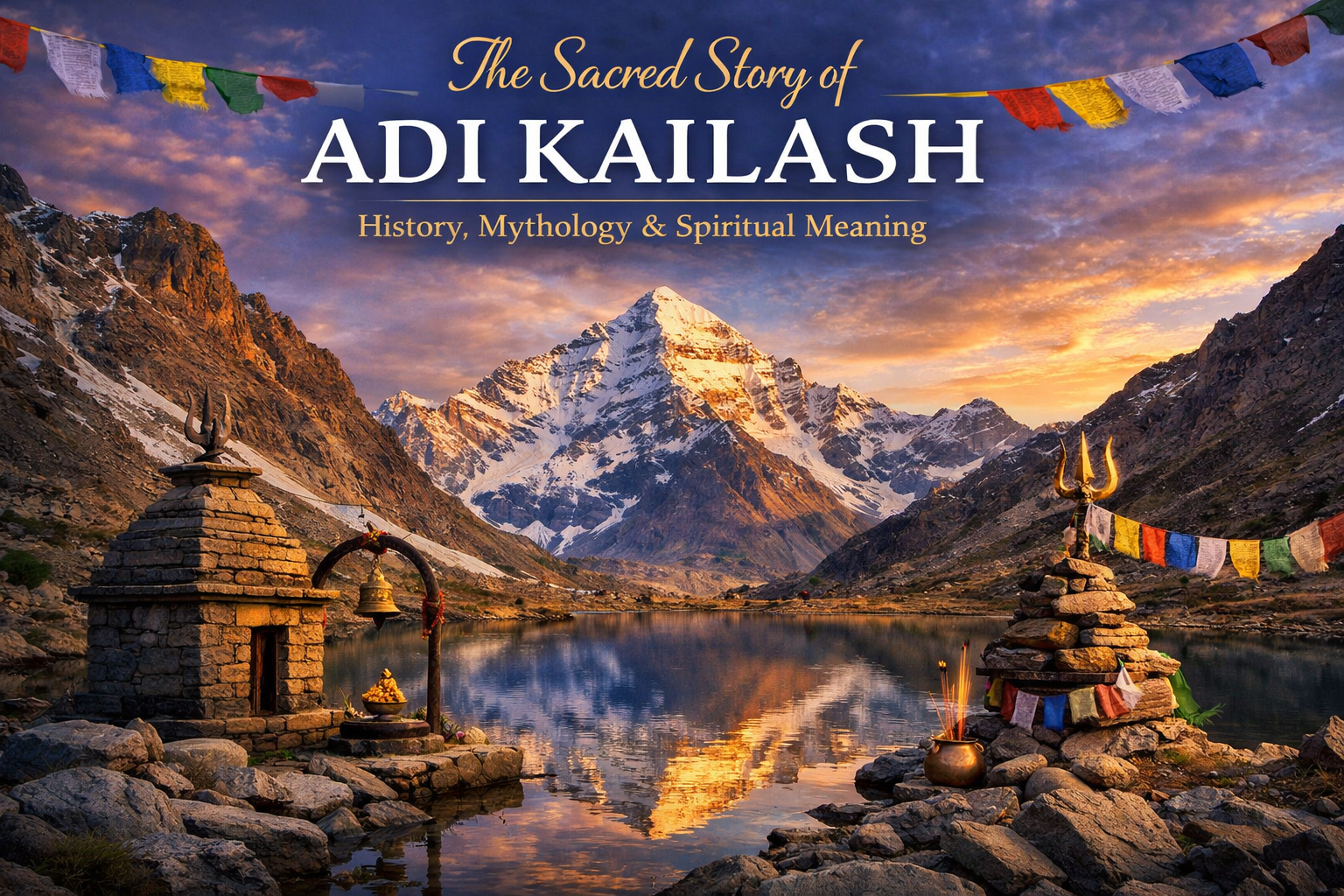
There are mountains, and then there are mountains that carry the weight of the cosmos. Adi Kailash is the latter. Rising silently at approximately 6,191 metres in the Pithoragarh district of Uttarakhand, this magnificent Himalayan peak is not merely a geographical landmark — it is, for millions of Hindu devotees, the earthly home of Lord Shiva himself. Its pyramid-shaped summit, mirroring the legendary Mount Kailash of Tibet, has drawn sages, pilgrims, and seekers across centuries, all drawn by the same ancient pull toward the divine.
The Sacred Story of Adi Kailash is not one story but many — woven together from the Puranas, the Mahabharata, the Ramayana, and centuries of living oral tradition. It is the story of Shiva’s cosmic dance, Parvati’s undying devotion, Ravana’s fearless penance, and the Pandavas’ final pilgrimage. It is the story of a sacred geography where mythology and landscape are inseparable, where the mountain itself is a scripture, and the wind through the Vyas Valley carries the echo of prayers spoken thousands of years ago.
In this article, we unfold that story in full — its history, its mythological roots, its sacred sites, and the profound Adi Kailash spiritual significance that continues to transform every soul who undertakes this journey. Whether you are planning to visit or simply wish to understand what makes Adi Kailash among the most revered peaks in the Hindu world, this is your complete guide.
What Does “ADI KAILASH” Mean? The Name Itself Is A Scripture
To understand the mountain, begin with its name. In Sanskrit, the word “Adi” means first, original, or primordial. “Kailash” is the sacred abode of Lord Shiva — the mountain at the centre of cosmic consciousness in Hindu cosmology.
Put together, Adi Kailash means “the Original Kailash” — the primordial manifestation of the divine energy that is more widely associated with Mount Kailash in Tibet. Ancient Hindu texts suggest that this peak was Lord Shiva’s first earthly dwelling — the original ground where the great god chose to anchor his divine presence on earth before the larger Kailash became his more universally known abode.
This is why Adi Kailash is also called Chhota Kailash, meaning “Little Kailash.” The name is both an affectionate reference to its smaller size compared to Mount Kailash in Tibet, and a mark of deep reverence, for in Hindu cosmology, “little” does not mean lesser. It means closer. More intimate. More accessible to the devotee who cannot cross the Tibetan border but yearns for the same divine experience.
The name is also a theological statement. To call a mountain “Adi” is to place it at the very beginning of sacred time — before history, before recorded scripture, in the age when gods and earth were still in direct conversation with each other.
Adi Kailash And Lord Shiva — The Cosmic Abode
The relationship between Adi Kailash and Lord Shiva is the spiritual core around which every myth, every ritual, and every pilgrimage revolves. Hindu tradition holds, with absolute certainty, that this mountain is not just associated with Shiva — it is where he resides.
Shiva’s Eternal Meditation
According to Hindu scriptures and Puranic texts, Lord Shiva — the Mahadeva, destroyer, and transformer of the universe — chose Adi Kailash as the site of his eternal meditation. For thousands of years, the god of gods sat in deep contemplation on this peak, his consciousness expanding across the universe while his physical form remained rooted to the mountain. This is why the atmosphere at Adi Kailash is described by pilgrims not as merely peaceful, but as charged — as if the very air carries the residue of Shiva’s concentrated divine awareness.
The mountain’s pyramid shape is considered deeply significant in this context. It mirrors the shape of cosmic Mount Meru — the axis of the universe described in Hindu, Buddhist, and Jain cosmology — reinforcing the belief that Adi Kailash is literally a point where the divine and the earthly converge.
The Tandava — Shiva’s Cosmic Dance at Adi Kailash
One of the most extraordinary mythological events associated with Adi Kailash is the Tandava — the cosmic dance of Lord Shiva that is said to represent the energy of the universe in perpetual creation, preservation, and dissolution.
According to Puranic tradition, it was at Adi Kailash that Lord Shiva performed the Tandava and revealed his complete divine form to the sage Ashtavakra. This was not a performance for spectators — it was a revelation of cosmic truth. The Tandava at Adi Kailash represents the moment when the veil between the human and the divine was lifted, when a sage in deep meditation witnessed the full, unfiltered power of the supreme being.
For devotees who visit Adi Kailash, this story gives the mountain an additional dimension. It is not just a place of stillness and meditation — it is also the stage of the most powerful dance in creation.
Lord Shiva and Goddess Parvati — The Second Home
A beautiful legend in the Puranas narrates that Lord Shiva and Goddess Parvati, wishing to remain close to their earthly devotees, chose Adi Kailash as their second home, with Mount Kailash in Tibet being their primary celestial abode. The very landscape reflects this divine domesticity. The sacred Parvati Sarovar, a pristine high-altitude lake near Adi Kailash, is believed to be the place where Goddess Parvati bathed. The Gauri Kund — a sacred lake at the foot of the peak — is named after her. Temples near the base of the mountain are dedicated jointly to both Shiva and Parvati.
The presence of both deities at Adi Kailash makes it a place of complete divine energy — not just the fierce austerity of Shiva, but also the nurturing, compassionate grace of Shakti in her form as Parvati and Gauri.
The Panch Kailash — Where Adi Kailash Stands In The Sacred Map
To understand the full Adi Kailash spiritual significance, one must understand it in the context of the Panch Kailash — the Five Sacred Kailash Peaks of the Himalayas. According to ancient Hindu texts, including the Puranas and the Skanda Purana, Lord Shiva selected five magnificent Himalayan peaks as his earthly manifestations. Together, these five peaks form one of the most profound pilgrimage circuits in Hindu tradition.
The Five Kailash Peaks are:
1. Kailash Mansarovar — Located in Tibet; considered the primary and most revered abode of Lord Shiva; revered also in Buddhism, Jainism, and the Bon religion.
2. Adi Kailash (Chhota Kailash) — Located in the Pithoragarh district of Uttarakhand, India; ranked second among the Panch Kailash; represents the primordial manifestation of divine energy.
3. Shrikhand Mahadev (Shikhar Kailash) — Located in Himachal Pradesh, an extremely challenging pilgrimage involving steep rocky ascents.
4. Kinnaur Kailash — Located in the Kinnaur district of Himachal Pradesh; revered in both Hinduism and Buddhism.
5. Manimahesh Kailash — Located in the Chamba district of Himachal Pradesh, famous for the Manimahesh Yatra during Bhadrapada.
Each of these five peaks represents a different aspect of Lord Shiva’s divine personality. According to Hindu cosmological understanding, they form a sacred energy grid across the Himalayas — points of concentrated divine power that, when visited, bring the devotee progressively closer to liberation or moksha.
Adi Kailash, ranked second in this divine hierarchy, holds a position of extraordinary importance. It is the most accessible of the sacred five for Indian pilgrims — entirely within Indian territory, requiring no international travel — and its spiritual potency is considered equal in essence, if not in scale, to Kailash Mansarovar.
For millions of devotees, the Adi Kailash Yatra Cost 2026 is not just a financial calculation — it is the price of a pilgrimage that delivers the same spiritual merit as the far more demanding and expensive Kailash Mansarovar journey in Tibet.
Parvati Sarovar — The Sacred Lake Of The Goddess
One of the most quietly sacred sites along the Adi Kailash Yatra route is Parvati Sarovar — a high-altitude glacial lake believed to be where Goddess Parvati performed her sacred bathing rituals. The lake sits at an elevation of approximately 4,700 metres near Jolingkong, in the shadow of Adi Kailash itself.
The spiritual significance of Parvati Sarovar is layered and profound:
- It is believed that the waters of Parvati Sarovar possess divine healing properties — not just for the body, but for the soul. Pilgrims who dip their hands or feet into its waters speak of an indescribable sense of calm and clarity.
- The lake freezes over completely in winter, transforming into a vast natural mirror of ice. This seasonal freezing and thawing is interpreted by locals as a rhythm in harmony with Parvati’s own cycles of presence and withdrawal.
- Ancient texts suggest that the divine beings from the higher realms — devas and apsaras — descend to bathe in Parvati Sarovar, drawn by its sanctity. The lake is therefore considered a meeting point between the earthly and the celestial.
- The sight of Adi Kailash reflected in the still waters of Parvati Sarovar on a clear morning is described by those who have witnessed it as among the most visually and spiritually stunning moments a human being can experience in the natural world.
The journey to Parvati Sarovar is itself a form of meditation — a gradual ascent through thinning air and expanding sky, where the noise of the ordinary world falls away completely, and something quieter and older takes its place.
Gauri Kund — The Lake Of Compassion
If Parvati Sarovar is the lake of the goddess in her regal aspect, Gauri Kund is the lake of the goddess in her healing aspect. Located at the foot of Adi Kailash at an elevation of 5,608 metres, Gauri Kund — also known as Jolingkong Lake — is one of the most mythologically rich sites along the yatra circuit.
The name Gauri Kund translates as “Lake of Compassion” — Gauri being another name for Parvati, emphasising her luminous, gentle, and compassionate form. The stories associated with this lake speak directly to the power of devotion and the healing grace of the goddess.
The Legend of the Demon Jalandhar
The most significant myth surrounding Gauri Kund involves the fearsome demon Jalandhar, who, blessed with extraordinary power, had become nearly invincible. After a great battle, Goddess Parvati, having exhausted her divine energy in defeating this demon, immersed herself in the waters of Gauri Kund to restore her strength. The sacred lake, it is said, replenished her divine power completely — enabling her to emerge renewed and fully radiant, ready to resume her role as Shakti, the cosmic feminine energy.
This story carries a message far beyond its mythological context: even the goddess needs restoration. Even the most powerful force in the universe requires a sacred space to heal and renew. For pilgrims who visit Gauri Kund, this is a deeply personal message — a reminder that the act of pilgrimage itself is an act of self-restoration.
The Shrine at the Lake’s Edge
On the shores of Gauri Kund stands a small shrine jointly dedicated to Goddess Parvati and Lord Shiva. Pilgrims performing the Adi Kailash Yatra invariably stop here to offer prayers, flowers, and water from the lake itself. The combination of the sacred lake, the distant peak of Adi Kailash visible overhead, and the small ancient shrine creates an atmosphere of extraordinary spiritual concentration — one that experienced pilgrims describe as unlike anywhere else on earth.
Local folk tradition holds that divine beings regularly descend to bathe in Gauri Kund’s waters — an extension of the same belief associated with Parvati Sarovar. The lake, in other words, is not merely remembered by the divine. It is actively frequented by them.
The Vyas Valley And Ved Vyas Gufa — Where Scripture Was Born
The Vyas Valley, through which the primary route to Adi Kailash passes, carries its own extraordinary mythological heritage. The valley is named after Maharishi Ved Vyas — the sage who is credited with composing the Mahabharata, the Brahma Sutras, and compiling the eighteen Puranas that form the backbone of Hindu scriptural knowledge.
According to tradition, it was in the silence and solitude of the Vyas Valley that this great sage meditated and channelled the words of these sacred texts. The Ved Vyas Gufa — a cave in the valley — marks the site where he is believed to have lived and worked. The cave is still visited by pilgrims, who sit in its darkness and feel, quite literally, that they are inhabiting the same space where the foundations of Hindu literature were laid.
The irony that this valley — where the Mahabharata was born — lies on the path to Adi Kailash — where the Pandavas themselves undertook their final pilgrimage — is not lost on devotees. The landscape collapses time. The pilgrim of today walks the same ground as Yudhishthira and Bhima, breathes the same mountain air that filled Maharishi Vyas’s lungs, and arrives at the same sacred summit that has drawn the faithful for millennia.
For pilgrims mapping out their journey and wondering about the How to Reach Adi Kailash from Delhi route, passing through the Vyas Valley is not just a matter of geography — it is a passage through living mythology.
Mythological Stories That Define Adi Kailash
The myths of Adi Kailash are not dusty relics of the past. They are living narratives that pilgrims carry with them as they climb, and that shape the meaning of every step taken toward the sacred summit.
Parvati’s Unwavering Devotion — The Test of Love
Among the most beloved stories of Adi Kailash is the account of Goddess Parvati’s penance to win the heart of Lord Shiva. Shiva, in his characteristic asceticism, had little interest in marriage. He was absorbed in eternal meditation, indifferent to earthly attachments, including romantic love.
Parvati, deeply in love with Shiva, undertook a series of gruelling tests at Adi Kailash to prove the depth of her devotion. She fasted, meditated in extreme cold, and withstood every challenge Shiva placed before her — not with resentment, but with unwavering faith and grace. Shiva, moved beyond measure by her dedication, finally agreed to marry her.
This story is the spiritual centrepiece of the Adi Kailash pilgrimage for many devotees, particularly for women who undertake the yatra as an act of devotion to both Shiva and Parvati. The message it carries — that sincere, patient, unshakeable devotion ultimately moves even the most seemingly inaccessible divine being — resonates across every era and every tradition.
Ravana’s Penance — Power Granted and Misused
The story of Ravana at Adi Kailash is one of the most dramatic in the entire mythological tradition associated with the mountain. Ravana — the demon king of Lanka, a devoted follower of Shiva, and the principal antagonist of the Ramayana — undertook an extraordinary penance at Adi Kailash, seeking to obtain supreme power from Lord Shiva.
His penance was so intense, so resolute, and so complete that Shiva was compelled to respond. The god granted Ravana the strength of twenty arms and the intellect of ten heads — an unprecedented boon that made him virtually undefeatable by mortal and most divine means.
The story does not end in triumph, however. Ravana’s misuse of these divine gifts — his pride, his arrogance, and ultimately his transgression against Sita — led to his defeat at the hands of Rama. The Adi Kailash portion of the Ravana story is therefore read as a cautionary parable: even the most extraordinary spiritual attainment, if corrupted by ego, leads to ruin. The mountain that granted the boon is the same mountain that bears witness to the consequences of how it was used.
The Pandavas’ Final Journey
The Mahabharata describes the last pilgrimage of the five Pandava brothers — Yudhishthira, Bhima, Arjuna, Nakula, and Sahadeva — along with their wife Draupadi, as they walked toward the heavens at the end of their mortal lives. Their path took them through Adi Kailash, which they regarded as a sacred ground capable of cleansing the accumulated karma of even the Kurukshetra war — the bloodiest conflict in Hindu epic tradition.
That the five warrior brothers who had carried the weight of an entire civilisation’s moral crisis chose Adi Kailash as their place of spiritual purification speaks to the mountain’s supreme standing in the Hindu imagination. The Pandavas’ pilgrimage to this sacred peak is the ancient world’s validation of its divine status.
OM Parvat— The Mountain That Writes Its Own Scripture
No account of Adi Kailash’s spiritual significance is complete without Om Parvat. Located near the India-Tibet-Nepal trijunction, this sacred mountain is where snow naturally settles in the shape of the “ॐ” (Om) symbol — the primordial sound of the universe in Hindu and Vedic philosophy.
This is not an artist’s rendering or a constructed symbol. It is a formation shaped by wind, snow, and the contours of the mountain’s rock face — and yet it produces, with remarkable consistency, the most recognisable symbol in all of Hindu spirituality.
According to tradition, there are only eight mountains in India on which an impression of the Om symbol appears naturally. Of these eight, only one has been definitively identified and visited — Om Parvat, near Adi Kailash. This makes Om Parvat not just rare, but singular: the only place in the world where the universe has written its own name in snow.
The spiritual significance of Om in Hindu philosophy cannot be overstated. It is the sound of creation — the first vibration from which all existence emerged. To witness it inscribed on a mountain face by nature itself, especially when the peak is draped in fresh white snow, is an experience that pilgrims across centuries have described using the same word: grace.
Those planning to undertake the Adi Kailash Yatra helicopter route will typically have a dedicated sortie to Nabidhang, the closest accessible viewpoint to Om Parvat, offering an aerial perspective of the Om symbol that ground-level pilgrims cannot access.
Adi Kailash Beyond Hinduism — A Confluence Of Faiths
One of the less-discussed but deeply significant aspects of Adi Kailash’s spiritual significance is its meaning beyond Hinduism. In Buddhist cosmology, Mount Kailash is identified as Mount Sumeru — the axis of the universe. Adi Kailash, as a mirror and replica of Kailash Mansarovar, carries that same symbolism for Buddhist practitioners.
Buddhist pilgrims undertake the circumambulation (kora) of Adi Kailash, walking around its base in a ritual that mirrors the kora performed at Kailash Mansarovar. The path around the mountain is dotted with colourful prayer flags and stone cairns — each one a physical marker of a prayer offered and a devotee’s passage through this sacred landscape.
The region surrounding Adi Kailash also reflects a rare and beautiful confluence of Hindu and Buddhist architectural traditions. Temples with Buddhist elements and monasteries with Hindu symbols stand in quiet coexistence, reflecting the inclusive, syncretic spirituality of the high-altitude communities who have lived in this region for generations.
Ancient healing practices, thangka painting, wood carving, oral recitations of epic stories, and traditional folk music all continue to thrive in the villages along the Adi Kailash route — preserved by the very isolation that has kept this region beyond the reach of rapid modernisation. For those undertaking the pilgrimage, this cultural richness is not a tourist attraction. It is an encounter with a living tradition whose roots reach all the way back to the age of the Puranas.
This cultural and spiritual depth is one of the reasons why, beyond the helicopter ride and logistics, completing the Adi Kailash registration process to undertake this journey is considered by many devotees an act of intention in itself — a formal step toward something sacred.
Other Sacred Sites Along The Adi Kailash Yatra Route
The pilgrimage to Adi Kailash is not a journey to a single site — it is a traversal through a landscape saturated with sacred significance at every turn. Here are some of the key spiritual stops along the route:
Kunti Parvat
A mountain in the Adi Kailash circuit is named after Kunti, the mother of the five Pandava brothers. Local legend holds that Kunti herself came to this peak in devotion, and the mountain carries her name as an eternal memorial to her sacrifice and maternal love.
Pandav Fort (Pandav Qila)
Ruins believed to be the remnants of a fort built by the Pandavas during their legendary Agyatvas — the thirteen years of exile, one year of which was to be spent incognito. The locals believe the Pandavas concealed themselves in this high-altitude region, using the remoteness of the Adi Kailash terrain as cover.
Kali Mandir
A small but powerful temple dedicated to Goddess Kali along the yatra route. Like all Kali shrines in this region, it carries a fierce and protective energy — a reminder that the divine feminine here is not only the gentle Gauri of the sacred lakes but also the fierce, transformative Kali.
Patal Bhuvaneshwar
A cave temple near Adi Kailash is dedicated to Lord Shiva and is accessible through a narrow underground passage that opens into a series of chambers containing naturally formed Shivalingas and other divine formations. Pilgrims consider entering this cave to be an experience of descending into the very earth of Shiva’s domain.
Neeb Karori Baba Ashram (Kainchi Dham)
Located near the Adi Kailash region, the ashram of the great saint Neeb Karori Baba — known in the West as Neem Karoli Baba — draws devotees from across the world. Kainchi Dham has become one of the most visited spiritual centres in Uttarakhand, its energy amplified by proximity to the sacred Kailash circuit.
What The Pilgrimage Does To You — The Inner Transformation
Every serious pilgrim who has undertaken the Adi Kailash Yatra speaks of the same phenomenon: the journey changes you. Not dramatically. Not in the way a sudden revelation might. But quietly, deeply, in the way that all sustained encounters with the sacred tend to work.
The thin air at high altitude forces a slowing down. The body cannot rush, and so the mind follows. The eyes, stripped of urban distraction, turn inward. The silence of the mountains — not the absence of sound, but the presence of a deeper stillness — gradually dismantles the noise that accumulates in the ordinary mind.
Ancient Hindu thought describes this as the effect of sattvic environments — places saturated with the guna (quality) of purity, clarity, and light. Adi Kailash is considered one of the most sattvic environments on earth. Spending days in its presence, breathing its air, sitting by Parvati Sarovar or Gauri Kund, and witnessing the Om symbol on Om Parvat is believed to purify accumulated karmic residue and reorient the pilgrim’s inner compass toward what truly matters.
Whether or not one holds a theological framework for these ideas, the transformation reported by pilgrims is consistent and cross-cultural. Something about Adi Kailash returns people to themselves.
For detailed practical guidance on how to get there, be sure to explore our comprehensive guide on the How to Reach Adi Kailash from Delhi route — covering all transport options, distances, and the best ways to reach Pithoragarh, the gateway to this sacred circuit.
Planning Your Adi Kailash Pilgrimage — Practical Spiritual Preparation
Beyond logistics and bookings, experienced pilgrims recommend preparing for Adi Kailash spiritually, not just physically. Here are some actionable insights:
- Begin your inner preparation weeks before departure. Practise early morning meditation or prayer. Reduce noise, distraction, and mental clutter. Approach the journey as something that begins before you leave home.
- Learn the primary myths and stories of Adi Kailash before you go. The mountains speak to those who know their language. When you stand at Gauri Kund and recall the story of Parvati’s restoration, the lake becomes far more than a body of water.
- Travel with an attitude of reverence, not just curiosity. Adi Kailash is not a photo opportunity — it is a living sacred space. The pilgrims who report the deepest transformations are those who approached the mountain with open hearts rather than packed agendas.
- Respect the environment. The sanctity of the landscape is inseparable from its physical purity. Leave no waste. Speak softly. Walk gently.
- Complete your Adi Kailash registration well in advance and comply with all documentation requirements, including the physical fitness certificate. These requirements exist not as bureaucratic hurdles but as genuine safeguards for your safety at high altitude.
- Consult our detailed resource on the Adi Kailash Yatra Cost 2026 for a realistic understanding of package pricing, the Uttarakhand Government’s ₹26,000 per person subsidy, and how to choose the right operator for your budget and needs.
FREQUENTLY ASKED QUESTIONS (FAQ)
Q1. What is the spiritual significance of Adi Kailash in Hinduism?
Adi Kailash is considered the primordial earthly abode of Lord Shiva and Goddess Parvati. It is the second most sacred peak in the Panch Kailash circuit, believed to carry the same divine energy as Mount Kailash in Tibet. Ancient texts, including the Puranas and the Mahabharata, mention Adi Kailash as a site of extraordinary sacred power, where Lord Shiva meditates, performs the Tandava, and responds to the prayers of his devotees.
Q2. Why is Adi Kailash called Chhota Kailash?
Adi Kailash is called Chhota Kailash — meaning “Little Kailash” — because of its physical and spiritual resemblance to Mount Kailash in Tibet. The mountain’s pyramid-shaped summit, surrounding landscape, and mythological associations closely mirror those of the larger Kailash Mansarovar. The name reflects affectionate reverence, not diminishment of its sanctity.
Q3. What is the Panch Kailash, and where does Adi Kailash rank?
The Panch Kailash refers to five sacred Himalayan peaks considered to be manifestations of Lord Shiva: Kailash Mansarovar (Tibet), Adi Kailash (Uttarakhand), Shrikhand Mahadev (Himachal Pradesh), Kinnaur Kailash (Himachal Pradesh), and Manimahesh Kailash (Himachal Pradesh). Adi Kailash ranks second in this divine hierarchy, after Kailash Mansarovar, and is the most important among those located within Indian territory.
Q4. What is the significance of Gauri Kund at Adi Kailash?
Gauri Kund is a sacred lake at the base of Adi Kailash at an elevation of 5,608 metres. Named after Goddess Parvati (Gauri), it translates as “Lake of Compassion.” According to Hindu mythology, after defeating the demon Jalandhar, Goddess Parvati immersed herself in Gauri Kund to restore her divine strength. A shrine dedicated to both Parvati and Shiva stands at its edge, making it a vital stop for pilgrims on the yatra.
Q5. What is the significance of Parvati Sarovar?
Parvati Sarovar is a high-altitude glacial lake near Jolingkong, believed to be the sacred bathing lake of Goddess Parvati. Its waters are considered spiritually purifying. The lake freezes in winter, and the sight of Adi Kailash reflected in its still surface is considered one of the most breathtaking and spiritually powerful moments of the pilgrimage.
SUMMARY
The Sacred Story of Adi Kailash is ultimately a story about what endures. Civilisations have risen and fallen. Languages have been born, evolved, and forgotten. Wars have been fought over mountains far less majestic than this one. And yet, through all of it, Adi Kailash has remained — standing in its pyramid-shaped silence in the eastern Kumaon Himalayas, waiting for the next devotee to arrive at its threshold with a sincere heart.
Its stories — of Shiva’s meditation and cosmic dance, of Parvati’s unwavering devotion, of Ravana’s ambition, of the Pandavas’ final surrender — are not historical curiosities. They are living wisdom, encoded in myth, designed to be unlocked not in libraries but in the body of a person who has breathed the thin air of 5,000 metres and witnessed the Om symbol written in snow on a mountain’s face.
The Adi Kailash spiritual significance that millions of pilgrims seek year after year is real — not because it requires a particular theological belief, but because something genuine happens when a human being journeys this far, this high, and this sincerely toward something greater than themselves.
Whether you plan your 2026 pilgrimage by road, by helicopter, or simply by reading every word of this guide and sitting with the stories it contains, Adi Kailash has already begun its work on you.
With the Adi Kailash Yatra season approaching, it’s time to plan a journey that blends spirituality with raw Himalayan adventure. From sacred lakes to the divine presence of Adi Kailash, every moment feels profound and transformative. If you seek purpose beyond travel, this is your path.
Visit this page for Yatra Packages, Itinerary & Booking.