There are pilgrimage routes, and then there are journeys that carry the weight of a civilisation’s deepest questions. The five Panch Kedar temples of Uttarakhand are not simply ancient shrines scattered across the Garhwal Himalaya — they are the physical record of a story that began on the battlefield of Kurukshetra and ended in the high snows of the world’s greatest mountain range. Every stone here has a name. Every summit holds a memory that the mountains have agreed to keep for the rest of time.
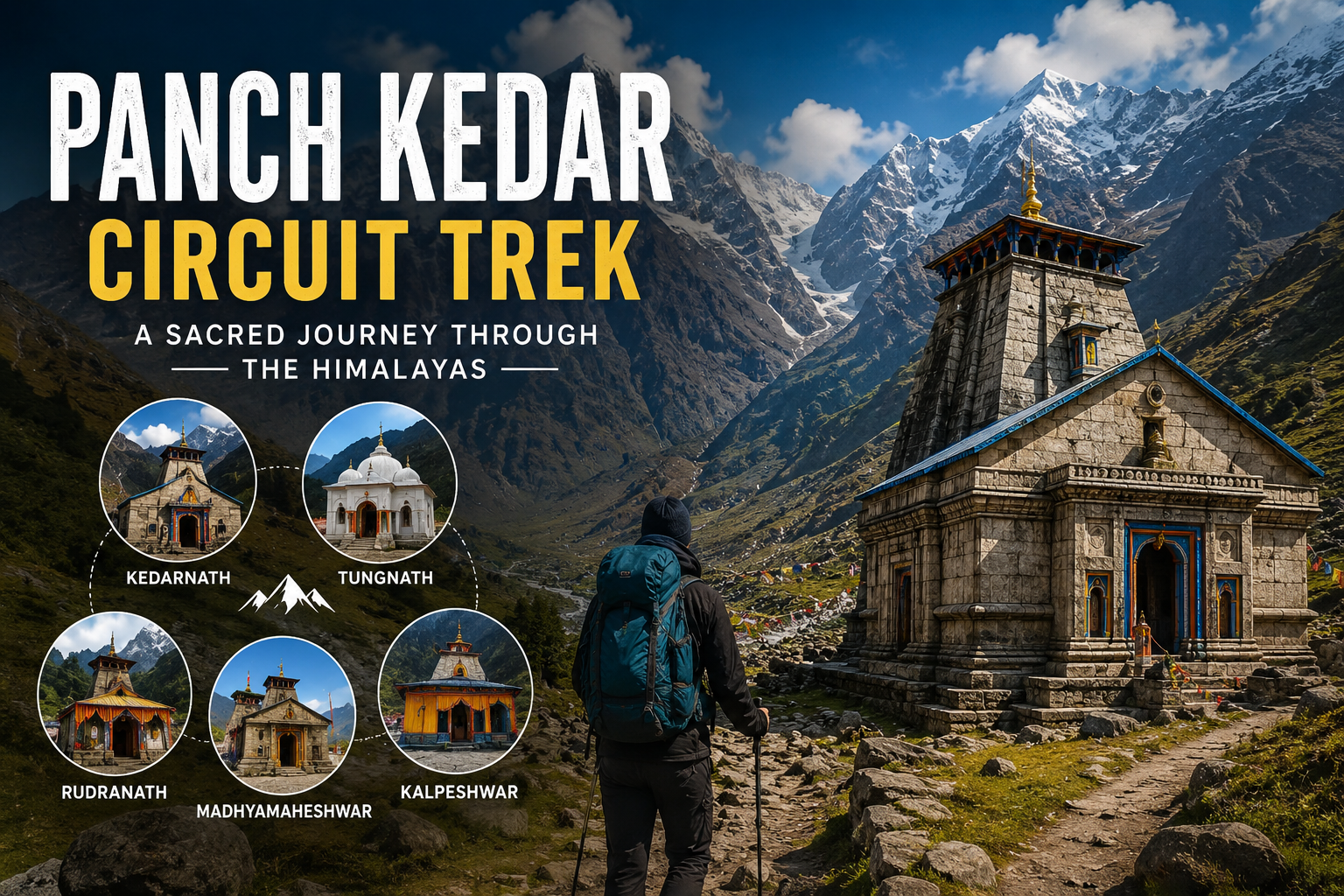
The Pandava Trail connects five of the most spiritually significant Shiva temples in Garhwal — Kedarnath, Tungnath, Rudranath, Madhyamaheshwar, and Kalpeshwar — across the ridges and valleys of the Garhwal Himalayas. But unlike most pilgrimages that converge on a single sacred point, this circuit tells a single, unbroken mythological story spread across five distinct locations and five divine manifestations of Lord Shiva.
This article goes beyond the standard summary. What follows is the definitive mythological account of the Panch Kedar pilgrimage — the sin that initiated the quest, Shiva’s dramatic disappearance into the earth, the precise meaning of each body part at each temple, the almost-unknown Pashupatinath connection, and what it truly means, theologically, to complete the full circuit.
The Sin That Started It All — Kurukshetra and the Pandavas’ Guilt
The story of the Panch Kedar temples does not begin in the mountains. It begins on a battlefield, in the smoke and silence that follows one of the most catastrophic wars in human memory.
The Kurukshetra War had ended. The Pandavas had won. But victory tasted like ash. The cost was staggering — millions dead, the Kuru dynasty nearly extinguished, and among the fallen were the Pandavas’ own cousins, beloved teachers, and blood kin. Ancient texts are explicit about the nature of this guilt: killing one’s own kin and the learned among the enemy incurred Brahmahatya — one of the gravest forms of karmic sin in the Vedic and Puranic framework.
Yudhishthira, bearing the weight of kingship and dharmic responsibility most visibly, could not be consoled by the fact of victory. The Pandavas sought absolution — not from priests, not from kings, but from Shiva himself. Only the destroyer could undo the karmic stain of mass destruction. Only Mahadev could grant the prayaschitta (atonement) that the five brothers now desperately needed.
They were directed, by sage counsel, toward Kashi (Varanasi) — the city of Shiva. But Shiva, fully aware of what was coming, had already made his decision. He was not prepared to grant forgiveness easily. The lord of the universe vanished — and the chase that would create one of India’s greatest pilgrimage traditions began.
Shiva’s Great Escape — Why the Lord Chose the Garhwal Himalayas
Shiva’s refusal to meet the Pandavas was not indifference. It was a cosmic test embedded within the structure of the story itself. The god who sees through all illusion understood that the Pandavas’ atonement had to be earned through the highest effort, not granted by proximity or convenience.
When the Pandavas arrived in Kashi and found no trace of Shiva, they were told the lord had been sighted moving toward the mountains. Through the foothills, across the Alaknanda and Mandakini valleys, through the dense rhododendron and oak forests of the Garhwal Himalaya, the five brothers followed.
In the region of Guptkashi — aptly named the hidden Kashi — Shiva is said to have disguised himself as a bull (Nandi) and merged into a grazing herd. Bhima, the most physically formidable of the brothers, recognised him. As Bhima reached for the bull, Shiva began to sink into the earth. His body parts emerged at five different sacred locations across the Garhwal highlands, each one becoming a site of eternal self-manifested divine presence — a swayambhu form that no human hand had shaped and no ritual had installed.
The mythology is deliberate in this detail. The fragmentation of the divine body across the landscape is not dissolution — it is multiplication of grace. And the geography itself, wild and demanding, became the final stage of the Pandavas’ transformation from warriors into pilgrims.
The Five Sacred Manifestations — Panch Kedar Mythology Explained
In Shaivite tradition, each location where Shiva’s body part emerged carries a specific theological significance — a different dimension of the lord made accessible through a specific sacred site. Together, the five form a complete divine body distributed across the Himalayan terrain.
Kedarnath — The Hump of the Sacred Bull
At 3,583 metres, Kedarnath is the gravitational centre of the entire Panch Kedar circuit. When the divine bull sank into the earth, the hump remained above ground. The Trikona — the triangular rock form worshipped inside the inner sanctum — is anointed with ghee, milk, and flowers by pilgrims throughout the yatra season.
The hump is not incidental mythology. In Shaivite symbolism, the hump of Nandi represents Shiva’s power of ascent — the upward movement of divine energy. Kedarnath is thus the seat of Shakti in its most concentrated, upward-moving form.
Folk tradition in Ukhimath, where the Kedarnath deity resides during winter, preserves a version in which Bhima’s grip on the bull is what prevented Shiva from disappearing completely. The hump remained because it was the last point of physical contact between the human and the divine.
Tungnath — The Arms of the Cosmic Lord
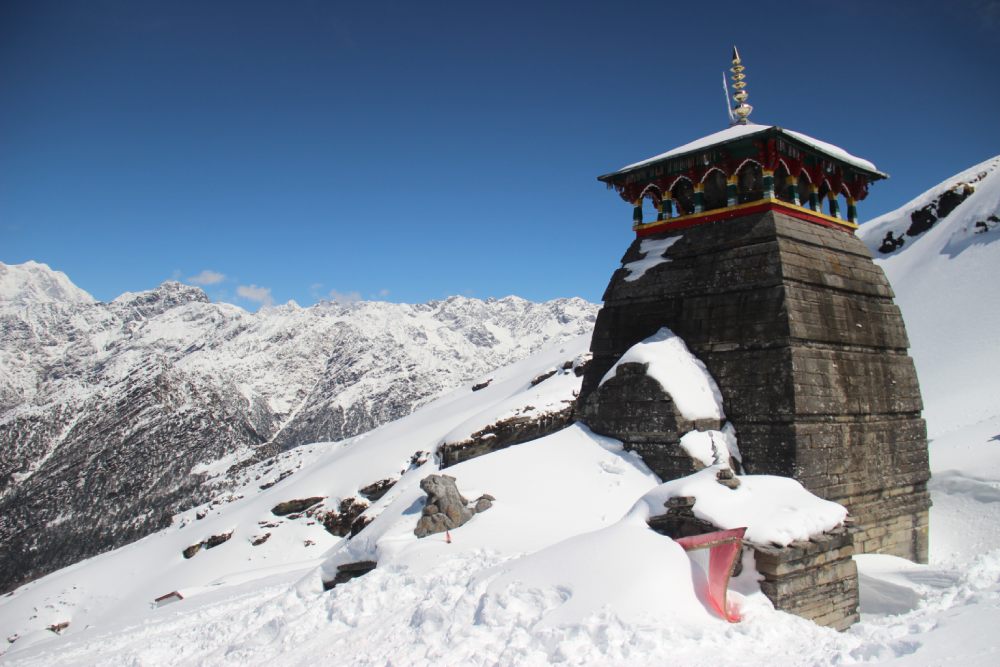
Tungnath, at 3,680 metres, holds the distinction of being the highest Shiva temple in the world. Here, Shiva’s arms (Bahu) emerged from the earth. In Shaivite cosmology, the arms represent Shiva’s capacity for action — his role as the one who creates, preserves, and dissolves simultaneously through gesture and intention.
The temple faces west — a rare orientation among Himalayan shrines, linked by local priests to the direction of the setting sun, representing Shiva’s sovereignty over endings and transitions.
The relatively well-maintained trail from Chopta makes Tungnath one of the more accessible stops on the circuit. Families and first-time Himalayan pilgrims often find this the most approachable of the five temples. For those considering bringing younger family members on parts of this sacred circuit, our dedicated resource on Panch Kedar with Kids covers altitude-appropriate segments, child-friendly campsites, and how to pace the circuit responsibly with children in tow.
Rudranath — The Face of the Formless
At Rudranath, situated in a remote high-altitude bowl at 2,286 metres, Shiva’s face (Mukha) emerged from the earth. In Shaivite theology, the face is the seat of the divine senses — the organ through which Shiva perceives, communicates, and ultimately transforms the universe with his third eye.
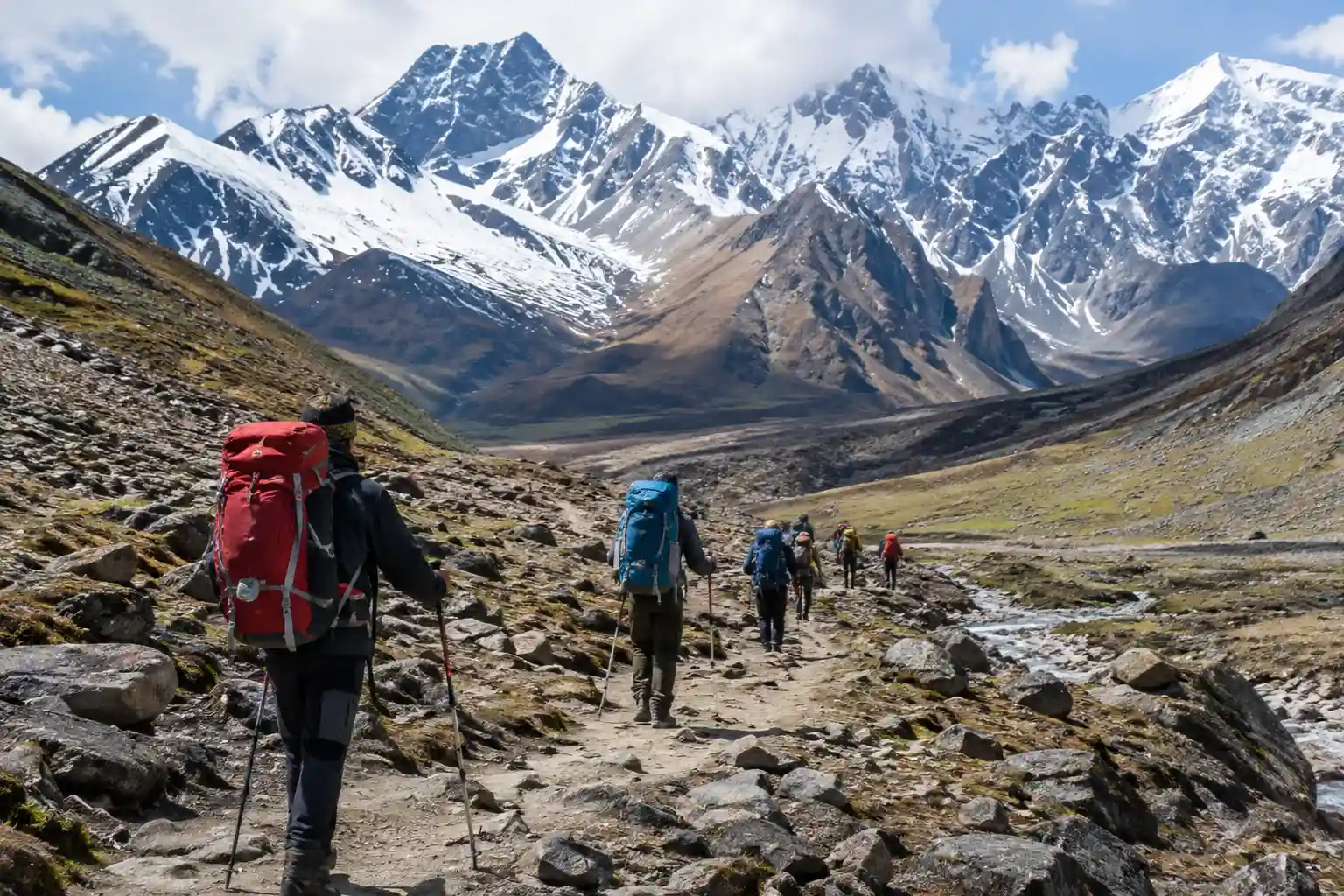
The approach to Rudranath is the most demanding of the five — a multi-day route through open alpine meadows, past sacred kunds, and through terrain with minimal infrastructure. This difficulty is considered theologically deliberate. The face of Shiva, which sees all, is not meant to be encountered easily.
Local Garhwali tradition describes the natural rock formation worshipped here as possessing an expression that shifts with the angle of light — fierce during storms, serene on clear mornings. Experienced priests of the region consider Rudranath the most potent of all five sites in terms of concentrated spiritual energy.
Madhyamaheshwar — The Navel of the Universe
Madhyamaheshwar marks the site where Shiva’s navel and the middle portion of the torso emerged. In Hindu philosophical tradition, the navel represents the centre of creation — the point from which the universe unfolds and to which it returns. The resonance with the lotus navel of Vishnu in Vaishnavite mythology is deliberate and points toward a shared cosmological framework across Hindu sects.
The temple sits at 3,497 metres in a meadow of extraordinary beauty, encircled by Kedarnath Peak, Chaukhamba, and Neelkanth. The view from this meadow is among the finest in the entire Garhwal range.
The route begins from Ransi village and passes through pastoral Gujjar and Garhwali settlements that carry a living cultural memory of the pilgrimage in their seasonal rhythms and oral traditions. For senior pilgrims drawn to the Panch Kedar circuit, Madhyamaheshwar’s moderate altitude and manageable gradient make it one of the more physically accessible temples. Our guide on Panch Kedar Trek After 60 addresses specific health, acclimatisation, and pacing strategies for older devotees — including which temples to prioritise when a complete circuit is not feasible.
Kalpeshwar — The Matted Locks of the Ascetic
Kalpeshwar, the fifth and final temple of the circuit, is located at 2,200 metres near Urgam village in Chamoli district. Here, Shiva’s matted hair — his jata — emerged from the earth.
Kalpeshwar is the only one of the five temples accessible year-round, sitting at a lower altitude and remaining free of the winter snowbound closure that affects the other four. This gives it a distinct, intimate character — more quietly devotional, without the seasonal surge of yatra crowds.
The jata of Shiva is among the most symbolically rich elements of his iconography. It is within his matted locks that the Ganga is said to reside before her descent to earth, making Kalpeshwar a site of connection between Shiva and the river that sustains the entire Gangetic civilisation. Ending the Panch Kedar circuit here carries the feeling of a release: from effort, from identity, into flow.
Before undertaking the full circuit, structural preparation is non-negotiable. The range of terrain — from Kalpeshwar’s gentle approach to Rudranath’s demanding multi-day climb — demands a layered fitness and altitude strategy built over months. Our comprehensive guide on How To Prepare For The Panch Kedar Trek covers the training plan, essential gear, altitude protocol, permit logistics, and temple-specific route planning you will need for a safe and meaningful yatra.
The Pashupatinath Connection — The Head That Completes the Circuit
If the body of Shiva’s bull form was distributed across five locations in the Garhwal Himalaya, a natural question arises: where did the head go?
This is the most theologically significant and least-discussed dimension of the entire Panch Kedar mythology — and it is genuinely absent from almost all existing English-language content on this subject.
Ancient Shaivite tradition and several learned priests of the Garhwali sampradaya point toward Pashupatinath Temple in Kathmandu, Nepal, as the location where Shiva’s head emerged. Pashupatinath is among the most sacred Shiva shrines in the world — a UNESCO World Heritage site, the presiding deity of Nepal, and a centre of Shaivite worship with an unbroken ritual tradition going back to at least the 5th century CE.
The name itself, Pashupati — Lord of All Creatures — is one of Shiva’s most ancient epithets, predating even the Puranic tradition, appearing in the Rigveda and linked to the Proto-Shiva figure found on Indus Valley seals.
The theological implication is striking. The Panch Kedar circuit, when understood alongside Pashupatinath, forms not a five-point pilgrimage but a six-point sacred body map — a complete form of Shiva distributed across the Himalayan arc from Nepal to Garhwal. This is the Shiva Sampoorna — the complete, undivided form — that the Pandavas were ultimately seeking to reassemble through their penance and worship.
For serious students of Shaivite theology and pilgrims committed to the deepest layer of this tradition, the journey to Pashupatinath before or after completing the Panch Kedar circuit holds a significance that no existing pilgrimage guide has yet articulated fully.
The Gorakhnath Sampradaya — The Lineage That Kept the Tradition Alive
The Panch Kedar temples did not survive two thousand years by mythology alone. They were maintained, protected, and continuously energised by a living lineage of spiritual practitioners — most significantly, the Gorakhnath Sampradaya, the Nath tradition associated with the great yogi Gorakshanath.
Gorakshanath himself is said to have meditated in the high ridges above Kedarnath and Tungnath. His order — the Kanphata Yogis — maintained many of the more remote Himalayan shrines for centuries, serving as the institutional memory of the Panch Kedar tradition during periods when royal patronage and formal temple administration were inconsistent.
The Nath tradition brought to these temples a strong emphasis on the experiential, body-based dimensions of Shiva worship. In their framework, walking the Panch Kedar circuit is not merely visiting five shrines — it is mapping the internal body of the devotee onto the body of Shiva distributed across the landscape. Each temple activates a different dimension of the pilgrim’s own awareness. The outer journey and the inner journey are understood as the same journey.
Folk Legends from Garhwali Villages — The Stories Behind the Story
Beyond the Puranic canon and the Nath tradition, the villages surrounding the Panch Kedar temples preserve a rich oral tradition that adds depth and intimacy to the larger mythological narrative.
In Triyuginarayan — the site where Shiva and Parvati are believed to have married — village elders narrate that the eternal fire burning in the temple courtyard was lit by Vishnu himself as witness to the cosmic wedding, and has never been extinguished. This fire is considered part of the same mythological moment that ultimately sent the Pandavas on their quest: Shiva’s marriage made him more accessible to human devotion and, therefore, the granting of forgiveness to the Pandavas more theologically possible.
In Ukhimath, where the Kedarnath deity winters, local priests carry a whispered version of the story in which Shiva, before sinking into the earth, turned briefly to the approaching Pandavas and said: “You will not find me in cities. You will find me where the air runs out.” This, in local tradition, is understood as the reason why high altitude is considered spiritually purifying in the Garhwal tradition — the thinness of air is a thinning of the veil between the human and the divine.
These oral traditions are not footnotes to the mythology. They are the mythology as it is actually lived, transmitted across generations not through scripture but through the mouths of grandmothers and mountain priests.
What Completing Panch Kedar Means Theologically
In the Shaivite Agamic tradition, the body of Shiva is the universe. When a pilgrim walks the full Panch Kedar circuit — visiting all five temples, traversing the ridges and valleys between them, enduring altitude and physical hardship across weeks of Himalayan terrain — they are, in the language of the tradition, reassembling the body of Shiva through their own body’s experience.
This is fundamentally different from visiting a single major shrine. The Panch Kedar pilgrimage is cumulative and processual, not singular. Each temple activates a different register of the pilgrim’s experience — physical and grounding at Kedarnath, expansive and action-oriented at Tungnath, fierce and perceptive at Rudranath, centred and integrative at Madhyamaheshwar, released and flowing at Kalpeshwar.
Theologians of the Garhwali tradition describe completing the full circuit as achieving Darshan of Shiva Sampoorna — the complete, undivided vision of the lord in his most merciful and accessible form. This is why, in certain Shaivite texts, completing the Panch Kedar is considered spiritually equivalent to the Kailash Mansarovar Yatra — not in terms of geography but in terms of the internal transformation it produces in the devoted pilgrim.
Pilgrimage vs Trek — Why the Distinction Matters Here
One of the most important framing questions for anyone approaching the Panch Kedar circuit is whether they are undertaking a pilgrimage or a trek.
A trek is defined by physical goals: altitude, summit, scenery, distance covered. A pilgrimage is defined by intention and inner transformation. The route serves the inner journey. Physical difficulty is not an obstacle — it is part of the practice.
In the Panch Kedar context, this distinction is theologically enforced by the varying difficulty levels of the five temples themselves. Kalpeshwar’s gentle trail at 2,200 metres welcomes the newly devoted. Rudranath’s demanding, multi-day approach is reserved for those who have already demonstrated sincerity through sustained effort. The mountains do not grade the pilgrim on fitness — they grade on intention.
Experienced spiritual guides of the Garhwal tradition consistently advise approaching the Panch Kedar Yatra as a pilgrimage first. The Himalayas will provide the adventure; the pilgrim must provide the intention.
Frequently Asked Questions
1. What is the mythological origin of the Panch Kedar?
The Panch Kedar mythology originates in the Mahabharata. After the Kurukshetra War, the Pandavas sought Shiva’s absolution for the sin of killing their own kin. Shiva, testing their sincerity, disguised himself as a bull in the Garhwal Himalaya and sank into the earth when Bhima tried to seize him. His body parts emerged at five separate locations — each becoming a permanent sacred site of worship.
2. Why is the Panch Kedar pilgrimage spiritually significant?
The Panch Kedar pilgrimage is significant because it encompasses the complete body of Shiva across the Himalayan landscape. Completing the full circuit is understood, in Shaivite theology, as reassembling the divine form through one’s own devoted effort — achieving a direct encounter with Shiva Sampoorna, the complete, undivided lord. It is considered spiritually equivalent to the Kailash Mansarovar Yatra in certain traditions.
3. Does the Panch Kedar circuit include Pashupatinath in Nepal?
Formally, the Panch Kedar comprises five temples in Uttarakhand. However, Shaivite theological tradition holds that Shiva’s head emerged at Pashupatinath in Kathmandu, completing the divine body map distributed across the Himalayan arc. Some serious Shaivite pilgrims include Pashupatinath as the final act of their circuit, understanding it as the theological completion of the full form.
4. Which Panch Kedar temple is the most difficult to reach?
Rudranath is the most challenging of the five temples, requiring a multi-day trek through remote terrain from Sagar village, with limited infrastructure and sustained altitude. It is considered the most spiritually intense of the five sites.
5. What is the best order to visit the Panch Kedar temples?
The traditional recommended sequence begins with Kedarnath and proceeds to Madhyamaheshwar, Tungnath, Rudranath, and Kalpeshwar last. This order aligns broadly with the mythological narrative and optimises logistics across the circuit.
Summary
The Pandava Trail through the Garhwal Himalaya is one of the oldest, most theologically layered, and most physically demanding pilgrimage traditions in all of India. It is a story that begins with guilt and ends with grace — a narrative arc stretching from the burning plains of Kurukshetra to the snowfields above Chopta, from the silence after war to the silence above Rudranath.
The five Panch Kedar temples are not simply sacred sites on a map. They are chapters in a story that the mountains have agreed to preserve indefinitely. Every pilgrim who walks this circuit — who anoints the hump at Kedarnath and sits at the cave mouth at Kalpeshwar — participates in that story, adding their own intention to a tradition that has never once been interrupted.
This is what distinguishes the Panch Kedar from almost every other pilgrimage in India: the mountains are not the backdrop. They are the protagonist.
With the Panch Kedar Yatra season approaching, it’s time to plan something truly extraordinary. From breathtaking Himalayan peaks to spiritually powerful temples hidden deep in remote valleys, this journey offers an experience that goes beyond a typical trek—it becomes a story you carry for life. To make your journey seamless and well-organised, choose the best trekking company in Uttarakhand for reliable trek packages, detailed itineraries, and hassle-free booking.
Visit this page for Trek Packages, Itinerary & Booking.