The Panch Kedar circuit is one of the most sacred and rewarding high-altitude pilgrimages in the Indian Himalayas. Spanning five ancient Shiva temples across the Garhwal region of Uttarakhand — Kedarnath, Tungnath, Rudranath, Madhyamaheshwar, and Kalpeshwar — the circuit takes trekkers through dense rhododendron forests, vast alpine meadows, glacial passes, and remote village trails that have remained largely unchanged for centuries. For women, the idea of undertaking this journey independently or in a small group can feel exciting but also raise genuine questions about safety, preparation, and logistics.
First and foremost, is this: yes, the Panch Kedar Trek is safe for women with the right preparation, the right group, and a clear understanding of what each leg of the circuit involves. Women are among the fastest-growing trekking demographics in India, and thousands complete Himalayan pilgrimages every year — many of them on the Panch Kedar circuit. What separates a safe, empowering experience from a difficult one is not gender but preparation, awareness, and choosing the right support structure for your journey.
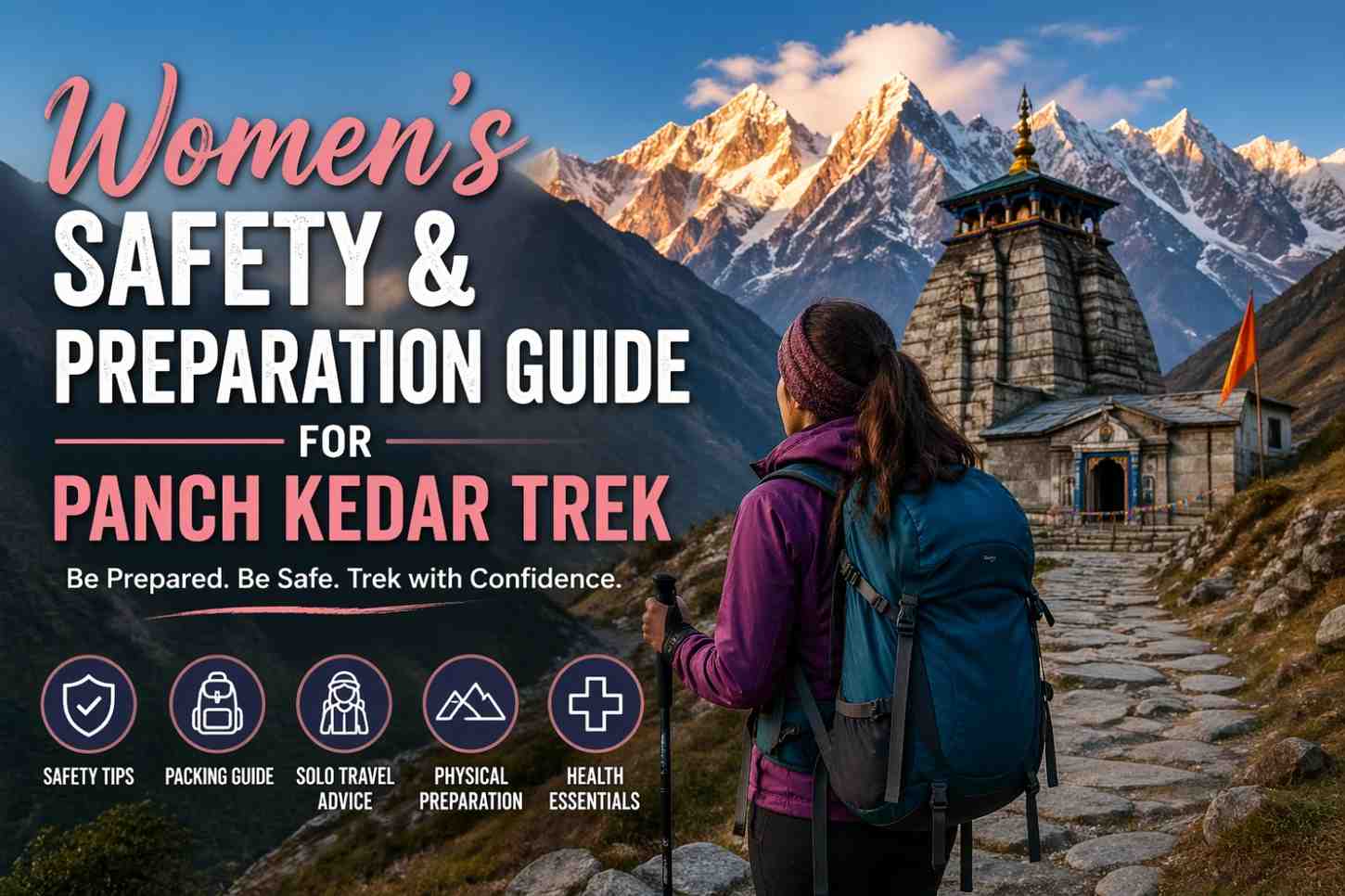
This is the definitive Women’s Safety and Preparation Guide for Panch Kedar 2026 — a resource built specifically for women planning this journey who want honest, practical, and deeply informed guidance. From safety realities on remote trails to period management at 3,500 metres, from accommodation choices to what to expect from local guides and co-trekkers, everything you need is covered here.
Is Panch Kedar Trek Safe for Women — The Honest Answer
Let’s address this directly before anything else. The Panch Kedar circuit passes through largely rural and remote Garhwal, a region where trekking and pilgrimage culture is deeply embedded in local life. The communities along the trail — in villages like Sari, Baniya Kund, Mandal, and Ukhimath — are accustomed to receiving pilgrims and trekkers from across the country, including women travelling in groups or pairs.
The trail itself does not present specific gender-based safety threats in the way urban environments sometimes do. However, two factors require honest acknowledgement:
The first is remoteness. Certain legs of the circuit — most notably Rudranath — are genuinely isolated. The trail to Rudranath from Mandal or Sari passes through dense forest and has zero mobile phone signal for stretches of 10 to 15 kilometres. There are no permanent settlements between certain camps. In this context, solo women trekking without a guide or group is inadvisable, not because of a specific threat, but because of the absence of any support infrastructure in case of emergency — injury, altitude sickness, or severe weather.
The second factor is accommodation. Guesthouses and dharamshalas along the route are mostly basic shared facilities, and private room availability is limited and inconsistent. Women travelling solo should specifically enquire about private or women-only accommodation at each stopover before arrival.
With both of these factors managed by travelling with a registered guide or a reputable tour operator and confirming accommodation in advance, the Panch Kedar Trek for women is as safe as any comparable Himalayan pilgrimage in India.
Solo Women vs Group Travel — Which Legs Suit Which?
Not every section of the Panch Kedar circuit carries the same risk profile. Here is a realistic, leg-by-leg breakdown that helps women make informed decisions about whether to join a group or whether certain legs can be undertaken with just a guide.
Kedarnath — Highest Footfall, Lowest Solo Risk
The Kedarnath leg is the most heavily trafficked section of the entire Panch Kedar circuit. The trail from Gaurikund to the Kedarnath temple sees thousands of pilgrims daily during the season. Pony and palanquin services are available, CISF personnel are deployed along the trail, and medical posts exist at regular intervals. This is the safest leg for solo women, with constant company and established infrastructure.
Tungnath — Accessible and Well-Serviced
Tungnath, the world’s highest Shiva temple at 3,680 metres, is accessed from Chopta — a small but reasonably well-developed tourist hub. The trail is short (approximately 3.5 kilometres one way), well-marked, and regularly used. Solo women with a local guide face minimal risk on this leg. Accommodation at Chopta has improved significantly in recent seasons.
Rudranath — Remote, No Signal, Group Travel Strongly Advised
Rudranath is the most remote and physically demanding section of the circuit. The trek from Mandal (or Sari via Panar) passes through dense mixed forest, open bugyals, and rocky high-altitude terrain. There is no mobile signal for most of the trail. Facilities at the temple site are extremely basic — tented camps and a small shelter. Women should travel this leg only with a registered guide and ideally in a group of at least three to four people. This is not negotiable for safety.
Madhyamaheshwar — Moderate, Beautiful, Group Recommended
The trail to Madhyamaheshwar from Ransi village is moderately challenging and passes through some of the most beautiful meadows in Garhwal. The route has reasonable footfall during the main season and established campsites. A guide is advisable, and a small group improves safety and comfort. Solo travel is possible with a guide but not recommended without one.
Kalpeshwar — Easiest Leg, Year-Round Access
Kalpeshwar, located near Urgam village in the Chamoli district, is the only Panch Kedar temple accessible year-round. The trail is short and relatively flat. It is also the leg most suitable for solo women, as the surrounding area is settled and the trail is never truly isolated.
Summary Safety Table
| Trek Leg | Solo Safety | Group Recommended | Signal Availability |
| Kedarnath | High | Optional | Good |
| Tungnath | Moderate-High | Optional | Moderate |
| Rudranath | Low (solo) | Yes, strongly | None on trail |
| Madhyamaheshwar | Moderate | Yes | Partial |
| Kalpeshwar | High | Optional | Moderate |
Choosing the Right Guide and Tour Operator
For women undertaking the Panch Kedar Trek, the choice of guide or operator is one of the most consequential decisions of the trip. A good guide is not just a navigational resource — they are a safety buffer, a cultural interpreter, a logistics manager, and, on remote legs like Rudranath, potentially a lifesaving presence.
What to Look for in a Panch Kedar Guide
- Registered with the Uttarakhand Tourism Department or a recognised trekking body
- Familiar with all five legs of the circuit, not just Kedarnath
- Has specific experience guiding women trekkers or mixed groups
- Can communicate in basic English if required, in addition to Hindi and Garhwali
- Carries a first-aid kit and knows altitude emergency protocols
- Has a portable charger or satellite communication device for remote legs
Questions to Ask Your Operator Before Booking
- Do you offer women-only group departures or mixed small-group options?
- What are your accommodation arrangements at each stopover, and are private rooms available for women?
- What is your emergency evacuation protocol for the Rudranath section?
- Do you have female guides or support staff available if requested?
- What happens if a participant needs to descend due to altitude sickness mid-circuit?
A reputable operator will answer all of these questions directly and without hesitation. Vague or dismissive responses are a red flag.
Women travelling with organised groups from mountainiax.com benefit from pre-planned women-sensitive accommodation arrangements, experienced guides familiar with all five legs, and full emergency protocols including satellite communication on remote sections.
What to Expect from Male Co-Trekkers and Local Communities
This is a topic that women researching solo women trekking India frequently ask about and rarely find answered honestly. Here is what the experience on the Panch Kedar trail is typically like.
Most male co-trekkers on the Panch Kedar circuit are pilgrims or trekkers on their own journeys, not people paying attention to solo women in their vicinity. The pilgrimage atmosphere of the circuit, particularly around Kedarnath and Tungnath, creates a broadly respectful social environment. Religious pilgrimage sites in Uttarakhand have strong cultural norms around decorum and appropriate conduct.
Local communities — the villagers in Sari, Ransi, Mandal, Urgam, and Chopta — are accustomed to receiving trekkers and pilgrims from across India and are not hostile or unwelcoming to women. Garhwali hill communities are known for their warmth and hospitality, and interactions with locals along the trail are typically positive.
That said, women should exercise the same situational awareness they would apply in any unfamiliar environment: avoid isolated stretches after dark, make their accommodation arrangements known to their guide each evening, and trust their instincts. If a situation feels uncomfortable, remove yourself from it without hesitation and inform your guide.
For those new to Himalayan trekking and managing altitude concerns alongside the general preparation for this circuit, the Altitude Sickness Guide is an essential companion resource covering symptoms, prevention, and emergency protocols specific to Garhwal Himalayan elevations.
Clothing and Packing Guide for Women
Packing strategically for the Panch Kedar Trek is both a comfort and a safety issue for women, particularly at altitudes above 3,500 metres, where temperature swings of 20 degrees Celsius between day and night are common.
Layering System — The Foundation of Comfort
- Base layer: Moisture-wicking merino wool or synthetic thermal top and leggings. Two sets minimum.
- Mid layer: Fleece jacket or light down jacket for active trekking in cold conditions.
- Outer layer: Waterproof, windproof shell jacket and shell pants. Garhwal weather can change within minutes.
- Insulation layer: A heavier down jacket for evenings, mornings, and high-altitude camps (Rudranath, Madhyamaheshwar).
Lower Body Clothing
Full-length trekking trousers are recommended for all legs of the circuit. They protect against the sun, wind, cold, scratching vegetation, and insect bites. Shorts are practical for the lower sections in warm weather, but are not appropriate as primary clothing given the pilgrimage context of the trail.
Avoid jeans entirely — they are heavy, offer no insulation when wet, and take hours to dry at altitude.
Footwear
- Well-broken-in ankle-support trekking boots are non-negotiable. New boots should be worn for at least 20 to 30 kilometres in urban conditions before the trek.
- Waterproof gaiters are useful on the Rudranath and Madhyamaheshwar legs where trails cross snowfields and wet meadows.
- Camp sandals or lightweight crocs for evening use at campsites.
Cultural Dress Considerations
The Panch Kedar circuit is a pilgrimage route, and temple premises at all five sites require modest dress. Women should carry a dupatta or light stole for temple visits. Shorts and sleeveless tops are inappropriate at temple sites regardless of the heat. This is not a restriction unique to women — the same standards apply to all pilgrims.
Period Management at High Altitude
This is one of the most searched questions among women planning Himalayan treks and one that is rarely addressed in mainstream trekking content. It deserves a clear, practical, and non-sensational answer.
Can You Trek During Your Period?
Yes, absolutely. Menstruation does not prevent or restrict trekking at altitude. Thousands of women complete Himalayan treks during their periods every year without incident. Physical activity generally continues normally, and altitude itself does not significantly worsen menstrual symptoms in most women.
Practical Management Tips
- Menstrual cups are highly recommended for high-altitude trekking. They require no disposal infrastructure, hold more fluid than tampons, and work well in cold weather when water for washing is limited.
- If using sanitary pads or tampons, carry sealed zip-lock bags for used products and pack them out entirely. Do not bury or burn sanitary waste — this is an ecological responsibility and a Leave No Trace principle.
- Carry a small personal hygiene kit with unscented wet wipes, hand sanitiser, and a small trowel for digging cat holes when toilet facilities are absent.
- Pain management: carry your usual pain relief (ibuprofen is generally preferred over aspirin at altitude). Consult your doctor about whether a hormonal option to delay your period during the trek is suitable for you.
- Water at altitude is cold, and the facilities at remote camps like Rudranath are minimal. Plan your hygiene routine for mornings before others are using shared facilities.
Sanitation at High-Altitude Camps
Toilet facilities along the Panch Kedar trail range from basic pit latrines at more developed sites (Chopta, Kedarnath) to nothing at all at remote camps. Women should:
- Carry a pee funnel device (such as a Peebuddy or similar) for urinating discreetly in the absence of toilet facilities.
- Always move at least 50 metres from any water source before using nature as a toilet.
- Use a head torch at night for any movement outside the tent or shelter.
- Inform your guide if you need to leave camp at night so your absence is noted.
Accommodation Guide for Women on the Panch Kedar Circuit
Accommodation along the Panch Kedar Trek ranges from government-run forest rest houses and GMVN guesthouses to dharamshalas, private homestays, and tent camps. The quality and privacy available vary enormously by location and season.
For women, particularly those travelling without a pre-booked group, the accommodation question deserves specific attention. The Best Accommodation Options for each leg of the circuit — including those with private room availability, security, and women-friendly facilities — should be confirmed with your operator before departure. Arriving at a remote stopover without pre-confirmed accommodation creates unnecessary vulnerability.
Accommodation by Leg
- Kedarnath: GMVN guesthouses and dharamshalas are available. Book well in advance during peak season (May, June, September). Private rooms are available but fill quickly.
- Tungnath/Chopta: Several private guesthouses at Chopta. The standard is basic but improving. Private rooms generally available.
- Rudranath: Tented camps only. No private rooms. Women should travel with a group with whom they share tent accommodation.
- Madhyamaheshwar: Forest rest house at Bantoli and basic tented camps near the temple. Pre-booking essential.
- Kalpeshwar: Small guesthouses in Urgam. Most comfortable leg for accommodation.
Always carry a sleeping bag rated for at least minus 5 degrees Celsius, regardless of operator-provided bedding.
Physical Preparation for the Panch Kedar Trek
The Panch Kedar circuit involves sustained ascents, long trekking hours (6–10 hours/day), and high-altitude exposure (up to ~3,500–4,000 meters). Expect uneven terrain, steep gradients, and variable weather conditions.
Fitness Requirements
The full Panch Kedar circuit covers approximately 145 to 160 kilometres of trekking across 12 to 16 days, depending on the itinerary. The daily distance ranges from 8 to 22 kilometres with significant elevation gain on several legs. This is not a beginner’s trail in its complete form, though individual legs can be undertaken by those with moderate fitness.
Women planning the full circuit should begin a dedicated fitness programme at least two to three months in advance, focusing on:
- Cardiovascular endurance: Daily walks of 8 to 12 kilometres, building to hilly terrain with elevation gain.
- Leg strength: Squats, lunges, step-ups, and stair climbing with a loaded backpack.
- Core stability: Critical for balance on uneven terrain, particularly on the Rudranath trail.
- Flexibility: Yoga or stretching routines reduce injury risk significantly.
For women who are newer to long-distance Himalayan trekking, understanding the detailed demands of the circuit through the Panch Kedar Trek for Beginners guide provides a structured introduction to the full circuit — covering fitness expectations, gear basics, and what the trail experience is actually like.
Pre-Trek Medical Checklist
- Consult a physician at least four weeks before departure.
- Get a cardiovascular fitness clearance, particularly if you are above 45 years of age.
- Discuss altitude medication options (Diamox / acetazolamide) with your doctor.
- Check your vaccination status.
- Carry a personal medication kit including: antihistamines, ORS sachets, antacids, pain relief, blister pads, antiseptic cream, and any personal prescriptions.
Real Accounts — What Women Who Have Done It Say
The most credible reassurance about any trek comes not from operators or guides but from women who have completed it themselves. Across trekking forums, travel blogs, and organised yatra groups, women who have completed legs of the Panch Kedar circuit consistently report the same core themes.
The sense of personal achievement is described as unlike anything experienced in daily life. The remoteness that seems intimidating in planning feels liberating in practice. Fellow pilgrims on the trail — overwhelmingly respectful and focused on their own devotional journeys — are described as some of the most genuine human encounters these women have had.
The challenges most frequently mentioned are not safety-related but physical: the unexpectedly demanding ascent to Rudranath, the cold at the Madhyamaheshwar camp, and the difficulty of managing hygiene at remote sites without adequate preparation. All of these are manageable with the information in this guide.
The women who struggled most were those who underestimated the fitness requirement, over-packed their bags, or arrived without clear accommodation arrangements. The women who thrived were prepared, flexible, and — crucially — had chosen a reliable guide or operator.
Panch Kedar vs Kedarnath — Which Is Better for Women?
Panch Kedar vs Kedarnath for women depends on fitness, time, and trekking experience. Kedarnath is more accessible with better facilities, while Panch Kedar offers remote, multi-trek challenges. Safety, altitude, infrastructure, and personal preparedness determine which pilgrimage is the better option.
The Honest Comparison
The Kedarnath trek is a single-destination pilgrimage with extremely high infrastructure, constant footfall, and clear emergency support. For women who are new to Himalayan trekking or are primarily motivated by the Kedarnath darshan, a solo Kedarnath visit is relatively safe and straightforward.
The Panch Kedar circuit is a different proposition entirely — longer, more remote, more physically demanding, and logistically complex across five separate legs. It is not a straightforward upgrade from Kedarnath; it is a fundamentally different experience that requires considerably more preparation.
For women with solid fitness, trekking experience, and proper guidance, the full Panch Kedar circuit is an extraordinary journey. For first-timers or those primarily drawn to pilgrimage over adventure, completing Kedarnath and one or two accessible Panch Kedar legs (Tungnath, Kalpeshwar) is a sensible starting point.
Frequently Asked Questions
1. Is the Panch Kedar Trek safe for solo women?
It depends on the leg. Kedarnath, Tungnath, and Kalpeshwar can be managed with a guide solo. Rudranath and Madhyamaheshwar require group travel due to remoteness and absent mobile signal. No leg should be undertaken without a registered guide.
2. What is the best season for women to trek to Panch Kedar?
May to June and September to October. These months offer stable weather, open trails, and active accommodations along the route. Monsoon months (July and August) are inadvisable due to landslide risk and leeches in the lower forest sections.
3. Is there mobile signal on the Panch Kedar Trail?
Varies by leg. Kedarnath and Tungnath have a reasonable signal in parts. Rudranath has no signal on most of the trail. Madhyamaheshwar has a partial signal at the base village but none near the temple site.
4. What should women wear on the Panch Kedar Trek?
Full-length trekking trousers, moisture-wicking base layers, fleece and down mid-layers, a waterproof shell, and well-broken-in ankle-support boots. Carry a dupatta or stole for temple visits. Avoid shorts as primary clothing, given the pilgrimage context.
5. How do women manage periods on the Panch Kedar Trek?
Menstrual cups are most practical for high-altitude remote trekking. Carry sealed bags for disposal of any sanitary waste and pack it out entirely. Standard hygiene practices apply with the addition of a pee funnel for convenience in the absence of toilet facilities.
Summary
The Women’s Safety and Preparation Guide for Panch Kedar Trek reaches one clear, evidence-based conclusion: this is a journey that women can and do undertake safely every season across India, and the experience is consistently described as one of the most powerful of their lives. The keys are not extraordinary courage or exceptional fitness — they are honest preparation, the right guide, smart accommodation planning, and a clear-eyed understanding of which legs demand group travel and which can be navigated more independently.
The Panch Kedar circuit rewards preparation with access to some of the most spectacular and spiritually charged landscapes in the Indian Himalayas. The meadows above Madhyamaheshwar, the forest silence approaching Rudranath, the first sight of Tungnath at dawn — these are experiences that belong equally to every pilgrim who earns them.
With the Panch Kedar Yatra season approaching, it’s time to plan something truly extraordinary. From breathtaking Himalayan peaks to spiritually powerful temples hidden deep in remote valleys, this journey offers an experience that goes beyond a typical trek—it becomes a story you carry for life. To make your journey seamless and well-organised, choose the best trekking company in Uttarakhand for reliable trek packages, detailed itineraries, and hassle-free booking.
Visit this page for Trek Packages, Itinerary & Booking.