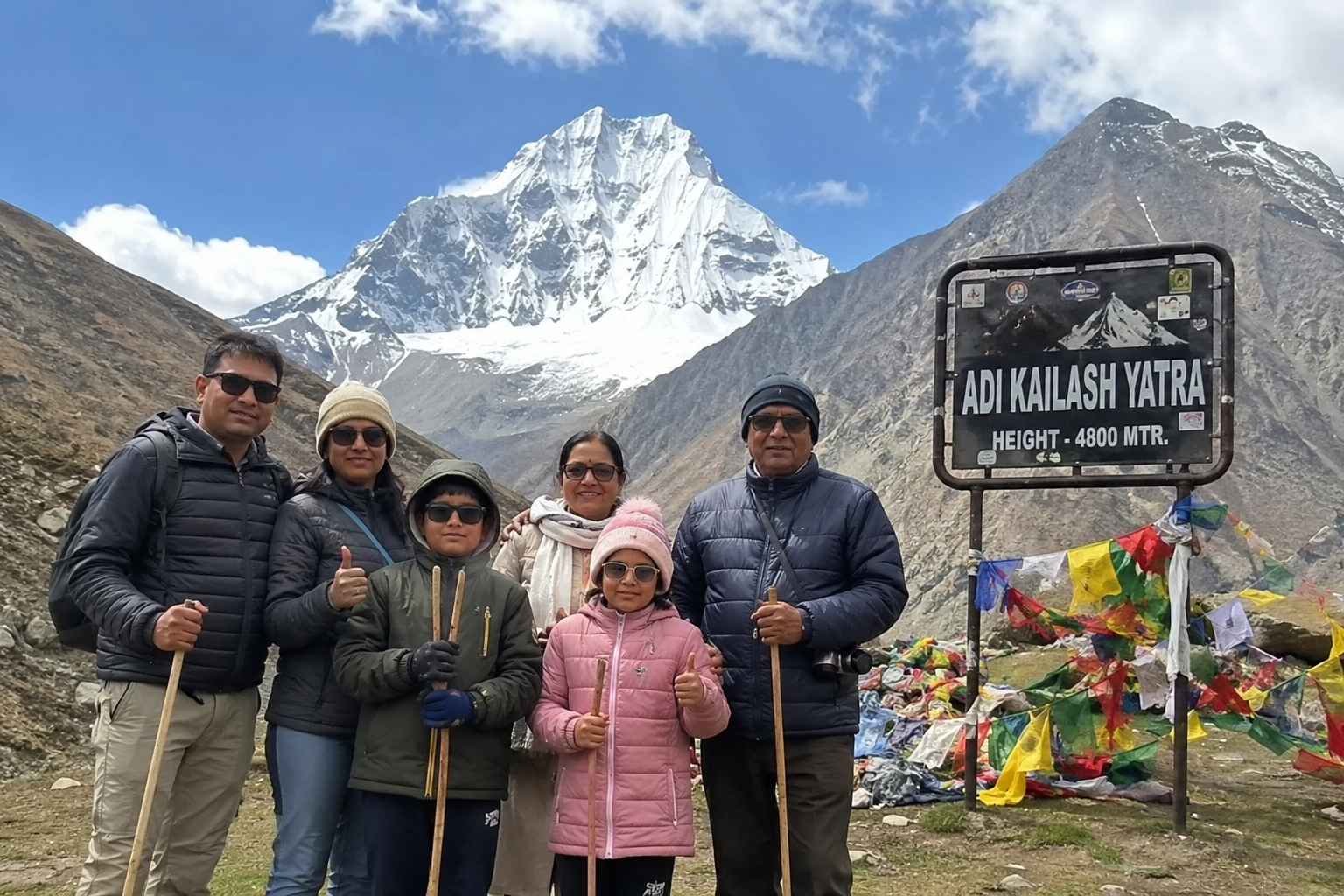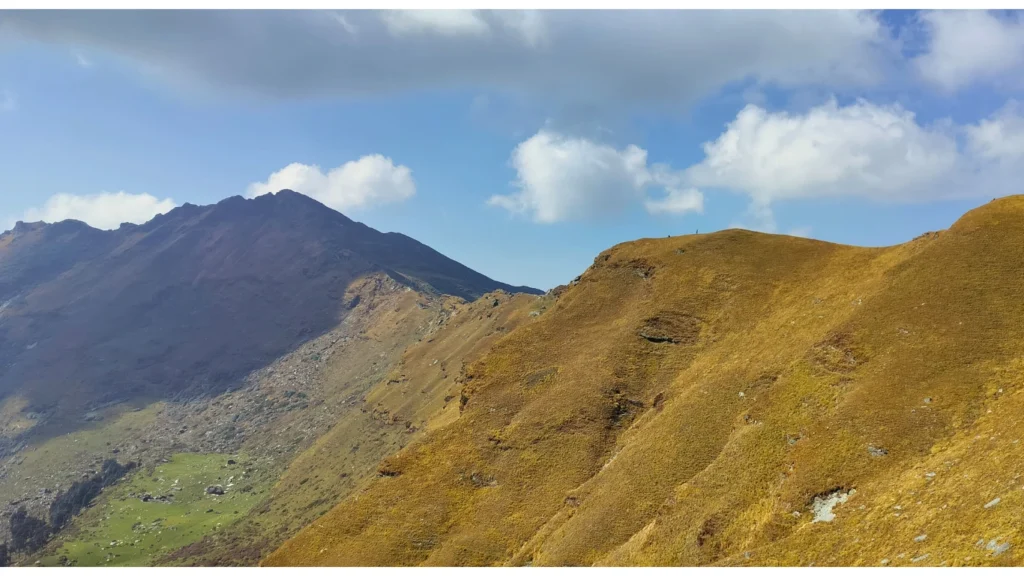
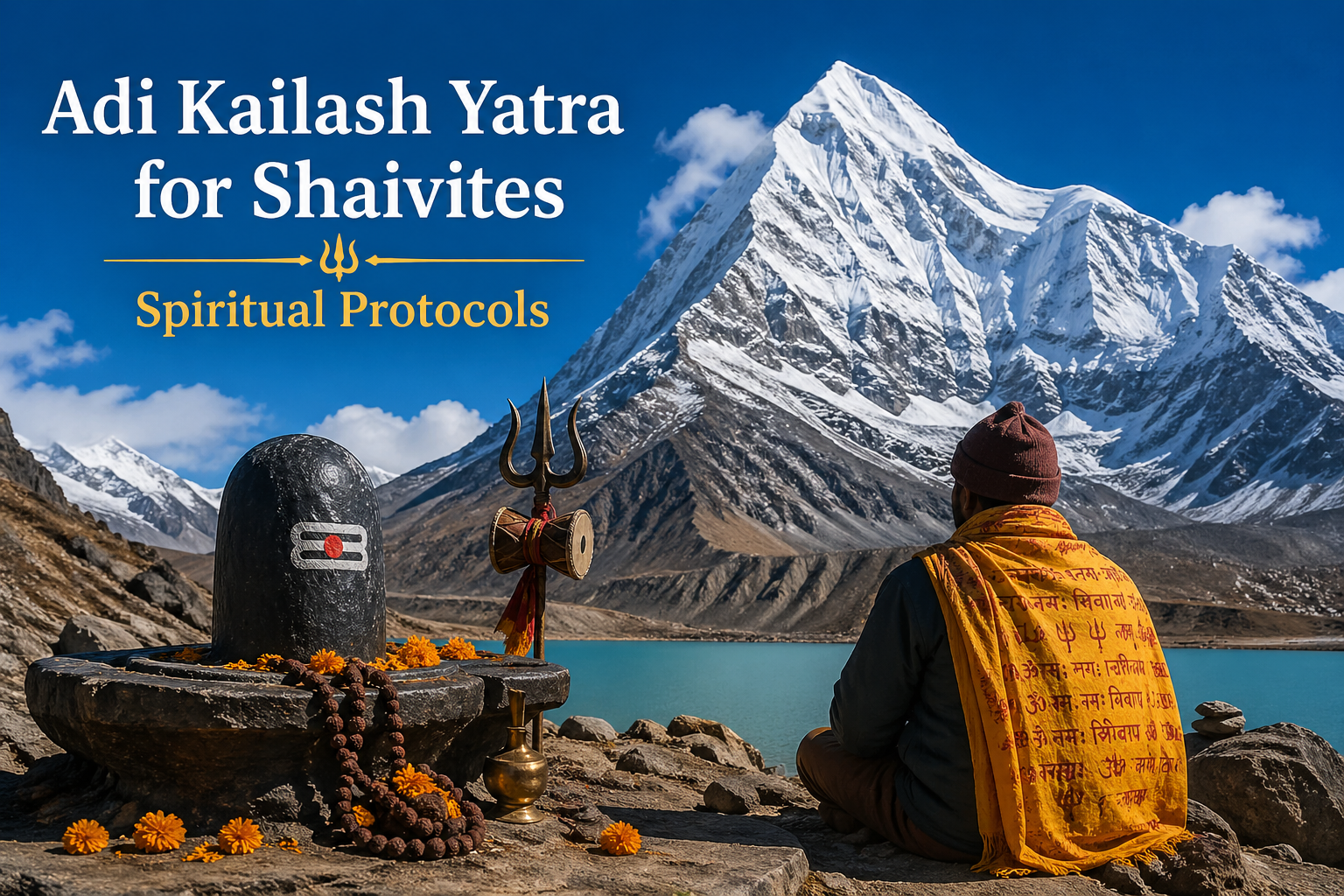
Among all the sacred peaks of the Indian Himalayas, Adi Kailash stands apart not for its altitude but for its devotional gravity. Nestled deep in the Pithoragarh district of Uttarakhand, its summit rises in the unmistakable silhouette of a Shivalinga — a natural self-disclosure of Mahadev that Shaivite pilgrims have been walking toward for generations. This is not a mountain you visit. It is a mountain that receives you if you come prepared.
The Adi Kailash Yatra for Shaivites is a living spiritual discipline — a pilgrimage woven through with precise ritual, sacred mantra, disciplined conduct, and a quality of surrender that no casual journey can produce. From the sankalpa you take at your home temple before departure to the full-body prostration at the Jolingkong shrine, every act on this yatra is a deliberate act of worship.
This guide is written for those who wish to walk this path as true seekers, not as spectators. The rituals described here — the prayers, the puja sequences, the mantra practices, the protocols of conduct — are drawn from living Shaiva tradition as observed by hereditary priests, sadhus, and devout pilgrims along the route. Let each section serve as preparation for an inner journey that the mountain will complete on your behalf.
Why Adi Kailash Is the Supreme Tirtha for Shaivites
The word Adi means primordial, original, first. In Shaiva sacred geography, this peak is understood as the mountain where Lord Shiva first established his presence in the material world, prior to the Tibetan Kailash gaining prominence in the broader pilgrimage imagination. Ancient verses of the Skanda Purana situate the Kumaon Himalayas firmly within Shiva’s domain, describing the region as sanctified by his footsteps and breath.
The Jolingkong valley — the high-altitude meadow from which the Adi Kailash peak rises in its Shivalinga form — is considered a swayambhu tirtha, a place where divine energy arises self-manifested, without any human construction or consecration. You do not bring the sacred to Jolingkong. The sacred was there long before you arrived and will remain long after you leave.
For a sincere Shaivite, the mountain is not a backdrop for trekking achievements. It is the living form of Mahadev. Every stone, every stream, every gust of wind descending from the glacier above is understood in devotional perception as the presence of the divine. The entire ritual structure of the Adi Kailash yatra rituals, puja mantra tradition is designed to awaken precisely this perception in the pilgrim — a direct, unmediated encounter with Shiva in his elemental form.
Pre-Departure Preparation — Purifying the Self Before the Yatra
Pre-departure preparation focuses on inner and outer purification, including disciplined routines, mindful diet, spiritual practices, and logistical readiness. Pilgrims cultivate clarity, resilience, and intention, ensuring they embark on the yatra with physical fitness, mental stability, and devotional awareness, with the overall purpose.
Taking the Shiva Sankalpa
Before a single bag is packed, the Shaivite pilgrim takes a formal Shiva Sankalpa — a sacred vow offered before the Shivalinga at the home temple or a local shrine. This is not a mere ceremony. The sankalpa is a deliberate announcement to the divine: your name, your gotra (lineage), the sacred sites you intend to visit, and your prayer for a safe and grace-filled yatra. The vow is offered while pouring water and milk slowly over the Shivalinga, with the Om Namah Shivaya mantra chanted 108 times on a rudraksha mala.
Pilgrims who take this step consistently report that the yatra unfolds with a quality of inner ease and opening that those who skip it do not experience. The sankalpa does not guarantee smooth weather or easy trails. It guarantees that you have placed the journey in the hands of Mahadev before it begins.
Ahara Shuddhi — Purification Through Food
The body is the vehicle of the inner journey. At least three days before departure — ideally for the entire duration of the yatra — observe strict ahara shuddhi: no meat, fish, eggs, garlic, onion, or alcohol. Eat simply: cooked grains, vegetables, fruits, dairy, and jaggery. This sattvic diet quiets the rajasic impulses of the mind and makes the devotional states that arise in the Himalayas far more accessible.
At altitude, heavy food also compounds exhaustion and nausea. Light, warm, easily digestible meals are both spiritually and physically appropriate. Carry dry fruits, chikki, herbal teas, and whole-grain crackers as trail rations.
Visiting Jageshwar Dham Before Departure
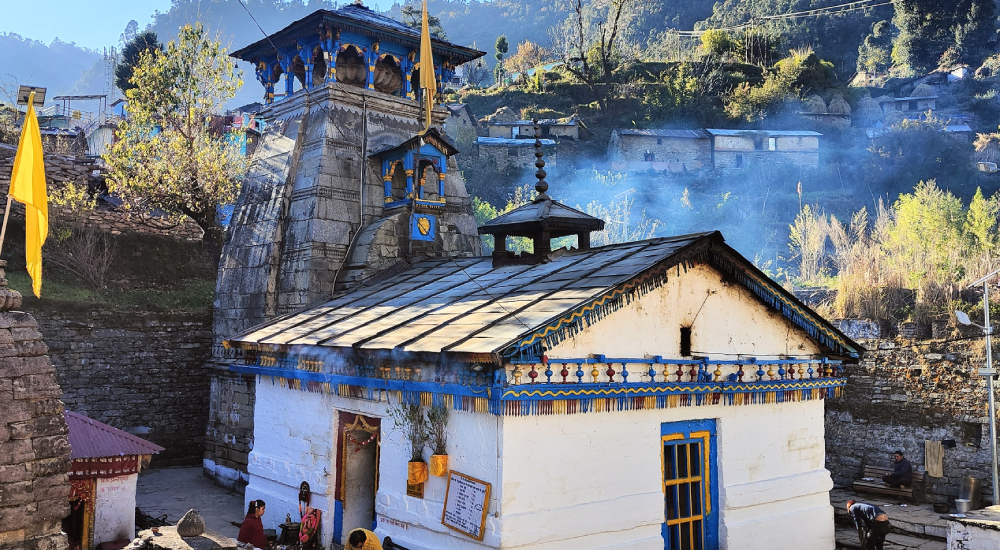
Many Adi Kailash pilgrims consider a pre-yatra darshan at Jageshwar Dham — the ancient cluster of Shiva temples near Almora — to be an essential first step. Revered as one of the twelve jyotirlinga equivalents in the Kumaon tradition, Jageshwar’s dense forest of towering stone temples and ancient Shivalingas offer a devotional immersion that spiritually calibrates the pilgrim before the higher journey begins. Perform a full abhisheka here with panchamrita — milk, curd, honey, ghee, and sugar — and take the blessings of the presiding deity for the path ahead.
Sacred Stops on the Route — Rituals at Each Stage
Each sacred stop along the route holds ritual significance, where pilgrims perform prayers, offerings, and purification rites. These stages symbolise spiritual progression, allowing devotees to deepen faith, seek blessings, and align their journey with tradition, discipline, and inner transformation at every step.
Dharchula — The Gateway Mantra
Dharchula is the traditional launchpad of the Adi Kailash yatra route, and its ritual significance is inseparable from its logistical role. On your first morning here, rise before dawn and visit the local Shiva temple. Offer bilva leaves — the three-lobed leaf of the bel tree, most beloved by Mahadev — along with raw milk poured in a slow, steady stream over the Shivalinga while chanting:
Na — Ma — Shi — Va — Ya
Let this five-syllable mantra become your walking companion from this moment. Match one syllable to each exhale as the trail steepens, and the Shiva Panchakshara mantra becomes simultaneously a prayer, a breathing practice, and a moving meditation simultaneously.
Narayan Ashram — The Threshold of the High Himalayas
Perched at 2,734 metres in the valley above Darchula, Narayan Ashram is a place of spiritual pause and inner recalibration. Though maintained in a Vaishnava tradition, Shaivite pilgrims bow with the understanding that all sacred Himalayan space is unified under the divine — Hari and Hara are aspects of the same absolute. Spend time in silence here. Let the ashram’s atmosphere — pine forests, clean air, prayer bells — begin the quieting of ordinary mental noise.
Gunji — Night Prayers Before the High Trail
Gunji is the last village of permanent human settlement before the trail rises sharply into the Jolingkong basin. The small Shiva temple here holds the accumulated prayer of countless pilgrims who have paused in exactly this spot, exactly as you will. This is the ideal location for a full evening prayer: light a ghee diya, offer white flowers, and recite the Maha Mrityunjaya Mantra 108 times on your rudraksha mala:
Om Tryambakam Yajamahe Sugandhim Pushti-Vardhanam Urvarukamiva Bandhanan Mrityor Mukshiya Maamritat
This mantra of Shiva as Tryambaka — the three-eyed conqueror of death — resonates with unusual intensity in the Himalayan silence. At 3,325 metres, with glacial peaks visible in every direction, the words of this ancient invocation cease to feel like recitation and begin to feel like recognition.
As the trail rises beyond Gunji toward the final approach to Jolingkong, pilgrims pass through one of the most devotionally charged sites on the entire route. Parvati Sarovar & Gauri Kund — twin sacred water bodies set into the high-altitude landscape — are not incidental geography. Local Shaiva tradition describes these as the bathing place of Goddess Parvati before her sacred union with Lord Shiva. Ritual bathing in the cool, clear waters of Gauri Kund before approaching the Adi Kailash peak is strongly observed by devout pilgrims. A symbolic sprinkling of the water on the head, accompanied by the mantra Om Gauri Namah, is considered sufficient for those who cannot fully immerse. The waters are held to dissolve accumulated karmic impurity, rendering the devotee ritually fit to receive the grace of the swayambhu Shiva at Jolingkong.
Mantras to Chant — The Sonic Architecture of the Pilgrimage
Mantra in the Shaiva tradition is not an ornament. It is technology — a precise vibration that creates a corresponding state in the mind and subtle body of the practitioner. At Adi Kailash, where the elements exist in their raw, unmediated intensity, these vibrations carry an amplified potency. Choose your mantras intentionally and practice them before departure.
Om Namah Shivaya — The Five-Syllable Heart of Shaiva Practice
The Shiva Panchakshara mantra is the devotional spine of the entire yatra. The five syllables Na, Ma, Shi, Va, Ya correspond to the five elements — earth, water, fire, air, and space — that Shiva embodies and transcends. Every tread on the mountain path, every breath in thin air, every moment of silence in the valley can be filled with this mantra.
The ideal method during the trek is mauna japa — silent internal repetition — which requires no breath expenditure and keeps the mind anchored in devotion through the most physically demanding sections of the ascent. Many experienced pilgrims report that the mantra takes on a spontaneous, self-arising quality by the time they reach Jolingkong — as if the mountain itself has taken over the chanting.
Maha Mrityunjaya Mantra — The Pilgrim’s Greatest Protection
At high altitude, where the body is genuinely tested, and the threshold between effort and exhaustion is thin, the Maha Mrityunjaya mantra is the most practically significant mantra the Shaivite carries. Complete 108 repetitions each morning before the day’s first step, preferably while facing east as the first light touches the peaks. This mantra of Shiva as the conqueror of death is chanted for health, fearlessness, and liberation from the cycle of fear. Many pilgrims carry a dedicated rudraksha mala reserved exclusively for this practice.
Rudrashtakam — Eight Verses of Fire and Surrender
Composed by Goswami Tulsidas, the Rudrashtakam is a concentrated hymn to Shiva in his Rudra aspect — fierce, primordial, and utterly compassionate. Memorise it before departure or carry a printed copy. Reciting all eight verses at dawn, facing the Adi Kailash peak as it catches the first light, is one of the most powerful devotional experiences available on this pilgrimage. It does not take long. Its effect lingers for hours.
After completing the Jolingkong puja and darshan, many sincere pilgrims perform a second act of gratitude at Parvati Sarovar & Gauri Kund on the return path — a quiet thanksgiving bath at dawn, with the Adi Kailash peak visible in the early light behind them. This second visit seals the experience received at Jolingkong and is considered particularly auspicious, completing the devotional circuit of arrival and departure that gives the yatra its complete sacred structure.
Puja at Jolingkong — How Local Priests Conduct the Ritual
The shrine at Jolingkong, maintained by hereditary priests whose families have served this tirtha for generations, is the devotional centrepiece of the Adi Kailash yatra rituals puja mantra experience. The puja follows a sequence rooted in Shaiva Agamic tradition, adapted with great sincerity to the conditions of a 4,572-metre site. Here is what unfolds:
- Shuddhi (Purification): The priest purifies the ritual space using kusha grass and sacred water, accompanied by Vedic purification mantras. Pilgrims stand silently and observe. This is not a moment for photography or casual conversation.
- Avahana (Invocation): Lord Shiva is formally invited into the shrine with invocatory Vedic verses that acknowledge his presence in the mountain, the stream, the wind, and the open sky. The priest’s voice carries a quality shaped by generations of practice at this altitude — measured, resonant, unhurried.
- Shodashopachara (Sixteen Offerings): Not all sixteen offerings are physically possible at this elevation, but the priest adapts with complete integrity — offering what is available with the understanding that sincerity outweighs quantity. Water, bilva, incense, a lamp, and naivedya (food offering) are the most consistently offered elements.
- Abhisheka: Water — ideally sourced from the sacred springs of the Jolingkong valley — is poured over the Shivalinga in a slow, continuous stream while the Shiva Panchakshara mantra is chanted without interruption. This is the emotional and devotional peak of the puja. Many pilgrims weep here without knowing why.
- Aarti and Pushpanjali: The aarti is performed with a camphor flame and hand bells whose sound carries across the entire valley. Pilgrims offer pushpanjali — flowers cupped in the hands, released at the moment of aarti — as the final offering before prostration.
A practical note that is inseparable from the spiritual: the puja at Jolingkong takes place above 4,500 metres. Physical readiness directly shapes devotional capacity here. Awareness of Altitude Sickness at Adi Kailash — its symptoms, its progression from headache to nausea to dangerous confusion — is not a distraction from the spiritual preparation. It is part of it. Pilgrims who acclimatise properly at Gunji, ascend slowly, and stay hydrated, arrive at Jolingkong physically stable and devotionally available. Those who rush arrive breathless and distracted, and cannot give the puja the attention it deserves. Acclimatisation is an act of devotional intelligence.
Pradakshina — The Sacred Circumambulation of Adi Kailash
Pradakshina — the ritual clockwise circumambulation of a deity’s form — is one of the most ancient and powerful acts in Shaiva worship. When performed around the Adi Kailash peak itself, or the Jolingkong shrine as a symbolic representation, it is understood to bring the devotee into a harmonious relationship with the cosmic axis that Shiva embodies.
The full Adi Kailash pradakshina is a multi-day high-altitude circuit that crosses glaciated terrain and demanding passes. It is not suitable for most pilgrims and should only be attempted by those in excellent physical condition with experienced local guides. The full circuit is undertaken in strict observance: silence or continuous mantra, no stopping except for essential rest, no animal products consumed during the circuit, and a spirit of absolute non-attachment to outcome.
Most pilgrims — including many of the most devoutly sincere — perform the symbolic pradakshina of the Jolingkong shrine area: a clockwise circuit of the sacred compound, performed three, seven, or 108 times according to the pilgrim’s capacity and intention. Even one sincere clockwise round, with the heart directed toward the Shivalinga peak and the lips moving in mantra, carries the full devotional merit of the ritual.
The clockwise direction — always, without exception — is the non-negotiable parameter of Shaiva pradakshina. Moving clockwise keeps the heart, on the body’s left side, closest to the deity throughout the circuit. This ancient logic is not a metaphor. It is the spatial embodiment of devotion.
Offerings Accepted at Adi Kailash Shrines
Offerings at Adi Kailash shrines typically include flowers, incense, sacred water, bilva leaves, fruits, and simple prasad. Devotees may also offer ghee lamps, coconut, and prayers, emphasising purity, humility, and devotion in alignment with traditional Himalayan worship practices.
Bilva Leaves — The Supreme Offering
The three-lobed bilva leaf is Shiva’s most beloved offering across all Shaiva tirthas, and Adi Kailash is no exception. Carry dried bilva leaves from home — they are not always available at altitude — and offer them with the understanding that a single leaf placed with true devotion carries infinite merit. The three lobes are understood to represent the three gunas, the three eyes of Shiva, and the three syllables of Om.
Raw Milk and Sacred Water
Where raw milk is available, it is offered as abhisheka directly on the Shivalinga. At high altitude, this is rarely possible, but water collected from the sacred spring in the Jolingkong valley — or carried from a lower elevation — serves with equal sanctity.
White Flowers, Incense, and Camphor
Dhatura flowers are traditionally Shiva’s own, but any white flower carried from lower elevations is accepted. Incense sticks and camphor are among the most portable and powerful offerings — carry enough for every shrine along the entire route, not only Jolingkong.
What Not to Offer
Avoid plastic packets, artificial flowers, packaged food with labels, or any material that cannot be ethically left at a high-altitude natural site. The mountain’s own austere simplicity is a teaching: sacred offerings need not be elaborate. A bilva leaf and a sincere heart are more than sufficient.
A consideration that experienced pilgrims emphasise alongside the ritual offerings: managing Altitude Sickness at Adi Kailash proactively is itself a form of offering — an offering of responsible stewardship of the physical instrument you have been given. Carry acetazolamide if prescribed by a physician, maintain consistent hydration, and communicate openly with fellow pilgrims and guides about any symptoms. The mountain teaches non-attachment. That teaching begins with releasing the ego’s insistence on pushing through warning signs.
The Etiquette of a Devout Shaivite Pilgrim
A devout Shaivite pilgrim follows discipline, humility, and purity throughout the yatra. This includes respectful conduct at shrines, simple living, vegetarian diet, silence or mindful speech, regular prayers to Lord Shiva, and adherence to sacred customs, reflecting devotion and spiritual restraint.
Maintain Silence Where Possible
The Jolingkong valley holds a quality of natural silence that most pilgrims encounter for the first time in their lives — a silence not empty but full, not peaceful in the sentimental sense but alive and aware. Loud conversation, music played on mobile devices, and casual chatter shatter this atmosphere. Many experienced pilgrims observe mauna — a complete vow of silence — from Gunji onwards, breaking it only for mantra and essential communication.
Dress with Ritual Intention
Change into traditional attire before entering the shrine area. Men traditionally wear a dhoti or simple trousers with a shawl or uttariya covering the upper body during puja. Women wear sober-coloured sarees or salwar kameez. Sportswear is acceptable on the trail but has no place in the ritual space. Bring warm socks — the ground at the open shrine is stone-cold.
Respect the Priest’s Direction
The local priests who conduct puja at Jolingkong carry not only training but lineage — generations of accumulated ritual knowledge specific to this tirtha. Follow their direction without question or negotiation. Do not suggest modifications to the puja sequence. Do not bargain over dakshina. Offer what you are asked with gratitude and trust.
Leave No Trace — The Ecological Ethic as Sacred Practice
The ecological integrity of the Jolingkong valley is inseparable from its spiritual power. Carry out every piece of waste you generate. Do not pick wildflowers or disturb the alpine flora. Do not wash with soap or shampoo in or near the water sources. The preservation of this sacred environment is understood in Shaiva tradition not as environmentalism but as seva — service to the divine that dwells in this place.
The physical environment of the high Himalayas will itself shape the quality of your ritual experience in ways that no guidebook can fully prepare you for. Understanding Adi Kailash Weather and Temperature before you plan is not separate from spiritual preparation — it is part of it. The Jolingkong basin experiences sharp temperature drops after sunset, sudden afternoon cloud cover, and occasional hailstorms even in peak pilgrimage season. Begin the day’s puja and pradakshina early, before afternoon weather closes in. Carry layered clothing capable of handling a temperature swing of 15 to 20 degrees Celsius within a few hours. The mountain rewards those who come prepared and tests those who come overconfident.
Post-Yatra Rituals — Completing the Sacred Circuit
The pilgrimage does not end when you step off the trail at Dharchula. How you return and how you integrate the experience determines how much of what Adi Kailash offers actually takes root in your life.
Upon reaching home, visit your home Shiva temple to perform visarjana — the formal completion of the sankalpa taken before departure. Offer flowers, pour water on the Shivalinga, light a ghee lamp, and recite the Shiva Panchakshara mantra 108 times in gratitude. This act closes the ritual circuit that was opened at the beginning of the journey. It tells both the divine and your own inner life that the pilgrimage is complete and that you return changed.
Many pilgrims observe a 40-day post-yatra sadhana: daily Shiva puja, continued sattvic diet, a journal of experiences and insights received during the journey. This is not a rule imposed from outside. It arises naturally from the desire to honour and preserve what the mountain gave. Journalling, in particular, captures transmission that fades quickly in the ordinary busyness of re-entry into daily life.
Share the prasad you have carried back — sacred ash received at Jolingkong, bilva from the shrines, water from the valley spring — with family, friends, and devotees who could not make the journey. The act of sharing extends the pilgrimage’s grace outward and fulfils the social dimension of tirtha: the blessing brought back to the community.
For those planning their yatra for the coming season, or advising others who are preparing, note that the window for the deepest ritual experience — stable conditions, open shrines, practising priests on site — aligns closely with the optimal pilgrimage window. Tracking current conditions through Adi Kailash Weather and Temperature forecasts and reports from KMVN (Kumaon Mandal Vikas Nigam) before finalising your dates will ensure that when you arrive at Jolingkong, the mountain is ready to receive you — and you are ready to receive it.
Frequently Asked Questions
Q1. What is the most important mantra to chant during the Adi Kailash yatra?
The Shiva Panchakshara — Om Namah Shivaya — is the foundational mantra for the entire journey and can be chanted continuously, silently, at every stage. The Maha Mrityunjaya mantra is equally important for protection, health, and fearlessness, and is best completed in 108 repetitions each morning before beginning the day’s ascent. If you can memorise only two mantras before departure, these are the ones.
Q2. Can non-Shaivites participate in the puja at Jolingkong?
The Jolingkong shrine is open to all sincere devotees regardless of sectarian affiliation. What matters is genuine devotion and respectful conduct. All visitors — Shaivite or otherwise — are asked to observe the same standards of silence, ritual decorum, and reverence described in this guide.
Q3. What offerings should I carry from home for the Adi Kailash puja?
Carry dried bilva leaves, camphor tablets, incense sticks, a rudraksha mala, and a small quantity of mishri (rock sugar) or panchamrita components that can be combined at altitude. These are portable, non-perishable, and ritually complete. Fresh flowers can sometimes be obtained at lower elevations along the route.
Q4. Is the full Adi Kailash pradakshina mandatory for Shaivite pilgrims?
The full mountain circumambulation is spiritually significant but physically demanding and not mandatory. Most devout pilgrims perform a symbolic clockwise pradakshina of the Jolingkong shrine compound — three, seven, or 108 circuits — as their offering. One sincere circuit, offered with full attention and mantra, carries the complete merit of the ritual.
Q5. How many days should be allocated for a spiritually complete yatra?
A minimum of eight to ten days from Dharchula to Jolingkong and back is recommended for a pilgrimage that includes adequate acclimatisation, ritual observances at every sacred site, a full Jolingkong puja, and the pradakshina. Rushing this yatra compromises both physical safety and the depth of the spiritual experience. More time is always better.
Summary
Every mantra chanted on the ascent, every bilva leaf offered on the Shivalinga, every prostration performed in the silence of Jolingkong — these are not performances for an audience. They are the language through which the devotee and the divine enter into direct conversation. The mountain listens. The mountain responds.
The Adi Kailash Yatra for Shaivites is among the most complete and demanding expressions of living Shaiva devotion accessible to the contemporary pilgrim. It asks for everything: physical endurance, ritual precision, devotional sincerity, and a genuine willingness to be changed by the encounter. Approached with the preparations described in this guide — the sankalpa, the mantras, the puja protocols, the etiquette of reverence — this yatra becomes far more than a Himalayan journey. It becomes a meeting with Mahadev, in the form he has chosen, at the altitude he has claimed, in a valley that has been holding space for this encounter since before memory began.
With the Adi Kailash Yatra season approaching, it’s time to plan a journey that blends spirituality with raw Himalayan adventure. From sacred lakes to the divine presence of Adi Kailash, every moment feels profound and transformative. If you seek purpose beyond travel, this is your path.
Visit this page for Yatra Packages, Itinerary & Booking.