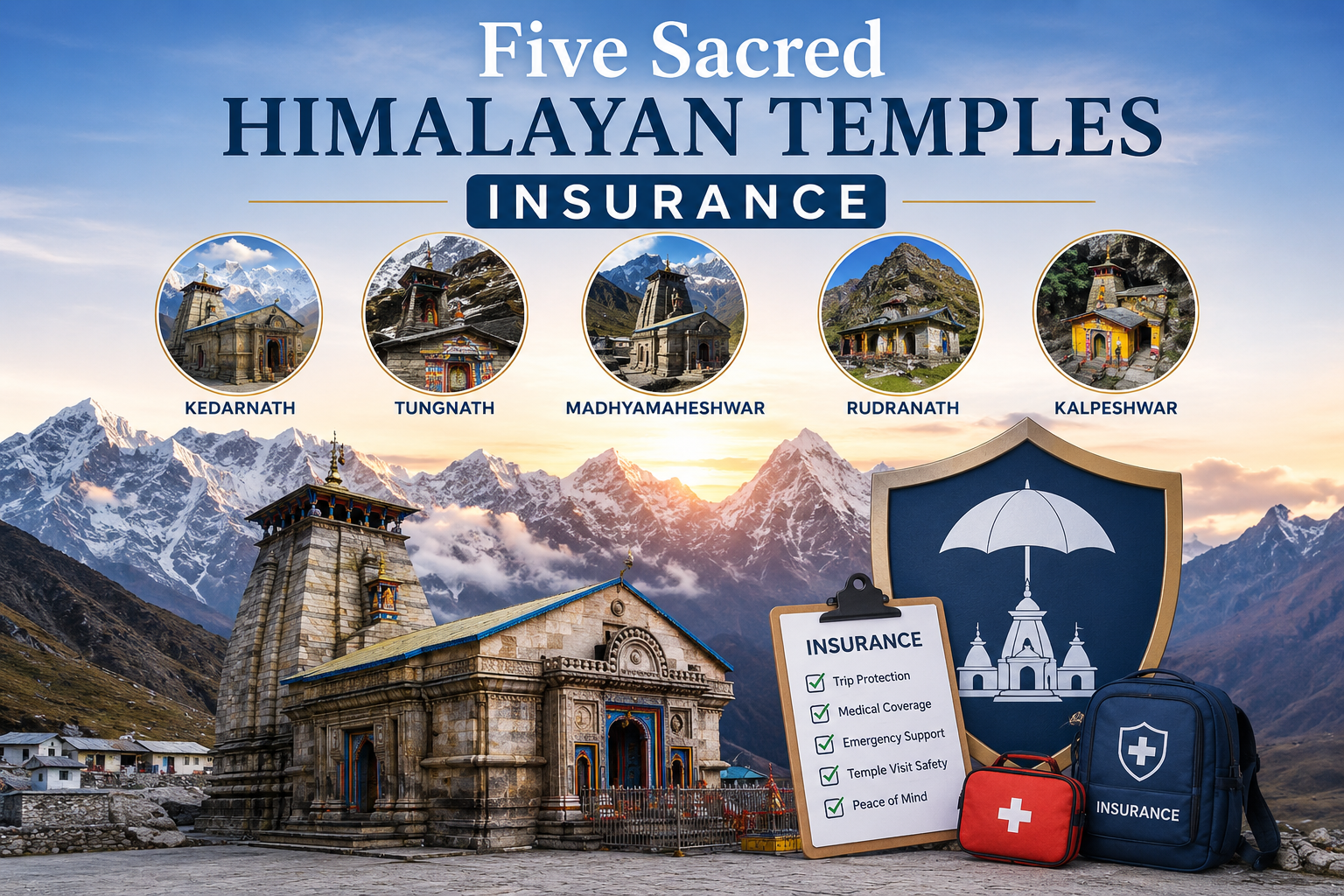
Most trekkers spend weeks researching trail distances, packing lists, and itineraries before a Himalayan pilgrimage. Very few spend even one hour understanding what happens if something goes wrong at 12,000 feet. Five Sacred Himalayan Temples Insurance is not a formality or an upsell — it is the one decision that separates a manageable emergency from a financially devastating one in one of the most remote trekking regions in India.
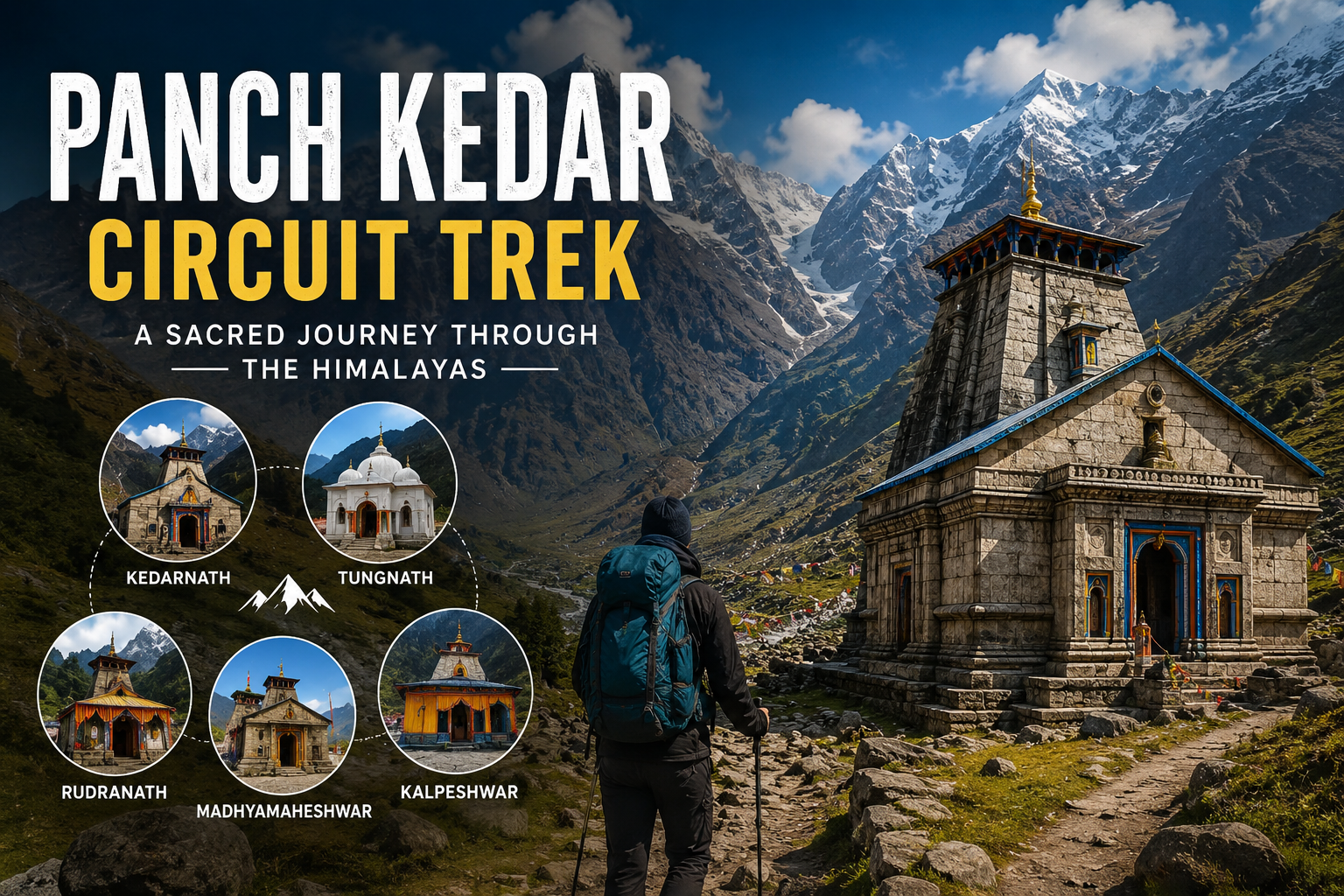
The Panch Kedar circuit covers five sacred Shiva temples spread across the Garhwal Himalayas of Uttarakhand: Kedarnath, Tungnath, Rudranath, Madhyamaheshwar, and Kalpeshwar. Several of these temples sit above 3,500 metres, deep inside terrain where the nearest motorable road can be eight to sixteen kilometres away. There are no road ambulances on the Rudranath trail. There are no hospitals between Ransi and Gaundhar. The only realistic emergency exit in a serious medical situation is a helicopter.
That single fact — helicopter evacuation from Rudranath or Madhyamaheshwar costs between ₹80,000 and ₹1,50,000 without insurance coverage — should be enough to make trek insurance non-negotiable. This guide explains exactly what a proper trekking insurance India Himalaya policy covers, what standard travel policies quietly exclude, and how to make an informed decision before you set foot on the trail.
Why the Stakes Are Higher on Panch Kedar Than on Most Treks
The Panch Kedar route is not a single trail with a single base. It is a circuit with five separate trek legs, each beginning and ending at a different village, each at a different altitude, and each with a different risk profile. A trekker doing the Kedarnath leg faces long-distance exertion at 3,583 metres. A trekker attempting to navigate Rudranath navigates rocky, unmarked terrain through dense forest above 3,600 metres with no phone signal for two consecutive days.
This geography creates a specific set of risks that standard travel insurance is not designed for:
— Altitude sickness requiring hospitalisation or emergency descent — Sudden cardiac events triggered by exertion at low-oxygen altitude — Fractures or sprains on remote, technically demanding trails — Flash floods and landslides cutting off entire trail sections — Temple closures due to natural disasters forcing complete itinerary abandonment
Each of these scenarios triggers a different insurance clause — and each clause exists in some policies but not others. The difference between a policy that covers you and one that does not is often a single line in the fine print about high altitude trekking above 3,000 metres.
What Standard Travel Insurance Does Not Cover
This is the section most insurers would prefer you skip. Standard travel insurance — the kind sold as an add-on when you book flights, or packaged with credit cards — is designed for missed flights, lost baggage, and hospitalisation in accessible urban areas. It is not designed for adventure in the Indian Himalayas.
Most standard policies explicitly exclude:
— Trekking above 3,000 to 4,000 metres (the exact altitude limit varies by insurer) — Activities classified as adventure sports, which include high-altitude trekking in some policy definitions — Helicopter evacuation unless a separate air-ambulance clause is included — Pre-existing medical conditions, which become significant when blood pressure or cardiac history is involved at altitude — Trip cancellations caused by natural disasters that are not named in the policy specifically
The result: a trekker who buys a ₹500 travel insurance policy at the airport, gets injured on the Rudranath trail at 3,600 metres, and requires helicopter evacuation may find that the entire claim is rejected because the activity was not covered under the base policy.
This is not a hypothetical. Medical evacuation insurance Himalaya claims are regularly disputed and denied because trekkers assume their standard travel cover is sufficient. It is not.
If you are planning the Panch Kedar Circuit Trek as a 12-day, multi-leg pilgrimage covering 107 kilometres across five different altitudes, a standard travel policy is the wrong product entirely. What you need is a dedicated adventure travel insurance India policy with a verified high-altitude rider.
What Proper Trek Insurance Must Cover
A policy designed for travel insurance for high altitude trek conditions should include all of the following. If any one of these is absent, request a rider or choose a different provider.
Helicopter Medical Evacuation
This is the single most important clause. Helicopter evacuation is the only realistic emergency transport from the Rudranath and Madhyamaheshwar legs of the circuit. The policy must explicitly state coverage for helicopter rescue up to the altitude you will be trekking at (minimum 4,000 metres). Coverage amount should be ₹5,00,000 or higher.
Many policies offer air ambulance coverage only within India’s metro cities. Confirm the policy covers remote high-altitude rescue in Uttarakhand specifically.
Altitude Sickness Hospitalisation
Acute Mountain Sickness (AMS) can escalate into High Altitude Pulmonary Oedema (HAPO) or High Altitude Cerebral Oedema (HACO) within hours. Hospitalisation at Jolly Grant Hospital in Dehradun or Srinagar (Garhwal) following an emergency descent should be fully covered. Look for a minimum hospitalisation cover of ₹3,00,000 to ₹5,00,000.
Trip Cancellation Due to Natural Disasters
The Panch Kedar temples close unpredictably due to early snowfall, flash floods, and landslides. If a temple closes mid-circuit or a route becomes impassable after you have paid for your trek, trip cancellation cover should reimburse non-refundable expenses. This clause must include Act of God or natural disaster as a valid reason for cancellation.
Personal Accident Cover
Fractures, sprains, and falls on rocky terrain are the most common trek injuries. Personal accident cover should include hospitalisation, orthopaedic treatment, and emergency repatriation to your home city.
Baggage Loss on Remote Legs
Baggage left at teahouses or carried by porters can occasionally be lost or damaged on remote trails. Baggage cover is a secondary clause but useful on a 12-day circuit with multiple accommodation changes.
IRCTC Kedarnath Insurance vs Private Trek Insurance
When you register for the Kedarnath yatra through the official Uttarakhand government portal or through IRCTC, a compulsory Kedarnath helicopter rescue insurance contribution of ₹150 per pilgrim is included in the registration. This insurance exists specifically because of the 2013 Kedarnath flood disaster, which required mass helicopter evacuations.
What the IRCTC or yatra registration insurance typically covers: — Accidental death during the yatra — Permanent disability due to accident — Emergency medical evacuation by helicopter for the Kedarnath leg only
What it does not cover: — Any medical situation on the Tungnath, Rudranath, Madhyamaheshwar, or Kalpeshwar legs — Altitude sickness that develops without a traumatic accident event — Trip cancellation or refund of trek costs — Baggage loss
The IRCTC yatra insurance is meaningful protection for the Kedarnath leg specifically, but it leaves four of the five Panch Kedar temples completely uninsured. For anyone doing the complete circuit, the ₹150 yatra cover is a supplement, not a replacement for proper travel insurance vs trek insurance India coverage.
The practical comparison looks like this:
| Coverage Type | Standard Travel Policy | Adventure Rider Added | Dedicated Trek Insurance |
| Helicopter Evacuation | Usually Excluded | Included Above 3,000m | Fully Included |
| Altitude Sickness | Usually Excluded | Included | Included |
| Trip Cancellation (Natural Disaster) | Limited | Included | Fully Included |
| Personal Accident | Basic | Extended | High Limit |
| All 5 Panch Kedar Legs Covered | No | Partial | Yes |
| IRCTC Yatra Cover Compatibility | Not Applicable | Supplement | Supplement |
Comparing Insurance Providers for High-Altitude Trekking
Three Indian insurers have strong track records on trek insurance in Uttarakhand claims and offer policies with explicit high-altitude adventure riders.
TATA AIG Travel Guard
TATA AIG’s Travel Guard policy with an adventure sports rider covers trekking above 3,500 metres and includes emergency medical evacuation. The cashless hospitalisation network is strong in Dehradun and Haridwar. The policy must be purchased with the adventure sports endorsement — the base policy excludes trekking above standard altitude limits.
Bajaj Allianz Travel Insurance
Bajaj Allianz offers a dedicated adventure sports add-on that covers mountain trekking and helicopter rescue. Their online claim process is among the most straightforward available. Confirm that the policy covers the specific altitudes of Tungnath (3,680m) and Rudranath (3,600m).
Care Health Travel Insurance
Care Health’s travel plans with adventure activity riders have competitive helicopter evacuation limits. Their customer support for emergency claims has been positively reviewed by the Himalayan trekking community. Useful for trekkers who need higher medical hospitalisation cover due to pre-existing conditions.
Regardless of provider, read the policy document — not just the summary — and confirm three things before purchasing: the maximum altitude covered, whether helicopter rescue is explicitly listed, and what the claim process is from a remote location with limited phone connectivity.
This is also a good moment to plan the non-emergency part of your Panch Kedar experience. If you are considering the full devotional and visual experience of the circuit, the Panch Kedar Photography Guide from Mountainiax covers the best golden-hour locations, camera settings for altitude cold, and the Chandrashila summit at 4,130 metres — the highest photography vantage point on the entire circuit.
What Mountainiax Group Trek Insurance Covers
Mountainiax includes group trek insurance in all Panch Kedar packages. This insurance is arranged at the group level with a specialist adventure insurer and covers all five legs of the circuit.
The Mountainiax group policy includes:
Helicopter medical evacuation from any point on the Panch Kedar route, including Rudranath and Madhyamaheshwar — Altitude sickness hospitalisation for all participants — Personal accident cover for trek injuries — Emergency descent and repatriation costs — Guide-initiated claim support — in an emergency, your lead guide initiates the evacuation and insurance claim process, removing the administrative burden from the trekker
This is structurally different from a policy you purchase individually. In a group emergency, a collective evacuation decision is made by the lead guide, who has the authority and the operator contacts to initiate the helicopter call within minutes rather than hours. The insurance is already in place; the process does not require an injured trekker to phone an insurer from a Himalayan ridgeline.
Individual trekkers choosing to self-arrange insurance should ensure their private policy matches or exceeds this level of cover. Minimum recommended: ₹5,00,000 helicopter evacuation cover, ₹3,00,000 altitude sickness hospitalisation, and a confirmed adventure-sports rider that explicitly names high-altitude trekking.
FAQ: Panch Kedar Trek Insurance
1. Is standard travel insurance enough for the Panch Kedar trek?
No. Standard travel insurance typically excludes trekking above 3,000 to 4,000 metres. The Panch Kedar circuit reaches 3,680 metres at Tungnath and 3,600 metres at Rudranath. You need a policy with an adventure sports or high-altitude trekking rider that explicitly covers these elevations.
2. What does helicopter rescue insurance in the Himalayas cost?
Helicopter evacuation from the Rudranath or Madhyamaheshwar trail costs between ₹80,000 and ₹1,50,000 out of pocket without insurance. A proper trek insurance policy with helicopter rescue cover costs between ₹1,500 and ₹4,000 for a 12 to 15-day trek — making it one of the highest-value financial decisions of any Himalayan journey.
3. Does the IRCTC Kedarnath registration include insurance?
Yes, but only for the Kedarnath leg. The ₹150 compulsory yatra insurance covers accidental death and emergency helicopter evacuation specifically on the Kedarnath route. It does not cover Tungnath, Rudranath, Madhyamaheshwar, or Kalpeshwar, and does not include altitude sickness unless it results from a named accident.
4. Can I buy trek insurance after reaching Rishikesh or Haridwar?
Some insurers allow purchase up to 24 hours before the activity starts. However, policies are almost always cheaper and easier to arrange from home. Do not leave insurance purchase to the departure point.
5. What should I do if I need to make a claim from the trail?
If you are trekking with Mountainiax, your lead guide initiates the emergency process. If you are trekking independently, save your insurer’s emergency line in your phone before you leave mobile network range. Your trek leader or the nearest SDRF (State Disaster Response Force) post in Uttarakhand can also assist with the initial evacuation process.
Summary
The mountain does not negotiate. If something goes wrong at 12,000 feet on the Rudranath trail, the response timeline and the financial outcome depend almost entirely on decisions you made before you left home. Panch Kedar Trek Insurance — specifically a policy with helicopter evacuation cover, altitude sickness hospitalisation, and a verified high-altitude adventure rider — is not optional for a 12-day, five-temple Himalayan circuit. It is as essential as your trekking boots.
The IRCTC yatra registration cover is a useful starting point for the Kedarnath leg but leaves four of the five temples unprotected. Standard travel insurance fails at the altitude the Panch Kedar circuit operates. The right product is a dedicated adventure insurance policy from TATA AIG, Bajaj Allianz, or Care Health with a confirmed high-altitude rider, or the group insurance included in a Mountainiax guided package.
With the Panch Kedar Yatra season approaching, it’s time to plan something truly extraordinary. From breathtaking Himalayan peaks to spiritually powerful temples hidden deep in remote valleys, this journey offers an experience that goes beyond a typical trek—it becomes a story you carry for life. To make your journey seamless and well-organised, choose the best trekking company in Uttarakhand for reliable trek packages, detailed itineraries, and hassle-free booking.
Visit this page for Trek Packages, Itinerary & Booking.