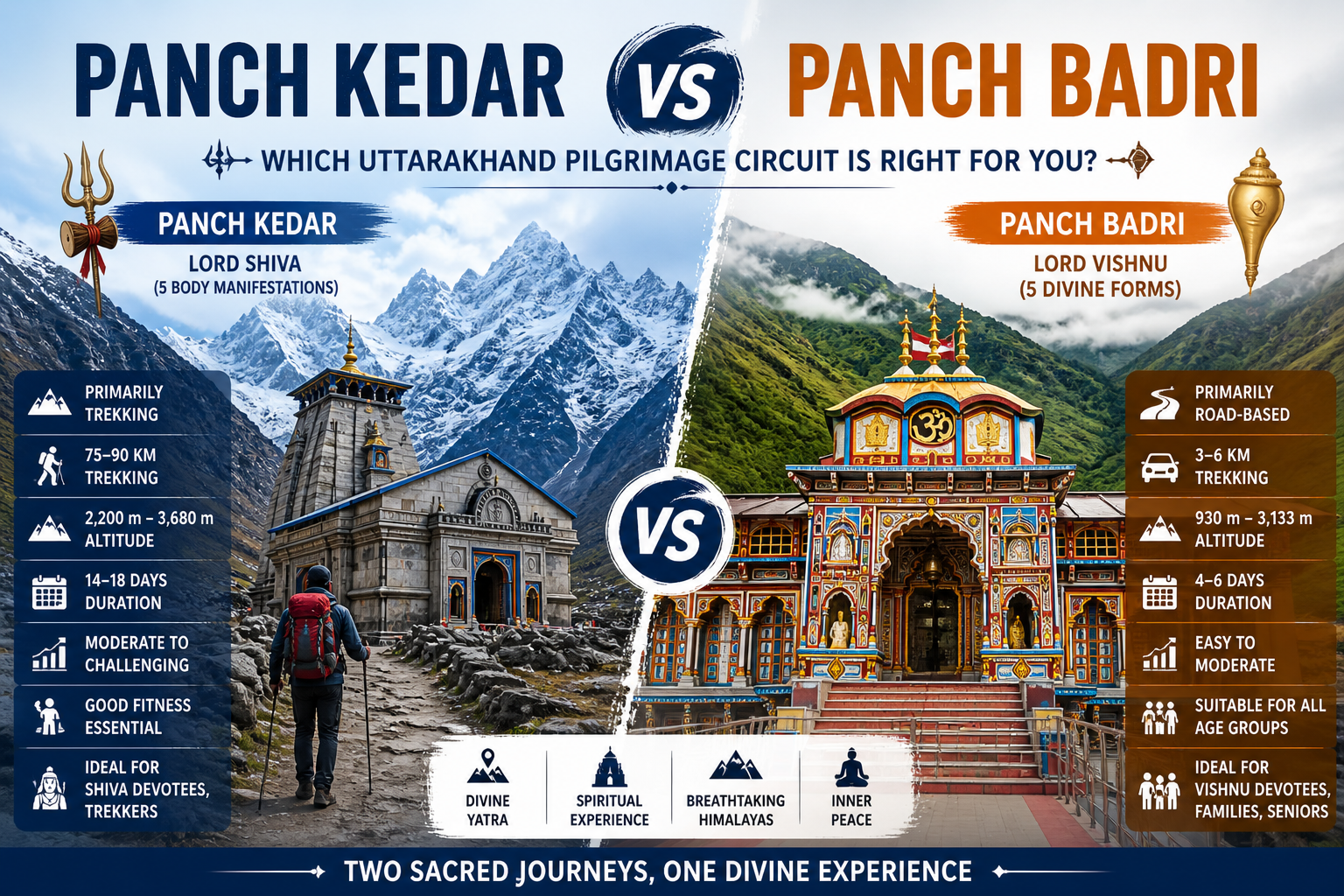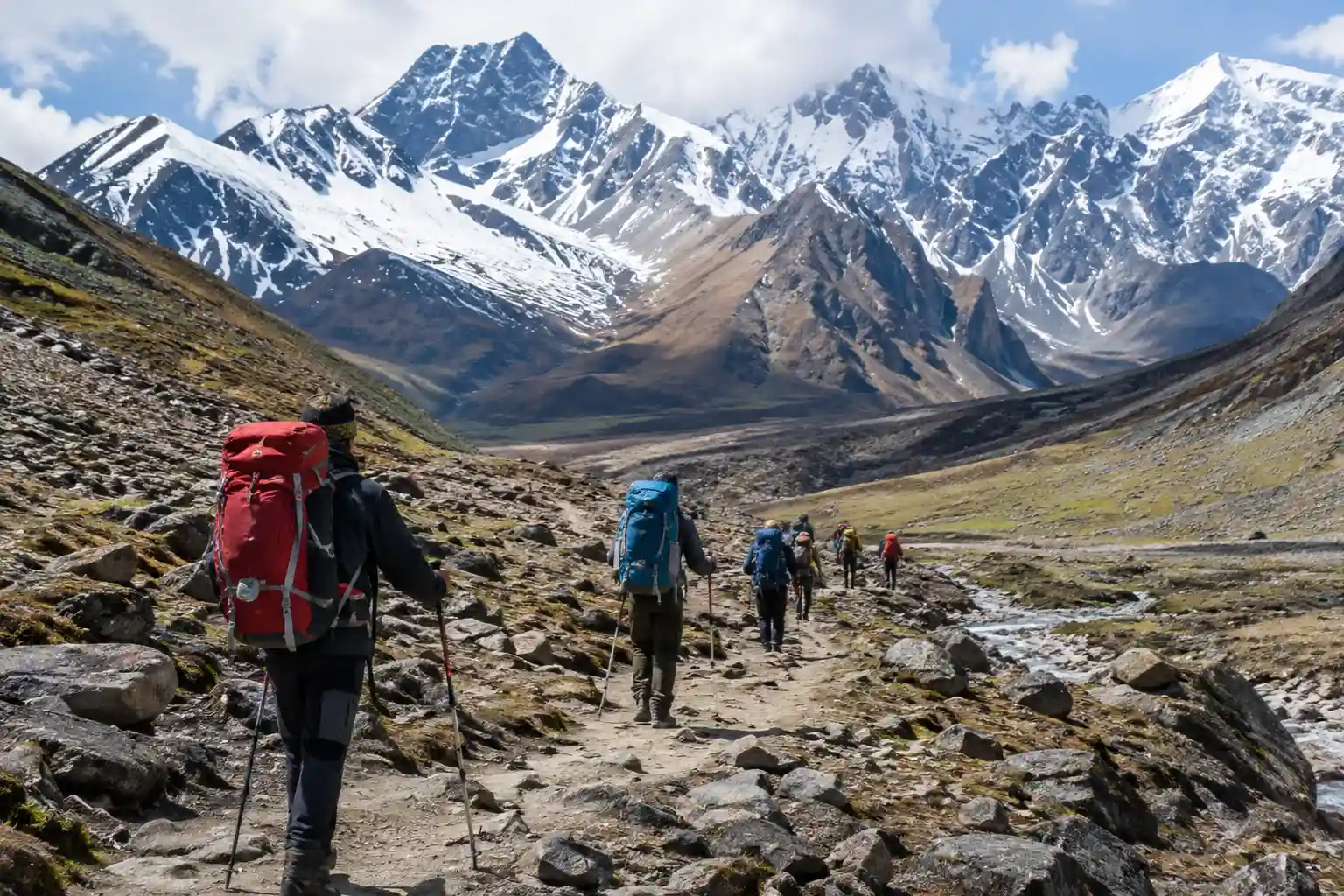

The Himalayas have always been a sanctuary for trekkers who seek more than just a trail — they seek transformation. Among the dozens of high-altitude routes that cut through glaciers, meadows, and ancient stone villages, few carry the spiritual weight and physical challenge of a sacred pilgrimage circuit. Spiritual Trekking in the Himalayas vs Adventure Treks is one of the most searched comparisons among experienced trekkers in 2026, and for good reason. This route is unlike any other.
The Panch Kedar circuit weaves together five ancient Shiva temples perched across the Garhwal Himalayas in Uttarakhand, each sitting above 3,000 metres and surrounded by terrain that demands both grit and reverence. It is simultaneously a spiritual yatra and a high-altitude trekking expedition — a combination that very few Himalayan routes can match. The devotion, the altitude, the remoteness, and the raw Himalayan scenery create an experience that lingers long after the trek ends.
Whether you are a seasoned trekker comparing your next big adventure or a first-timer trying to understand where Panch Kedar fits among the celebrated routes of the Indian Himalayas, this guide gives you an honest, well-researched breakdown. From difficulty and duration to accessibility and spiritual significance, here is everything you need to make your decision.
The Panch Kedar Trek?
The Panch Kedar circuit is a multi-temple pilgrimage trail dedicated to Lord Shiva across five sacred shrines in the Garhwal region of Uttarakhand. The five temples — Kedarnath, Tungnath, Rudranath, Madhyamaheshwar, and Kalpeshwar — are spread across different valleys and altitudes, each requiring a separate trek to reach.
The Five Shrines at a Glance
- Kedarnath (3,583 m) — The most famous and highest-visited of the five shrines, accessible via a 16 km trek from Gaurikund. Considered the crown of the circuit.
- Tungnath (3,680 m) — The highest Shiva temple in the world, reached via a relatively short 3.5 km trek from Chopta. Often called the easiest of the five.
- Rudranath (2,286 m) — The most remote and mystical of the shrines, deep within dense forest and meadow landscape near Sagar village. A 24 km trek one way.
- Madhyamaheshwar (3,497 m) — Set amidst stunning alpine meadows with close-range views of Kedarnath and Chaukhamba peaks, requiring a 24 km trek from Ransi.
- Kalpeshwar (2,200 m) — The only shrine accessible year-round, nestled inside a natural cave near Urgam village with a short 1 km trail.
Together, these five shrines form one of the most spiritually complete and scenically diverse Himalayan trekking circuits in India. The full panch kedar circuit takes approximately 20 to 24 days to complete if all five temples are visited consecutively, though most trekkers visit them in separate trips spread over multiple seasons.
How the Panch Kedar Trek Compares to Other Popular Himalayan Treks
Understanding how Panch Kedar stacks up against other iconic routes requires looking at five key factors: difficulty, duration, altitude, crowd levels, and overall experience.
Panch Kedar vs Kedarkantha Trek
Kedarkantha is arguably the most popular winter trek in Uttarakhand, drawing thousands of trekkers between December and April. It sits at a summit altitude of 3,800 metres and takes 6 days round trip from Sankri. It is beginner-friendly, well-supported with infrastructure, and rewards trekkers with a spectacular 360-degree snow panorama at the top.
Panch Kedar, by comparison, is far more demanding in every way. The full circuit covers over 170 kilometres of trail, reaches altitudes above 3,600 metres at multiple points, and requires sustained high-altitude trekking over weeks rather than days. The experience is less about a single summit moment and more about cumulative immersion — in terrain, culture, devotion, and solitude.
Verdict: Choose Kedarkantha for a focused, beginner-to-intermediate winter trek with a clear summit reward. Choose Panch Kedar if you are an experienced trekker seeking a multi-week, spiritually layered Himalayan journey.
Panch Kedar vs Valley of Flowers Trek
The Valley of Flowers National Park trek in Chamoli district is one of UNESCO’s most celebrated Himalayan treks in India. It peaks between late July and mid-August when the sub-alpine meadow blooms with over 500 species of wildflowers. The trek is moderate in difficulty, covers around 17 km return from Ghangaria, and sits at a maximum altitude of 3,858 metres.
While the Valley of Flowers is visually breathtaking, it is a relatively short and contained experience. Panch Kedar, on the other hand, passes through similarly lush meadows — especially around Madhyamaheshwar and Rudranath — while also offering high-altitude ridge walks, dense rhododendron forests, ancient temple architecture, and Himalayan village culture.
Verdict: Valley of Flowers wins for pure botanical beauty in a short window. Panch Kedar offers a broader, more demanding journey that includes comparable meadow landscapes alongside much more.
Panch Kedar vs Roopkund Trek
Roopkund is often called the Mystery Lake Trek and sits at 5,029 metres in the Chamoli district. It is a moderately challenging to difficult route taking 8 to 9 days, crossing high mountain passes and offering views of Trishul and Nanda Ghunti peaks. The infamous skeletal remains at the lake add a layer of historical intrigue.
This is a high-altitude snowfield trek with serious technical sections in some conditions. Compared to Panch Kedar, Roopkund focuses on a single dramatic destination at a much higher altitude. Panch Kedar’s highest point — Tungnath at 3,680 m — is considerably lower, but the sustained multi-week nature of the circuit makes cumulative altitude exposure a real factor.
For those exploring the Best Treks in Uttarakhand, both Roopkund and Panch Kedar consistently rank at the top — but for entirely different trekking personalities.
Verdict: Roopkund suits trekkers chasing high altitude and dramatic landscapes in a contained itinerary. Panch Kedar suits those seeking a sacred, immersive circuit over a longer duration.
Panch Kedar vs Har Ki Dun Trek
Har Ki Dun is a relatively accessible valley trek in the Govind Wildlife Sanctuary of Uttarkashi, sitting at around 3,566 metres. Known for its ancient villages with Indo-Tibetan architecture and Swargarohini mountain views, it is a moderate trek ideal for families and intermediate trekkers.
Har Ki Dun shares Panch Kedar’s emphasis on culture and landscape over pure summit-bagging, but the scale is incomparable. Panch Kedar covers five distinct valleys and ecosystems, while Har Ki Dun remains within a single valley corridor. The experience at Har Ki Dun is gentler and more accessible for those not yet ready for a multi-week high-altitude circuit.
Verdict: Har Ki Dun is a gentler cultural trek within a single valley. Panch Kedar delivers that cultural depth across five valleys at greater scale and difficulty.
Panch Kedar vs Rupin Pass Trek
Rupin Pass (4,650 m) is one of India’s most dramatic crossings, connecting Uttarakhand and Himachal Pradesh via a steep, technically challenging route. The 8-day trek involves snow bridges, hanging villages, waterfalls, and a vertical ascent to the pass itself. It regularly features on lists of the best Himalayan treks for intermediate to advanced trekkers.
Panch Kedar’s individual temple treks are less technically demanding than Rupin Pass, but the full circuit demands far greater endurance, planning, and logistical effort. The spiritual dimension also sets Panch Kedar apart — Rupin is purely an adventure trek, while Panch Kedar carries layers of mythology, devotion, and cultural significance that define the Garhwal Himalayan identity.
Verdict: Rupin Pass wins on technical challenge and dramatic scenery for a one-week window. Panch Kedar wins on depth, spirituality, and total Himalayan immersion.
Why Panch Kedar Stands Apart: The Spiritual and Cultural Dimension
Most Himalayan trek comparisons focus on altitude, distance, and scenery. But Panch Kedar operates on a dimension that purely adventure-focused treks cannot match: mythology embedded in landscape.
Each shrine in the circuit is tied to the Mahabharata legend of the Pandavas seeking atonement from Lord Shiva. Different parts of Shiva’s divine form are believed to have emerged at each site — the hump at Kedarnath, the arm at Tungnath, the face at Rudranath, the navel and chest at Madhyamaheshwar, and the hair at Kalpeshwar. This mythology transforms each day of trekking into a journey through living scripture.
The priests at each temple are members of the Jangam community, and local communities in Garhwal have preserved age-old rituals and traditions around these shrines for centuries. Trekking the panch kedar circuit means walking through villages where lifestyle and faith have remained largely unchanged for generations — an experience that no other Himalayan route fully replicates.
Practical Planning: What to Know Before You Trek
Understand permits, fitness requirements, weather conditions, accommodation, transportation, packing essentials, altitude preparation, and route planning before starting the Panch Kedar Trek for a safer and smoother Himalayan trekking experience.
Best Season to Visit
May to June and September to November are the ideal windows for most of the five shrines. Kedarnath opens in late April and closes in November. Kalpeshwar remains open year-round. Tungnath is accessible from May through November but becomes especially scenic in spring when rhododendrons bloom.
Difficulty Level
The full circuit rates at moderate to strenuous, depending on individual fitness and which route variants are taken. Rudranath is considered the most challenging of the five due to its remote trail through dense forest and extended distance. Tungnath and Kalpeshwar are comparatively easy.
Permits, Insurance, and Logistics
Unlike some national park treks, the Panch Kedar temples do not require separate trekking permits, though registration at base checkpoints is advisable. It is worth noting that proper Panch Kedar Trek Insurance covering high-altitude trekking, emergency evacuation, and medical expenses is not optional on this circuit — it is a genuine necessity given the remoteness of shrines like Rudranath and Madhyamaheshwar, where evacuation logistics are complex and response times are longer than on popular commercial routes.
Accommodation on the Trail
Dharamshalas and simple guesthouses are available near each shrine, though the quality varies significantly. Carrying a tent and sleeping bag is advisable for the Rudranath and Madhyamaheshwar sections. Food options are basic and limited to local dal-roti meals during peak season.
Physical Preparation
A minimum of 6 to 8 weeks of dedicated fitness training including long-distance hiking, cardiovascular conditioning, and strength training is recommended for the full circuit. Even individual shrine treks like Rudranath require substantial fitness preparation before you set out.
Who Should Choose the Panch Kedar Trek?
Panch Kedar is the right choice for you if:
- You have prior experience on multi-day Himalayan treks above 3,000 metres.
- You are drawn to the intersection of adventure, culture, and spirituality.
- You want a trek that tells a story — mythological, cultural, and geographical — rather than just reaching a summit.
- You are prepared for limited infrastructure, remote trails, and self-sufficient camping in places.
- You have the time to invest in a multi-week expedition or are happy to complete the circuit across multiple seasons.
It may not be the right first choice if you are a beginner trekker, have significant altitude sensitivity, or prefer well-maintained trails with abundant accommodation and guided infrastructure at every stage.
Frequently Asked Questions
Which is harder — Panch Kedar or Roopkund?
Roopkund reaches a higher altitude (5,029 m vs 3,680 m at Tungnath) and has more technically demanding sections. However, the full Panch Kedar circuit demands significantly greater endurance and cumulative fitness over a much longer duration. For overall challenge, the Panch Kedar circuit edges out Roopkund on total physical demand.
Can beginners do the Panch Kedar Trek?
Individual shrines like Tungnath and Kalpeshwar are accessible to well-prepared beginners. However, the full circuit and shrines like Rudranath are recommended for experienced trekkers only.
How long does the full Panch Kedar circuit take?
The complete circuit, visiting all five shrines in one continuous journey, takes approximately 20 to 24 days. Most trekkers complete it across two or three separate trips over different seasons.
Is Panch Kedar Trek open in winter?
Most shrines close between November and April due to heavy snowfall. Kalpeshwar is the only shrine accessible throughout the year. Kedarnath typically reopens in late April or early May on the auspicious occasion of Akshaya Tritiya.
What makes Panch Kedar different from other Himalayan treks?
The combination of five sacred Shiva temples, deep mythological significance, diverse terrain across multiple valleys, and the living cultural traditions of Garhwal villages creates an experience that is genuinely unique among all Himalayan trekking routes.
Summary
The Panch Kedar Trek stands apart from other Himalayan treks because it combines spiritual depth, cultural heritage, remote mountain exploration, and long-distance trekking into one extraordinary journey. Unlike routes focused only on scenery or summit experiences, Panch Kedar offers a deeper connection with the Himalayas through ancient Shiva temples, traditional Garhwali villages, and diverse landscapes spread across multiple valleys.
While the trek demands strong physical preparation and careful planning, the rewards are unmatched for those seeking both adventure and meaning. Whether compared with Kedarkantha, Roopkund, Valley of Flowers, or Rupin Pass, the Panch Kedar circuit delivers a uniquely immersive Himalayan experience that remains unforgettable long after the journey ends.
With the Panch Kedar Yatra season approaching, it’s time to plan something truly extraordinary. From breathtaking Himalayan peaks to spiritually powerful temples hidden deep in remote valleys, this journey offers an experience that goes beyond a typical trek—it becomes a story you carry for life. To make your journey seamless and well-organised, choose the best trekking company in Uttarakhand for reliable trek packages, detailed itineraries, and hassle-free booking.
Visit this page for Trek Packages, Itinerary & Booking.