Every year, thousands of trekkers set out for one of Nepal’s most iconic high-altitude journeys — drawn by the promise of glacier-ringed amphitheatres, Gurung villages draped in rhododendron, and that final, breathtaking arrival at 4,130 metres inside the Annapurna Sanctuary. Many make it there and back without incident. Others are turned around by a condition they did not fully prepare for: altitude sickness. It is not dramatic when it begins. It is just a headache. A slight dizziness. An appetite that has quietly disappeared somewhere between Chomrong and Dovan.
What separates trekkers who complete the journey safely from those who don’t is rarely fitness. It is knowledge. Understanding how your body responds to elevation, how to read the early signals, and how to respond before symptoms escalate — these are the things that determine whether your trek is a memory worth keeping or a medical situation you wish you had avoided.
This guide covers everything you need to know about Altitude Sickness on the Annapurna Base Camp Trek — the three levels of the condition, how symptoms progress, proven prevention strategies, acclimatization protocols that actually work, and a detailed look at what experienced mountain guides carry in their medical kits when they lead groups through the Annapurna Sanctuary.
WHAT IS ALTITUDE SICKNESS AND WHY DOES IT HAPPEN
Altitude sickness, clinically known as Acute Mountain Sickness or AMS, occurs when the body fails to adjust quickly enough to the reduced oxygen levels at high elevation. The air at 4,000 metres contains roughly 40 percent less oxygen than at sea level. Your body needs time to compensate — producing more red blood cells, increasing breathing rate, and redistributing blood flow. When you ascend faster than your body can adapt, the result is AMS.
The critical threshold is around 2,500 metres. Above this point, symptoms can develop in anyone, regardless of age, gender, or physical fitness. This is an important point: being a strong runner or a seasoned gym-goer does not protect you. Elite athletes have been evacuated from the Annapurna Sanctuary. First-time trekkers have sailed through without a symptom. Altitude does not respect your fitness level.
The Annapurna Base Camp trek reaches 4,130 metres at the sanctuary itself, with several nights spent above 3,000 metres at teahouses in Himalaya Hotel, Deurali, and Annapurna Base Camp. The elevation gain in the final two days is steep. This makes the ABC trek a genuine altitude-risk journey, even though it is often categorised as moderate difficulty.
THE THREE LEVELS OF ALTITUDE SICKNESS EVERY TREKKER MUST KNOW
Not all altitude sickness is equal. The condition exists on a spectrum, and understanding where you sit on that spectrum determines what action you should take.
Mild AMS
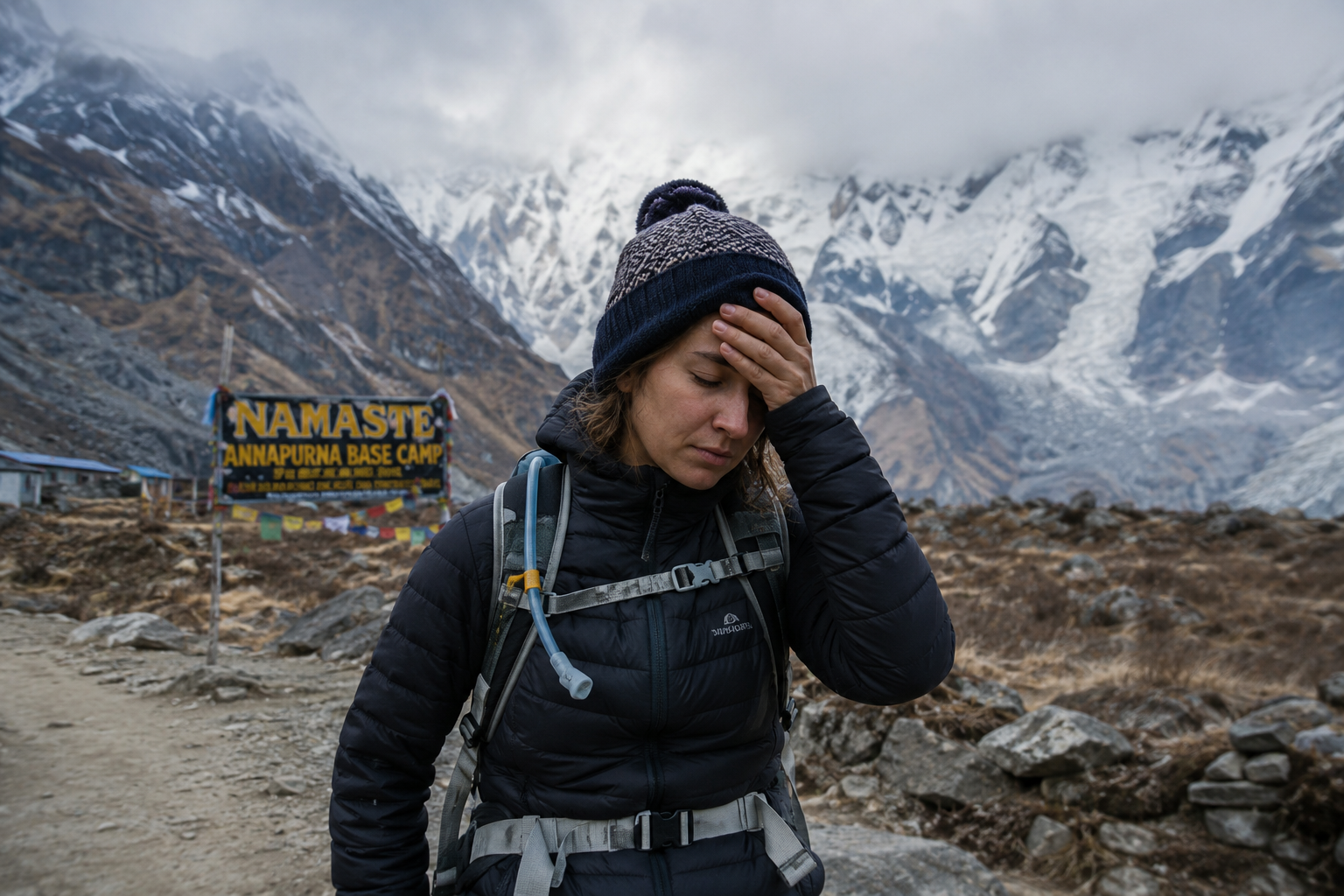
This is the most common form and, if handled correctly, does not have to end your trek. Symptoms typically appear 6 to 12 hours after reaching a new elevation.
Common signs include:
- Persistent headache, especially behind the eyes or across the forehead
- Mild nausea or loss of appetite
- Fatigue that feels disproportionate to the effort
- Dizziness when standing up quickly
- Disrupted or unusually light sleep
- Slight shortness of breath during exertion
The golden rule for mild AMS is simple: do not ascend further until symptoms have fully resolved. Rest at your current elevation, hydrate well, and allow your body to catch up. Most trekkers with mild AMS recover within 12 to 24 hours.
Moderate AMS
When symptoms worsen rather than improve after rest, or when new symptoms begin to appear, you have crossed into moderate AMS. This is the point where medical intervention becomes necessary and descent should be seriously considered.
Warning signs include:
- Headache that does not respond to ibuprofen or paracetamol
- Persistent vomiting
- Severe fatigue and weakness
- Difficulty walking a straight line
- Confusion or unusual behaviour
- A persistent dry cough developing at night
At this stage, the standard protocol is descent of at least 300 to 500 metres, combined with medication. Do not attempt to sleep off moderate AMS at altitude in the hope of feeling better in the morning.
HACE and HAPE: The Life-Threatening Extremes
HACE stands for High Altitude Cerebral Oedema — a condition where fluid builds up around the brain. HAPE is High Altitude Pulmonary Oedema — fluid accumulation in the lungs. Both are medical emergencies requiring immediate descent and, in most cases, helicopter evacuation.
Symptoms of HACE include severe confusion, inability to walk without assistance, extreme drowsiness, and loss of consciousness. Symptoms of HAPE include breathlessness at rest, a gurgling sound when breathing, blue-tinged lips or fingernails, and a rapidly worsening cough producing pink or frothy mucus.
If either of these is suspected, descent must begin immediately. Every minute at altitude worsens the condition.
ALTITUDE PROFILE OF THE ANNAPURNA BASE CAMP TREK: WHERE THE RISK BUILDS
Understanding the day-by-day elevation gain helps you identify where you are most vulnerable on the route. Here is a simplified altitude breakdown of the standard itinerary:
- Pokhara: 820 metres
- Nayapul / Tikhedhunga: 1,540 metres
- Ghorepani: 2,860 metres
- Tadapani: 2,630 metres
- Chomrong: 2,170 metres
- Himalaya Hotel: 2,920 metres
- Deurali: 3,230 metres
- Machapuchare Base Camp (MBC): 3,700 metres
- Annapurna Base Camp (ABC): 4,130 metres
The most significant elevation gain happens in the final two days — from Deurali to MBC and then to ABC. Trekkers who are already feeling symptoms at Deurali are making a dangerous choice by pushing on. The ascent to ABC should only happen when your body has clearly adapted to 3,000-plus metres.
If you are travelling from India, it is worth factoring in travel fatigue and potential dehydration from long journey days before the trek even begins. For those planning an Annapurna Base Camp Trek from India, building in a proper rest day in Pokhara before beginning the approach is not optional — it is essential preparation.
PROVEN PREVENTION STRATEGIES FOR ABC TREKKERS
Prevention is not complicated. It requires discipline, patience, and the willingness to slow down when your instinct is to keep moving.
Follow the Ascend High, Sleep Low Principle
Your body acclimatizes during sleep, not during activity. The most effective strategy is to spend active hours gaining elevation but return to a lower altitude to rest. On the ABC trek, this can mean taking a side hike above your planned campsite before descending to sleep.
Pace Your Daily Elevation Gain
As a general rule, once you are above 3,000 metres, limit your sleeping altitude gain to 300 to 500 metres per day. The standard ABC itinerary pushes this boundary on some days. If you feel any symptoms above MBC, stop. The summit view will still be there tomorrow.
Stay Relentlessly Hydrated
Dehydration significantly worsens altitude sickness symptoms. At elevation, you lose moisture rapidly through respiration — the cold, dry Himalayan air draws it out with every breath. Aim for at least 3 to 4 litres of water daily. Avoid alcohol entirely above 2,500 metres and limit caffeine, both of which accelerate fluid loss.
Eat Even When You Don’t Feel Like It
Loss of appetite is one of the earliest signs of AMS — but continuing to eat is important for maintaining energy and aiding recovery. Favour carbohydrates, which require less oxygen to metabolise than fats or proteins. Garlic soup, a staple in Himalayan teahouses, is widely consumed by locals and trekkers alike for its believed acclimatization properties. Science is mixed on this, but it does no harm and is genuinely warming.
Consider Diamox Under Medical Guidance
Diamox (acetazolamide) is the most widely used pharmaceutical aid for altitude sickness prevention. It works by stimulating faster breathing, which increases the oxygen content in your blood and speeds up acclimatisation.
It is not a magic pill and it comes with side effects — increased urination, tingling in the fingers and toes, and occasional nausea. It should never be taken without prior consultation with a doctor, and it is not suitable for people with sulfa allergies or certain kidney conditions. If your doctor approves it, a preventive course is typically started one to two days before ascending to altitude.
The important thing to understand: Diamox masks some symptoms of AMS. It should not make you feel confident enough to ascend faster than your body is actually adapting.
THE ACCLIMATIZATION ADVANTAGE: HOW TO USE GHOREPANI WISELY
One of the underused advantages of the standard ABC itinerary is the natural acclimatisation window it provides. The route passes through Ghorepani at 2,860 metres — an altitude at which many trekkers begin to feel their first subtle signs of acclimatisation, such as slightly laboured breathing on steep sections or a mild headache in the evening.
Spending an extra night at Ghorepani, or using the classic Poon Hill side trip (3,210 metres) as an acclimatisation excursion, gives your body a meaningful head start before the push above 3,500 metres. Many experienced guides specifically recommend this rest stop, particularly for trekkers who have come from low-altitude cities or spent only one night in Pokhara.
A well-structured Guide of Annapurna Base Camp Trek 2026 will always factor in these acclimatisation opportunities, rather than rushing the itinerary to save days. When comparing packages, any itinerary that reaches ABC in fewer than seven trekking days from Nayapul should be scrutinised carefully.
WHAT EXPERIENCED GUIDES ACTUALLY CARRY
A qualified, experienced guide does not just know the trail. They carry a specific medical kit designed to manage altitude emergencies from the first symptoms to helicopter evacuation coordination. Here is what the best guides bring into the Annapurna Sanctuary:
Diamox (Acetazolamide)
For preventive use and for treating moderate AMS when a trekker has either not brought their own supply or needs an additional dose. Guides typically carry both 125mg and 250mg tablets.
Dexamethasone
A powerful corticosteroid used exclusively in emergencies — specifically for HACE. It reduces brain swelling rapidly and can be life-saving when immediate descent is not possible. This is not a medication for everyday AMS. Guides are trained on when and how to administer it.
Nifedipine
The emergency treatment for HAPE. It reduces pressure in the pulmonary arteries, buying critical time for the affected trekker to descend while a rescue is coordinated. Like dexamethasone, this is an emergency drug carried by guides for extreme situations.
Pulse Oximeter
One of the most important and underestimated items in a guide’s kit. A pulse oximeter clips onto your finger and measures blood oxygen saturation (SpO2) in seconds. A healthy reading at altitude is typically above 90 percent. Readings below 85 percent signal inadequate acclimatisation and potential AMS. A reading below 75 percent at rest is a medical emergency.
Guides use pulse oximeters not just when trekkers feel unwell, but proactively — checking the whole group each morning and evening above 3,000 metres. This is one of the most effective early warning tools available.
Portable Oxygen Canister
Supplemental oxygen does not cure altitude sickness — only descent does — but it provides temporary relief, stabilises a deteriorating trekker, and buys time during the coordination of a descent or evacuation. Most experienced guides carry at least one portable canister on the ABC approach.
Gamow Bag (In Some Cases)
A portable hyperbaric chamber, the Gamow bag is inflated around the patient and simulates a lower altitude environment by increasing the internal pressure. It is most commonly found at higher-elevation lodges and with organised expedition teams rather than in every guide’s personal kit — but for group treks above 3,500 metres, it can be a genuine life-saving addition to the medical supplies.
Ibuprofen and Paracetamol
The frontline treatments for altitude headache. Ibuprofen is often preferred over paracetamol at altitude due to its anti-inflammatory properties. Both are carried in generous supply.
Rehydration Salts (ORS)
Oral rehydration salts are essential for treating dehydration-related collapse, which is common at altitude, particularly when a trekker has been vomiting or has significant diarrhoea from a gastrointestinal illness on the trail.
Anti-nausea Medication
Ondansetron or promethazine is typically carried to manage persistent vomiting — both as a symptom of AMS and as a standalone illness that accelerates dehydration.
THE DESCENT RULE: NON-NEGOTIABLE
Every guide, every doctor, and every experienced high-altitude trekker agrees on one principle above all others: if in doubt, descend.
No view, no summit, no completion certificate is worth your life or your long-term health. Descending 300 to 500 metres at the first sign of worsening symptoms resolves the vast majority of AMS cases within hours. The mountain will be there next season. You only have one set of lungs and one brain.
Experienced guides are trained to override the protests of determined trekkers who insist they feel fine and want to push on. If your guide tells you to descend, listen. Their judgment in that moment is more reliable than your own motivation.
ALTITUDE SICKNESS AND TIMING: DOES SEASON MAKE A DIFFERENCE
The Best Time to Trek Annapurna Base Camp from a safety standpoint is the pre-monsoon window of March to May and the post-monsoon period of late September through November. These seasons offer the most stable weather, clearer skies for acclimatisation monitoring, and warmer temperatures that reduce the physiological stress on your body at altitude.
Trekking in winter (December to February) significantly increases cold-exposure risk, which compounds the effects of altitude. Temperatures at ABC can drop to minus 15 degrees Celsius at night. Cold air makes breathing more difficult, increases caloric demand, and reduces your body’s ability to acclimatise efficiently. Monsoon season (June to August) brings high rainfall, leeches on the lower trails, and reduced visibility — though the risk of altitude sickness itself does not change with season. The danger is compounded by wet trails and potential for landslides rather than the altitude alone.
FREQUENTLY ASKED QUESTIONS
Q1. Can you get altitude sickness on the Annapurna Base Camp Trek?
Yes. The trek reaches 4,130 metres at the Annapurna Sanctuary, well above the 2,500-metre threshold at which AMS can develop. Any trekker ascending to ABC is at risk if they ascend too quickly or do not allow adequate acclimatisation time.
Q2. What are the first signs of altitude sickness on the ABC trek?
The earliest signs are typically a persistent headache, mild nausea, loss of appetite, unusual fatigue, and disrupted sleep. These usually appear 6 to 12 hours after reaching a new elevation.
Q3. Is Diamox necessary for the Annapurna Base Camp Trek?
Not for every trekker. Many people complete the ABC trek without Diamox. However, it is a useful preventive option for those with a history of altitude sickness or those on a shorter itinerary. Always consult a doctor before taking it.
Q4. What should I do if I feel altitude sickness at Deurali or MBC?
Do not ascend further. Rest at your current elevation, hydrate, and take ibuprofen for headache. If symptoms do not improve within 12 to 24 hours or begin to worsen, descend. Inform your guide immediately.
Q5. How do guides detect altitude sickness before it becomes serious?
Experienced guides use pulse oximeters to monitor blood oxygen saturation morning and evening above 3,000 metres. They also observe trekkers for behavioural changes, balance issues, and pale or blue-tinged lips — signs that self-reporting may not catch in time.
Conclusion
The Annapurna Base Camp trek is not just a walk through the mountains. It is a journey into one of the most dramatic and spiritually charged landscapes on the planet — a place where glaciers meet sky, where Machapuchare rises like a guardian over the sanctuary, and where every step above 3,000 metres demands a quiet, honest conversation with your own body. Altitude sickness is the one variable that can rewrite that story overnight. But it does not have to. Every symptom covered in this guide has a response. Every risk has a strategy. The mountain does not punish the prepared.
What separates a successful ABC trek from an abandoned one is almost never courage or physical strength. It is patience — the willingness to rest one more day, drink one more litre of water, and trust your guide when they say the body needs time. Acclimatisation cannot be rushed, negotiated with, or overridden by determination. The trekkers who summit with the clearest heads and the widest smiles are almost always the ones who moved the slowest on the way up.
With the Annapurna Base Camp Trek 2026 season approaching, now is the perfect time to plan an unforgettable Himalayan adventure. Surrounded by snow-covered peaks, diverse landscapes, and authentic mountain culture, the Annapurna Base Camp Trek offers an experience far beyond an ordinary trek—it becomes a lifetime memory filled with challenge, beauty, and achievement. To make your journey smooth, safe, and well-organised, choose a trusted trekking company for expertly designed trek packages, detailed itineraries, and hassle-free booking assistance.
Visit this page for Trek Packages, Itinerary & Booking.