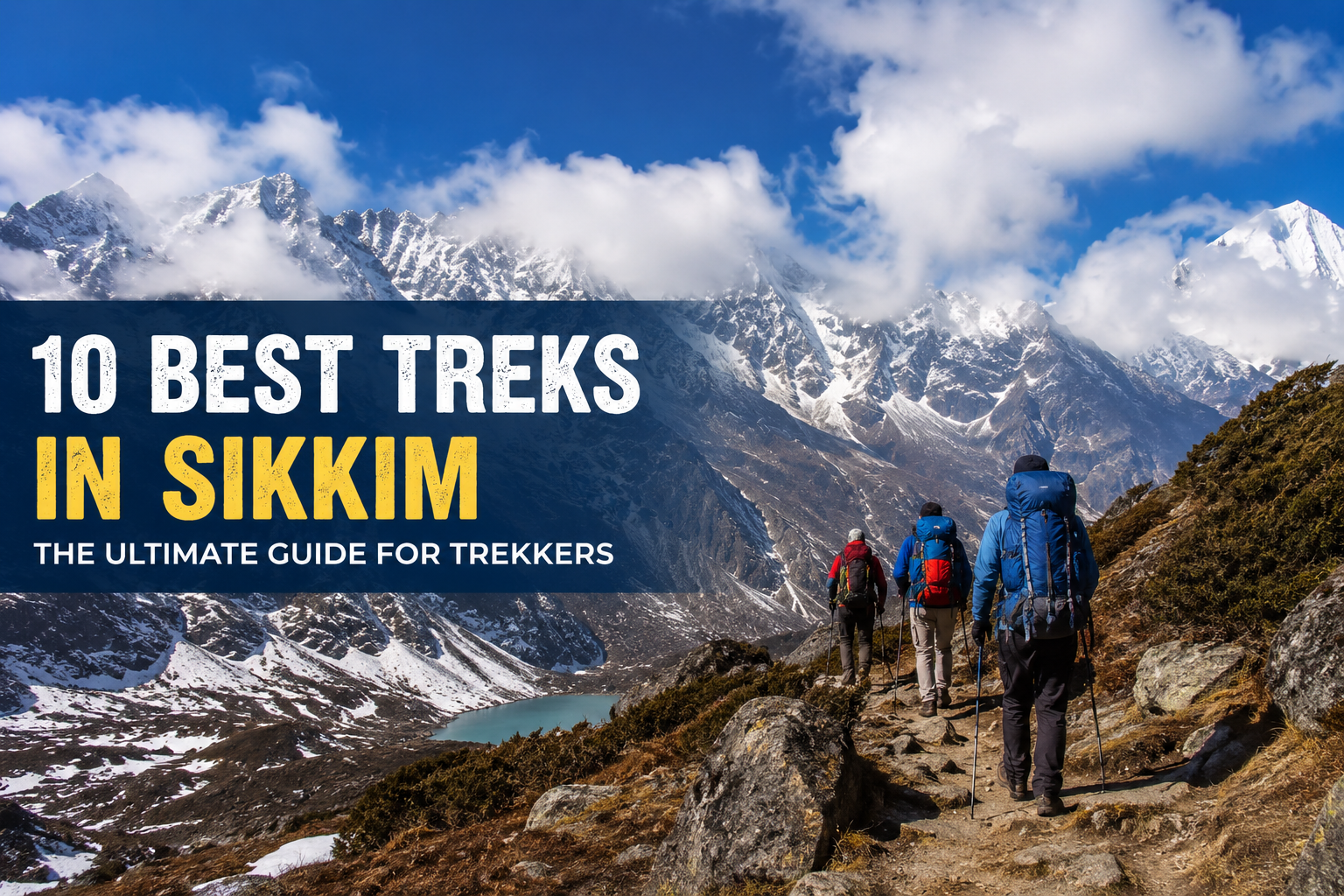
Sikkim sits quietly in the eastern Himalayas, overshadowed in most travel conversations by Nepal and Ladakh, yet it holds some of the most rewarding trekking terrain in the entire mountain range. From rhododendron forests that turn hillsides pink and red every spring to high-altitude passes that open onto Kanchenjunga, the world’s third-highest peak, this small state packs an outsized punch for anyone chasing real Himalayan trekking experiences.
This guide to the 10 Best Treks in Sikkim is built for trekkers who want more than a generic checklist. Whether you are planning your first high-altitude trek or looking for your next serious challenge after Uttarakhand or Nepal, you will find route details, difficulty levels, permit requirements, and honest guidance on what each trail actually demands.
At Mountainiax, we work with trekkers across the Himalayas every season, and Sikkim consistently surprises first-timers with how varied and well-organised its trekking infrastructure has become. Below is a route-by-route breakdown to help you choose the trek that fits your fitness, timeline, and travel goals.
Why Sikkim Deserves a Spot on Your Trekking List
Sikkim is compact, but its geography ranges from subtropical forests near Yuksom to glacial terrain above 4,500 metres. A few things set it apart from other Himalayan trekking regions:
- Kanchenjunga National Park, a UNESCO World Heritage Site, anchors most of the state’s major routes
- Trails pass through Buddhist monasteries, prayer flags, and Lepcha and Bhutia villages, giving the treks a strong cultural layer alongside the scenery
- Rhododendron blooms between March and April turn several routes into some of the most photogenic trails in India
- Trekking seasons are relatively predictable, with clear pre-monsoon and post-monsoon windows
Because Sikkim borders Nepal, Bhutan, and Tibet, several routes near the international boundary require permits. Planning ahead for these is essential, and we cover the specifics for each trek below.
1. Goecha La Trek
The Goecha La Trek is the flagship trekking route in Sikkim and one of the most celebrated treks in the Eastern Himalayas. It runs from Yuksom, at roughly 1,780 metres, through Sachen, Tshoka, and Dzongri before reaching Goecha La viewpoint at around 4,600 metres, delivering close-up views of Kanchenjunga, Pandim, and Kabru.
Key details:
- Duration: 8 to 11 days depending on the itinerary and acclimatisation days built in
- Difficulty: Moderate to difficult, suited to trekkers with prior high-altitude experience
- Best season: April to June and late September to November
- Permits: Inner Line Permit required, arranged through a registered trekking agency, along with entry into Kanchenjunga National Park
This trek is not one to underestimate. The climb from Tshoka to Dzongri gains over a thousand metres in a single push, so a reasonable base level of cardiovascular fitness matters more here than technical climbing skill.
2. Dzongri Trek
For trekkers short on time but unwilling to compromise on views, the Dzongri Trek is the natural choice. It follows the same trail as Goecha La for its first stretch but turns back after reaching Dzongri Top, a viewpoint that still delivers a sweeping Kanchenjunga panorama.
- Duration: 6 to 7 days
- Difficulty: Moderate
- Best season: March to May, October to December
- Highlight: Sunrise from Dzongri Top, when the Kanchenjunga range briefly glows gold
Dzongri works well as a shorter alternative for people testing their readiness for a longer high-altitude route later.
3. Green Lake Trek
The Green Lake Trek approaches Kanchenjunga from its northern flank and is widely regarded as one of the more demanding and less crowded routes in Sikkim. It follows the historic path used by early mountaineering expeditions attempting the peak, passing through Zemu Glacier terrain and remote high-altitude camps.
- Duration: 11 to 14 days
- Difficulty: Difficult, recommended for experienced trekkers only
- Best season: April to June, September to October
- Permits: Restricted Area Permit required, along with military and forest department clearances arranged well in advance
Because this route sits close to sensitive border areas, group size and documentation requirements are stricter than on the Goecha La side, so early planning with an experienced operator is non-negotiable.
4. Singalila Ridge Trek
Running along the natural boundary between Sikkim and Nepal, the Singalila Ridge Trek offers something few other trails in the region can: views of four of the world’s five highest peaks, including Everest, Lhotse, Makalu, and Kanchenjunga, from a single vantage point near Dafey Bhir.
- Duration: 6 to 9 days
- Difficulty: Moderate
- Best season: Mid-March to mid-June, with October and November offering the clearest long-range views
- Starting point: Usually Uttarey or Dhotrey
This trail is less commercialised than Goecha La, which makes it a good option for trekkers who want solitude without sacrificing scale.
5. Barsey Rhododendron Sanctuary Trek
If your trekking calendar is built around spring bloom, the Barsey Rhododendron Sanctuary Trek is the route to prioritise. Between late March and April, the forest canopy turns into a wall of red, pink, and white rhododendron blossoms.
- Duration: 3 to 4 days
- Difficulty: Easy to moderate, suitable for beginners
- Best season: March to April for blooms, October to November for clear mountain views
- Notable stops: Hilley, Dentam, and the sanctuary’s dense oak and magnolia forests
This is one of the more accessible entries on this list, making it a smart pick for first-time trekkers or families with older children.
6. Tholung Monastery Trek
The Tholung Monastery Trek combines moderate trekking with genuine cultural depth. The route leads to one of Sikkim’s oldest and most sacred monasteries, tucked deep in the Dzongu region, home to the Lepcha community and their protected reserve forest.
- Duration: 5 to 6 days
- Difficulty: Moderate
- Best season: October to December, March to May
- Cultural note: Dzongu is a protected Lepcha reserve, and permits are required for outsiders entering the region
Trekkers interested in Himalayan trekking beyond scenery alone tend to rate this route highly for its monastery visits and interaction with Lepcha villages.
7. Kasturi Orar Trek
Kasturi Orar is one of Sikkim’s quieter, lesser-known trails, winding through dense forest and alpine meadows in the West Sikkim region. It rarely appears on standard trekking itineraries, which is exactly its appeal for trekkers who have already done the more popular routes.
- Duration: 4 to 5 days
- Difficulty: Moderate
- Best season: April to June, September to November
- Highlight: Uncrowded meadows with views toward the Kanchenjunga range from a different angle than Dzongri
8. Rhenock-Aritar-Lampokhari Trek
Located in East Sikkim, this trek is a good fit for trekkers looking for shorter, lower-altitude routes that do not require major acclimatisation planning. It moves through terraced farmland, forest, and the Lampokhari lake area.
- Duration: 2 to 3 days
- Difficulty: Easy
- Best season: October to May
- Best for: Beginners, weekend trekkers, and those combining trekking with a broader East Sikkim itinerary
9. Tshoka-Phedang Short Trail
For travellers who want a genuine taste of Kanchenjunga National Park without committing to a full multi-day expedition, the Tshoka-Phedang stretch works as a standalone short trek. It covers part of the classic Goecha La route through rhododendron and magnolia forest up to Phedang’s open meadows.
- Duration: 3 to 4 days round trip from Yuksom
- Difficulty: Easy to moderate
- Best season: March to May, October to November
- Best for: First-time trekkers testing altitude tolerance before attempting Dzongri or Goecha La
10. Versey-Dentam-Hilley Circuit
This circuit links several West Sikkim villages and forest sections into a loop trek, giving trekkers a mix of rhododendron forest, farmland, and monastery visits without the logistical demands of a high-altitude expedition.
- Duration: 4 to 5 days
- Difficulty: Easy to moderate
- Best season: March to April, October to November
- Best for: Trekkers who want cultural immersion alongside forest trekking
Permits and Documentation You Will Need
Most routes described above fall within or near Kanchenjunga National Park, so a few permit rules apply broadly:
- Indian nationals need an Inner Line Permit for most Sikkim treks, arranged through a registered trekking agency
- Foreign nationals require a Protected Area Permit, and certain border-adjacent routes like Green Lake need a Restricted Area Permit with additional clearances
- Solo trekking is not permitted on several of these routes; groups must trek through a registered operator with a minimum group size
Carrying two passport-size photographs and original identity proof is standard practice across most Sikkim trekking checkpoints, so it is worth preparing these before you travel rather than at the last minute.
Practical Trekking Tips for Sikkim
A few points worth planning around before you commit to any of these routes:
- Acclimatisation days matter more here than the total distance covered, since several routes gain altitude quickly over short stretches
- Weather in Sikkim shifts fast, particularly near Dzongri and Goecha La, so packing proper layering is not optional
- Rhododendron season is short, generally late March through April, so book early if that is your priority
- Mobile network coverage disappears past Yuksom on most western Sikkim routes, so inform family of your itinerary in advance
Final Thoughts
Sikkim’s trekking routes reward patience and planning more than raw endurance. Whether you choose the demanding push to Goecha La or a gentler few days through the Barsey Rhododendron Sanctuary, each trail offers a distinct read on the Eastern Himalayas that few other regions can match. If you are weighing this against other Himalayan trekking regions, Sikkim tends to offer shorter travel windows and less crowded trails than comparable routes elsewhere in the range.
If you are ready to plan your Sikkim trek, Mountainiax can help you pick the right route for your fitness level, sort out permits, and build an itinerary around the season that suits you best. Get in touch with our team to start planning your trek today.
Frequently Asked Questions
Which is the best trek in Sikkim for beginners?
The Barsey Rhododendron Sanctuary Trek and the Rhenock-Aritar-Lampokhari Trek are the most beginner-friendly, with shorter durations and lower altitude gains.
What is the best time to trek in Sikkim?
Pre-monsoon, from March to June, and post-monsoon, from late September to November, are the two main trekking windows. Spring is ideal for rhododendron blooms, while autumn offers the clearest mountain views.
Do I need a permit to trek in Sikkim?
Yes. Indian nationals typically need an Inner Line Permit, and foreign nationals need a Protected Area Permit or Restricted Area Permit depending on the route. These are usually arranged by your trekking operator.
Is the Goecha La Trek suitable for first-time trekkers?
It is possible but not ideal. The trek involves significant altitude gain and multiple consecutive high-altitude days, so prior trekking experience or a shorter acclimatisation trek beforehand is recommended.
How difficult is trekking in Sikkim compared to Nepal or Uttarakhand?
Sikkim’s routes are generally comparable in difficulty to moderate Uttarakhand treks, though high-altitude routes like Goecha La and Green Lake match the demands of longer Nepal treks in terms of altitude and duration.
Can solo trekkers do these routes?
Solo trekking is restricted on most Sikkim routes within Kanchenjunga National Park. Trekkers must go through a registered operator, often with a minimum group size requirement.
Planning your next Himalayan trek? Reach out to Mountainiax for expert-guided treks across Sikkim, Uttarakhand, and Nepal, with permits, logistics, and route planning handled end to end.
Ready to Trek Sikkim With Mountainiax?
Ready to trek through Sikkim’s rhododendron forests and Kanchenjunga viewpoints? Mountainiax handles permits, itineraries, and expert guides for every route on this list. Book your Sikkim trek with Mountainiax today and turn this guide into your next real Himalayan adventure.