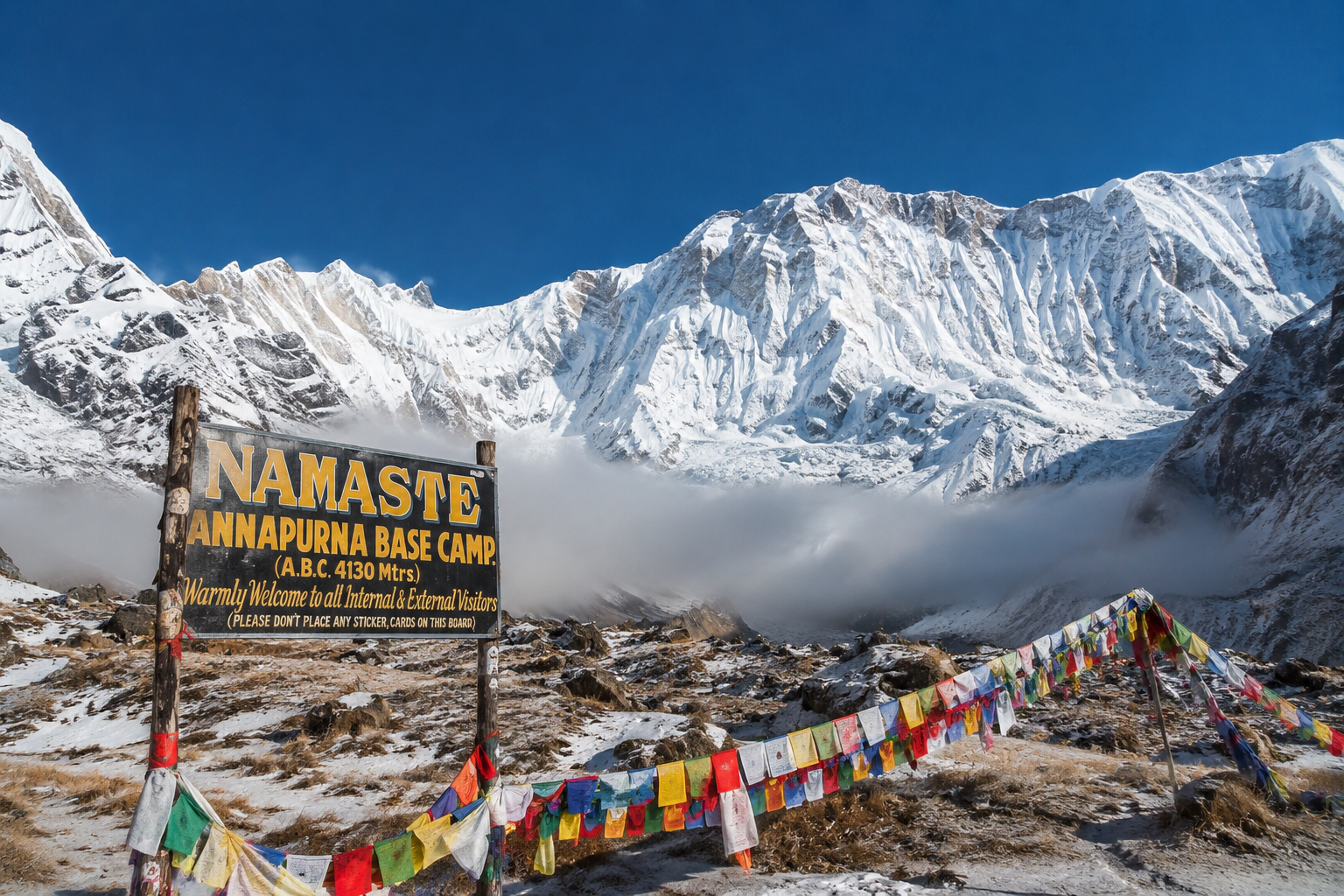
The Himalayas hold many secrets, but few are as dramatic or as deeply rewarding as the hidden world tucked behind the great ridgelines of central Nepal. Nestled at an elevation of 4,130 metres above sea level, the Annapurna Sanctuary is not just a trekking destination — it is a geological phenomenon, a spiritual basin, and one of the most awe-inspiring natural amphitheatres on the planet. Every year, thousands of trekkers from across the world make their way through narrow gorges and forested ridges to reach this sacred glacial bowl.
What makes this place truly extraordinary is not just the scenery — though the scenery alone would justify any journey. It is the feeling of being completely enclosed by giants. When you finally step into the sanctuary, you are surrounded on all sides by some of the highest peaks in the world, including Annapurna I (8,091m), Machhapuchchhre (6,993m), Gangapurna (7,455m), and Hiunchuli (6,441m). The scale is simply incomprehensible until you stand inside it.
So What Is the Annapurna Sanctuary? It is a high-altitude glacial basin formed over millions of years by tectonic uplift and glacial erosion, cradled by the Annapurna massif in the Gandaki Province of Nepal. For trekkers, it is both the destination and the experience — a place where geography, adventure, culture, and inner reflection converge in one unforgettable setting.
The Geography That Created the Sanctuary
To truly understand what you are walking into, it helps to know how the Annapurna Sanctuary formed. The basin is essentially a cirque — a bowl-shaped depression carved by glacial activity over thousands of years. It sits at the heart of the Annapurna Conservation Area, which at over 7,600 square kilometres is one of the largest protected regions in Nepal.
The sanctuary is accessed via a single, narrow gorge cut through by the Modi Khola river. This river valley acts as the only natural corridor into the basin, and this is precisely why the sanctuary remained relatively unknown to the outside world until British climber Jimmy Roberts entered it in 1956. Roberts called it a “sanctuary” because the towering walls of ice and rock give the impression of an enclosed, protected space — and the name has stuck ever since.
The floor of the sanctuary is covered by the South Annapurna Glacier and the Modi Glacier, both of which are slowly retreating due to climate change. This glacial retreat is one of the most visible signs of the broader environmental changes affecting the Himalayas, and researchers from around the world monitor these changes closely. The rocky moraines, meltwater streams, and ice seracs you encounter near Annapurna Base Camp (ABC) at 4,130m are living remnants of a more expansive glacial past.
The surrounding peaks form a near-complete ring, broken only by the gorge through which the Modi Khola escapes southward. This creates a unique microclimate within the basin — one that can be cold, windy, and unpredictable even in the trekking seasons of spring (March to May) and autumn (October to November).
The Peaks That Form the Amphitheatre Walls
Standing at Annapurna Base Camp and looking around is like standing at the centre of a stadium where the audience is made of mountains. Each peak has its own character, history, and significance.
Annapurna dominates the northern skyline. It was the first 8,000m peak ever summited, by Maurice Herzog and Louis Lachenal of France on 3 June 1950. It also holds the grim distinction of having one of the highest fatality rates of any 8,000m peak in the world. The south face of Annapurna I, visible from base camp, is among the most technically challenging walls in Himalayan mountaineering.
Machhapuchchhre, or Fishtail Mountain, guards the entrance to the sanctuary from the south. Its distinctive twin-peaked silhouette is visible from as far away as Pokhara, making it one of the most photographed mountains in Nepal. Strikingly, Machhapuchchhre has never been officially summited — it is considered sacred by the local Gurung people and has been closed to climbing since 1964.
Hiunchuli rises to the east of the gorge entrance and is one of the first major peaks visible as you approach the sanctuary. Gangapurna, Annapurna III, and Annapurna South complete the panoramic ring, each contributing to a skyline that changes colour dramatically from dawn to dusk — from cold blue-grey before sunrise to vivid orange and pink at golden hour.
The Trek to the Sanctuary: What the Journey Looks Like
The trail to the Annapurna Sanctuary is known commercially as the Annapurna Base Camp Trek (ABC Trek). The most common starting points are Nayapul or Phedi, accessible from Pokhara, which serves as the gateway city. The full trek typically covers between 110 to 120 kilometres and takes 10 to 14 days depending on acclimatisation stops, fitness level, and the route taken.
The trail passes through a remarkable range of ecological zones. You begin in the subtropical lowlands where rice paddies and banana trees line the path, then ascend through rhododendron and oak forests, alpine meadows, and finally the rocky high-altitude terrain above the treeline. Key waypoints include:
- Tikhedhunga and Ulleri, famous for the long stone staircase climb
- Ghorepani, where most trekkers wake before dawn to climb Poon Hill for panoramic sunrise views
- Tadapani and Chhomrong, a classic Gurung village with sweeping views of Annapurna South
- Sinuwa, Bamboo, and Dovan — the forested lower gorge sections
- Himalaya Hotel, Deurali, and Machhapuchchhre Base Camp (MBC) at 3,700m
- Annapurna Base Camp at 4,130m — the final destination inside the sanctuary
The trail is well-marked and served by a network of teahouses, making it one of the most accessible high-altitude treks in the world. That said, accessibility should not be confused with ease. The terrain is demanding, the altitude is serious, and preparation matters enormously.
One factor that every trekker must prepare for carefully is the risk of altitude-related illness. If you plan to do the Annapurna Base Camp Trek from India, managing your acclimatisation schedule from the moment you land in Kathmandu or Pokhara is essential. The jump from Pokhara (827m) to ABC (4,130m) happens over a few days, and the body needs time to adjust. Symptoms of Altitude Sickness on the Annapurna Base Camp Trek can range from mild headaches and nausea to potentially serious conditions like High Altitude Pulmonary Oedema (HAPO) or High Altitude Cerebral Oedema (HACO). Knowing the warning signs, descending promptly when needed, and staying well-hydrated are the most critical safety measures on this trail.
Wildlife and Ecology Inside the Sanctuary
The Annapurna Conservation Area is not only one of the most biodiverse regions in Nepal — it is one of the most biodiverse mountain regions in the world. The sanctuary itself sits within this protected zone, and the variety of life you encounter along the approach trail is genuinely extraordinary.
The lower forest zones are home to the red panda, one of the most elusive and beloved animals in the Himalayas. Leopard, snow leopard, Himalayan tahr, musk deer, and barking deer are also found within the conservation area, though sightings on the main trail are rare. The birdlife is spectacular — over 440 species have been recorded in the Annapurna Conservation Area, including the Himalayan monal (Nepal’s national bird), various species of laughingthrush, and several eagle and vulture species.
The rhododendron forests between Ghorepani and Chhomrong are particularly stunning during March and April when the trees are in full bloom. The forests here include over a dozen species of rhododendron, and the combination of red, pink, and white blossoms against snow-capped peaks is one of the defining visual memories of the spring trekking season.
Above the treeline, the landscape becomes starker but no less beautiful. Hardy cushion plants, mosses, and alpine grasses cling to the rocky slopes. The silence at high altitude, broken only by wind and the occasional distant rumble of a serac collapse, is profound.
The Cultural Significance of the Sanctuary
The Annapurna region is home to several indigenous groups, most notably the Gurung and Magar peoples, whose villages dot the foothills and mid-hills of the approach trail. For these communities, the mountains are not simply scenery — they are sacred presences that shape daily life, seasonal rhythms, and spiritual practice.
The name “Annapurna” itself comes from Sanskrit, combining “anna” (food, grain) and “purna” (full, complete). In Hindu mythology, Annapurna is a goddess of nourishment and abundance — a fitting name for a massif that sits above some of Nepal’s most fertile river valleys.
Machhapuchchhre holds particularly deep spiritual significance for the Gurung people and is revered as the home of Lord Shiva. The prohibition on climbing Machhapuchchhre is respected not just out of legal obligation but out of genuine cultural reverence — a rare and admirable example of mountain conservation driven by indigenous belief systems.
Many trekkers who complete the Annapurna Base Camp Trek from India comment that the cultural immersion along the trail — sharing meals in Gurung teahouses, learning about local festivals, and hearing stories from veteran guides — adds a dimension to the experience that goes far beyond the physical achievement of reaching base camp.
Trekking Seasons and the Best Time to Visit
The Annapurna Sanctuary has two primary trekking windows, each with distinct advantages.
Spring (March to May) is widely considered the most spectacular season. Rhododendron forests are in bloom, visibility is generally good, and the days are warm enough for comfortable hiking. The higher altitudes still hold snow from winter, giving the peaks a particularly dramatic appearance.
Autumn (October to November) offers the clearest skies and the most stable weather. Monsoon rains have freshened the landscape, and the visibility at high altitude is exceptional. This is the most popular trekking season, so teahouses along the main route tend to be busy.
Winter (December to February) is possible for experienced trekkers but brings significant snowfall above 3,000m and the risk of trail closures. Monsoon (June to September) is not recommended due to heavy rainfall, leeches, and reduced visibility, although the lower sections of the trail remain navigable.
Permits and Logistics
To trek in the Annapurna region, you currently need two permits:
- ACAP (Annapurna Conservation Area Permit) — issued by the Nepal Tourism Board
- TIMS Card (Trekkers’ Information Management System) — a basic trekking registration document
Both can be obtained in Kathmandu or Pokhara. As of recent years, Nepal has been reviewing its permit and trekking regulations, so it is always worth checking current requirements before departure.
Most trekkers reach the sanctuary independently using a teahouse-to-teahouse approach, staying in locally owned guesthouses along the route. Hiring a local guide and/or porter is strongly recommended — not only for safety and navigation but because it directly supports the local economy and ensures a more authentic experience.
FAQs: Common Questions About the Annapurna Sanctuary
1. What is the Annapurna Sanctuary, exactly?
The Annapurna Sanctuary is a high-altitude glacial basin at 4,130m in the Annapurna Conservation Area of Nepal. It is encircled by a ring of Himalayan peaks including Annapurna I, Machhapuchchhre, Gangapurna, and Hiunchuli, forming a natural amphitheatre. The sanctuary is accessed via the Modi Khola gorge and is the destination of the popular Annapurna Base Camp Trek.
2. How difficult is the trek to the Annapurna Sanctuary?
The trek is classified as moderate to challenging. It does not require technical climbing or ropes, but involves long daily walks, significant elevation gain, and exposure to altitude above 4,000m. Physical fitness, proper acclimatisation, and good trekking gear are essential.
3. How many days does it take to reach Annapurna Base Camp?
The standard itinerary takes 10 to 14 days for a round trip from Pokhara, depending on your starting point, pace, and acclimatisation schedule. Shorter express itineraries of 7 to 9 days are possible but are not recommended for those without prior high-altitude experience.
4. Is altitude sickness a real concern on the ABC Trek?
Yes. Altitude Sickness on the Annapurna Base Camp Trek is a genuine risk, particularly above 3,000m. Symptoms include headache, nausea, fatigue, dizziness, and disturbed sleep. Gradual ascent, adequate hydration, and avoiding alcohol at altitude are the key preventive measures. If severe symptoms develop, descent is the only safe course of action.
5. Can you trek to the Annapurna Sanctuary from India?
Yes. The Annapurna Base Camp Trek from India is very popular, with most Indian trekkers flying into Kathmandu or Pokhara from major Indian cities. No separate visa-on-arrival facility is required for Indian citizens entering Nepal by air or land. Many Indian trekking operators offer organised packages that include flights, permits, and guides.
Summary
The Annapurna Sanctuary is one of those rare places that exceeds every expectation. No photograph — however well composed — fully prepares you for the moment you step through the Modi Khola gorge and find yourself standing inside the glacial amphitheatre, surrounded on all sides by the Himalayas. It is a moment of genuine awe, earned through days of walking, altitude, and immersion in one of the world’s most extraordinary mountain environments.
Whether you are an experienced Himalayan trekker or planning your first serious high-altitude adventure, the sanctuary rewards careful preparation and an open mind. Read everything you can. Train consistently. Choose your season thoughtfully. And when you finally arrive, take a long, slow look in every direction.
Ready to start planning your Annapurna Base Camp Trek? Explore our detailed route guides, packing lists, permit information, and insider tips at mountainiax.com — your trusted companion for Himalayan adventure.
With the Annapurna Base Camp Trek 2026 season approaching, now is the perfect time to plan an unforgettable Himalayan adventure. Surrounded by snow-covered peaks, diverse landscapes, and authentic mountain culture, the Annapurna Base Camp Trek offers an experience far beyond an ordinary trek—it becomes a lifetime memory filled with challenge, beauty, and achievement. To make your journey smooth, safe, and well-organised, choose a trusted trekking company for expertly designed trek packages, detailed itineraries, and hassle-free booking assistance.
Visit this page for Trek Packages, Itinerary & Booking.