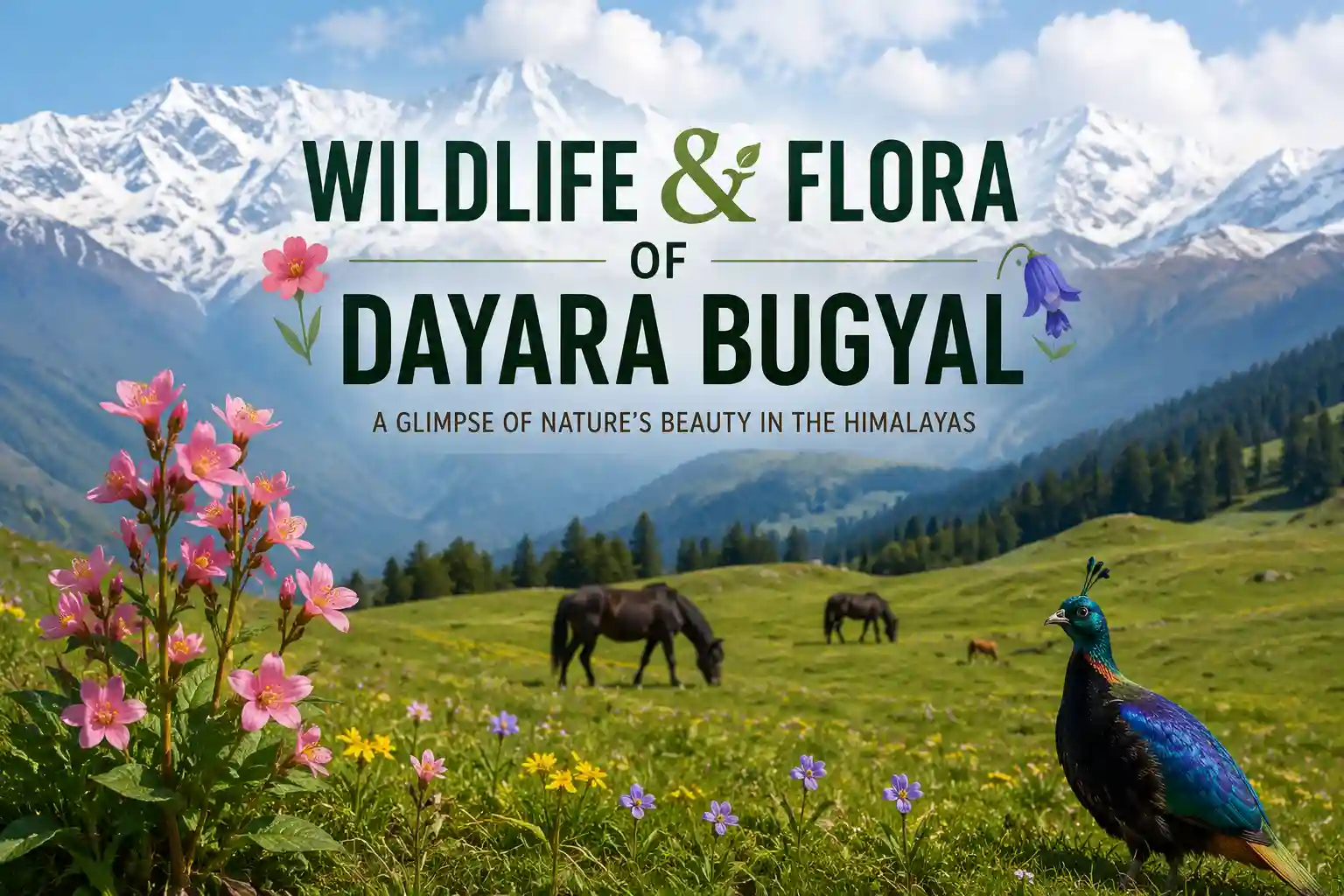
Dayara Bugyal is talked about for its meadows and mountain views, but the ecosystem that surrounds the trail is one of the most quietly extraordinary in the Garhwal Himalayas. Between the oak forests at the base and the open grassland at 3,408 metres, the trail passes through three distinct ecological zones, each with its own cast of birds, animals, and plants. Trekkers who slow down and look beyond the obvious — beyond the Bandarpunch panorama and the golden meadow grass — consistently describe wildlife encounters as among their strongest memories from the route.
The biodiversity here is a direct product of altitude and forest type. The dense oak and rhododendron belt below Barnala Tal supports a different set of species from the open subalpine shrubland near the meadow edge, and both differ again from the exposed grassland at the top. Understanding that layered structure before you arrive sharpens what you notice on the trail. A flash of iridescent colour through the rhododendron is almost certainly a Himalayan Monal. A rustle in the talus near the meadow fringe could be a Himalayan Snowcock before you have even heard its call.
This guide covers the complete Wildlife & Flora of Dayara Bugyal across all sections of the trail — with identification notes, best sighting windows, season-by-season ecology, and tips for trekkers who want to observe responsibly without disturbing the habitat.
The Three Ecological Zones of the Dayara Bugyal Trail
Before diving into individual species, understanding the ecological structure of the trail makes every encounter more meaningful.
Lower Forest Zone (2,200 to 2,800 Metres)
This zone covers the trail from Raithal or Barsu up to approximately halfway to Barnala Tal. The dominant tree species are Himalayan Oak (Quercus semecarpifolia) and Rhododendron arboreum, with dense understorey cover of Berberis, Viburnum, and various fern species. The canopy creates a cool, moist microclimate. Birdlife is at its richest and most varied in this zone, and large mammals such as Himalayan Black Bear and Leopard are present though rarely seen.
Mid-Elevation Transition Zone (2,800 to 3,200 Metres)
Approaching Barnala Tal, the forest begins to thin and open. The understorey shifts to alpine shrubs including Juniper, Potentilla, and Cotoneaster. This transition zone is ecologically important as a corridor between the closed forest below and the open grassland above. Pheasant species are most frequently encountered here, particularly in the early morning and late afternoon.
Subalpine Meadow Zone (3,200 to 3,408 Metres)
The Dayara Bugyal meadow belongs to the subalpine grassland ecosystem. Here, grasses, alpine herbs, and cushion plants replace tree cover entirely. This is the habitat of the Himalayan Snowcock, alpine wildflowers, and the medicinal plants that have made the Garhwal Himalaya significant to Ayurvedic practice for centuries.
Birds of Dayara Bugyal: What to Watch For and When
The Dayara Bugyal trail corridor is home to over 80 documented bird species across its different altitude zones. These are the ones trekkers are most likely to encounter and most worth looking for.
Himalayan Monal (Lophophorus impejanus)
The Himalayan Monal is the state bird of Uttarakhand and the single most sought-after sighting on this trail. The male is unmistakable — a deep emerald and copper iridescence across the back, electric blue facial skin, and a distinctive crested head that catches the light through the forest canopy like no other bird in India. The Monal is most reliably seen in the mid-elevation transition zone, particularly in the hour after dawn. Look for them feeding along open forest edges and rocky slopes. The best sighting months are October through December and again in March through May.
Himalayan Snowcock (Tetraogallus himalayensis)
The Himalayan Snowcock is one of the most characteristic birds of the subalpine meadow zone. A large, pale grey and white partridge-like bird, typically seen in small coveys moving across rocky terrain near the upper meadow boundary. The call — a series of clear, echoing whistles — is often the first indication of their presence. Snowcocks are most often encountered on the upper meadow near exposed ridge sections, particularly on the northwestern edge of the bugyal in the early morning.
Koklass Pheasant (Pucrasia macrolopha)
The Koklass Pheasant inhabits the same oak-rhododendron zone as the Monal but is considerably more secretive. It is heard far more often than it is seen — its two-note call is one of the signature sounds of the lower trail section from Raithal. Males have a striking grey and chestnut body with a dark head and white neck patches. Sightings typically happen at forest edges at dawn and dusk.
Spotted Nutcracker (Nucifraga caryocatactes)
A year-round resident of the oak and conifer zones, the Spotted Nutcracker is the most commonly seen bird on the Dayara Bugyal trail by volume of sightings. Its habit of hammering acorns and conifer seeds into bark crevices makes it audible long before it is visible. A chunky, dark brown bird covered in white spots, it is less shy than the pheasants and genuinely abundant in the Uttarkashi forest.
Lammergeier (Gypaetus barbatus)
Also called the Bearded Vulture, the Lammergeier is one of the most spectacular raptors in the Himalayan sky. Its wingspan can exceed 2.8 metres, and its characteristic long, diamond-shaped tail makes it unmistakable in flight. At Dayara Bugyal, Lammergeiers are most commonly seen riding thermals above the meadow zone after 9 AM. The reddish-orange chest of adults comes from dust bathing in iron-rich soil — a deliberate behaviour unique to this species.
Other Notable Birds
• Red-billed Chough and Yellow-billed Chough: Acrobatic corvids often seen performing aerial displays over the meadow edge
• Grandala: Vivid blue thrush found near the upper meadow, the male one of the most visually striking birds in the Himalayan ecosystem
• Himalayan Griffon Vulture: Frequently seen in soaring groups above the ridge
• White-throated Redstart: Common at mid-elevations, the male with a vivid orange tail and grey cap
Mammals of the Dayara Bugyal Trail
Mammal sightings on the Dayara Bugyal trail require patience and timing, but are far more possible than most trekkers expect.
Himalayan Black Bear (Ursus thibetanus)
The Himalayan Black Bear is present in the Uttarkashi forest belt year-round, most active in the lower forest zone from late summer through autumn. Sightings are uncommon on the main trail but not rare — the most likely encounter is in the oak forest between Raithal and Barnala Tal in October when oak mast is abundant. Bear signs — claw marks on oak bark, overturned rocks, partially consumed ant nests — are more commonly seen than the bears themselves. Trekkers should make ambient noise on forested sections and avoid wearing earphones.
Musk Deer (Moschus chrysogaster)
The Himalayan Musk Deer is one of the most elusive animals in the Garhwal ecosystem. A small, slender, deerlike animal without antlers, it is most active at dawn and dusk and rarely ventures into open terrain. Its preferred habitat is the dense shrub layer at the forest-meadow transition. Sightings are genuinely rare but have been recorded by guides on the Dayara Bugyal route, particularly near Barnala Tal at dawn.
Himalayan Weasel and Yellow-throated Marten
These two mustelids are the mammals most likely to provide a brief and surprising trail encounter. The Yellow-throated Marten is a handsome, chocolate-brown animal with a yellow chest patch and a long bushy tail, bold enough to cross the trail in full daylight. The Himalayan Weasel is smaller and rust-red, typically seen in rock piles and around stream margins. Both are active year-round.
Snow Leopard (Panthera uncia) — Remote Possibility
Snow Leopards are present in the broader Uttarkashi mountain ecosystem but sightings on the Dayara Bugyal trail itself are extremely rare and largely confined to upper ridge areas above the main meadow. Their presence is most commonly evidenced through pugmarks in snow and cached kill sites near rocky outcrops. Serious wildlife observers who extend their route beyond the main meadow toward the higher ridges during winter may encounter snow leopard sign.
Flora: The Plant World of Dayara Bugyal
The plant life of the Dayara Bugyal trail is extraordinary both in its visual impact and in its ecological and medicinal significance.
Rhododendron arboreum (Buransh)
The Buransh is the state tree of Uttarakhand and the defining visual character of the lower trail section from February through May. At full bloom, the dense forest approach from Raithal becomes a tunnel of crimson and deep pink, with flowers clustered at the tips of every branch. The nectar of Rhododendron arboreum flowers is used locally in a traditional drink, and the flowers are a critical food source for nectar-feeding birds in the early spring window.
Brahmakamal (Saussurea obvallata)
The Brahmakamal is the most spiritually significant alpine flower in the Uttarakhand Himalaya. Named for the Hindu deity Brahma, it blooms in the subalpine and alpine zones from July through September, producing a large, pale cream flower enclosed within parchment-like bracts. It is strictly protected under Indian law — collection is prohibited. Trekkers planning their visit around the Dayara Bugyal in May & June: Weather & Tips 2026 window will just miss the Brahmakamal bloom, which peaks in late July and August.
Himalayan Blue Poppy (Meconopsis aculeata)
One of the most visually dramatic flowering plants in the Himalayan subalpine, the Himalayan Blue Poppy produces flowers of an intense, saturated sky-blue on tall, prickly stems. It blooms in July and August at elevations above 3,000 metres and can be found on the upper meadow margins and sheltered north-facing slopes near the Dayara Bugyal summit area.
Alpine Primula and Gentian Species
Several Primula and Gentian species bloom across the Dayara Bugyal meadow from late May through August, producing clusters of purple, pink, and deep violet flowers across the open grassland. They are among the first botanical signs that the meadow is entering its flowering season and give the grassland a dotted, painterly quality when seen from the ridge.
Medicinal Plants of the Higher Trail
The Dayara Bugyal meadow zone is known to local communities for the presence of several important Ayurvedic plants, including Atees (Aconitum heterophyllum), Kutki (Picrorhiza kurroa), and Jatamansi (Nardostachys jatamansi). All three are legally protected in Uttarakhand. Trekkers should not collect or disturb any plant material on the trail, regardless of purpose.
Best Seasons for Wildlife and Flora Observation
Each season on the Dayara Bugyal trail offers a completely different natural experience.
April to June
The rhododendron bloom and the arrival of spring wildflowers make this the most visually dramatic season for botanists and bird photographers in Uttarakhand. Migrant bird species are passing through, and the resident pheasants are at their most active. The meadow is greening rapidly by late May and June. Anyone exploring this window should read the guide on Dayara Bugyal in May & June: Weather & Tips 2026 for current trail and weather conditions before setting out.
October to November
The post-monsoon clarity makes this the best season for raptor watching, as Lammergeiers and Griffon Vultures are highly active above the meadow zone. The oak forest is entering mast season, which concentrates bear activity in the lower forest. The Himalayan Monal is particularly easy to spot in this window as birds begin moving to lower elevations in preparation for winter.
December to February
Winter brings Snow Leopard and Snowcock to more accessible terrain on the upper ridges. The open snowfield improves sightlines considerably across the meadow zone, and tracking in snow makes mammal observation more productive for experienced naturalists.
Responsible Wildlife Observation on the Trail
The biodiversity of Dayara Bugyal depends directly on trekkers behaving responsibly within this ecologically sensitive Himalayan habitat.
• Maintain a minimum distance of 50 metres from all wildlife — significantly more for large mammals
• Do not attempt to attract birds by playing recordings of their calls, which disturbs breeding behaviour
• Never leave food scraps at campsites — this conditions wildlife to associate human presence with food, leading to dangerous encounters
• Photograph from a stationary position rather than walking toward a subject
• Do not collect any plant material, including flowers, seeds, or bark — the majority of alpine species are legally protected
• Report unusual wildlife behaviour or injured animals to forest guards at the Raithal or Barsu checkpost
For trekkers inspired by the biodiversity of this trail and looking for comparable natural richness at similar altitudes elsewhere in Uttarakhand, the Offbeat Treks in Uttarakhand is an excellent companion resource. The Har Ki Dun, Dayara Bugyal, and Phulara Ridge share overlapping ecosystems, and building a broader Garhwal trekking itinerary allows you to observe the same species across different habitat configurations.
Frequently Asked Questions
1. What is the most iconic bird to see at Dayara Bugyal?
The Himalayan Monal is the most celebrated bird on this trail. The male’s iridescent plumage makes it one of the most visually spectacular birds in the Indian Himalayas. It is most reliably sighted in the mid-elevation transition zone in the hour after dawn from October through May.
2. What large mammals are present on the Dayara Bugyal trail?
The trail corridor supports Himalayan Black Bear, Leopard, Himalayan Musk Deer, and, remotely, Snow Leopard on the upper ridges. Large mammal sightings are uncommon but not exceptional — experienced guides in the lower forest zone regularly observe bear sign.
3. What is the best month for wildflower photography at Dayara Bugyal?
July and August are the peak wildflower months at meadow altitude, with the Brahmakamal, Himalayan Blue Poppy, Gentians, and Primulas all in simultaneous bloom. May and June offer the rhododendron transition and early meadow flowers for those visiting earlier in the season.
4. Is it safe to trek near Himalayan Black Bears?
Yes, with proper awareness. Make noise on forested trail sections, avoid surprising animals, never approach a bear, and do not leave food unsecured at camp. Bears on this trail are generally shy and move away from human presence well in advance of an encounter.
5. Are any plants at Dayara Bugyal poisonous or dangerous?
Yes. Aconitum (Atees/Monkshood) species are present in the meadow zone and are highly toxic to touch or ingest. All members of the Aconitum genus should be treated as dangerous. Do not handle any unidentified plants on the trail.
Summary
Dayara Bugyal is not a backdrop for a trek — it is a functioning Himalayan ecosystem that the trail passes through. Every bird call you hear, every medicinal plant you pass, and every mammal track in the trail mud is part of an ecological network that has been here far longer than any trekking route.
The more you know before you arrive, the more you will notice when you are there. The Himalayan Monal did not appear for the first time when you spotted it. It has been feeding along that same forest edge every morning for years. Understanding that continuity is what transforms a trek into something richer — an encounter with a living world rather than a journey through a scenic setting.
For guided treks to Dayara Bugyal that include wildlife briefings, ecology-focused route planning, and expert naturalist guides alongside standard trekking support, visit mountainiax.com. The meadow is extraordinary. The ecosystem around it is equally worth your attention.
With the dayara bugyal trek season approaching, it’s time to plan something truly extraordinary. From breathtaking Himalayan peaks to spiritually powerful temples hidden deep in remote valleys, this journey offers an experience that goes beyond a typical trek—it becomes a story you carry for life. To make your journey seamless and well-organised, choose the best trekking company in Uttarakhand for reliable trek packages, detailed itineraries, and hassle-free booking.
Visit this page for Trek Packages, Itinerary & Booking.