Choosing your first Himalayan trek is not a small decision. The mountains are not forgiving of poor planning, and the gap between an unforgettable first experience and a deeply miserable one is often a matter of picking the right trail. Most beginners are handed the same recycled shortlist — Triund, Kedarkantha, Chopta — without anyone explaining what actually makes a first trek work for a specific type of trekker.
Dayara Bugyal earns its place on that list not through marketing but through terrain. A sweeping high-altitude meadow in the Gangotri region of Uttarakhand, it sits at approximately 3,408 metres and rewards trekkers with rolling alpine grasslands, glacier views across the Gangotri range, and a trail that is genuinely manageable without prior Himalayan experience. It is the kind of place that makes first-time trekkers want to go back.
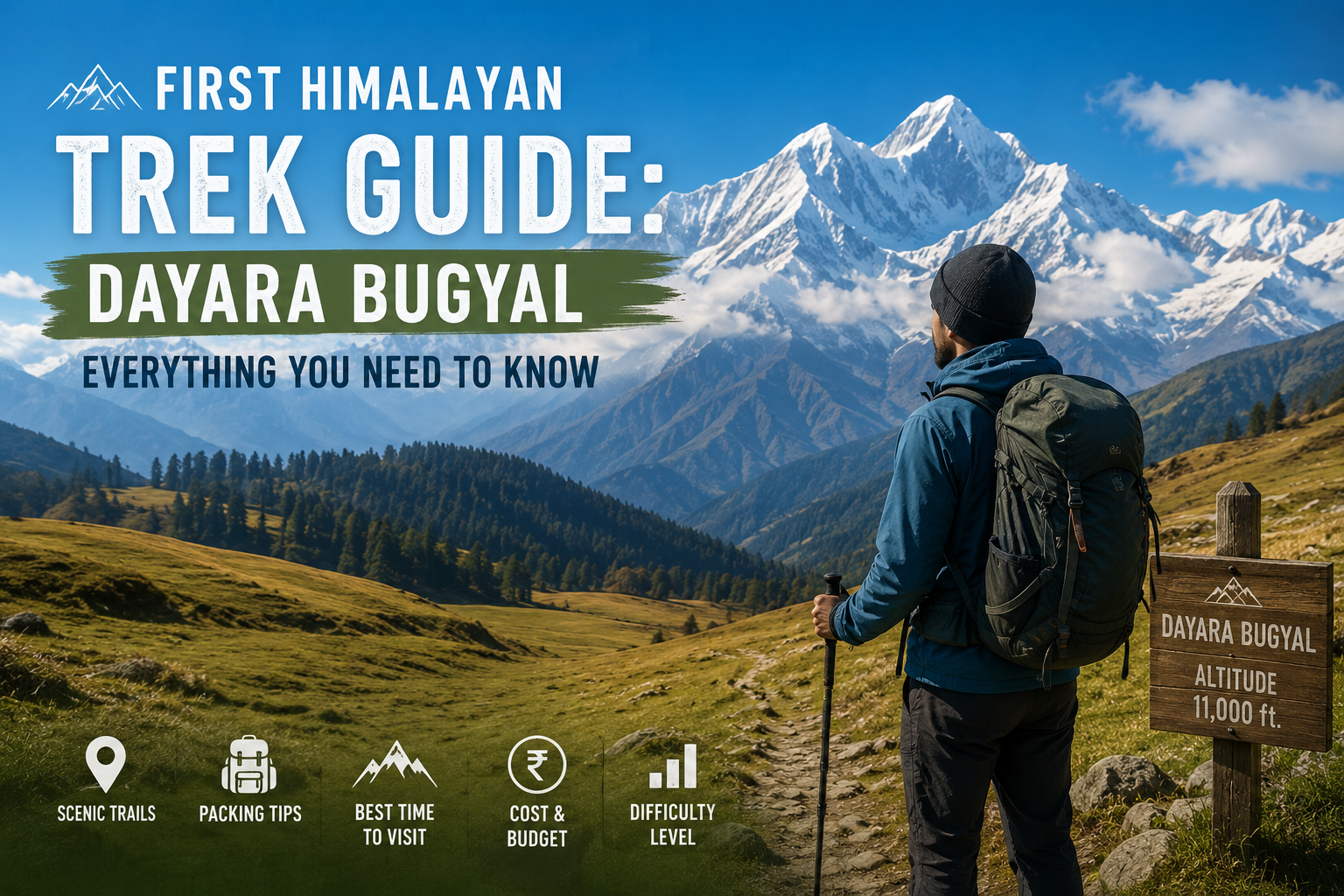
This is your complete First Himalayan Trek Guide to Dayara Bugyal — covering the trail, the terrain, the timing, the logistics, and everything in between so that your first time above the treeline is built on solid preparation and clear expectations.
Why Dayara Bugyal Works as a First Himalayan Trek
The best first Himalayan treks share a specific profile: moderate altitude gain, well-established trail infrastructure, multiple exit options, and a payoff that justifies the effort. Dayara Bugyal checks every one of those boxes.
The trek typically runs 4 to 5 days, starting from the village of Raithal (approximately 2,200 metres) and ascending through dense oak and rhododendron forests before breaking into open meadows near the bugyal. The altitude gain is steady rather than sudden — ideal for first-timers who have not previously experienced sustained elevation. At 3,408 metres, the bugyal summit does not push into dangerous altitude territory, but it is high enough to deliver genuine Himalayan panoramas.
Unlike some beginner trails that funnel hundreds of trekkers through narrow corridors, Dayara Bugyal for beginners feels spacious. The meadows are wide, the trail is clearly marked through the forest sections, and the base village of Raithal has enough homestay infrastructure to handle trekkers without overwhelming the local ecosystem.
Perhaps most importantly for a first-time trekker: you feel remote without being inaccessible. Raithal is about 75 km from Uttarkashi, a town with hospitals, ATMs, and bus connectivity. That margin of safety matters when you are still learning to read your body at altitude.
Dayara Bugyal Trek Overview: Key Facts
Before stepping into logistics, here is a clean snapshot of the trek’s essential data.
- Trek base village: Raithal, Uttarkashi district, Uttarakhand
- Maximum altitude: Dayara Bugyal altitude — approximately 3,408 metres (11,178 ft)
- Total trek distance: Dayara Bugyal trek distance of approximately 22 to 26 km (round trip depending on route variation)
- Duration: 4 to 5 days
- Difficulty: Easy to Moderate
- Best seasons: April to June (spring/summer), October to November (autumn), December to February (snow trek)
- Nearest town: Uttarkashi (~75 km from Raithal)
- Nearest airport: Jolly Grant Airport, Dehradun (~175 km)
- Nearest railway station: Dehradun or Haridwar (~195 km)
How to Reach Raithal: The Gateway to Dayara Bugyal
The Dayara Bugyal trek route begins at Raithal village, and reaching it is one of the more straightforward approach journeys among Himalayan trek bases.
From Dehradun
Dehradun to Barkot (via Mussoorie or Chamba) is approximately 170 km, taking 6 to 7 hours. From Barkot, Raithal is around 35 km further — a 1.5 to 2-hour drive on a winding forest road. Dehradun to Raithal by private cab costs approximately ₹4,000 to ₹5,500 (2026 rates).
From Haridwar
Haridwar to Raithal is approximately 220 km and takes 7 to 8 hours. This route also passes through Rishikesh, Chamba, and Barkot. Shared jeeps run from Haridwar to Uttarkashi, from where local vehicles connect to Barkot and Raithal.
From Uttarkashi
If you are already in Uttarkashi for acclimatisation or logistics, Raithal is roughly 75 km away — a 2.5 to 3-hour drive through the Bhagirathi Valley. Uttarkashi has ATMs, pharmacies, and a well-stocked market, making it a smart pre-trek stop before entering the mountains.
The Trail: Day-by-Day Route Breakdown
This section explains the complete day-by-day trekking route, including key stops, terrain conditions, trekking distance, altitude changes, and important highlights throughout the journey.
Day 1 — Raithal to Gui Camp (2,800 m) | ~6 km | 4–5 hours
The first day eases you in. The trail rises through mixed forest — oak, rhododendron, and deodar cedar — with the gradient building gradually. Gui is a small clearing used as the first night’s campsite. Porters and guides know it well. In spring, rhododendrons light the forest in vivid red and pink.
Day 2 — Gui to Dayara Bugyal (3,408 m) | ~5 km | 3–4 hours
The forest thins and gives way to open meadowland. This is the moment most first-time trekkers remember longest — the sudden shift from enclosed forest to vast, sky-wide openness, with snow peaks of the Gangotri region ranged across the northern horizon. Draupadi Ka Danda, Bandarpunch, and Srikanth glacier are visible on a clear day.
Day 3 — Rest Day / Exploration at the Bugyal
A day dedicated to the meadow. Many trekkers walk to Bakaria Top (3,624 m), the highest accessible point, for a wider panoramic sweep. This rest day also serves as low-level acclimatisation before the descent — and gives you time to simply sit in a place that does not feel fully of this world.
Day 4 — Dayara Bugyal to Raithal | ~11 km | 5–6 hours
The descent returns through Gui and back to Raithal. Knees will feel the gradient. Trekking poles are worth every rupee on this day.
Best Time to Trek Dayara Bugyal
Dayara Bugyal: The best time to visit Dayara Bugyal depends on what you want from the landscape.
April to June — Spring / Early Summer
Rhododendrons are in bloom through the forest sections in April. By May, the bugyal comes alive with wild Alpine flowers. Snow may still linger on upper patches, adding drama to the meadow. Temperatures are comfortable — cool nights, mild days.
October to November — Autumn
Crystal-clear skies and sharp visibility make October one of the best windows. The meadow grasses turn golden, and the northern peaks stand out in exceptional definition. Nights get cold by November, dropping to -5°C at the bugyal.
December to February — Snow Trek
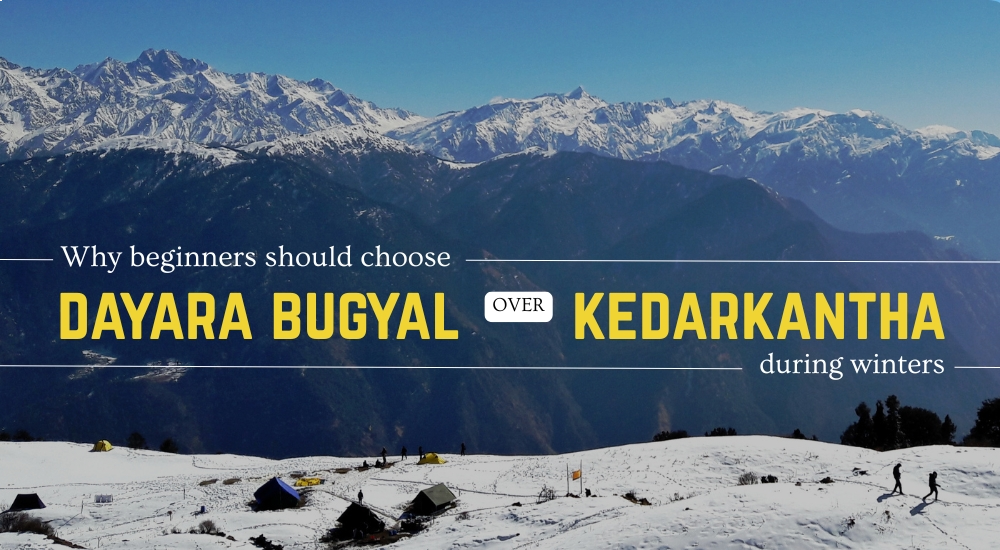
Dayara Bugyal in winter is an entirely different beast. The meadow lies under deep snow, the trail becomes significantly harder to follow without a guide, and temperatures fall well below zero. This is not the season for first-timers — but for trekkers who have done the summer version and want a more demanding return, it is one of the most dramatic snow experiences in Uttarakhand.
Avoid July and August. The monsoon brings leeches, landslides on approach roads, and poor visibility that makes the meadow views — the entire point of this trek — largely inaccessible.
Altitude, Fitness and What to Expect on the Trail
At 3,408 metres, Dayara Bugyal’s altitude sits comfortably within the range that most healthy adults can reach without experiencing serious altitude sickness — provided the ascent is paced correctly. The four-day itinerary builds elevation gradually, giving your body time to adjust.
That said, first-time trekkers should watch for symptoms of Acute Mountain Sickness (AMS): persistent headache, nausea, fatigue disproportionate to exertion, or difficulty sleeping. If any of these appear and do not resolve with rest, the only correct response is descent. Never ascend with AMS symptoms.
Fitness preparation matters more than most beginners expect. Three to four weeks of consistent cardiovascular training — stair climbing, running, cycling — makes a significant difference on the trail. Dayara Bugyal is not technically demanding, but sustained uphill hiking for four to six hours per day on variable terrain is physically real work for anyone who has not prepared.
Understanding where the trail sits on the difficulty spectrum is just as important as physical training. The Difficulty Level Of Dayara Bugyal Trek guide on Mountainiax.com gives a granular breakdown of each day’s gradient, cumulative elevation gain, trail surface conditions across seasons, and a comparative assessment against other popular beginner treks in Uttarakhand — helping you calibrate your preparation accurately.
Accommodation and Food on the Trail
Raithal village has a well-developed homestay network. Local Garhwali families offer simple but warm rooms with home-cooked meals — typically dal, rice, sabzi, roti, and chai. These homestays are among the best introductions to mountain hospitality available on any trek in Uttarakhand. Booking ahead is recommended for the May–June and October windows.
On the trail beyond Raithal, camping is the standard. Most trek operators provide tents, sleeping bags, and a camp kitchen. If trekking independently, carry a three-season tent and a sleeping bag rated to at least -10°C.
Food at camps is basic and calorie-focused: porridge or paratha in the mornings, packed lunch on the trail, and hot dinner at camp. Hydration is critical — altitude suppresses thirst signals, so drink consistently even when you do not feel thirsty.
There are no dhabas or tea stalls on the trail beyond Gui. Everything you eat above Raithal comes from what your porter carries or your operator provides.
What to Pack for Dayara Bugyal
Packing for a first Himalayan trek is one of the most common areas where beginners either over-prepare with unnecessary weight or under-prepare in critical categories. The principle is layering — not volume.
Key categories:
- Insulation: Thermal base layer, fleece mid-layer, and a windproof outer shell. At 3,408 m, even summer nights require this stack.
- Footwear: Waterproof, ankle-supporting trekking boots, broken in before the trek. This is non-negotiable. New boots on a Himalayan trail cause blisters severe enough to end a trek.
- Rain gear: A compact, packable rain jacket. On Dayara Bugyal, afternoon clouds can arrive suddenly even in October.
- Sun protection: UV intensity at altitude is significantly higher than at sea level. Sunscreen (SPF 50+), UV-protective sunglasses, and a brimmed hat are essentials, not luxuries.
- Hydration: A two-litre water bottle or hydration bladder, plus water purification tablets.
- Trekking poles: Highly recommended, particularly for descent.
- First aid: Blister treatment, ORS sachets, basic painkillers, and Diamox (consult a doctor before carrying).
The complete Dayara Bugyal Trek Packing List on Mountainiax.com goes into full detail — including a weight-by-weight breakdown of essentials versus optional items, recommended brands available in India, and what to hire versus buy for a first-time trekker on a budget.
Permits, Costs and Budgeting
Trekking permits, entry fees, transportation costs, accommodation expenses, guide charges, food budgeting, and overall estimated expenses for planning the trek efficiently.
Forest Permit
A forest department entry permit is required for Dayara Bugyal. It is typically arranged through your trek operator or can be obtained in Barkot or Raithal. Permit fees are nominal — approximately ₹100 to ₹200 per person as of 2026.
Trek Cost Breakdown
Budget range for a guided 4-day Dayara Bugyal trek (per person):
- Budget option (local guide + homestay + basic camping): ₹4,500 – ₹6,500
- Mid-range operator package (guide, porter, tent, meals included): ₹8,000 – ₹12,000
- Premium organised trek (professional operator, quality gear, support staff): ₹14,000 – ₹18,000
If trekking independently, factor in transport to Raithal, permits, campsite fees, food, and porter hire separately. For first-timers, a guided package from a reputable operator adds safety infrastructure that is worth the cost.
Photography on Dayara Bugyal
Dayara Bugyal offers some of the most accessible high-altitude photography in the entire Uttarakhand range. The bugyal’s open topography means unobstructed sightlines in every direction — and the shifting quality of mountain light across dawn, midday, and golden hour creates three completely different visual environments from the same location.
Bakaria Top, the highest accessible point above the bugyal, gives a 270-degree sweep of the Gangotri glacier peaks. Early morning light on the snow-covered Draupadi Ka Danda face is among the best photography moments on any beginner trek in India.
The Dayara Bugyal Photography Guide on Mountainiax.com covers the specific locations, timing windows, and technical considerations for capturing the meadow across different seasons — including how winter snow conditions change composition entirely and what lens lengths work best for the glacier panoramas from Bakaria Top.
Safety, Guides and Trek Operators
No matter how experienced you become as a trekker, a first Himalayan trek benefits from professional guidance. The reasons are practical: a local guide knows the trail in fog and cloud, can read weather shifts before a smartphone app detects them, and carries the experience to make sound decisions when a trekker’s judgement is compromised by fatigue or altitude.
For Dayara Bugyal for beginners, hiring a certified guide through a registered trek operator is strongly recommended. Look for operators with NIMAS (National Institute of Mountaineering and Allied Sports) certified guides and proper emergency protocols.
Key safety guidelines:
- Do not ascend with any AMS symptoms.
- Start each day’s trek before 8:00 AM — afternoon clouds and wind are predictable in the mountains.
- Inform your homestay or operator of your exact route and expected return time every morning.
- Carry a fully charged power bank; mobile coverage is minimal on the upper trail.
- Do not attempt the winter version of this trek without a professional guide experienced in snow navigation.
Frequently Asked Questions
1. Is Dayara Bugyal suitable for first-time trekkers?
Yes. Dayara Bugyal is one of the most well-suited introductory Himalayan treks in Uttarakhand for beginners. The altitude is manageable, the trail is clearly defined, and the four-day itinerary allows for gradual acclimatisation without technical climbing demands.
2. What is the altitude of Dayara Bugyal?
Dayara Bugyal’s altitude is approximately 3,408 metres (11,178 feet) at the main meadow, with Bakaria Top reaching around 3,624 metres — the highest accessible point on this trek.
3. What is the best time to visit Dayara Bugyal?
The best time to visit the Dayara Bugyal is April to June for wildflowers and snow patches, and October to early November for clear skies and golden meadow colours. December to February offers a snow trek experience suitable for more experienced trekkers.
4. How difficult is the Dayara Bugyal trek?
The trek is rated Easy to Moderate. Fit beginners can complete it comfortably with basic physical preparation. The Mountainiax.com Difficulty Level of Dayara Bugyal Trek guide provides a detailed per-day assessment.
5. What is the total distance of the Dayara Bugyal trek?
The Dayara Bugyal trek distance is approximately 22-26 km round trip, depending on whether the Bakaria Top extension is included.
Summary
Dayara Bugyal is not just a beginner’s trek — it is the right beginner’s trek. The trail is graded with care, the meadow payoff is genuine, and the Gangotri peaks framing the northern horizon deliver views that hold their own against anything in the Himalaya. For trekkers stepping into the mountains for the first time, it builds confidence without removing challenge.
This First Himalayan Trek Guide has covered every logistical layer — from the Raithal base and day-by-day route to accommodation, packing, permits, safety, and photography. The preparation you put in before reaching the trailhead determines the quality of the experience you carry back.
Start planning early. Book your guided package in advance for the May and October windows. And go.
With the dayara bugyal trek season approaching, it’s time to plan something truly extraordinary. From breathtaking Himalayan peaks to spiritually powerful temples hidden deep in remote valleys, this journey offers an experience that goes beyond a typical trek—it becomes a story you carry for life. To make your journey seamless and well-organised, choose the best trekking company in Uttarakhand for reliable trek packages, detailed itineraries, and hassle-free booking.
Visit this page for Trek Packages, Itinerary & Booking.