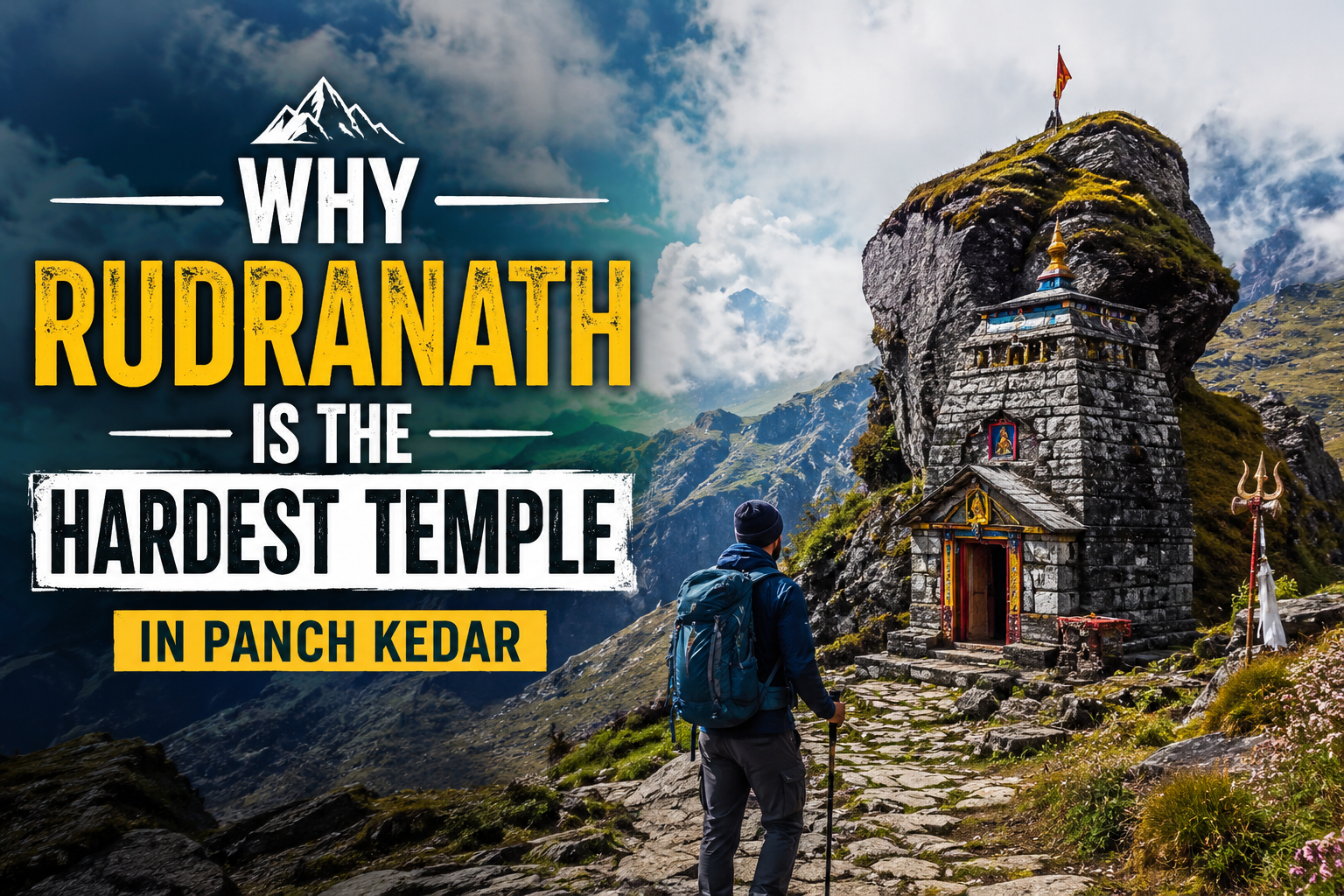
The Panch Kedar circuit is among the most spiritually charged and physically demanding yatras in all of Uttarakhand. Five ancient Shiva temples. Five completely different terrains. Five very different demands on your body, your preparation, and your will. And yet, among all five, one temple stands apart — not just in its location, but in every single variable that defines difficulty on a mountain trail.
Ask any seasoned Himalayan trekker or a local guide from Gopeshwar, and they will tell you the same thing without hesitation. Rudranath is the one that earns real respect. The question of why Rudranath is the hardest temple in Panch Kedar is not just about distance or altitude — it is about the combination of unmarked trails, complete remoteness, zero mechanical support, dense forest navigation, and a high-altitude finish that hits you all at once.
This article breaks the route down, section by section, and compares it directly with the other four Kedars so you understand exactly what separates Rudranath from the rest — and whether you are ready to attempt it.
What Makes Panch Kedar Special Before We Talk Difficulty
The Panch Kedar consists of five sacred Shiva temples in the Garhwal Himalayas of Uttarakhand — Kedarnath, Tungnath, Rudranath, Madmaheshwar, and Kalpeshwar. Each temple enshrines a different body part of Lord Shiva, according to the ancient legend in which he disguised himself as a bull to evade the Pandavas. Together, they form one of Hinduism’s most complete and physically demanding pilgrimage circuits.
The Panch Kedar trek is not one continuous trail. Each temple has its own trailhead, its own base village, and its own character. This is why comparing their difficulty levels requires looking at each route independently rather than treating the yatra as a single, uniform challenge.
Here is a quick difficulty snapshot of all five temples before we go deep on Rudranath:
- Kedarnath (3,583 m): Moderate. 14 km from Gaurikund. Paved trail, pony support, helicopter service.
- Tungnath (3,680 m): Easy to moderate. 3.5 km from Chopta. Smooth gradient, well-marked.
- Madmaheshwar (3,497 m): Moderate. 24 km from Ransi. Long but well-supported trail.
- Kalpeshwar (2,200 m): Easy. Less than 1 km walk from the road. Open year-round.
- Rudranath (3,600 m): Moderate to difficult. 20–22 km from Sagar Village. No pony support. Partially unmarked. No infrastructure on large sections.
The contrast is stark. And when you look at the route in detail, it becomes clear why Rudranath has earned a reputation even locals describe with the phrase: “Rudranath ki chadai, German ki ladai” — climbing Rudranath is like fighting a war.
The Three Routes to Rudranath Temple: A Detailed Breakdown
There are three trekking routes to Rudranath. Understanding each one is essential to understanding the true difficulty of this destination.
Route 1 — Sagar Village to Rudranath (The Most Popular Route)
Starting Point: Sagar Village, near Gopeshwar, Chamoli district One-way distance: Approximately 20 km Altitude gain: From 1,400 m at Sagar to 3,600 m at Rudranath Duration: 2 to 3 days (ascent), 1 to 1.5 days (descent) Difficulty: Moderate to difficult
This is the route most trekkers and pilgrims take, and even being the “popular” option, it demands serious preparation. The trail from Sagar Village climbs steeply through dense oak and rhododendron forest. There are no tea stalls, no rest points, and no human settlement for the first 8 to 10 km. The forest section alone requires 4 to 5 hours of continuous uphill walking.
After the forest, the terrain opens into the vast alpine meadow of Lyuti Bugyal, one of the most beautiful high-altitude grasslands in the Garhwal Himalayas. Most trekkers camp here overnight at approximately 2,800 m. The meadow is strikingly scenic — panoramic views of Nanda Devi, Trishul, and Nanda Ghunti — but it also exposes you to cold wind, rapid weather changes, and the psychological weight of knowing there is still significant altitude to gain the next day.
From Lyuti Bugyal, the trail continues through Pitradhar and Panar Bugyal before the final steep push to Rudranath Temple at 3,600 m. The last 4 km are among the most demanding on the entire route — loose rock, steep gradient, and thin air converge exactly when your legs are already at their limit.
There are no mule services available on this route. No helicopter landing pad near the temple. No shortcuts.
Route 2 — Mandal Village Route (The Scenic Longer Option)
Starting Point: Mandal Village, on the Gopeshwar-Ukhimath road Distance: Approximately 24 km one way Duration: 3 to 4 days Difficulty: Difficult
This longer alternative passes through Anushuya Devi Temple and Anusuya forests before joining the Sagar route near the upper bugyals. It is less commonly used, more remote, and has even fewer facilities. The route rewards serious trekkers with greater forest depth and fewer crowds but demands exceptional navigation skills or a knowledgeable local guide. Trail markers are sparse on this route, and getting lost in the oak forest without a guide is a real risk.
Route 3 — Helang to Rudranath (The Rarest Route)
Starting Point: Helang, on the Joshimath-Chamoli highway Distance: Approximately 32 km one way Duration: 4 to 5 days Difficulty: Very difficult
This is the least-used and most demanding route to Rudranath. It passes through extremely remote terrain with almost no infrastructure and is best suited only for highly experienced Himalayan trekkers with prior multi-day wilderness experience. This route is rarely attempted by pilgrims and even many experienced trekkers avoid it due to the complete absence of support along the way.
Why Rudranath Is Harder Than the Other Four Kedars: A Head-to-Head Comparison
The difficulty of Rudranath is not about any single factor. It is the accumulation of multiple challenges across the same trek that sets it apart from every other temple in the circuit.
Distance and Terrain Quality
Kedarnath covers 14 km from Gaurikund on a paved, well-maintained trail. Ponies and palanquins are available. Tungnath requires just 3.5 km of gentle climbing from Chopta. Even Madmaheshwar, which is longer at 24 km, has a relatively better-marked trail with local guide availability.
The Rudranath trek demands 20 to 22 km one way on a trail that is partially unmarked, passes through dense forest with poor visibility, and has no support infrastructure for most of the distance. Distance alone does not define difficulty, but terrain quality multiplies it.
Zero Mechanical Support
This is perhaps the single most significant differentiator. At Kedarnath, pilgrims unable to walk can take a helicopter or hire a pony. At Tungnath, the short trail means even elderly visitors can manage with a slow pace and a walking stick. At Rudranath, there is no helicopter service near the temple, no ponies on the trail, no porter network comparable to Kedarnath, and no roads beyond Sagar Village. Every single kilometre must be completed on foot. Every kilogram in your bag comes with you.
If you need to come down quickly due to an emergency, you are walking. This reality changes how you approach the entire trek.
Infrastructure Gap
Along the Kedarnath route, food stalls and tea shops appear every few kilometres. Accommodation options are plentiful at Kedarnath base and the temple area itself. At Rudranath, the only reliable overnight stop before the temple is the Lyuti Bugyal campsite, where basic tents or a simple dharamshala may or may not be available depending on the season. You must carry your own food and water purification for a significant portion of the route.
For those exploring the Panch Kedar and Jyotirlinga Connection, Rudranath holds special spiritual weight — it enshrines the face (mukh) of Lord Shiva, making it unique among all the Panch Kedar shrines and indeed across the entire Shiva pilgrimage landscape of India. That spiritual significance only deepens the sense of effort and reward when you finally arrive at the temple after two or three days on the trail.
Navigation Challenge
The trail to Rudranath through the oak forest is partially unmarked, especially after heavy rainfall which can obscure path edges and cause the trail to merge with dry stream beds. Most experienced trekkers and almost all Himalayan trek guides strongly recommend not attempting Rudranath without a local guide from Sagar or Gopeshwar village. The forest section especially — where trees block light and trails split unpredictably — has caused trekkers to lose their way even during peak season.
By contrast, the Kedarnath and Tungnath trails are impossible to get lost on during the season due to the volume of foot traffic and continuous human presence.
Weather Window and Trail Access
Rudranath has a shorter and less forgiving weather window compared to the other four Kedars. The temple opens in mid-May and typically closes by the third week of October. However, the trail can become dangerous much earlier and later than those dates due to early monsoon rain making the forest section slippery and post-monsoon snowfall arriving in September or October at the upper bugyals. Trekkers planning around the 2026 season should aim for late May to mid-June or the September window before early snowfall.
Day-by-Day Difficulty: What the Rudranath Trek Actually Feels Like
Understanding the difficulty on paper is one thing. Knowing what each day demands from your body is another.
Day 1: Rishikesh or Haridwar to Sagar Village by road, then initial trail entry. Many trekkers begin the trail late afternoon and camp near the forest edge. This day is preparation — your legs are fresh but the road journey is long.
Day 2: Sagar Village (1,400 m) to Lyuti Bugyal (2,800 m). This is the hardest day. Approximately 10 to 12 km of continuous climbing through dense forest with no flat section for the first 6 hours. Altitude gain of nearly 1,400 m in a single day. No tea shops. Carry all your water. You will arrive at camp exhausted but the views across the bugyal at sunset will make it feel worth it.
Day 3: Lyuti Bugyal (2,800 m) to Rudranath Temple (3,600 m). Approximately 8 to 10 km on a trail that begins across open meadow and ends on steep, rocky ground. The final 3 to 4 km is the physically hardest segment of the entire trek. At this altitude, every step requires deliberate breathing. Reach the temple, attend the evening aarti, and spend the night at the basic accommodation near the temple.
Day 4: Descent back to Sagar Village. Downhill is faster but demands strong knees. The forest section remains as demanding on the way down.
This is the standard itinerary. For those planning a Panch Kedar Solo Trek 2026, Day 2 is the section that most underprepared trekkers struggle with — the long, lonely forest climb with no landmark, no company, and no flat ground to rest on is where solo trekkers must be most honest about their fitness and mental readiness.
Who Should and Should Not Attempt Rudranath
Rudranath is appropriate for:
- Trekkers with prior multi-day Himalayan trekking experience
- Individuals who can walk 6 to 8 hours continuously with 800 to 1,000 m of daily ascent
- Those aged 14 to 60 with good cardiovascular fitness
- Anyone willing to hire a local guide and carry emergency supplies
Rudranath is not appropriate for:
- First-time trekkers with no prior mountain experience
- Senior citizens with no recent physical training
- Children under 12 or those with heart or respiratory conditions
- Anyone expecting the infrastructure of Kedarnath or Tungnath
Devout pilgrims who cannot complete the trek can visit Gopinath Temple in Gopeshwar during winter months, where the deity of Rudranath is enshrined after the temple closes for the season. This is the official winter seat and provides a spiritually valid alternative darshan.
Essential Gear and Preparation for the Rudranath Trek
Given the infrastructure gap and absence of mechanical support, your gear list for Rudranath must be more comprehensive than for any other Panch Kedar temple.
Mandatory items:
- Trekking poles (highly recommended for the forest climb and descent)
- Waterproof rain cover for your backpack
- Sleeping bag rated to at least minus 5 degrees Celsius
- Water purification tablets or a filter bottle
- High-energy snacks for at least 2 days of trekking
- First aid kit including altitude sickness medication (consult a doctor)
- Layered clothing including a warm mid-layer and a waterproof outer shell
- Headlamp with extra batteries
- Local guide contact arranged from Sagar or Gopeshwar before you arrive
Permits: As of the 2026 season, Rudranath does not require a formal trekking permit, but the forest department has implemented a 2 PM trail-entry cutoff from Sagar Village. Arrive early. Starting after noon significantly reduces your chances of reaching a safe camping point before dark.
Frequently Asked Questions About Rudranath Trek Difficulty
1. Why is Rudranath considered the toughest Panch Kedar temple?
Rudranath combines the longest trek distance, zero mechanical support, partially unmarked trails, sparse infrastructure, and high-altitude camping requirements — all in a single route. No other Panch Kedar temple demands all these factors simultaneously.
2. How long is the Rudranath trek from Sagar Village?
The trek is approximately 20 to 22 km one way from Sagar Village, covering an altitude gain of over 2,200 m from the base to the temple at 3,600 m.
3. Can I do the Rudranath trek without a guide?
Technically yes, but it is strongly discouraged. The forest section is partially unmarked and confusing, especially after rain. Hiring a local guide from Sagar or Gopeshwar adds both safety and local knowledge that significantly improves your experience.
4. Is there a helicopter service to Rudranath Temple?
No. Unlike Kedarnath, there is no helicopter service to or near Rudranath Temple. The entire route must be completed on foot.
5. What is the best time to visit Rudranath in 2026?
The ideal trekking windows are late May to mid-June and the first three weeks of September. The Rudranath Temple opened on 18 May 2026 and is expected to close around 17 October 2026.
Final Thoughts
If you have been planning to complete the Panch Kedar circuit, Rudranath will be the most memorable and most demanding leg of your journey. Not because it is technically beyond reach, but because it demands honesty — about your fitness, your preparation, and your respect for the mountain.
The temple itself is extraordinary. Sitting at 3,600 m with 360-degree views of Nanda Devi, Trishul, Nanda Ghunti, and Chaukhamba, surrounded by wild alpine meadows that most tourists will never see, the darshan at Rudranath carries a weight that is different from any other Panch Kedar. You earn it. Completely.
If you are planning your 2026 trek season and want expert itinerary support, route planning, or customised advice for your fitness level, explore the trekking resources and Panch Kedar guides at mountainiax.com. Our team has field experience across all five Kedar routes and can help you plan your Rudranath trek safely, with the right preparation timeline, gear list, and local guide contacts built into your itinerary.
Rudranath does not forgive underpreparation. But it absolutely rewards those who show up ready.
With the Panch Kedar Yatra season approaching, it’s time to plan something truly extraordinary. From breathtaking Himalayan peaks to spiritually powerful temples hidden deep in remote valleys, this journey offers an experience that goes beyond a typical trek—it becomes a story you carry for life. To make your journey seamless and well-organised, choose the best trekking company in Uttarakhand for reliable trek packages, detailed itineraries, and hassle-free booking.
Visit this page for Trek Packages, Itinerary & Booking.